Interpretations
Links to dances on other pages
Introduction
If you've ever looked at the original Playford notation, or indeed most books of dances from the 17th and 18th century, you'll be aware that they are in need of interpretation (or reconstruction, as people say in the States). The instructions are very condensed, with lots of errors, probably intended as a quick reminder to those who already knew the dances. Playford said “Sides all” and everybody knew what he meant; now we discuss it for hours.Graham Christian objects to “Playford said”, since Playford was just the publisher, and the same is true of Johnson, Thompson, Young, etc. There's no evidence that these people edited or even compiled their books; they just published them. In some cases we do know more: Kynaston was the editor (and possibly the composer); Walsh was the publisher. And certainly if Playford were publishing a book by Purcell I would say “Purcell said”. But we don't know who contributed the dances or edited them; the only name we have is Playford so that's what I use. I could say “The instructions in Playford's book say”, but that seems unnecessarily wordy.
My book Playford with a Difference, Volume 1 contains a number of my interpretations, together with my reasoning behind them. There are dances which I've interpreted since that was published, and I'll be putting most of them on this page rather than publishing a Volume 2. There are also a few where I've done very little in the way of interpretation but still feel it's worthwhile publishing them here.
When I started interpreting dances you had to go to the Vaughan Williams Memorial Library at Cecil Sharp House, the British Library or some other institution. Now you can find various Playford originals online.
- Dancing Master facsimile all Eds. (I prefer to go straight to The Index)
- Playford's Dancing Master: The Compleat Dance Guide Facsimiles plus text and music in modern notation — these may not be accurate and many of the later dances aren't present, but you can check the interpretations against the original wording. However some of the facsimiles (the ones with a yellow background) come from Walsh's Dancing Master of 1709 rather than Playford's — you can't trust anybody!
- Volume 1 Editions 1-10, 12, 14, 17, Part 2 Editions 1, 2, Volume 2 Edition 3 All from the International Music Score Library Project imslp.org
- 1st Ed. facsimile
- 10th Ed. facsimile
- 14th Ed. facsimile
- Vol. 2, 4th Edition facsimile
- 1st Ed. text
- 1st Ed. text and music
You may find the last two easier because they're written in a modern type-face, but they aren't necessarily accurate!
Bob Barrett has found several copies on archive.org. Some may be the same scans as held elsewhere, but archive.org has a better page viewer!
- Second Edition, 1653 This appears to be identical to the Second Edition of 1652.
- ??? Edition Catalogue says 1665, but has no title page and judging from the table of contents it's the third Edition of 1657.
- Fourth Edition, 1670
- Fifth Edition, 1675
- Sixth Edition, 1679 Catalogue says 1679, but actual date is unreadable. Some pages cropped. Dark and smudged.
- Seventh Edition, 1686 Quite dark and smudged.
- Eighth Edition, 1690
- Ninth Edition with Second Part, 1696
- Unknown Edition National Library of Scotland: The Glen Collection. Missing title page and index. “Published : 1697” handwritten on first page. But where does it come from? See below.
- Tenth Edition, 1698
- Second Part, Second Edition, 1698 With handwritten additions to the index. This contains pages 1-16, 27, 18-19, 30-36, then 37 says “An additional sheet to the second part of the Dancing Master” followed by pages 38-48. I make that 37 dances.
- Twelfth Edition, 1703
You can see Bob Keller's lists of the dances in each volume here:
1-1 1-2 1-3 1-3 1-4 1-5 1-6 1-7 1-8 1-9 1-10 1-11 1-12 1-13 1-14 1-15 1-16 1-17 1-18 2-1 2-2 2-3 2-4 3-2
So what is that book from the Glen Collection? It comes from:
digital.nls.uk/special-
I looked through the titles of the first 20 dances of the book and compared them with Bob Keller's database of all the dances in all the editions. There are a lot of dances from the 10th Edition here, plus some from much earlier. But “Up with Aily” doesn't appears until the 12th Edition according to Bob Keller's index, and indeed it's not in the index at the start of the 10th Edition so the Glen Collection must be later than the 12th Edition. I hadn't realised until I began this research that the size of the book jumped dramatically from the 10th Edition of 1698 (215 pages) to the 11th Edition of 1701 (maybe 420 pages though I don't know of a facsimile) — roughly double the size! Why was this? I don't believe there were any competitors publishing country dances at this time, except Thomas Bray in 1699 but his book contained 20 display dances rather than dances for ordinary people. Were lots more good dances suddenly being written? Did Henry decide people would be willing to pay more for a bigger book? I don't know. But I have no reason to doubt Bob Keller's indexes. He says that Editions 13, 14, 15 and 16 start with “Sage Leaf”, “Madge on a Tree” and “Joan Sanderson”, while 17 and 18 start “Sage Leaf”, “Dull Sir John” and “Joan Sanderson”. There are no known editions starting “Sage Leaf”, “Madge on a Tree” and “Ely Minster”. Sorry, I don't know where the Glen version comes from!
You can also find originals of other publishers' books:
- John Walsh: The Compleat Country Dancing-Master or here
- Wilson's Companion to the Ball Room, 1816
- An American Ballroom Companion (Lots of books available here)
- An amazing collection of links and downloads from Nick Enge
- Collections in the Vaughan Williams Memorial Library *
- Links found by George Williams who does lots of animations
- Nick Barber's scans of dance manuals from the British Library
- regencydances.org/sources.php
- …and undoubtedly many others that I haven't yet discovered.
And here's a paper detailing a manuscript which has only recently been studied: Try The Ward Manuscript or direct to the download or if those links don't work you can read about it at academia.edu by signing up for a free account.
If you want to get a quick idea of what dances are in the various editions — particularly an edition not available online — George Williams has various indexes. For instance upadouble.info/index.
Table of Dates 
I've been fooled more than once by Bob Keller's layout of the facsimiles in the CDSS website. At the bottom in “Source/Library” he gives the edition from which the image is taken, both edition and year, but that's not necessarily the first appearance of the dance. Three lines up in “Occurrences” he gives all the editions, but no dates. So here's my table for converting edition to year:| Edition — Volume 1 | Year | Publisher | Edition — Volume 2 | Year | Publisher |
|---|---|---|---|---|---|
| 1-1 | 1651 | John Playford | 2-1 | 1710 | John Young |
| 1-2 | 1652 | 2-2 | 1714 | ||
| 1-3 | 1657 | 2-3 | 1718 | ||
| 1-4 | 1670 | 2-4 | 1728 | ||
| 1-5 | 1675 | Edition — Volume 3 | Year | Publisher | |
| 1-6 | 1679 | 3-1 | 1719 | John Young | |
| 1-7 | 1686 | 3-2 | 1726 | ||
| 1-8 | 1690 | Henry Playford | |||
| 1-9 | 1696 | ||||
| 1-9 Part 2, First edition | 1696 | ||||
| 1-9 Part 2, Second edition | 1698 | ||||
| 1-10 | 1698 | ||||
| 1-11 | 1701 | ||||
| 1-12 | 1703 | ||||
| 1-13 | 1706 | John Young | |||
| 1-14 | 1709 | ||||
| 1-15 | 1713 | ||||
| 1-16 | 1716 | ||||
| 1-17 | 1721 | ||||
| 1-18 | post 1728 |
My Rules for Dance Interpretation
- The dance must fit the music.
- You must know how long standard figures take. It's a common mistake to squash too much dance into a phrase of music. Start by assuming that a cast is 8 steps, not 4. It helps to be able to read music.
- Be aware of the different groups of standard figures, and keep in the style. There's a lot of difference between John Playford (Black Nag, Mage on a Cree, Parsons Farewell) and the Apted book (The Fandango, The Bishop, The Shrewsbury Lasses).
- Be aware that instructions are usually given to the first man or the first couple. In a triple minor, the twos and (particularly) the threes do very little.
- “Cross over” always means “Cross and cast”. (I'm talking about a couple crossing over, not corners crossing.) Read my justification for this further down. Many dance interpreters didn't know this — here are some examples which I have interpreted and there are lots more. “Nampwich Fair”, “Nine Elms”, “The Nobles of Betly”, “Dick's Maggot”. “Draw Cupid Draw”, “Irish Lamentation”, “Jack's Health”, “Mr Beveridge's Maggot”, “The Punch-Bowl”, “Whimbleton House” on this web page, and Portsmouth on my Session 3 page. If you find a counter-example, please Contact me with full details.
- Follow the spirit rather than the letter of the original wording. I realise this is controversial — it gives you the licence to do virtually anything — but I really think this is what makes a good interpretation. Sharp didn't do this — he stuck to the letter whenever possible — and in my opinion that gave him a lot of problems.
 Andrew Swaine also has a page on Playford interpretation guidelines.
There's also the question of how much you're entitled to modify the dance to suit current preferences. In the 17th and 18th century the progressive longways dances were all about the ones — the twos and threes were just there to help the ones in their passage through the dance. These days, when the shortness of the run means that many people never get to be ones, dancers' attitudes are different.
There's a spectrum of approaches, and I'm very much on the side of historical accuracy, so when I work out what the dance means and realise the twos and threes have nothing worth doing, I usually discard the dance and move on to something else. See my page on Thompson's 1788 collection for examples of this!
Charles Bolton used to say he took the view that the ones' track is sacrosanct but it's permissible to add moves for the other couples. And yet have a look at Lady Winwood's Maggot and follow the link to Charles's version.
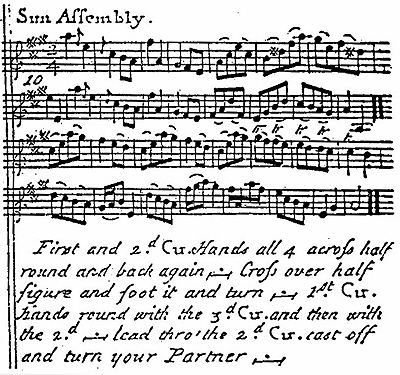
Andrew Shaw also adds things that aren't there in the original, and sometimes changes what is there — you can read about his approach here. And when you get to Tom Cook and Ken Sheffield their dances are often pure invention! For instance, look at the original of Sun Assembly on the right and ask yourself how much of Ken Sheffield's (deservedly popular) version you recognise.
Time signatures
I've never been clear about what the time-signatures in the various Playford editions meant. For instance, the following all have a time-signature of 6/4:Queen's Jig
The Galloping Nag (same dance and tune as Black Nag)
But these are from later editions. When I look at an earlier edition Black Nag there's a circle and the number 3.
And the first edition Merry Merry milke-maids
I don't know what that says.
So I took the sensible step of asking Jeremy Barlow who knows much more about these things that I do. His book “The Complete Country Dance Tunes from Playford's Dancing Master, 1651-c.1728” details all the variations and misprints between the 18 original editions.
He explains:
6/4 means 2 beats or (I suppose) steps per bar, each beat being subdivided into three quarter-notes (American usage) or crotchets (UK), making six of the latter per bar (as in all the examples you've given). So 6/4 means, literally in mathematical terms, 6 x 1/4 notes per bar, but doesn't indicate the way in which the beats are subdivided. The time signatures in early editions are inconsistent, and in the case of Merry Milkmaids a mistake, along with the key signature of one flat.3/2 also has six quarter-notes/crotchets per bar, but they're subdivided into pairs, making three beats of half-notes/minims per bar. So 3/2 means, literally, 3 x 1/2 notes per bar. An early example with dance instructions in Playford is Old Simon the King (supplement to 6th ed. 1679; 233 in my ed.). It's the characteristic metre of the early hornpipe, e.g. Eaglesfield's New Hornpipe from supplement to the 9th ed. 1696, 353 in my ed.
6/8 gradually replaces 6/4 in the 18th century, as part of general notational inflation. It means, literally, 6 x 1/8 notes per bar. On a quick look through, the earliest example in my Playford ed. is The Pilgrim from the 11th ed., 1701 (462 in my ed.). In its early use 6/8 may sometimes indicate a faster 2-in-a-bar than 6/4. 6/4 and 6/8 are used for many jigs; 9/4 and 9/8 (three beats per bar, subdivided into three quarter-notes or eighth-notes per bar) are used for slip jigs.
The circle is a symbol of perfection, i.e. the Trinity, and in a time signature came to indicate that, for a main beat of 2-in-a-bar, each beat is subdivided into 3, as in The Black Nag (I had to go to an encyclopedia to check on this!). It came to be replaced by 6/4 and then 6/8. The circle was becoming obsolete by Playford's time and the three that follows it is meaningless or redundant. The half-circle or C time signature represents imperfection and means that the main beat is subdivided into 2, as in for example Newcastle. That time signature of course survives.
Cross over
I've been asked to justify my assertion that “Cross over” always means “Cross and cast”. Take a look at the start of “The Collier's Daughter”.The first Couple cross over and turn in the second Couple's Place . And then cross over and turn in the third Couple's Place :
There's no mention of casting, but they must get to the next place somehow — either by casting round the other couple or by crossing through them — and I think in the latter case the instructions would have said so.
Or look at “St Albans”. It seems clear that the first half of the figure leaves people where they started. For the B-music we have:
Then cross over and Figure, the 2. Man lead to the wall, and back again, the 2 Wo. do the same at the same time, then all Hands quite round :
Assuming that “2. Man” is a misprint for “2. Men”, the leading out and back and the circle left do not involve any change of position. “Figure” means “Figure of eight” or “Half figure of eight” and in this case it must be a half figure to get the ones back on their own side. So “Cross over” must be the progressive move, which therefore means “cross and cast”.
Or look at “Portsmouth”.
The First Man Hay with the first and second Woman, the first Woman do the same with the first and second Man; then the first Couple cross over and Figure inn; then Right and Left quite round.
The heys in A1 and A2 leave people where they started. “Figure inn” again means a half figure eight, and “Right and Left quite round” also leaves people where they started the move. The only place for a progression is the “cross over”.
Thomas Wilson in “An analysis of country dancing” (1811) gives a diagram showing “Cross over one couple” and “Cross over two couples”.
Nicholas Dukes in “A Concise & Easy Method of Learning the Figuring Part of Country Dances”, published in London in 1752, has a diagram on page 4 of “To cross over and half figure” which shows the ones crossing, looping down below the twos and then doing a half figure eight up through them, finishing in the second couple's place.
Pat Shaw in “Holland as seen in the English Country Dance 1713-1820” (1960) says,
Cross over almost invariably means to cross over a couple, in other words to cross over with your partner and move down outside the next couple into their place.
I also need to mention “cross over below the second [or third] couple” which I believe means exactly the same: cross and cast one place. In my interpretation of The Punch-Bowl I thought it meant “cross down through the twos” but I've now decided Pat Shaw was right and I was wrong! You'll also see this phrase in Arundel Street, Whimbleton House, Charming Maid, The French Ambassador, The New Tambourin, The Midnight Ramble (page 14), The More the Merrier… And if you search village-music-
What does “Quite” mean?
This is a word which can throw dance interpreters because it seems so obvious that no-one would question it. “Right and Left quite round” obviously means four changes, finishing where you started. Only sometimes it doesn't! “All four hands quite round” obviously means circle left all the way. But again, sometimes it doesn't! I came across these examples while reading through Henry Playford's 12th Edition of 1703 and no doubt there are others in other Editions. In these cases “quite round” means “until you get to where you need to be”! Click a title to see a facsimile of the dance.Indian Queen — a dance we all know, and I've never danced a different version. But the final instruction is Right and Left quite round
and we all know it's three changes rather than four.
Epsom Wells — it finishes (with everyone in home positions):
the 1. man change places with the 2. wo. the other doing the like; then all four take hands and go quite round till the 1. cu. comes into their own places, and then the 1. cu. cast off
So it says the circle is quite round but then gives the finishing places which means it's only half-way round.
The Irish Ground says,
First all 4. hands half round, and turn single, then quite round, and turn single
Here “quite round” means “do the other half circle to finish in home places”.
The Ladies Maggot says Right and Left quite round
but then contradicts itself with till the 1. cu. is in the 2. cu. place
so it's three changes, not four.
Cheshire Rounds — says Right and Left quite round
but then contradicts itself by saying into the second couples place
so again it's three changes not four.
Country Farmer says Right and Left quite round
but it must be three changes rather than four to get a progression.
The Happy Meeting apparently has four changes at the end of both B1 (from progressed places) and B2 (from original places), so the second must be only three changes, even though it says “as before”.
It's even possible that when a triple minor such as A School for Scandal, The Rosetta, Trip to Oatelands, Ticonderoga, Who's afraid, The Bishop (all from Thompson's 1788 collection) finishes with hands 6 quite round
it actually means “circle left and right” which I would certainly prefer! I've no evidence for this conjecture, and there are a couple of dances in that collection which omit the word “quite”, but it's an interesting thought.
In fact I've used it ambiguously myself, as I've found by searching for the word on this page, and so do other people. When I say “It's quite possible” I mean “It's very likely”. When I say “It's quite busy” do I mean “It's very busy” or “It's rather busy”? If a man says of a young woman “She's quite innocent” he means “somewhat innocent” whereas if he says of the accused in a trial “She's quite innocent” he means “completely innocent”.
I have run workshops on Dance Interpretation at Festivals and Dance Weeks in England and the States — if you'd like one please Contact me.
See also my notes on Interpreting dance instructions and The Hey. And I've added links to my Session 2 page for callers which also contains some of my interpretations.
You can see George Williams' animations of many of my interpretations at: upadouble.info/
The Dances
Albarony 

Source: Dancing Master Vol 3, 2nd Ed, c1726: John Young.Interpretation: Colin Hume, 2021.
Format: Longways triple minor
First cu. cross over and fall between the 2d. and 3d. cu. then turn single; the first Man take Hands with 2d. and 3d. Woman and turn quite round; the first Woman do the same with the 2d. and 3d. Man . Then first Man go round the 2d. Man and fall between the 2d. couple, the first Woman go round the 3d. Woman and fall between the 2d. couple, facing one another; the Man turning the 2d. couple, and the Woman the 3d couple quite round . Then the first Man meet his Partner, then both Ballance twice and turn single, then lead thro' the two Woman . Then both meet as before and Ballance, then turn single and lead thro' the Men and turn :One question that people sometimes ask is “Are there any dances left to be interpreted?” Yes, there are thousands — and most of them aren't worth interpreting! I have a page on Thompson's 1788 collection where you can see this for yourself! I ran a Dance Interpretation workshop for the Friends of Cecil Sharp House in March 2021 and my suggested list of dances included “Newcastle” and “St Margaret's Hill”. The committee asked me: “can we find dances to interpret that are not canonical favorites?” I looked through the Dancing Master index for letter A and found three which nobody has had a serious go at. This is one of them.
Each line of music is 8 bars, and the instructions say “Each strain twice” so that's standard. We assume “Woman” should be “Women” in two places.
Cross and cast normally takes 8 walking steps, so why and when then turn single
? We're going to circle on the side, so the ones need to finish behind the side lines rather than between the second and third couples, and I assume they do a turn single as they get there. I don't have strong feelings about which way the turn single would be. Another possibility is that the ones cross down through the twos (who move up) and then turn single, but as I keep saying, “cross over” always means “cross and cast” so I'm discounting that.
The word “fall” appears three times in the instructions. I don't believe this means “fall back”, just “finish”, as in “Things fall into place”. So the ones cross over, loop over their right shoulder and finish outside that couple, then circle with them, finishing in lines across.
Now the problems start! What does “Ballance twice” mean? I don't think I've seen any reference to a balance in the Dancing Master. I assume “lead thro' the two Woman” is followed by casting round them back to the middle, which will take eight steps, so I can only assume that the ones set moving forward and turn single. That plus the lead and cast is surely B1. They can then repeat the move through the men — but that again finishes with the first man above his partner with no time for “and turn” which gets them into second place proper ready to start the dance again — remember, this is a triple minor.
One possibility is to leave out the second set and turn single. After casting round the women the ones can go straight into the lead through the men and cast. They then have time to meet with a two-hand turn ¾ to their own side, or to convert it to a three couple dance they can turn to the bottom as the threes cast up. Is it right? I don't know, but I'm pretty sure John Young's version is wrong! Don't forget — he was a publisher. He wasn't a Dancing Master or a caller. No doubt he was a dancer — everyone who was anyone danced in those days — but if you ask a dancer to write down the instructions for a dance he thinks he knows, you'll find he doesn't actually know it that well. And of course the Dancing Masters who read his book would play the tune through and think, “No, he doesn't mean that” and they'd teach it so that it did fit the music — they'd have to!
Albarony
Format: 3 couples longways| A1: | Ones cross and cast to middle place but behind the others, turning single as they get there — twos and threes face them and the twos move up. Circle left on the sides, finishing in side lines with the ones improper in the middle. |
| A2: | Ones cross right shoulder and loop right round one person to finish man above the set, woman below. Circle left with this couple, finishing in lines across with the ones in the middle. |
| B1: | Ones set moving forward; turn single. Lead through the women and cast back to the middle. |
| B2: | Lead through the men and cast back to the middle. Two-hand turn ¾ to the bottom as the threes cast up to second place. |
The Ale Wife and her Barrel
Source: Rutherford, 1756Interpretation: Colin Hume, 2023.
Format: Longways duple minor
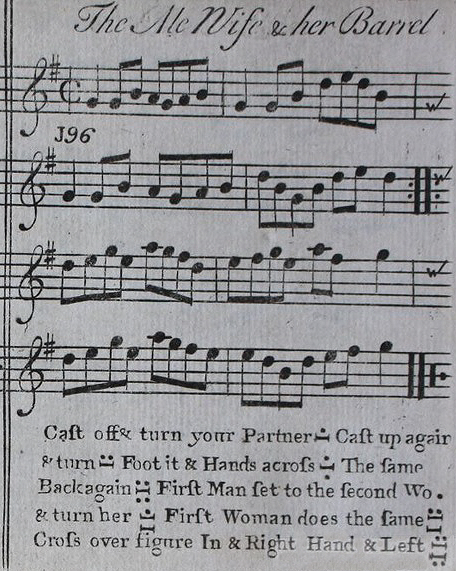
David Rutherford published it in London, but the dance is claimed by the Scots, so there would be differences of interpretation: a Scottish dancer would expect “turn” to mean a right-hand turn whereas an English dancer would expect a two-hand turn. But the RSCDS version is certainly not what Rutherford wrote. Here's the RSCDS version in English terminology.
| A1: | Ones cast, quick right-hand turn. |
| A2: | Ones cast up, quick left-hand turn. |
| B1: | All set; right-hand star half-way. |
| B2: | All set; left-hand star half-way. |
| A3: | First man and second lady set advancing; right-hand turn — first man end in progressed place. |
| A4: | First lady and second man set advancing; left-hand turn — first lady end in progressed place. |
| B3: | First man cross right with second lady; first lady cross right with second man. |
| B4: | Two changes with hands. |
The trickery in A3 and A4 to get the ones progressed is really awkward. Admittedly the dancers in the RSCDS videos have practiced it long enough to make it look natural, but you can see from Rutherford's original that it's a complete fabrication. And what happened to Cross over figure In
?
George Williams asked me to look at this dance, and once I'd studied the original I saw what the problem was. The A and B music are only 4 bars each rather than the standard 8 so it's all rather frantic. I'm quite sure that “cross over” means “cross and cast” and “figure in” means “half figure eight”, giving an absolutely standard sequence to achieve the progression: Ones cross and cast, twos move up, then ones half figure eight up. But you can't possibly do that in 4 bars. So my conclusion is that the music should be played with 4 beats to the bar rather than 2 — in other words at half the speed of the Scottish version. Click the treble clef symbol and then click “Play MP3” (rather than “Play MIDI”) and see what you think. Now there's time for the stars to go all the way round, time for the “cross, cast, half figure eight up”, time for “foot it” which takes twice as long as “set”… the whole thing falls into place.
George then asked,
Is there any way to tell by looking at the music whether a reel should be played with 2 or 4 beats per bar?If it's 6/8 I know it's 2, and if it's 3/4 or 3/8 I know it's 3, but I don't understand why 4/4 or ¢ or 2/4 is sometimes 2 and sometimes 4…
That's a good question and I don't have a good answer! In addition to the numbers, some composers and publishers use  for 4/4 and
  for 2/2 — I never do and I always have to look them up! Some composers and publishers (old and new) use 4/4 when in my opinion they should be using 2/2 because there are two beats in a bar, not 4. If you clap or walk to a tune you can normally tell whether it's two or four beats to the bar. Hornpipes and Strathspeys (which are much the same) actually do have 4 beats to the bar, but most reels have 2 beats to the bar. I just believe this one is an exception — it should be notated in 4/4 rather than the C with a vertical line through it which means 2/2. It's quite rare to have a tune where the A and B music are both only 4 bars, particularly when the tune needs to be played through twice for one turn of the dance. So my version of the dance goes like this.
The Ale Wife and her Barrel
| A1: | Ones wide cast; twos lead up. Ones two-hand turn. |
| A2: | Ones wide cast up; twos lead down. Ones two-hand turn. |
| B1: | All set twice (or fancy step *). Right-hand star (all the way). |
| B2: | All set etc. Left-hand star. |
| A3: | First man set twice to second woman. Two-hand turn. |
| A4: | First woman set twice to second man. Two-hand turn. |
| B3: | Ones cross and cast; twos lead up. Ones half figure eight up. |
| B4: | Four changes with hands. |
* The fancy step (where the original says “foot it” rather than “set”) is described on my 200 Years of American page.
George Williams has provided an excellent animation of this at upadouble.info/dance.
Arundel Street
Source: Dancing Master 9th Edition, 1695: Henry Playford.Interpretation: Colin Hume, 2020.
Format: Longways triple minor Improper
The 1. Man being improper, go back to back with the 2. Man; the 1. Wo. being improper, go back to back with the 2. Wo . The 1. Wo. go back to back, side with the 2. Man, the 1. Man go back to back side with the 2. Wo. then 1. cu. go back to back with their Partners : The 1. cu. cross over below the 2. cu. and go the Figure thro' till they come into the 2. cu. place, then go the Figure thro' the 3. cu till they come into the 2. cu. place, then the Figure thro' the upper cu. and cast off :One of the few improper dances in Playford; a better known one is “King of Poland”. In both cases (and others such as “Arcadia” and “Old Simon the King” in the 7th edition) the printer prints the usual diagram with four proper couples, but the wording is unambiguous.
No difficulties of interpretation here. Arundel Street in London ran south from The Strand to the river Thames until the Embankment was built — it now stops short. That was where John Playford (who was a good musician and singer as well as a music publisher) lived for forty years, and his son Henry lived there until at least 1703. The tune is a rather quirky 32-bar jig.
The 1. cu. cross over below the 2. cu.
could be taken to mean that they cross down through the twos, but the fact that they finish in the twos' place makes it clear that it's cross and cast. It seems obvious from the timing that go the Figure
is a half figure eight rather than a full one. Playford doesn't give the symbol for the end of B1 but we know where this should be. And surely the final and cast off
is just part of the half figure eight; they wouldn't finish the half figure eight and then cast off to finish below the threes.
But now the usual dilemma — will anybody want to dance it? It's a triple minor where the threes do absolutely nothing — we only know they exist because the ones do a half figure eight through them. We could convert it to a three-couple dance — but the threes would still do nothing except move up to become twos! Better to convert it to duple minor and point out to the bottom ones that they need to do the half figure eight down through an imaginary couple. But should we add in extra moves for the twos? Usually I avoid that, but this time I'm giving in to the temptation! It was all about the ones in Henry Playford's day, but now other people want to keep moving. Certainly at the end of A2 we can have the twos doing a back-to-back at the same time as the ones. What about converting “half figure eight” into “half double figure eight”? There are three of them, and we can't convert all three or the twos would end improper. In fact “Ones cross, cast and half figure eight up” is such a standard move that I wouldn't want to mess with it. But we could certainly convert the matching pair of half figure eights in B2 to half double figure eights. This is the point where you get to dance with a new couple, so I would stress both when walking it through and when calling the dance, face the next couple. And then tell the twos that they don't need to cast up into it, as some people insist on doing — they're already facing up, so they just move up the outside as the ones cross down through them. Similarly when they finish the first half double figure eight by crossing down through the ones they stay facing down and start the second half double figure eight by moving down the outside while their original ones cross up through them. Again if there's a couple missing at the end the twos need to do it with an imaginary couple.
And I need to talk about the music. The version Playford gives has so many short notes that it's virtually unplayable! I imagine some virtuoso flautist or recorder player embellished the original tune with lots of grace notes and presented that as the correct version, so it's here for any virtuosos and musicologists, but for ordinary musicians I've put it back to what I imagine was the original version of the tune — take your pick!
Arundel Street
Format: Longways duple minor Improper| A1: | Men back-to-back on the diagonal. Ladies back-to-back on the diagonal. |
| A2: | Back-to-back neighbour. Back-to-back partner. |
| B1: | Ones cross and cast; twos lead up. Ones half figure eight up through twos and all face the next couple. |
| B2: | Half double figure eight with this new couple, started by the ones crossing down through their new twos (who would have been threes in the original triple minor dance) as the twos move up the outside. Half double figure eight with your original couple, started by the ones crossing up through the twos as the twos move down the outside, finishing with the twos crossing up through the ones ready for the new men to start again with the back-to-back. At each end of the set, couples out of a half double figure eight must do the move with a ghost couple or just cross over. |
Barham Down
Source: Dancing Master 11th Edition 1701: Henry Playford.Format: Longways triple minor
First cu. cast off into the 2. cu. places, then Arms round with both Arms, the same back again : First cu. cross over into the 2. cu. places, then go the half Figure, then 1. cu. lead down abreast with the 3d. cu the first man goes round the 3d man, the 1st wo. the same with the 3d. wo. at the same time into the 2. cu. places :
The facsimile is from John Young's 17th Edition of 1721, but I've given Henry Playford's wording in the 12th Edition of 1703 which is almost identical, with an identical tune. See this here on page 297 but you need to go to page 309 because the PDF has several pages before Playford's page 1.
The music is in triple time, with two sections each 4 bars long, and in the 12th Edition the underlined dots are both double, presumably meaning two A's and two B's without saying where to split them though that seems clear enough. The 17th Edition has three dots after the B section, but I think that's a mistake.
It's a dance for the ones: the twos move up, move down, move up, and the threes lead down and presumably move up. I don't blame interpreters for making it a more equal dance. I'd be inclined to do the half figure eight down through the threes rather than up through the twos, but who knows? And there's that strange phrase Arms round with both Arms
rather than “turn two hands” if that's what it means. But I don't need to interpret the dance: there are already at least three versions.
Tom Cook has a rather complicated duple minor version which you can see here. A. Simons (the “Kentish Hops” man) has a triple minor version which you can see here.
Here's yet another version:
Barham Down
 Interpretation: Daisy Black, 2019.
Format: Longways duple minor
| A1: | (4 bars): Ones cast, twos lead up, ones (or both couples) two-hand turn. |
| A2: | Twos the same (home). |
| B1: | (4): Ones cross, go below twos who lead up (6 steps); ones half figure eight up, meet in the middle of a line of four. |
| B2: | Lead up in line three steps, fall back; ones assisted cast. |
Daisy's preference is for both couples to do both two-hand turns, and she's in good company — Pat Shaw does the same in his interpretation of Holborn March — but as in that dance, each couple doing one turn is closer to the original.
The Barley Mow Added 24-Jun-25
Source: Twenty four Country Dances for the year 1779: Thompson. Added 24-Jun-25Format: Longways triple minor.
Original wording: (Or see the whole book)
Hands round 3 with the 2d. Wo.the same with the 2d. Man
Cross over & half figure
lead thro' the bottom and cast up
Hands 3 round Man at bottom & the Wo. at top at the same time
This one appears in The Apted Book, though they've substituted “Linnen Hall” for the original tune. In the Preface the editors say,
Actual alteration of the figures has been avoided as far as possible, but in several cases the original instructions have been expanded and supplemented, as will be seen from the notes appended to each dance.
And yet they've left out the half figure eight up, left out the final allemandes, and cut the dance down to 32 bars, i.e. once through the tune, which involves a hey for three in only 4 bars. The dot symbols show that once through the dance needs twice through the tune, as with The Fandango and others. It's easy to say “Well, that's obviously wrong” and hack it about to make it fit once through the tune, but Andrew Swaine stresses that an interpreter must first make a real effort to determine whether the original instructions could actually be correct.
The tune is a jig with A and B sections 8 bars each. [There are actually several tunes called “The Barley Mow”.] How could a circle of three people be padded out to 8 bars? Surely by circling left and right. The same with A2. For B1 we have ones cross, cast and half figure eight up which is certainly 8 bars. But B2 is ones lead down one place and cast up which would be very slow for 8 bars — let's leave that for the moment. A3 is circles of three (as is A1), so again circle left and right. A4 is a hey in the same threes, cut slightly short so that the ones finish in middle place on their own side. B3 is all six circle left and right, and B4 is two allemandes, though there's time to allemande once around in each direction rather than the half-way specified.
So that leaves us with the problem that there's too much music for the ones to lead down and cast up. I suggest that Thompson has missed out something for the ones before or after casting up, so I'm adding a two-hand turn. Of course I can't prove it, and you may say I'm just as guilty of changing the dance as the editors of the Apted Book, but at least I'm giving you my reasoning.
As with many triple minors, I would convert this to a set dance for three couples by making a small change in the last four bars, though actually the threes do a lot more in this dance than in most triple minors of the period. Anyway, here's my version.
The Barley Mow
Format: 3 couples longways.Interpretation: Colin Hume, 2025.
Music: 6 x Own tune.
| A1: | Ones and second woman circle left. Circle right. |
| A2: | Ones and second man circle left. Circle right. |
| B1: | Ones cross and cast; twos lead up. Ones half figure eight up, finishing proper in second place. |
| B2: | Ones two-hand turn. Ones lead down through threes and cast up to second place. |
| A3: | Man down, woman up (i.e. ones to own right): circle left with this couple. Circle right. |
| A4: | Hey across with the same couple: ones go through the gap and turn left to start, finishing in middle place on own side. |
| B3: | All circle left (slip-step). Circle right. |
| B4: | All allemande right. Ones cast to the bottom as the others allemande left, threes moving up. |
The Bath Waltz
Skip to instructionsI learnt a version of this from Valerie Webster and have called it many times since 2008. It's been cleverly converted from triple minor to a 3 couple set, and it's accessible: I've called it three times at a Jane Austen evening arranged by The Round in Cambridge where there were lots of young women in beautiful dresses who wanted to be Elizabeth Bennett but knew nothing about dancing. However in 2023 I decided I really wanted to look at the original wording — and this turned out to be more difficult than I expected! When I looked on RegencyDances.Org I found two versions, here and here. The first is from William Campbell's “20th Book of New and Favorite Country Dances & Strathspey Reels” from around 1805 — but it's a different tune and dance! How can this be? Well, very easily. Bath was the fashionable place to dance in Regency England, so if you were a publisher hoping to sell lots of copies of your book it's an obvious title to choose. The second is from a later book — Charles Wheatstone and Augustus Voigt's “A Selection of Elegant & Fashionable Country Dances, Reels, Waltz's &c. Book 9” from 1814 — this is a version of the tune I had, but the figure bears no resemblance. And I had believed that the dance and tune had been published by Cahusac in 1798, three years before he published “Duke of Kent's Waltz”. There's also a dance of that name in the Preston 1799 collection but that's another tune and figure.
So I asked Paul Cooper, the Regency expert who does most of the interpretations and animations for the site. He sent me a copy of the Cahusac which turned out to be yet another tune and dance bearing no resemblance to what I was looking for! He then added,
That said, your tune is included in a later Cahusac publication named 'The German Flute Preceptor' from around 1815. So there is a genuine Cahusac source, and an assumption might have been made that the 1798 and c.1815 tunes would be the same just because the names are the same. Wilson published the same tune in his 1816 'Companion to the Ballroom'… and looking at his figures, that's what you have! You have an arrangement of Wilson's first suggested figures for 'Prussian or Bath Waltz'.
WALTZ FIGURE Each strain repeatedChain figure 6 round with progressive waltz step
waltz whole poussette with sauteuse step
OR THUS
The 3 ladies turn their partners a la waltz
Again some people would say “But how can there be two figures to the same dance?” because they've been led to believe that every dance has one tune and one figure. This was probably true in John Playford's day, but 150 years later it certainly wasn't. You can read Wilson's book at google.co.uk/books/edition/
The time of each Tune has been carefully marked against it, in order to render the Dance uniformly complete, and the Figures are written to correspond exactly; and, with a view to render the Work as correct as possible, each figure is written expressly for this Work, calculated equally to suit the Learner and the most experienced Dancer…Accordingly, three Figures are generally given to each — the first easy; the second more difficult; and the third for the most part double.
“double” generally means each part of the tune is repeated, whereas “single” generally means without repeats. So I think we must accept what Wilson says. He has made up two or three sets of figures for each tune and the combination of this tune and figure has never appeared anywhere before. Indeed on page vii he says,
… those who wish for a greater variety of Figures, may consult the Tables in the “Analysis of Country Dancing,” invented for the purpose of enabling Dancers to set their own Figures to any Extent.
This reminds me of Mozart, who (allegedly) produced a mix and match method for writing your own minuets by throwing a dice to select chunks of music from each column in turn.
Wilson finishes his preface:
All the Airs in this Collection are original, and such as have received general applause. Every attention has been paid to rendering them correct; and the Author trusts that this Work, when closely examined, will be found the most perfect of any thing of the kind hitherto attempted, and that it cannot fail to be rewarded with universal Approbation.
So what do we make of Wilson's first figure? I don't know what he means by progressive waltz step
unless he means moving steadily forwards rather than rotating. Chain figure 6 round
is surely what I would call a grand chain, where the ones start giving right hands to partner and the twos and threes give right hands to neighbour. But taking two waltz steps per change still only adds up to 12 bars, and the music has 16 bars.
waltz whole poussette with sauteuse step
isn't obvious either. whole poussette
actually means one and a half because the ones need to finish in second place ready for the “swing corners” figure. And what is a sauteuse step? According to Susan de Guardiola,
For the sauteuse waltz: the sauteuse step as described by Thomas Wilson, that being the closest description available. Leap-slide-close, leap-run-run.
That sounds far too energetic for me!
Paul Cooper has written a paper on The Works of Thomas Wilson, Dancing Master.
You can read the whole of Thomas Wilson's “The complete system of English country dancing containing all the figures ever used in English country dancing, with a variety of new figures, and new reels” (c. 1815) on the Library of Congress website.
You can read Wilson's “An analysis of country dancing” on the same site. Or if you want the full title: “An analysis of country dancing wherein are displayed all the figures ever used in country dances, in a way so easy and familiar, that persons of the meanest capacity may in a short time acquire (without the aid of a master) a complete knowledge of that rational and polite amusement. To which are added, instructions for dancing some entire new reels; together with the rules, regulations, and complete etiquette of the ball room”. But I don't know where Wilson describes “sauteuse step” or “progressive waltz step”.
At gallica.bnf.fr/ark:/
Paul Cooper says:
Wilson's terminology for waltz country dances is open to interpretation. He announced (in various advertisements and publications) that he'd invented the concept of “waltz country dancing” in 1815. He didn't invent the concept of country dancing in Waltz time of course, that had been popular since 1790 or so. What he'd invented was this new terminology involving Sauteuse steps and 'a-la-waltz' variations of figures. He also advertised that he was working on a book to explain it all. His 1816 “Correct Method of Waltzing” has “Part 1” written on the cover. Part 2 was perhaps (I'm guessing) intended to be his volume on Waltz Country Dancing in which he'd have answered all our questions. It seems never to have been published so guess work is required. He included examples of his waltz country dances in all of his dance collections from 1815 forwards; they're an interesting sub-genre of late Regency country dancing. But interpreting his meaning is an exercise for the reader. I imagine that he must have been teaching something moderately unusual/new; the industry would have laughed at him if all he'd done was claim credit for what everyone had been dancing for the past 25 years. So slightly fanciful arrangements of the figures makes sense to me.My current guess on the pousette is that some kind of waltz turns would be injected into them. Perhaps adopting a waltz embrace with your partner, then waltzing around the neighbouring couple; perhaps doing so as many times as uses up the music. Just a guess, I've nothing to base that on except the guess that it's something other than a regular pousette.
This is an area which is still being explored, and I'm not the expert to do so — I'll just give one example. See efdss.org/vwml-digitised-
Le Sylph — An elegant collection of Twenty four Country Dances, the figures by Mr. Wilson. For the year 1818 Adapted for the German Flute, Violin, Flageolet or Oboe.
For many of the dances, such as “The New Tyrolese Waltz” and “Twoli”, there are two figures. The first is a Waltz figure
, the second is a Country Dance figure
and they take the same amount of music. Looking at the first of these dances, I can see how the Country Dance figure fits 32 bars of waltz time, but I've no idea how the start of the Waltz figure, The 3 Ladies & 3 Gent:set to each other
can fill up 16 bars. I'm not even going to guess; I'll leave that to the real scholars.
Moving on from all that, here's Wilson's description of Whole pousette (as he spells it) from “The complete system of English country dancing containing all the figures ever used in English country dancing, with a variety of new figures, and new reels”.
The top couple at A join hands and move in the line a a a, while the second couple B join hands and move in the line b b b, by which means they move round each other twice and change situations, the couple B will have moved to A, and the couple A will then take the place of the couple at B, which finishes the Figure.
From the diagram you can see that the movement is anti-clockwise, i.e. first man pull, second man push, and it's 1½ rather than twice. There's no mention of rotating, so it seems to be a regular push-pull poussette — but how can you pad it out to 16 bars?
Some time after writing this I went to a workshop with Anne Daye in which she said that a poussette in Regency days was a rotating move, much like a “swing and change” in English Folk dancing — though that's a move which seems to be little known now. Paul Cooper has an article on The Pousette Figure in English Regency Dancing in which he says,
Wilson's figure was similar to a that of a regular rotational pousette except that the couples rotate one-and-a-half times in order to change places.
and later,
The Waltz dance entered the English ballrooms from the start of the 19th Century, it triggered the invention of something named the Waltz Pousette. Thomas Wilson, for example, used this figure in his 1818 Le Sylphe dance collection. He employed such phrases as “whole poussette with sauteuse step” and “waltz whole poussette”. This appears to be a turning pousette, it could be the origin of the pousette figure used in RSCDS Scottish Country Dancing.
I haven't tried to add in that factor — and I still don't see how it could use up 16 bars.
The final figure is swing corners a la waltz
. Does a la waltz
just mean “using a waltz step”, and is that different from a progressive waltz step? I don't know, but at least I can find Wilson's description of “swing corners” on page 64 (Image 89):
The Gentleman at B swings the Lady at A with his right hand and moves to C, while the lady moves to D.The Lady at A swings the Gentleman at C with her left hand, while the Gentleman at B swings the Lady at D with his left hand, then meets his partner at E.
The Gentleman at C swings his partner at A with his right hand and moves to D, while the Lady moves to B.
The lady at A swings the Gentleman at C with her left hand, while the Gentleman at B with his left hand swings the Lady at D, they then then return to their places at E F, which finishes the Figure.
N. B. In performing this Figure the Lady always swings her partner with the right hand, and the top and bottom Gentlemen with the left. The Gentleman likewise swings his partner with the right hand, and the top and bottom Ladies with the left.
I find it very confusing that he keeps changing the letter names between the four figures, but I understand what he's saying. And yes, he does say “then then”.
There are several differences from the tune I picked up from somewhere. You can see the version on page 22 of “The German Flute Preceptor” at imslp.org/wiki/
I was wondering why different publishers printed slightly different versions of the same tune. Paul Cooper explains:
One interesting thing about the early 19th century is that there were an abundance of music shops operating in London, they were competing with each other for much of the same market. If a tune was remotely popular, it was liable to be published many times over. In some cases publishers straight up copied from each other; in others tunes migrated more organically, perhaps with a musical person hearing a tune at a ball and memorising it, then selling it to a music shop the next day from memory (perhaps as Lady so-and-so's favourite). The result being that it's not at all uncommon for minor differences to appear between published tunes, names of tunes, time-signature, and so forth. That all came to an end in the late 1810s when the copyright regime became less permissive, but for roughly 20 years a proliferation of tunes across published sources was common. All of which is a complicated way of saying that I wouldn't be concerned about minor differences between your tune, the Wheatstone version and the Wilson version. They're close enough that they were surely intended (and understood) to be the same.
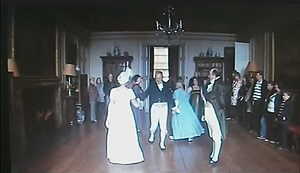
I contacted Liz Bartlett, leader of the Jane Austen Dancers, who told me that the reconstruction was by the group's founder, Elspeth Reed, and Valerie learnt it at the same time that she did. She confirmed that it was from Wilson's “Companion to the Ball Room” 1816, Figure 1. And althought that calls it “Prussian or Bath Waltz” I'm using Elspeth's title: “The Bath Waltz”.
I asked her how she distinguished between “country dance figures” and “waltz country dance figures” and she replied,
- Country Dances: dances to Reel-time, Jig-time, Waltz-time tunes etc. Even if the tune was waltz time it was still a Country Dance
- Couple Waltzing: enclosed embrace-hold dancing exclusively with your partner entire time — becoming more widely danced in 1810s it was frowned on, so to dilute the amount of time “embracing” (and to gain acceptance for Couple Waltzing in society) they “invented”:
- Waltz Country Dances: dances to Waltz-time tunes but containing waltz moves such as “turn a la waltz” with both partner and corners etc. — so you would in effect be Couple Waltzing but with more than one person and only for a short time before the next move, e.g. lead down and back etc. By his 1816 Companion, he dropped the term, but the Couple Waltzing aspects remained (see Prussian/Bath Waltz 1816). I use it as it's a good way of distinguishing the dances, to see how they got Couple Waltzing through society.
I asked whether the figures explained by Wilson have a different meaning when it's a waltz country dance. She said,
They will be based on the figures everyone knew, but waltz-i-fied. There's no documentation / book I know of explaining “poussette a la waltz”, “waltz with progressive steps” (when applied to Waltz Country Dancing) — I have looked, but it seems you needed to go to class! There was chaos back then too — I've got extant quotes — especially during the Napoleonic Wars when all the Allied countries had their own version of Couple waltzing.
One such quote which always makes her laugh is from Lord Clive's Journal, 1814-1815 (page 89):
In the evening afterwards I went to a dance at the Baron de Gagern's, where they were dancing country dances à l'Anglaise, as like them to be sure as Germany is to England; but, however, I thought myself safe at that sport, or else that my London education had been wholly thrown away, upon which I asked Lady Isabella Fitzgibbon to honor me with dancing a country dance with me. As the devil himself would have it, they introduced a waltz in the middle of the figure, and there I was in a glorious scrape. Luckily Planta, Lord Castlereagh's secretary, knows no more of dancing waltzes than I do, and so I was not single in my blunders. First we attempted to pousset it, that did not suit; we made one attempt at a waltz, and then we went to the bottom of the dance, which I thought a remarkably wise measure. I have made some good resolutions about dancing. I do not know how long I shall keep them, but no more waltzing for me, unless I get some fair instructress first, who is a perfect mistress of the art of waltzing, to give me a few lessons.
She also said,
When I started Regency calling in c2006 we had only a few Waltz Country dances, and I decided to make a study of them alongside couple waltzing etc (pre Internet giving us all the answers!), so if I was interpreting the 1816 dance, now I'd probably interpret it with “rotating as you go poussettes” / waltz arm holds etc. But we like Bath Waltz 1816 as it is, in the same way as Duke of Kent and Mr Bev aren't worth changing.
Naturally I had to point out that I have my own interpretations of both Duke of Kent's Waltz and Mr Beveridge's Maggot!
And then Paul Cooper made an equally clever suggestion for the first move: instead of everyone starting the grand chain, how about making it progressive: the ones start, bring in the twos and threes as they meet them, and keep going till everyone is home. This goes all the way back to “Nonesuch” in Playford's first edition of 1651. But it doesn't tie up with Wilson's description on page 88 (Image 113):
The Lady at A and Gentleman at B, the Ladies at C G, and the gentlemen at D H, swing with the right hands, then they all swing with the left hands, continuing in a direction from right to left, swinging with the right and left hands alternately till they all regain their original situations, which finishes the Figure.
That's really disappointing! Wilson may tell us how perfect his book is, but he doesn't explain the timing, and Paul's suggestion fits the music perfectly.
So my (current) approach is to go with Elspeth's version but add Paul's suggestion for the grand chain. Is it right? I doubt it. Does it work? Certainly! The final move of the grand chain is the threes crossing back to their own place, so the ones and twos can be ready for the poussette. And the final move of the dance is the ones doing a left-hand turn in middle place, which means the new ones are ready to start the grand chain, and the twos and threes don't need to remember which way to face — the ones will bring them in to the chain as they meet them. I called this successfully at The Round at their first meeting in October 2023 with several new dancers, and I look forward to calling it to yet more beautifully dressed young women!
I may return to this topic later, but it's turned out to be much more complicated than I expected, and I need a break from it! I'll leave you with Paul Cooper's paper on The Regency Waltz: regencydances.org/paper013.php
The Bath Waltz
Format: 3 couples longways.Dance: Thomas Wilson: Companion to the Ballroom, 1816
| A1/2: | Ones start a progressive grand chain: change right hand with partner, change left hand with the twos. Everyone change right hand with the next (ones with threes, twos with partner) and keep going till all are home. Use two waltz steps per hand, dancing in a curve rather than just pulling by. |
| B1: | First man push, second man pull: Half poussette at the top. First man pull, third man push: half poussette at the bottom. [It's always the end man who pushes.] |
| B2: | Twice more from new places, finishing 3, 1, 2. |
| C1: | Ones turn first corner right, partner left 1¼. [There is more time than people think for this, so don't rush it.] |
| C2: | Second corner right, partner left 1½. [Reverse progression] |
One final comment: Alan Winston, Regency Dance expert from California says, “It seems like a lot of the [Regency period] waltz-time dances are 48 bars and have 16 bars of ”swing corners“ in them, so they're not very different.”
The Beggar Boy Added 26-Jan-26
Source: Dancing Master 1st Edition, 1651: John Playford Added 26-Jan-26Format: Longways duple minor
Leade up all forwards and back .
That againe :First and last on each side to the wall, while the 2. Cu. meet, back all to your places, men hands and goe halfe round, We. doing the like . All that againe : Sides all .
That againe :First and last meet and change places, while the 2. Cu. goes back and meet, first foure hands and goe round, while the other set and turne S. . All this again : Armes all .
That againe :Back all a D. meet againe. half the S. Hey : That againe :
This is basically the same as Cecil Sharp's version.
Sharp has the circles in the first figure going all the way round rather than the halfe round
specified, and I agree with him.
In B2 for the second figure he just says Repeat B1, to places.
but Playford says First 4.hands and go round,while the other set and turn S
so surely this has to be positions rather than numbered couples.
In the third figure, as I say on my page about The Hey, I expect the ones to lead the hey. I see it as a whole Hey interrupted by falling back and coming forward, so the first half starts at the top with the ones and twos passing right shoulder and the second half starts at the bottom with the ones and twos passing left shoulder. I would do the same in Chestnut.
| First Figure: | |
| A: | Up a double and back. That again. |
| B1: | Ends face out and move out a double while twos meet; all fall back. Circle left on own side. |
| B2: | All that again. |
| Second Figure: | |
| A: | Side right shoulder to right. Side left. |
| B1: | Middles fall back a double and move forward, tops lead to the bottom, bottoms move up to the top outside them. Circle left at the top, set and turn single at the bottom. |
| B2: | All that again from new places. |
| Third Figure: | |
| A: | Arm right. Arm left. |
| B1: | Take hands in lines: Fall back a double; lead forward. Twos face up: half a straight hey starting right shoulder. |
| B2: | Lines fall back a double; lead forward. Twos face down, pass left shoulder: half a hey. |
Bobbing Joe
Source: Dancing Master 1st Edition, 1651: John Playford.Interpretation: Colin Hume, 2013.
Format: Longways duple minor
Leade up forwards and back . That againe : Set and turn S. . That againe : First Cu. slippe down between the 2. they slipping up . then they slippe downe . hands and go round : The first two men snap their fingers and change places . Your We. as much : Doe these two changes to the last, the rest following. Sides all . That againe : Set and turn S. . That againe : First two on each side, hands and go back, meet againe . Cast off and come to your places : First foure change places with your owne . Hands and goe halfe round : These changes to the last. Armes all . That againe : Set and turn Single . That againe : Men back a D. meet againe . We. as much : First Cu. change with the 2. on the same side . Then change with your owne : These changes to the last.
The tune is a jig with a 4-bar A and a 4-bar B, presumably both repeated. The dance apparently appeared in all editions of The Dancing Master, though it seems highly unlikely that people would still have been dancing it in 1728 when “Up a double”, “Sides” and “Armes” were ancient history. As I mention in my Connections notes, many of the progressive longways dances from the first edition had the three standard introductions. We hardly ever dance them now, but I was looking for something different to call at my “Playford for Fun” session at Whitby Folk Week in 2013 and picked on this one. Playford lays out the instructions so that it is clear which go with the A-music and which the B. The underlined dots reassure us that there are two A's and two B's except that the line starting First Cu. slippe down between the 2. they slipping up
has two underlined single dots, but let's assume that's a mistake. So the first figure starts in an absolutely standard manner: Up a double and back, that again, set and turn single, that again. The body of the figure starts with a move reminiscent of the “matchboxes” move in the second figure of “Picking of Sticks”: the ones slip down the middle as the twos slip up the outside, then reverse it, and circle left. The second half needs to progress, and it clearly does. Playford refers to “first two” or “first foure” because at that time a progressive longways dance was started by just the first two couples, the others watching and joining in as the original top couple reached them. We might wonder if Doe these two changes to the last
means that the progressive part is just the B part repeated over and over, with these two changes
meaning the men changing places and then the women, but I would like to think that you do the body of the figure with each couple in turn, otherwise the progression would be perfunctory indeed.
But what about the timing? How can we use up 4 bars (8 beats) on The first two men snap their fingers and change places
? Sharp contrives this by having the first man snap on the second beat of bar 1, the second man on the second beat of bar 2, then four steps to change places. But is that really what Playford meant? Let's see what happens in the other two figures. The second figure has cross with partner and circle left half-way, which I would expect to be 8 steps. The third has cross with neighbour and then with partner — again 8 steps. Sharp gets round this by adding some inventive finger snapping at the start of the second figure, but that still means 8 steps for the circle half-way which seems very slow given the liveliness of the dance and tune. In the third figure he adds finger snapping before each half of the move, but who's he kidding? Is it likely that John Playford left all this out? I know Playford is very concise — Sharp takes three pages to explain the dance — but I don't believe he would have left out so much. Surely a more likely explanation is that the underlined dots are wrong, and there is only one B.
One other point worth mentioning is that the final figure leaves everyone improper. I'm assuming throughout the dance that the instructions refer to both couples; I think it was later that the instructions were by default addressed to the first couple. So the second figure is “cast and lead, lead and cast” rather than just the ones casting and leading back up. Similarly I believe Then change with your owne
in the last figure is addressed to the twos as well. So if we've just danced the first turn of the final figure, the original top couple are now progressed and improper when the figure starts again with Men back a D
I'm guessing that the first man would take the instruction as referring to him, though since he's improper he would be taking hands with the next woman and falling back with her. I may yet change my mind about this! For modern use I would start by taking hands four from the top, so everyone except the neutral couples would be improper on alternate turns of the figure. The other concession to modern taste is that I wouldn't run each figure all the way down the set and back. Four or six times through each figure sounds a good compromise, meaning that with an even number of couples everyone will be in at the start of each figure. Of course if there is a neutral couple at the bottom they can join in the three introductions, just as the whole set would have done in 1651 before the top two couples started the body of each figure.
A final thought is that since Playford wrongly indicated two B's in the body of the figure he may well have the same mistake in the introduction, in which case there should be only one “Set and turn single”. I'll assume that, if only to make things easier for the musicians! So I've written the music out with an 8-bar A and a 4-bar B which means the musicians just have to play A B repeatedly, and that's how I've notated the dance in the following instructions.
Bobbing Joe
Format: Longways duple minor| First Figure: | |
| A1: | Up a double and back. That again. |
| B1: | (4 bars): Set and turn single. |
| A2: | “Matchboxes”: Ones give two hands and slip down the middle as the twos slip up the outside; reverse. Circle left. |
| B2: | (4 bars): Men snap their fingers and change places; women the same. [Progression. Do A2 + B2 three more times.] |
| Second Figure: | |
| A1: | Side right. Side left. |
| B1: | Set and turn single. |
| A2: | Take nearer hand with neighbour and fall back; lead forward. Ones cast and lead back to place, twos follow. |
| B2: | (4 bars) All cross right shoulder with partner, turn right; circle left half-way. [Do A2 + B2 three more times.] |
| Third Figure: | |
| A1: | Arm right. Arm left. |
| B1: | Set and turn single. |
| A2: | Men fall back with neighbour; lead forward. Women the same. |
| B2: | (4 bars) Cross with neighbour; cross with partner. [Do A2 + B2 three more times.] |
The Bowmen of Kent
Source: Skillern, 1795Format: Longways triple minor.
Interpretation: Colin Hume, 2023.
Format: 3 couples longways.
Right hands 4 half roundLeft back again
lead down 1 Cu
up again cast off
hands 4 round at bottom
right & left at top

The tune is a lively double jig with an 8-bar A-music and a 4-bar B-music, each repeated. Paul Cooper has interpreted the original triple minor dance at regencydances.
There are one or two oddities to consider. The underlined dots say that there are three sections of music, each repeated, but I assume that the musical notation is correct and that each dot represents four bars. Right hands 4 half round
seems to be an odd mix of “Right hands across half round” and “Hands 4 half round” but I'm assuming the former. I find it fussy to have the stars going half-way, perhaps with setting or falling back to fill up the music, so I'll go for stars all the way round. The rest will work, though it's very busy for the ones going from a circle left all the way to four changes at the top with only two steps per change.
However, in “Kentish Hops” (the book, not one of the leaflets) it has been converted to a 3 couple set which looks undanceable to me. In fact I can't blame Simons for this: the book is a tribute to him, and says:
Collected by A. (Bert) Simons
Produced by Charles Learthart — Orpington Folk Dance Chairman
First of all he has all three couples in the right-hand star and left-hand star — that's not undanceable but it's so wrong that I wouldn't call it — the star would certainly have been for the ones and twos. No objections to the ones leading down, leading up, casting to second place and then circling left with the threes. But in the next four bars (8 walking steps) he has the ones and twos doing four changes plus a fifth change to get the ones to the bottom, and then they have to turn back to become threes in the next right-hand star. So what's the answer? We could have the twos moving up as the ones lead down, then the ones lead up to second place and cast to the bottom as the threes move up, so we're already in progressed positions (2, 3, 1), and then it's circle left at the bottom and four changes at the top. The dancers still have to make sure that the circle left goes all the way round and they're facing the right way for those four changes, but it's possible. It also means the ones aren't involved in the four changes at the top, which is unusual — the expectation is that the ones will be dancing the whole way through the figure. So here's what I think is a better (i.e. less frantic, easier) solution — though I've yet to call it! Of course another possibility is that Skillern missed out the first four bars of the B-music and it should actually be a 32-bar dance!
Click the treble clef and then “Play MP3” (not “Play MIDI”) to download something you can call the dance to: two bars introduction, three times through the tune and a final chord. George Williams has a nice animation of this version at upadouble.info/dance.
| A1: | Ones and twos right-hand star. Left-hand star. |
| A2: | Ones lead down the middle, turn in. Lead back, cast to second place (twos lead up). |
| B1: | (4 bars): Bottom two couples circle left. |
| B2: | Same two couples, three changes with hands. |
Bulock's Hornpipe
Source: Dancing Master Volume 3, 1726: John Young.Interpretation: Colin Hume, 2009.
Format: Longways triple minor
The first Cu. lead thro' the 2d. Cu. cast up and cast off . The 2d. Cu. do the same : First Cu. cross over and half Figure at top . Then whole Figure with the 3d. Cu. : First Cu. turn all four corners : And then cross over quite round all the 4 corners : Then first Man Heys on his own side and his Partner Heys on hers at the same time . First Cu. leads thro' the 3d. Cu. at bottom and thro' the 2d. Cu. at top and turn his partner :
The instructions say that there are five sections, and the music indeed gives five sections of four bars, each repeated.
I would like to look at this in conjunction with Ravenscroft's Hornpipe, another dance from the same edition:
Note: Each Strain is to be Play'd twice, and the Tune twice through.First cu. lead thro' the 2d. cu. and cast up and cast off . The 2d. cu. do the same : Then first cu. cross over and half Figure a-top with the 2d. Cu . Then whole Figure at the bottom with the 3d cu : Then First man turn the 3d. Wo. with his Right-hand, and his Partner the 2d. Man with hers, and her Partner with her Right . Then first Wo. turns the 3d. Man with her Right, and the first Man turnes the 2d. Wo. with his Right, and his Partner with his Left :
Then the first Man cross over on the outside the 3d. Wo. and his partner cross on the outside of the 2d. Man, and both cast into the 2d. cu. place . Then first Wo. cross over on the outside the 3d. Man. and the first Man cross on the outside of the 2d. Wo, and both cast into the 2d. cu. place : Then the first Man Heys with the 3d. cu. and the 2d. Wo. Heys with the 2d. cu. a-top . Then the Man the same a-top, and the Woman the same at bottom : Then Right-hand and left quite round with the 2d. cu. a-top . Then lead thro' the 3d. and turn your Partner :
The instructions to the two dances are quite similar, but Ravenscroft's is more explicit about the instructions and the timing — it says there are three 4-bar phrases each repeated and the whole tune is then repeated, giving 6 x 8 bars for once through the dance. Bulock's implies that there are five 4-bar phrases each repeated, giving 5 x 8 bars. Both tunes are in triple-time. Ravenscroft's appears in Fallibroome 6.
“Bulock” and “Ravenscroft” are both in italics, indicating that these are men's names.
Bulock's Hornpipe
A1: Ones lead through twos and cast up, then cast as twos lead up (12 steps).
A2: Twos repeat with ones.
I originally had “Twos repeat with threes” but I didn't mean that — thanks to Norman Bearon for pointing it out to me!
B1: Ones cross and cast, twos lead up (6 steps). Ones half figure eight up.
B2: Ones full figure eight down through threes (12 steps).
So far this is identical to Ravenscroft.
C1/2: “First couple turn all four corners” (24 steps). Ravenscroft's has Ones turn first corner right, partner left (in my opinion, though it actually says right), second corner right, partner left. Six steps for each sounds reasonable, and though the ones each turn two corners, together they turn all four corners. Let's go along with that (as Bernard Bentley does).
D1/D2: “And then cross over quite round all the four corners” (24 steps). Ravenscroft's has “Then the first man cross over on the outside the 3d. Wo. and his partner cross on the outside of the 2d. Man, and both cast into the 2d. Cu. place . Then first Wo. cross over on the outside the 3d. Wo. and first Man cross on the outside of the 2d. Man, and both cast into the 2d. Cu. place : ” I suggest these are describing the same figure, and again I go along with Bentley: Ones cross, turn right, man round the third lady and man, lady round the second man and lady, back to second place. Repeat going left, round the other couple. This time each person really does go round all four corners.
Now the two dances differ significantly. Bulock's has: “Then first Man Heys on his own side and his Partner Heys on hers at the same time . The first Cu. leads thro' the 3d. Cu. at bottom and thro' the 2d. Cu. at top and turn his partner : ”
Hey on the side can be done in twelve steps, though you need to start with the ones going down through the threes to make the following move feasible. I believed that Lead down, cast up, lead up, cast down could be done in twelve steps, but when we tried it the dancers thought otherwise — and there's no time for a turn. In fact I think there's a number of dances which glibly throw “and turn” at the end of a set of moves which doesn't allow any time for a turn. So what do we do? The usual answer is to leave out the turn, but if we compare with Ravenscroft's we see that the lead up and cast doesn't appear there, so next time I try it I'll leave that out instead.
As with many triple minors, the threes don't do much, so to my mind it's better danced now as a three couple longways. The only change needed is that the ones turn to the bottom as the threes move up or cast up.
Bulock's Hornpipe
Format: 3 couples longwaysEach paragraph is four bars of 3-time: 12 steps.
| A1: | Ones lead through twos and cast up, then cast as twos lead up. |
| A2: | Twos repeat with ones. |
| B1: | Ones cross and cast, twos lead up. Half figure eight up. |
| B2: | Ones full figure eight down through threes. |
| C1: | Ones turn first corner right hand, partner left. |
| C2: | Ones turn second corner right hand, partner left. |
| D1: | Ones cross left, turn right, round this couple and back to second place. |
| D2: | Ones cross right, turn left, round the other couple and back to second place. |
| E1: | Ones down through threes: symmetrical reels of three up and down. (Morris hey except ends don't cast at start) |
| E2: | Ones lead down through threes and cast up. Ones two-hand turn to bottom, threes cast up. |
| Modified from triple minor. | |
Carpenter's Maggot
Source: Dancing Master 11th Edition, 1701: Henry PlayfordFormat: Longways triple minor
The 1. cu. cross over below the 2. cu. the Man cast up again and go quite round into the 2. Wo. place, his Partner following him . The 2. cu. do the same : Then all four Hands half round, and turn single, the 1. Man turn the 2. Wo. into the 1. Man's place . The other cu. do the same, then Right and Left till you come below the 2. cu. :
The tune is a jig — and yes, it really does have an 11-bar A-music and a 14-bar B-music, each repeated. Thomas Wilson in his book “The complete system of English country dancing, containing all the figures ever used in English country dancing, with a variety of new figures, and new reels” (published in 1808) is very scathing about the old dances which didn't conform to his rules, including this one:
loc.gov/resource/
TUNES WITH AN ODD NUMBER OF BARS.Several of the old Country Dances have Strains containing an odd number of Bars, “Gay Molly's Delight,” contains nine Bars, in “May Fair,” there is nine Bars in the second Strain, and in “Ianthe the Lovely,” also in “If 'twere Tweedy,” “The Carpenter's Maggot,” contains eleven Bars in one Strain, and fourteen in the other. No regular steps or proper Figures can be performed as Country Dances to this odd Measure of Music.
From the foregoing quotations and observations, as applicable to the absurdities and irregular manner of setting Figures to improper Music, the misapplication of the several uses of the Figures, &c. &c. The reader will have become acquainted with the manner and style of “Old Country Dancing.”
He then goes on to attack the steps used, saying that moves like the “Single” and the “Double” are equally absurd! Let's ignore all that prejudiced opinion.
I'd say the dance is triple minor, even though the threes are not mentioned. Why do I think that? Well, as I keep saying, “cross over” means “cross and cast”. Similarly I believe cross over below the 2. cu.
means cross down through the twos (who move up) and then cast below the threes (who probably don't move up). I've made the same assumption in The Punch-Bowl. No, they wouldn't have cast below the next twos — that's action outside the minor set, which never happened. 4 bars for that, leaving 7 bars (14 walking steps or preferably 7 skip-change steps). The ones are improper in 3rd place and they need to finish improper in 2nd place. I believe go quite round
means the man casts up above the twos, across the set, down to second place and across to second woman's place, his partner following to second man's place. Now the twos do the same, so we end with the ones above the twos, both couples improper.
The B-music starts with circle half and turn single, so now both couples are proper in their progressed place. I'd expect 4 bars for that, but on listening to the tune it seems to split into sections of 5, 5 and 4 bars. I'd say 4 steps for the circle half as usual, then a wide turn single left taking 6 steps rather than the usual 4. That leaves 9 bars for the remainder of B1:the 1. Man turn the 2. Wo. into the 1. Man's place
. That can't be the first man's original place which is already occupied, it must mean his current place, but even a two-hand turn 1½ surely can't be padded out to 18 walking steps (9 skip-change steps). And it seems very odd that B2 starts with the other two doing the same move, when surely the two moves belong together. So here's a revolutionary suggestion — my usual approach of following the spirit rather than the letter of the instructions — perhaps there's only supposed to be one B, not two! This is a bizarre tune, and it wouldn't surprise me if whoever contributed the dance — sitting at a writing desk rather than observing in the ball-room — put in that first underlined dot by mistake. With that assumption the second 5-bar phrase breaks down into two bars for the first man and second woman to turn half-way, two bars for the others to turn half-way, and one bar in which to recover. Then we finish with a standard 4 bars for two changes with hands. It's going to be quite tricky phrasing this to the music, so I've taken the liberty of putting in a rest rather than the long note near the end of bar 10 of the B-music to make it more obvious when the final 4-bar phrase starts.
For modern dancers I would certainly convert it to duple minor, so the ones will cast below the next twos (or a ghost couple at the bottom of the set), and I know they won't like that one bar doing nothing before the final two changes, so I'll add a brief acknowledgement! I called this at the Playford Ball at Chippenham Folk Festival in May 2024, and after several minutes of incredulity during the walkthrough it went really well. The band were also incredulous — Paul Hutchinson said they had a version of the tune from Andrew Shaw which was much more regular — but you can see the facsimile yourself and the facsimile of Thomas Wilson's comments.
Carpenter's Maggot
Source: Dancing Master 11th Edition, 1701: Henry PlayfordInterpretation: Colin Hume, 2024.
Format: Longways duple minor
| A1: | (11 bars): Ones cross down through the twos (twos move up) and cast below the next twos (8 steps). First man cast up, followed by partner, above original twos and all the way round them to finish in second place improper (14 steps, or preferably 7 skip-change steps). |
| A2: | Twos the same, ending twos below ones, all improper. |
| B: | (14 bars): Circle left half-way; wide turn single left (6 steps). First man second woman two-hand turn half-way; the others turn half-way; all acknowledge partner (1 bar). Two changes with hands. |
Charming Maid
Source: Dancing Master Volume 2, 3rd Edition: John Young, 1718Interpretation: Colin Hume, 2022
Format: Longways triple minor
Note: The first strain is to be play'd twice, and the last but once.
The 1st Cu. cross over below the 2d Cu and Figure thro' the 3d Cu . The 2d Cu do the same : The 1st Cu. go between the 2d and 3d We. then cast off, and Figure thro' the 2d and 3d Men, then the 1st Man fall back with the 2d Cu. and the 1st Wo. fall back with the 3d Cu. and cast off, then first Wo. cast up, and both turn in the 2d Cu. Place .
The tune is a lively notey reel with an 8-bar A-music and a 16-bar B-music, giving a standard 32 bars if the note above the music is correct. George Williams has pointed out that the dance was published by Walsh/Kynaston in 1716, two years before John Young. See it here.
See Cross over for my explanation that cross over below the 2d Cu
means the ones cross straight over and cast below the twos (who move up). Is it a half or full figure eight? A1 with 4 bars to cross and cast and then 4 bars for a half figure eight is the standard — it's often a half figure eight up through the twos rather than down through the threes, but it still uses the same amount of music. And after the twos repeat the move in A2, both couples are home.
Now we have a move reminiscent of The Bonny Breastknot: the ones lead down a little, lead through the other two ladies, separate, and Figure thro' the 2d and 3d Men
must mean half figure eight through the men rather than just leading through and casting because we need to finish with the man at the top between the second couple and the lady at the bottom between the third couple. I would say that (as in Bonny Breastknot) that's 8 bars — the first half of the B-music — so we need to fit the remaining moves into the second 8 bars. Falling back in lines of three is 2 bars, and we would expect another 2 bars for the lines to lead forward again though it doesn't say so. Instead it says and cast off, then first Wo. cast up
but only the first man is in a position to cast off (i.e. down) so I don't believe this is two separate moves; I think the man casts off as the woman casts up, to finish in middle place on their own sides, and the last 4 bars is for the ones to do a two-hand turn in second place, ready to start again in their new triple minor set. But this means there's no time for the expected “lines lead forward”, yet if they don't the twos and threes are a long way apart and the ones will have a long way to go to cast into second position in two bars. I suggest that the twos and threes move forward as the ones cast.
The only other interpretation of this dance that I know of is by Bert Simons (of “Kentish Hops” fame) in a leaflet entitled Seven Country Dances from “The Dancing Master” published in 1973. These are a few of the interesting tunes and dances which he found while delving for Kentish “Hops” but which clearly didn't belong in those leaflets because the titles didn't have connections with Kent. I've come up with much the same interpretation as him, except that he squeezes in “lines move forward to meet” at the end of the first 8 bars of the B-music. And I agree with converting the dance from triple minor to a 3-couple set; he has the first couple swinging to the bottom as the threes cast up but I'd prefer a two-hand turn.
Charming Maid
Source: Dancing Master Volume 2, 3rd Edition: John Young, 1728Interpretation: Colin Hume, 2022
Format: 3 couples longways.
| A1: | Ones cross and cast; twos lead up. Ones half figure eight down through the threes. |
| A2: | Twos the same, all finishing home. |
| B: | (16 bars): Ones lead down a little, through the ladies, separate, cast round one, meet, half figure eight through the men to finish with the man between twos and the lady between threes. |
| Lines fall back; ones cast left shoulder to middle place proper as twos and threes move forward. Ones two-hand turn to the bottom as threes cast up to second place. |
Chelsea Reach
Source: Dancing Master 3rd Edition, 1657: John Playford.Interpretation: Colin Hume, 2011, modified 2013. Format: Square.
Meet all in and fall back, set each to his own . Lead up all a Square, fall back and set to your own : The first and third Cu. change places with their women while the second and fourth Cu. meet and clap back to back, the first man and 3. wo. meet the second Cu. and the first wo. and 3. man meet the 4. Cu. the first man and third wo. take hands round with the 2. Cu. and the 1. wo. and 3. man take hands round with the 4. Cu. and go half round, the first man give his right hand to the third wo. whilst the second man gives his right hand to his own wo. the first man gives his left hand to the second man and turn a whole turn, and the third wo. give her left hand to the second wo. and turn a whole turn and then turn your own the first wo. and 3. man do as much to the fourth Cu. all at one time together, and the second and fourth Cu. do the same to the first and third Cu. :
Sides all with your own . Set to your own : That again : Men take your we. by both hands and put all back to back, then change places all with your own we. then we. give right hands across and go half way round, whilst the men go on the outside the contrary way till you meet your we. and fall back with your own we. into the contrary place . Men do the same as the we. did, whilst the we. go on the outside as the men did, till you come to your places :
Arms all with your own, set to your own . That again : Men take all the co. we. by the hand and lead out, then lead back again, give all right hands to the Co. and left to the next, and right and left till you meet the same again . Then lead out again with the same, and give right and left hands till you come to your own places :
I thought I'd been calling Cecil Sharp's version for many years, with one change of my own, but people asked me to put my version on the website and when I looked at the original wording I decided to make some other changes. I then discovered that I wasn't calling Sharp's version of the first figure, but the way I had learnt it from other callers! The version I learnt is that described in Palmer's Pocket Playford and I believe that's how everybody was doing it when I started dancing. In fact Sharp admits:
Playford's description of the First Part is so obscure, that the editors would probably have omitted the dance altogether, had it not been such an interesting and beautiful one.
Sharp then gives two interpretations of the first figure, though he says the second is less probable. Let's see what we make of it.
As always, Playford is scanty with the details. “Meet all in and fall back” — do we take hands in the circle, or just with partner, or none at all? And why does he add that word “in”? Sharp is equally scanty:
All move forward a double and fall back a double to places
and Palmer is even scantier:
Meet, fall back
This sounds as if it means without hands, but why? It's the introduction to the first figure — the equivalent of “Up a double and back”, just as the second figure starts with siding and the third with arming — so I would at least take my partner's hand. But these are minor points compared with the next instruction: “Lead up all a Square, fall back”. Does Playford really mean that the entire square moves up a double towards the presence and back? To describe such an unusual move in a mere seven words seems so unlikely that I don't believe it. Sharp and Palmer (and everybody else except, I believe, Ken Sheffield) interpret this as lead out a double with partner and fall back. I'm happy to go along with this. Perhaps Playford was addressing the direction of movement to the first man, who does indeed lead up, and the others are expected to make the corresponding adjustment. It also explains why Playford adds that extra “in” the first time, though I wish he'd said “out” the second time.
I find people are very hesitant about falling back a double after leading out, though they do it confidently when leading in, so I usually point out that they're falling back to where they've just come from and therefore they know there isn't anybody to collide with.
Now we get to the part that baffled Sharp. Playford is very clear in his instructions, but remember that in Playford's time the square was numbered clockwise rather than the later American anti-clockwise — the twos are on the left of the ones. So if the ones change places with their partners the first man is headed towards the fours, not the twos. Sharp suggests that possibly the couples all started improper, though there seems no reason for that, and his second interpretation is the one that everybody uses: instead of the head couples just passing each other by they do (in effect) a gipsy right, moving away from each other at the end to stand facing their corner. Meanwhile the sides lead in — everybody seems to ignore the word “clap” — and face out, so you can form circles on the side of the set. Agreed it's not what Playford says, but it does get you all to the right person and there's certainly enough time for it provided the heads finish the gipsy facing away from each other.
After the half circles, Playford says the first man give his right hand to the third wo.
and so on — typically he doesn't tell the women which hand to use — and Sharp interprets this as a right-hand turn half-way, which I agree is the only sensible interpretation, so why doesn't Playford say so? I suggest because it's more of a pull-by than a turn, and in fact you want to turn left out of this to get comfortably into the next move. Everybody is now close to their home place, though still working in groups of four at each side of the set. He then says the first man gives his left hand to the second man and turn a whole turn, and the third wo. give her left hand to the second wo. and turn a whole turn
and surely the only interpretation for this is a left-hand star, though neither Playford nor Sharp says so — let's give a point to Palmer who actually says L hands across once round
. And after turning partners in home place, the same figure is led by the sides.
Because the first figure is 48 bars (6 lines of music) and the other two are the standard 32 bars, Sharp directed the musicians to play ABABAB…, presumably to make it easier for them. But that doesn't fit the dance movements at all. The leading, stepping and honouring are A1, and much the same move must surely be A2. The same with the second and third figures. I ask musicians to play AA BBBB for the first figure and then AA BB for the second and third figures, and although they give me funny looks they usually manage to do what I ask. I'm pleased to say that Bare Necessities have recorded my version of the music on Volume 5 of their “At Home” CD — Gene Murrow phoned me from the recording studio in the States to check it! See their full list of CDs. Playford isn't totally clear with the underlined dots — he suggests that the first figure moves B1-4 are all done in a single B — but you can see that generally he expects two A's and two B's.
Another thing that Sharp standardised was always crossing by the right shoulder. This is a good general rule, but sometimes it flies in the face of the figure. In the second figure Playford says: Men take your we. by both hands and put all back to back, then change places all with your own we. then we. give right hands across…
Assuming the men are standing on the left, and putting their women in the quickest way, the dancers are moving anti-clockwise. Sharp doesn't actually say which shoulder to cross by, but when I started dancing everybody taught it as crossing right shoulder, which is an abrupt change of direction in quite a fast figure — it looks and feels awkward. I believe it's much more natural to cross left shoulder. Then there's the further complication that the instructions continue with the women doing a right-hand star half-way — but they have just moved to the outside. Sharp adds that partners change places again, which I'm happy to go along with, but if both of these crosses are by the right shoulder everyone is now facing the wrong way for the next move. Left shoulder solves everything. I had been calling it this way for several years when I danced it to Philippe Callens and instead of “Cross left shoulder. Cross left shoulder again.” he said “Gipsy left”. I don't know whether he picked up the left shoulder crossing from me — he may well have come up with the idea himself — but using the work “Gipsy” (or “Gypsy” for Americans, although that's no longer politically correct) is so much clearer and quicker. In the second part where the women put the men in you're already moving clockwise, so a gipsy right works fine. Just make sure the dancers keep moving throughout the figure: some people seem to want to stop before the gipsy and there's no time for that.
In the third figure Sharp originally had each man lead his corner out with his right hand to her left (their nearer hands if they are facing out), change hands and lead back, then the woman has to change hands for the grand chain. In a set of corrections he changed this to leading out right hand in right, falling back, and the right hands are already joined for the chain. I can't see why he changed his mind, but I followed Sharp for years — I don't change things just to be awkward you know! On the other hand Playford certainly says “lead back again” whereas in the first figure he says “fall back”, and in 2013 Neil Stuart read these notes and suggested that the lead out with corner should be right hand in right, keep hold and lead back. This makes a lot of sense, especially as after the first half of the grand chain both men and women are approaching their corner with the right hand, so I'm now changing my version to that. Agreed, Playford says “give all right hands to the Co. and left to the next, and right and left till you meet the same again” but I think he's just spelling out what we would call a grand chain (grand right and left in American Square terminology) rather than implying that you don't already have right hands joined with your corner.
Chelsea Reach
| First Figure: | |
| A1: | Lead partner in a double; fall back. Step right and honour; left. |
| A2: | Lead out; fall back. Step and honour. |
| B1: | Sides lead in and about turn while heads gipsy right and finish in front of your corner. In these fours circle left half-way, face up and down (head lines); pull-by right hand with opposite and turn to your left. |
| B2: | In these same fours, left-hand star. Two-hand turn partner. |
| B3/4: | Heads lead in, sides gipsy right, etc. |
| Second Figure: | |
| A1: | Side right. Step and honour. |
| A2: | The same left. |
| B1: | Give two hands to partner and men put the ladies into the middle (4 steps); gipsy left with partner, flowing into ladies right-hand star half-way, men round the outside (the other way) half-way and re-form the square (12 steps). |
| B2: | Give two hands to partner and ladies put the men in; gipsy right; men left-hand star half-way, men round the outside (the other way) half-way to meet partner in home position. |
| Third Figure: | |
| A1: | Arm right. Step and honour. |
| A2: | The same left. |
| B1: | Give corner right hand: lead out; lead back. Grand chain half-way (skip-change step). |
| B2: | Same, finishing with left hand in partner's to honour. |
Cheshire Rounds Added 2-Dec-25
Source: Dancing Master 11th Edition, 1701: Henry Playford Added 2-Dec-25Format: Longways duple minor
The first Man casts off and his Partner follows him, the Man goes quite round; the Woman slips up the middle, the Woman casts off and goes quite round; the first Man slips up the middle, the first couple cross over below the second couple, and cross up into their own places again, then Right and Left quite round into the second couples place.
The tune is in triple-time with a 4-bar A and B, and with no underlined dots to guide us we assume two of each. The word “slips” doesn't necessarily mean a slip-step, it just means “goes”. I believe that cross over below the second couple
means cross and cast. Similarly I believe cross up into their own places again
means cross straight over below the twos and cast up. Once again the word quite doesn't mean all the way, as the ones need to finish progressed (and so do the twos, though of course they don't get a mention). So I don't see any argument about what Henry Playford meant:
| A1: | (4 bars): First man cast, partner follow: he goes all the way round the twos, she cuts through, both finishing improper. |
| A2: | First lady cast, partner follow: she goes all the way round the twos, he cuts through, both finishing home. |
| B1: | (4 bars): Ones cross and cast. Cross and cast up. |
| B2: | Three changes with hands. |
But it was all about the ones in those days: all the twos do is three changes! Charles Bolton has a version in his “Retreads” series, now available at cdss.
Cheshire Rounds
Interpretation: Colin Hume, 2025.| A1: | (4 bars): First man cast, partner follow: he goes all the way round the twos, she cuts through, both finishing improper (12 steps). |
| A2: | Second lady cast up, partner follow: she goes all the way round the ones, he cuts through, both finishing improper. |
| B1: | (4 bars): Ones cross and cast, twos lead up (6 steps). Twos cross and cast, ones lead up — all now home. |
| B2: | Three changes with hands — three steps for each of the first two, and six steps for what is in effect a right-hand turn partner half-way. |
Circassian Circle
Dance: English traditional. Format: Circle. Music: 32 bar reels/jigs| A1: | All join hands: in to the middle and back. And again. |
| A2: | Ladies in three steps, clap; fall back. Men in, clap; turn left and go back to corner (the other one you were holding hands with). |
| B1: | Swing this new partner. |
| B2: | Promenade. |
Yes I know you'll find this dance in dozens of places, but there's a confusion that I must address — there are actually two dances with this name. If you look at collections of dances published in the 19th century you'll find many of them include “Circassian Circle”, but it's a totally different dance in Sicilian Circle formation — couple facing couple round the room. Ian Cutts tells me that the confusion stems from Community Dance Manual 1 which gives the title “THE CIRCASSIAN AND THE BIG CIRCLE” followed by both figures (though I've never seen any folk dance club using the first figure) and the name “Circassian Circle” became attached to the second figure. Maud Karpeles collected the dance in 1928, and her notes give two figures:
| A1 | 1-4 | Corners cross, women first, passing left shoulders and men right shoulders (w.s.) |
| 5-8 | Repeat to places. | |
| B1 | 1-4 | Partners side (w.s.). |
| 5-8 | Partners swing (pivot step). | |
| A2 | Ladies chain, i.e. women change places giving right hands and turn contrary partners left, cross back again giving right hands and turn partners with left hands (w.s.) | |
| B2 | Partners Swing and change, moving half-way round each other c.cl. (Progressive) | |
| A1 | All take hands in a ring and move forward a double and back twice (r.s.) | |
| A2 | 1-4 | Women forward a double to centre, bowing on 4th beat, and fall back. |
| 5-8 | Men forward a double to centre, bowing on 4th beat, make a half-turn c.cl. and move forward a double towards women on their left. | |
| B1 | Men swing their contrary partners (pivot step) (progressive) | |
| B2 | Men put right arms round new partners' waists and facing c.cl. all dance round c.cl. (sk. step). | |
| Movements repeated until men regain their own partners. | ||
| N. B. The dancers said there should be a 2nd Figure, but they could not remember it. | ||
The words in red have been added by hand. Lots of interesting questions here! Compare it with Joseph Lowe's version below.
The corners crossing in A1 could be Thomas Wilson's version of “Right and Left” (see pages 47-49). Wilson says The chain figure has frequently been substituted and performed for Right and Left.
. In fact he explains “Another chain figure” on page 77 and says N.B. — This is the figure that has erroneously been taken for Right and Left.
As far as I can see, this is indeed the figure which everyone else means when they say “Right and Left”.
And then Karpeles has Partners side
by which she meant Cecil Sharp Siding. Were these old traditional dancers in Northumberland really doing swirly siding in 1928 (and remembering a dance which they had obviously learnt a long time ago since they had by then forgotten the second figure)? Or did she just convert what she saw into something she could label? It's also interesting that she had to explain “Ladies chain” in detail, suggesting that this was not a well-known figure since the demise of the quadrille. And that the promenade was with the man's arm round the woman's waist rather that the skaters' hold which was used in the quadrille and is still used in England (and in Modern Western Square Dancing).
Ian Cutts says it's also odd that they were dancing to the jig “Bonny Dundee”, when all the late 19th and early 20th century tune books including Lowe give the same tune, called “Circassian Circle” in Peter Kennedy's Fiddlers' Tune Book, which is a reel. But that doesn't surprise me. If dancers have trouble remembering dances, they have even more trouble remembering tunes — that's just not their job. They probably said to the fiddle player “Play us a lively tune” and that's what they got.
Another area of confusion is that I had long believed that the CDM gave “Good Humour” as the suggested tune, but no it doesn't. All it says is, Music: a jig tune for one part and a reel for the other.
HoweverJohn Sweeney at contrafusion.
When you look at the CDM version it says (Collected by Maud Karpeles in Northumberland)
but there are several differences from her notes. She starts the first figure with “Right and left through” and then gives the option of corners crossing. She converts “siding and swing” to “balance and swing” which makes more sense, and for B2 she has Swing and change OR Promenade on to next couple.
I don't know why she added promenade as an option, and I don't see how you could fill up 8 bars by just promenading past this couple to face the next. She hasn't changed the “Big Circle” except to remove the bows and convert “women” to “girls”.
Here's a version of “Bonny Dundee” — there are several tunes of this name but I'm guessing this is the one they meant — and here's Lowe's version of “Circassian Circle”
Joseph Lowe in 1853 explains the formation and dance — he has an arrangement of two longways sets one on each side of the room, and then two leading couples sideways-on who dance together, progress to the top couple of the other longways set, progress all the way down that set bringing the other couples in, meet at the bottom and come up the other longways set to finish where they started, while the other couples keep going until they also finish where they started. Other books just have couple facing couple round the room — what we now call a Sicilian circle — and all start at once. Lowe gives the figure as:
Ladies chain by top couples (8 Bars) Balancez and turn partners (8 Bars) Right and left (8 Bars) Hands four half round, then turn partners and face the next couples on the sides of the dance. (8 Bars)
The first three-quarters of this comes straight from The Plain Quadrille, plus a final (not very convincing) move to give a progression. The “turn partners” must include a half to get people back on the correct side, so I would say it's 2 bars to circle half-way and then 6 bars for a two-hand turn 1½, though I would flow from one to the other rather than making it two distinct moves. In fact other books say you can use quadrille figures or country dance figures as you wish — they're really saying that “Circassian Circle” means “Sicilian Circle formation” and you can do whatever figures you like. Chivers in 1822 gives four figures which you can do in this formation — you can see an animation of “La Daphne” at upadouble.info/dance.php?
The Scots have their own take on this dance, with yet another variation on the last eight bars: scottish-country-
Ian Cutts and Anne Daye of the Historical Dance Society have produced a book giving a facsimile of Joseph Lowe's book and instructions on how to perform the dances, together with much informative background information and two CDs of music to fit the dances. This is now available shortly, and I'll give a link to the sales page when it's there. Anne says that “poussette” in those days didn't mean the push/pull move that you find in earlier country dances such as “Orleans Baffled” or “Long Odds”. It's actually a swing and change — a two-hand or crossed-hand hold with your partner, swinging round clockwise while moving round the other couple anti-clockwise, which is what Karpeles says in the CDM.
The Comical Fellow
Source: Thompson, 1776.Format: Longways triple minor.
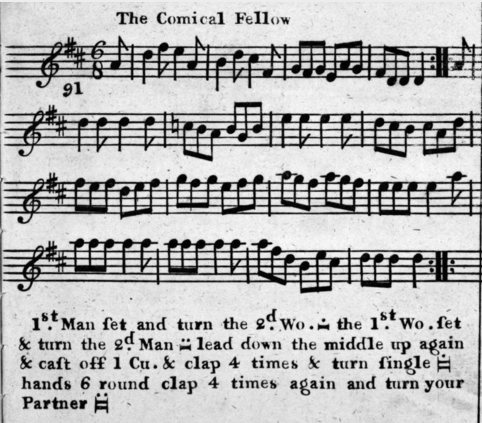
Actual alteration of the figures has been avoided as far as possible, but in several cases the original instructions have been expanded and supplemented, as will be seen from the notes appended to each dance… The original dances are, without exception, triple-minor progressives for as many as will, but when — as frequently happens — the third couple takes almost no part in the figure, the Editors have not hesitated to re-arrange the dance for duple-minor sets.
I totally agree with this approach, and if I call the dance I would normally use their version (in fact I would have both corners setting in the A part), but if I'm specifically running a session on Regency Dance I want to give the dancers an idea of how it was actually danced in 1776, so let's study the original.
The music has a 4-bar A and an 8-bar B, both repeated. The first thing we notice is that the Apted book has expanded this to two 8-bar A's (without mentioning the fact). The editors must have decided that two bars was not enough time for a two-hand turn, so they've added a fall back after the set and added an extra four bars for the turn. But dances were vigorous in those days, and I'm always complaining that people do a two-hand turn too quickly, so here's a case where they won't have a chance to get there too soon! In fact in “Top and Bottom” from an unnamed original before 1750 there's exactly the same move, and Bernard Bentley in Fallibroome 4, 1971 obviously thinks the timing isn't a problem in a single 8-bar A-music:
A2 1st man set to 2nd woman and turn her. 1st woman set to 2nd man and turn him.
As usual the original doesn't mention details like what hand you use for the lead down and back, so I'm happy to use the Apted Book suggestions, but they wouldn't have walked down and danced back — it would have been danced all the way through, as Scottish dances still are. Provided you're aware that you need to come back and cast in the same amount of music as for the lead down, it's really not a problem — just make sure that at the end of the four bar phrase you have already turned and are ready to dance back a little faster than when leading down.
The clapping would have been just for the ones, on the principle that the other couples only do something when the ones need them to. And the editors have noted that instead of the turn single (for the ones only) they have substituted a two-hand turn half-way for both couples.
Now the threes get an implicit mention. I would like to think that “hands 6 round” means circle left and back to the right but I believe if this were the case the instructions would have said so, and there are plenty of triple minors which say “hands 6 round” or “hands 6 quite round”, such as “The Bishop” so I believe it means circle left all the way, with a real danger of getting there too soon. Then just the ones clap four times, and again there's that quick turn all the way round in two bars — and the man needs to be ready to start the next turn of the dance by setting to the new second lady. Yes, it's busy, but it's not impossible. I called this version at a Jane Austen Evening for Friday Folk in St. Albans (a lively group) in 2018 and it worked fine.
A triple minor takes a long time if you want everybody to have a chance to be ones, so I suggest the Scottish approach of a 4 couple set. The top couple lead the figure once with the two couples below them, at the end of which they have progressed one place. The same couple then lead the figure with the two couples now below them. At the end of the second turn the new top man and second lady are ready to dance together while the original ones cast to the bottom. Eight times through gets everyone back to their original place, having led the dance twice. It's a good system, so don't throw up your hands in horror and say “But that's Scottish” — where do you think Scottish dancing comes from?!
Warning Watch out if you're using recorded music — I expect all the recordings have two 8-bar A's.
The Comical Fellow
Interpretation: Colin Hume, 2018.Format: Triple minor or 4 couples longways (three active).
| A: | First man set on the spot to the second lady; they dance a quick two-hand turn. First lady set to second man; two-hand turn. |
| B1: | (12 bars): Ones right hand in right dance down the middle and turn in to face up. Dance back with a cross-hand hold, cast round the twos (who lead up). Ones clap 4 times; turn single. |
| B2: | Circle 6 left all the way (possibly with a skip-change step). Ones clap 4 times; quick two-hand turn. |
Confesse
Source: John Playford, 1651Format: 3 people facing 3 people, in lines sideways-on to the presence
Meet all a D. back againe . That againe : Men go between the We. on your left hand, leading them from the other, change hands, meet againe, turne them you meet . Leade your own Wo. from each other, meet againe, turne them as you meet : Goe all crosse the room to the left hand . Back againe : One man goe forwards alone, take one Wo. with one hand, then the other hands all foure, and goe round . The other man as much : Goe all crosse the room to the right hand . Back againe : The two We. at each end leade to each wall, while one man goe up and the other downe, the foure We. meet hands and goe rounnd, men turning S. . Goe all as before, men hands and goe round, We. turning single : Meet all as at the first : The men leade the We. at one end to the wall and back, while the other We. goe up on the outside, and come each under the others armes, and turne each other, men turning each a Wo. As much with the other We. :
Margaret Dean-Smith, in her facsimile of Playford's first edition, points out that in the Table of Contents the dance is referred to as “Confesse his Tune” and that Mr Confesse was a dancing-master of the early 17th century.
The diagram in the first edition shows a standard longways set of three couples, but the instructions make it clear that the dance is for one man between two women facing the same. And it appears that the lines are sideways-on to the presence. Cecil Sharp's interpretation numbers all six people and looks so complicated that I suspect most callers would immediately move on to another dance, which is a pity. Playford is actually much easier to understand, and I now see that on The Round's website after Sharp's words there is a much simpler explanation. But Sharp also changed things, sometimes for no good reason, so let's see what we make of Playford's wording.
First figure: Playford is perfectly clear, if typically terse. When you lead back the ends turn the opposite end person once around while the middles need to turn each other three-quarters to get to their own partners.
Second figure: The leading must be two doubles in each direction, and I encourage dancers to really make it two doubles rather than eight steps, so I would like feet together at the end of the first double. If you're calling this gender-free and you don't like the phrase “left wall” you can use some other identifier — “towards the clock”, “towards the kitchen”, etc. But now Playford gives the dancers a choice: one man go forward alone, take one woman with one hand… and Sharp simply couldn't do that. Everybody would say, “But which man? Which woman?” so Sharp had to choose, and he chose the first man, whom he defined as the man on the men's side, and the second woman who is on the first man's left diagonal. I go along with Playford in letting the middles choose, and I point out that they don't have to choose the same end in the dancing as they did in the walk-through! Sharp puts in a balance back, as he often did to use up the music, and then they give right hands only. Playford says take one Wo. with one hand, then the other hands all foure, and goe round
and surely there should be some punctuation after “other”. hands all foure, and goe round
means the other four circle left, but it's pretty pointless for two people to take hands and then the other four to circle somewhere else so I'm with Sharp that the circle goes under an arch made by the first two people, and I would say the giving hands is quick, one hand per bar as in “Jamaica”, allowing six bars or twelve steps to form the circle, go round and finish in home places. And then the other man has a choice of woman to make the arch with.
In February 2025 Andrew Swaine pointed out that his interpretation of the main part of this figure at andrewswaine.take one Wo. with one hand, then the other
meant “the other hand”, but it could mean “the other woman”! So hands all foure, and goe round
could mean the two men and these two women. He points out that the two women are already holding hands with their man, so he naturally becomes part of the circle, though this isn't true when the other man takes over. I quite like my interpretation (naturally!) but you may well prefer Andrew's. As I've said before, none of us interpreters insists that we're right and everybody else is wrong.
Third figure: A caller can't possibly say all that at the start, so (as in the Maggot Pie dance Queen of Sheba) I would call the move “bomb-burst” and make sure in the walk-through that everyone knows what this means. Sharp has people turning single right and then left because he's defined a turn single as taking four steps but there are eight steps to use up; I'm happy for people to do a much slower turn single. There's also confusion in Playford's directions. We think we've established that the lines are facing across — the introductions to the second and third figures say Goe all crosse the room
rather than “lead up” or “lead down” — and yet for the bomb-burst Playford says the women lead to the wall (which always meant a side wall) and the men go up or down. I can't make any sense of that, and I agree with Sharp that Playford got it wrong.
Fourth figure: It's busy but it all makes sense; it's obvious that men turning each a Wo.
means they turn the women they were making arches with back to place, though one pair have further to turn than the other.
Confesse
| First Figure: | |
| A: | Lines forward a double and back. That again. |
| B1: | Middles go left, lead these ends away; turn and lead back. All two-hand turn opposite — middles turn ¾ to flow into… |
| B2: | Middles lead own partners away; lead back. All two-hand turn opposite. |
| Second Figure: | |
| A: | All lead two doubles to left wall. Turn and lead back. |
| B1: | One middle step forward and give right to either of the opposite ends, then left; raise them to make an arch and the other four circle left through it (12 steps). |
| B2: | The other middle as much. |
| Third Figure: | |
| A: | All lead two doubles to right wall; turn and lead back. |
| B1: | Bomb-burst (top ends lead up, bottoms down, middles move out); lead back. Ends circle left while middle turn single (8 steps). |
| B2: | Bomb-burst. Middles two-hand turn, ends turn single (8 steps). |
| Fourth Figure: | |
| A: | Lines forward a double and back. That again. |
| B1: | Middles lead your top ends down, change hands and arch back while bottom ends cast up and go down through an arch. Middles two-hand turn this person to place — bottom ends turn each other. |
| B2: | Middles lead your bottom ends up, change hands and arch back while top ends cast down and go up through an arch. Middles two-hand turn this person to place — top ends turn each other. |
The Cornish Squire
Source: Dancing Master 9th Edition, 1695: Henry PlayfordFormat: Longways triple minor
The 1. cu. cross over and meet in the 2. cu. place, the 1. man take hands with the 3. cu. and lead all three abreast downwards, and the 1. wo. take hands between the 2. cu. and lead with her face upwards, the 1 man and 3. cu. going the Hey at the same time, and the 1. wo. and 2. cu. do the like; the 1. man meet his own Partner in the middle and turn her round, lead through the 1. cu. and cast off into the 2. cu. place again, then go the Figure of eight through the 3. cu. into the 2. cu. place.
The music is in 3-time with a 4-bar A and a 5-bar B, and the B-music has a lot of very quick notes which most bands wouldn't want to play! I suspect it was the same in Playford's day — they weren't all top classically trained musicians — maybe that's why this dance appears only in the 9th Edition!
The instructions have no underlined dots to help us, just a semicolon which might mean the start of the B-music, so let's assume two A's and two B's and see where that gets us. 6 steps for the ones to cross and cast to second place, and the man to move down to stand between the threes as the woman moves up to stand between the twos. The lines lead away — but surely they must come back again, and to fit this into A1 it needs to be three steps out and three to fall back — I think it would be too rushed to lead out, turn individually and lead back in 6 steps. I don't know what to make of going the Hey at the same time
— you can't do a hey while leading out, and surely the hey should start at the start of a phrase of music. So A2 is heys for three across, which we can do in 12 steps, and since that needs to flow into the ones doing a two-hand turn I would suggest the ones start the hey by facing the person on their right (man to man, woman to woman).
B1 starts with the ones two-hand turn, and Playford then says lead through the 1. cu. and cast off into the 2. cu. place again
— the ones can't lead through themselves and it must mean lead up through the couple in first place (the twos) and cast off to second place. We have 5 bars for this — 15 walking steps — and people seem to need to be told how to split this up so I would suggest about 9 steps for the turn and 6 for the lead and cast — the two-hand turn will be 1¼ to get the ones proper and this flows into the lead up and cast back. And then B2 is a full figure eight down through the threes — usually 16 steps but we can do it in 15 and the ones finish in second place ready to start the next round of this triple minor dance. But like most triple minors it's very much a dance for the ones, so I would speed up the figure eight to fit into 12 steps and in the final 3 beats the ones lead down as the threes cast up, and we have a perfectly good 3 couple set dance. Don't think of this final movement as something separate: the ones just continue moving down as the threes cast up the outside. I know some interpreters would get the twos to cast and lead up as the ones lead up and cast, and make it a double figure eight with the threes casting up to start, but that's not my style — let's keep it as a dance for the ones but give everybody the same number of turns being ones without having to run the dance for 25 minutes.
Now we need to look at that music again. The A-music is passable, but the first four bars of the B-music are horrendous! Maybe the man who supplied Playford with the tune was a real virtuoso on the flute or recorder and had added his own flourishes in there. Can we get back to what the tune was before he “improved” it? All four bars of the A-music start with a crotchet followed by a minim (a quarter-note followed by a half-note) which gives the same syncopation we find in “Dick's Maggot” — the second of the three beats comes in the middle of the minim. Maybe the first three bars of the B-music were originally the same rhythm. So let's take out the first two grace notes, and take out enough other notes to give the same rhythm as the first bar of A. Bar 4 is very odd because it's the same phrase twice — one and a half beats each — which doesn't make sense when there are three beats in the bar. Maybe our hypothetical virtuoso (seemingly more of a musician than a dancer) decided he was so clever that he could play the whole bar twice in the time of a single bar — in other words he halved the lengths of all the notes. So let's put them back the way they might have been. And I'm pleased to report that the final bar of three minims needs no change. Having done all that, I look at the A-music and realise that he's probably added extra notes there too. So I've given two versions of the tune in the above link: the original and then my simplified version. And I'm using the same chords, so if a melody player decides to switch from one version to the other the chord players don't need to worry. Am I justified in doing that? — you ask in horror. Certainly I am! This is my website, and I'm a practical man, not an academic — yes I do plenty of research and think very hard about both dances and music, but the dance instructions are here so that callers can call them to dancers, and the music is here so that ordinary musicians can play it for dancers. At least I've given Playford's version and been up front about the fact that I've changed it, whereas many dance and music interpreters change all sorts of things without admitting to it!
The Cornish Squire
Source: Dancing Master 9th Edition, 1696: Henry PlayfordInterpretation: Colin Hume, 2024. Note: the music is in 3-time.
Format: 3 couples longways
| A1: | (4 bars): Ones cross and cast (twos lead up), then go left (man down, woman up) and stand between this couple (6 steps). Lines of three lead away 3 steps; fall back. |
| A2: | Ones to own right (man to man, woman to woman): hey across with this couple. |
| B1: | (5 bars): Ones meet with a two-hand turn 1¼ to finish proper (say 9 steps), then lead up through tops and cast back to middle place (say 6 steps). |
| B2: | Ones full figure eight down through bottom couple (12 steps), threes cast up, ones lead down (3 steps). |
The Coronation
Source: Thompson, 1762.Format: Longways triple minor
Cast down two Cu: and turncast up to the top and turn
Gallop down the middle up again and turn
Hands round 4 at top

No difficulties of interpretation here. A 32-bar jig with two A's and two B's — absolutely standard. There's no mention of casting in B1 and there wouldn't be time anyway, so I take it that the ones gallop down not very far, the twos move up, and the ones gallop up to the twos' place. The only question is: Is it worth dancing?! It's very much a dance for the ones: the threes do nothing and the twos just circle left and right. Normally I wouldn't have bothered with it, but Coronation Fever gripped the country in 2023 and I was sure many groups would like a simpler alternative to “The Coronation Day” which is the next dance on this page. So first I'll convert it from triple minor to a 3 couple dance, but then I'll allow myself more license than usual and reallocate the moves to each couple in turn. That means we can eliminate the business of galloping down and then galloping up to finish in a different place and we get a reverse progression, so three times through means each couple dances in a different place. In fact since I'm changing it so drastically, let's have all three couples join in the circle! What do you think?
The Coronation
Source: Thompson, 1762.Interpretation: Colin Hume, 2023.
Format: 3 couples longways
| A1: | Ones cast to the bottom; the others lead up. Ones two-hand turn. |
| A2: | Twos cast to the bottom; the others lead up. Twos two-hand turn. |
| B1: | Threes gallop to the bottom and back. Threes two-hand turn. |
| B2: | All circle left. Circle right. |
| Repeat the dance twice more. |
The Coronation Day
Source: Dancing Master 10th Edition, 1698: Henry Playford.Interpretation: Colin Hume, 2022.
Format: Longways duple minor
Note: Each strain is to be play'd twice over. First couple lead down in the contrary place, the second couple cast up at the same time, and cross over; the second lead down as before; First couple cast up in their own place; First Man go within-side round his Woman into her place, she turning single at the same time into the second Woman's place, she going round her Man at the same time, he turning single into the first Man's place. First couple lead through the second, then the first Man's place, then turn single all four; First couple cross over into the second couple's place, they leading up at the same time, cross into their own place.
The tune is a reel with a 4-bar A and an 8-bar B, each said to be repeated. The instructions require a lot of thought. It's quite unusual to mention the twos casting up — normally they are just expected to move to accommodate the ones — so this is intended to be a big movement which I would like to take the whole 4 bars (8 walking steps). But who does “and cross over” refer to? I would say it's the couple leading down rather than the couple casting up. But it could mean the casting couple, or it could mean both couples! The leading and casting will take up the two A's and end with everyone home and improper (unless both couples cross each time, which would leave everyone proper, but that's most unlikely).
I take “within-side” to mean “inside” as I have seen “within-side” and “without-side” in several dances of this period. The sentence gives the move for each person in turn, and I would explain it thus: First man and second woman pass left shoulder and turn right to go behind your partner and finish in your partner's place; the others wait 4 beats and then turn single right, first woman moving down and second man moving up. That's not a difficult move but it's a lot for the caller to say, and after mulling it over for a week or two I realised that the move for everybody could be described as half a gipsy right, with the people moving to the right continuing to turn clockwise to face into the set. This will take 4 bars and leave the men above the women. But then we have “First couple lead through the second” which is most unusual when one couple is on each side of the set: I can't think of any dance from the period which does this. And “lead through” must surely be followed by “cast back again” — they can't just lead through and then stay there outside the set. There's also the point that the only full stop (period) within the instructions is before the first couple lead through, which says to me that the lead through should be at the start of the B-music. And following that, what do we make of “then the first Man's place”? It's not a sentence, and it would appear to be a 2 bar move since it's followed by “then turn single all four”. And how can we get to progressed places anyway?
The dance was republished by Walsh around 1709 but don't expect any help from him — he just copied Playford word for word! (He made one slight change to the tune.)
I had a go at interpreting this in 2016, though fortunately I never tried to call it, but looking at it fresh in 2022 (with King Charles III's Coronation Day coming up in May 2023) I had some new ideas. First of all, surely that odd phrase “then the first man's place” is just a printer's error. He was presumably copying it from some handwritten source — he set the word “then”, got distracted, looked back at the source and saw the earlier phrase “the first man's place” and set that. But my main conclusion was that I just don't believe the dance would leave one couple on each side of the set. And if the first corners do something, it's very common to follow this by the second corners doing the same or a complementary move — I could give dozens of examples of that. So what happens if we follow this with the first woman and second man leading the same move: crossing left shoulder and looping right (around neighbour rather than partner this time)? That gets everyone to their progressed places, and is so much more likely. Maybe the printer set the long explanation of where all four dancers were to go, and didn't realise he'd failed to set the very similar corresponding move. Maybe the person who produced the handwritten original missed it out. Whoever it was, I've now put it back!
Now indeed B2 can start with the ones leading up through the twos to their original place (the twos moving down, though that wouldn't be mentioned) and all four turn single — I would suggest a clover-leaf with the ones turning single up and the twos down. And then the progression: ones cross and cast (remember that “cross over” means “cross and cast”), twos lead up (and to my surprise Playford not only mentions this, he actually says “lead up” rather than “move up”), ones cross back to their own side.
cross into their own placeand the twos crossing over as they move up. I'd say he's added many more moves to the original than I have. The version in “Serendipity” is by Pat Shaw and is basically the same as Sharp's.
Presumably the event being celebrated was the joint coronation of William and Mary in 1689, and Playford published the dance 9 years later (though of course it could have been written much earlier). William died in 1702 and his cousin and sister-in-law Anne became Queen, but Playford couldn't have been anticipating that in 1698 — William was only 52 when he died of an illness.
I tried out this interpretation at the Christmas Course in the Netherlands, with music played by Triple Time — see the photo on the right. It worked, but it's very busy for both caller and dancers; one person said I sounded like a commentator at a horse race. If you're looking for an easier dance, there's one called “The Coronation” just above this!
The Coronation Day
Format: Longways duple minor| A1: | (4 bars) Ones lead down (inside hand) and then cross over (I suggest the man hand his partner across) and face while twos wide cast up. |
| A2: | Twos lead down and then cross over and face while ones wide cast up. |
| B1: | Second corner positions (1M 2L) pass L; gipsy right half-way on the side (with partner). Second corner positions (1L 2M) pass L; gipsy right half-way on the side (with neighbour). Now progressed and proper. |
| B2: | First couple lead up, second couple move down the outside; all turn single away from neighbour (ones up, twos down). Ones cross, cast as twos lead up, cross again into progressed place. |
George Williams has created an animation of this version at upadouble.info/dance.
Country Bumpkin
Source: Heathfield Memorials, 1821-1831: Sylvan Harmer.
Interpretation: Colin Hume.
Format: 4 couples longways. Music: I'm suggesting 4 x 48 bar polkas such as Bluebell Polka.
Original wording:
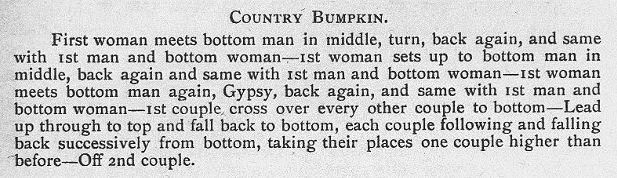
| A1: | Top lady bottom man two-hand turn. Their partners do the same. |
| A2: | Top lady bottom man set moving forward; fall back. Their partners do the same. |
| B1: | Same people gipsy right [or back-to-back]. |
| A3: | Ones cross, go below twos. Cross again, below threes. |
| A4: | Cross again, below fours. Cross to own side, lead to top. |
| B2: | Ones cast, others follow. Ones arch at bottom, others up. |
Sylvan Harmer (1803-1884) lived in the village of Heathfield in Sussex. Between 1821 and 1831 he wrote a manuscript which later became the book “Heathfield Memorials” detailing his life there, and in an appendix he gave the instructions of some of the country dances he remembered dancing — the facsimile above is from this book. You can see more information at the end of harmer.org/JONATHAN HARMER2.pdf. This says that the whereabouts of Sylvan's manuscript is unknown, but John Sweeney has told me that it's now held in the Vaughan Williams Memorial Library, catalogue.
I was staying with Jan Nuttall who lived in Heathfield and she showed me the book, so I tried my hand at interpreting some of the dances. Many of them seemed to have far too much in them, and they all had several titles, no doubt depending on which tune was used. The dance as I interpreted it has many similarities to “Sir Roger de Coverley”.
There are at least two other dances called “Country Bumpkin” — one by Mike Barraclough is a 5 couple longways having no connection with this one; the other an 8 couple longways in a book called “The Heathfield Dances” by Harold Downing purports to be an interpretation but he admits it's mainly spurious.
Crosby Square
Source: Dancing Master 11th Edition, 1701: Henry Playford.Interpretation: Colin Hume, 2025.
Format: Longways duple minor
Longways for as many as will
Note: Each Strain is to be play'd twice over.The first couple cast off and clap hands, then they are in the second couple's place, the second couple do the same. This to the first Strain play'd twice. Then they draw the first couple into second, and the second into the first's place, then Right and Left, then the first couple cast off and turn, so to the end of the Tune. This to the second Strain play'd twice.
The music is a jig with a 4-bar A and a 6- bar B, each repeated according to the instructions. The title has been spelt several ways over the various editions. I don't think the 11th Edition is on-line, but I've looked at the 12th Edition of two years later and the wording is virtually identical. The dance has been interpreted by Cecil Sharp and more loosely by Charles Bolton. Sharp assumes the clapping comes before the casting, but surely in that case Playford would have said “clap hands and cast off” rather than “cast off and clap hands” so I'm trusting Playford's order. 4 steps for a quick cast and 4 beats for clapping, using the standard sequence. The twos repeat this, giving A1 and A2.
You may be confused by Then they draw the first couple…
— who is drawing the first couple?! I take it to mean “Then both couples draw: the first couple…”. So it's what we would call a half poussette, but is it a push-pull poussette or a draw poussette? On my page about Poussette I say I believe the draw poussette is a 20th century misinterpretation of instructions which actually mean an ordinary push-pull poussette. Now I'm not so sure! We have 6 bars (12 walking steps) for A1. 8 steps for the poussette leaves just 4 steps for “Right and Left”, and when Henry Playford uses this term he means two, three or four changes — two in Carpenter's Maggot, three in Indian Queen (though he actually says “quite round”), four in Nobe's Maggot. In this case two changes without hands since it's only two steps per change. So after a draw poussette this gets everyone home; after a push-pull poussette they would finish home but improper — there certainly wouldn't be time for a third change in those 4 steps. Finally B2 is then the first couple cast off and turn
and this is a lively dance where I wouldn't expect a wide 8 step cast and then 4 steps to turn half-way; I'd expect a 4 step cast and then 8 steps to turn all the way. So I'm going for a draw poussette, but I may change my mind later!
Sharp indeed uses a draw poussette (though the term wasn't current then) but following that he has a quick corners cross move rather than two changes for some reason. I agree with his B2, though I expect it would just have been the ones turning at the end.
Crosby Square
| A1: | (4 bars): Ones cast, twos lead up. Ones clap: together, right, together, left. |
| A2: | Twos the same. |
| B1: | (6 bars): Draw poussette, first man pull, second man push, finishing progressed and improper. Two quick changes, no hands (2 steps each) — home. |
| B2: | Ones cast, twos lead up (4 steps). All two-hand turn. |
The Cuckoo
Source: Dancing Master 12th Edition, 1703: Henry Playford.Interpretation: Colin Hume, 2010.
Format: Longways duple minor
The CookowThe first Man goes back to back with the second Woman; then turn Right-hands with her; the first Woman and second Man do the same. The first couple take both Hands and go half round, and back again; then cross over and half Figure, then all four quite round. The first strain twice, and the second once, and Repeat.
I originally had this down as Henry Playford 1703, then Michael Barraclough told me it was Walsh, then Les Barclay told me I was right the first time! Here's the wording from Walsh: Compleat Country Dancing Master 1718-1760. Playford spells it “Cookow”, Walsh spells it “Cuckow”, and to add to the confusion there is a different dance with a different tune called The Cuckoo (or Smith's Rant) in Playford 3rd Edition which you can see here.
I can't really claim this as my own interpretation — I picked the dance up many years ago, and the original instructions are so clear that there's only one point I want to question. But as far as I know the dance hasn't been published in a modern book, and it deserves to be, if only for the terrific tune which has echoes of Handel's “Arrival of the Queen of Sheba” and is not one to give to your average band!
There are no repeat marks in the original music, but there's a letter “S” above the start of what I'm calling the C-music which performs the same function. Assuming that “all four quite round” means circle left, the only unusual phrase is “The first couple take both Hands and go half round, and back again”. Surely if he'd just meant “two-hand turn” he would have said so. It certainly sounds like a two-hand turn half-way and then a reverse two-hand turn half-way, which is actually no stranger than Cecil Sharp siding! I learnt it with both couples doing a two-hand turn all the way but with a slight hesitation half-way to “listen to the cuckoo”, and the version of the music I use has some “cuckoos” added to the original which makes this feasible. From Francis Carter I picked up the rise on the toes and fall back at this point — it's totally inauthentic but dancers in England enjoy it.
The Cuckoo
| A1: | First corners back-to-back. Right-hand turn (skip-change step). |
| A2: | Second corners the same. |
| B: | All two-hand turn partner, half-way, pause to listen to the cuckoo (rise on toes and fall back, in time with music); reverse turn half-way with the same pause. Ones cross, go below twos who lead up. |
| C: | Ones dance half figure eight up through twos. Circle left once around (slip-step). |
| The two-hand turn was originally for the ones only. | |
Cupid's Garden
Source: Dancing Master 7th Edition, 1686 Appendix 3: John (or possibly Henry) Playford.Format: Longways triple minor
The first man go the Hey betwixt the second and third man into the fourth mans place; then the first woman do the same as the first man did; then the first man back to back with his own woman, and then cast up into the second place; then the first man cross over into the second womans place, and the second woman at the same time cross over into the first mans place; so meet and set, and then cast off into the second Couples place; then they go the half Figure into the second Couples place, and so turn their own; the rest doing the like.
Much later, in the 18th Edition, John Young changed the title to “Cupid's Gardens” and I think he was right — see later.
Walsh gives minor differences in the wording:
The 1. man go the Hey between the 2. and 3. man into the 4. man's place, then the 1. wo. do the same as the 1. man did, then 1. man back to back with his own wo. and cast up into the 2. place, then 1. man cross over into the 2. wo. place, and 2. wo. at the same time cross over into the 1. man's place, then meet and set, and cast off into the 2. cu. place, then go the half Figure into the 2. cu, place, and so turn their own; the rest doing the like.
The tune is a jig with 8 bar A and B, and no indication of repeats though the length of the instructions certainly suggests two of each. Playford gives no underlined dots to help, though it seems the semicolons fulfil that function. The dance is longways triple minor — a very early example of that formation — but what's this mention of the “fourth man's place”? It certainly wasn't quadruple minor! I take it as meaning “finish below the third man”. But if it's half a hey he would actually finish in the third man's place, and the third man would finish in his. Let's leave that for the moment and assume that after the first woman has done the same thing the order after A1 will be 2-3-1. A2 is then the ones doing a back-to-back and casting up into second place, giving 3-1-2. But nowhere do the threes get back to their original place. However, on my page all about The Hey I give some examples where a hey involves some people moving and others standing still. Here the instructions are addressed to the first man, rather than saying “the men do half a hey”, so perhaps it's just the first man weaving through the second and third men — and if they don't move up he will indeed finish in “fourth man's place”. Then if as the ones cast up we have the twos moving up to make room for them (rather than the threes moving down) the set is back in its original location in the order 2-1-3 — that's much more likely.
Now we need to get the ones back into top place so that they can cast off into the second couple's place. Why the long-winded “then the first man cross over into the second womans place, and the second woman at the same time cross over into the first mans place” rather than simply “then the first man cross over with the second woman” as Playford says in Bellamira which he first published in that same 7th Edition? Maybe it's because they aren't starting from their original positions, and it must mean “current place” rather than their original places which are already occupied. That would normally take 4 steps, leaving the two men at the top; there's no mention of the second man and first woman doing the same move. Maybe in that long-winded description Playford thought he'd already said that. But even if we add in that move, we finish with the ones above the twos, both improper. The final instructions are addressed to the ones, so there seems to be no way of getting the twos proper again.
At this point there are three options. We can give up. We can study the instructions for hours, hoping that a fresh insight will hit us (and yes, that does happen). Or we can invent something which we know isn't right but which works and produces something worth dancing.
That's what I wrote in 2016, but in 2020 I discovered that in this case there's a fourth option: further evidence may come to light. In 1685 the Dancing Master André Lorin accompanied a diplomatic mission from Louis XIV to carry French congratulations to James II on his accession. You can read more about this in Kitty Keller's article at mountvernon.org/library/
The first [manuscript]:contains no date, but explains clearly in the prefatory letter to Louis XIV that the collection was the result of a trip to England which Lorin had undertaken at Louis's behest in 1685 (as we know from other sources) to find the loveliest and most interesting English country dances and bring them back to be introduced to the French court.
But I don't read it like that. Gill Plant's translation says,
Andre Lorin, one of your Majesty's professors of dance, having travelled to England with M. le Maréchal d'Humières in order to learn the contredances he would see performed at Court there, has not only brought back the best ones, but has composed a quantity of new dances, in which he has put the most fitting steps and has written them down in such a way that they can be readily understood straight away. Because he only undertook this journey with the intention of showing something extraordinary to Your Majesty, to whom the dance has a strong attraction, and from whom this art form receives such great favours, he thought he could not have chosen a more favourable time to present these contredances than this occasion on which Your Majesty's health has happily been restored for which occurrence both his Court and all his subjects have been praying.
So he has to start by telling the King who he is, and in contredances he would see performed
surely “he” refers to Lorin (as it does everywhere else in the introduction) — if he were referring to the King he would say “Your Majesty”.
My thanks to Anne Daye and Ann Hinchliffe of the Historical Dance Society for their input on this topic.
He collected 13 country dances, 9 of them in Playford's books, which he then presented to Louis, and among these was “Cupid's Garden”. Notice that this was a year before Playford published the dance, so Lorin didn't get it from there; presumably he saw it being danced and wrote down the figures and music himself. Lorin explains the dances in diagrams rather than words, and all the mysteries are resolved! The first move is indeed a weave rather than a hey: Lorin shows the first man casting, going behind the second man and in front of the third man, then the first woman doing the same. I'd prefer to go inside and then outside as the third woman would be then moving forwards into the back-to-back, but Lorin is clear on this. Nowhere does he show the twos and threes moving up, but he does show the threes moving down as the ones cast up so that says to me that people move up as the ones weave past them. He does indeed show the second corners crossing after the first corners have crossed, and he does show the twos turning half-way at the end. Quite possibly Playford's and so turn their own
is addressed to both couples since it's “their own” rather than “your own” — as always the other couples are expected to do whatever is necessary to enable the ones to lead the dance, and the twos would realise that at the end of the figure then needed to be back on their own side.
That would work as a triple minor, but it's not very interesting for the twos and threes, so I would convert it to a three-couple dance, and the cleanest way to do that is for the ones to move down while doing their final turn as the threes cast up.
“Cuper's Gardens”, often called “Cupid's Gardens” was a pleasure garden in Vauxhall, London, opened by Abraham Boydell Cuper or his son some time between Playford's 1st Edition and this 7th Edition.
You can read about it at vauxhallhistory.
Cupid's Garden
 Format: 3 couples Longways
Interpretation: Colin Hume, 2020.
| A1: | First man cast, weave behind the second man and in front of the third man, they moving up as he passes. First lady the same. |
| A2: | Ones back-to-back. Ones cast up to second place; threes lead to the bottom. |
| B1: | First man second lady cross; first lady second man cross. Ones set; cast back to middle place, twos lead up. |
| B2: | Ones half figure eight up. Ones two-hand turn to the bottom, threes cast up, twos two-hand turn half-way. |
Finally I should point out that this dance and tune have no connection with the beautiful, mainly triple-time, square dance in Maggot Pie.
Damme
Source: Dancing Master 10th Ed.,1698: Henry Playford.Interpretation: Colin Hume, 2013.
Format: Longways duple minor
All four Sett to your Partners and turn S. and hands four half round . All four Sett to your Partners and turn S. and hands four half round into your own places : The 2. Man go back to back, the Woman the same at the same time, then right and left with your Partners quite round . The 1. cu. go the Figure through into their own places, then right and left with your Partners which brings the 1. cu. into the 2. cu. place :
The dance was republished by Walsh in 1718 as “Dampier” with slight differences in the tune. Heather Clarke, dancer and dance historian from Australia, points out that William Dampier was the first Englishman to explore Australia and gave his name to a major port in Western Australia. He died in 1715, so maybe this is Walsh's acknowledgement of his importance. Walsh also published “Dam it” around 1735, which has the same tune as Dampier but is a different dance, interpreted by Tom Cook in his book “Again Let's Be Merry” in 1979. “Damme” is pronounced as two syllables: “Damm-ee”, short for “Damn me” — you can hear it in “H.M.S. Pinafore” when the Captain discovers his daughter is in love with a common sailor.
The music has a 4-bar A and an 8-bar B, both repeated according to the underlined dots in the instructions, and gives every indication of being a dotted hornpipe — the sort of tune you would use for “Nottingham Swing”. Playford never mentions steps, but I would not consider a walking step to a tune like this: it needs to be a step-hop or a 1-2-3-hop, the latter covering more ground.
So how do you do a set and turn single to a dotted hornpipe?! I tried doing the set as 1-2-3-hop to the right, 1-2-3-hop to the left (like RSCDS Strathspey setting) but that only leaves one 1-2-3-hop for the turn single and another for the circle left half-way. It can be done but it's quite awkward, and anyway I would expect the set to take the same amount of music as the turn single. John Playford defined only three steps in his first edition:
A Double is foure steps forward or back, closing both feet.
A Single is two steps, closing both feet.
Set and turne single, is a single to one hand, and a single to the other, and turne single.
The “turne single” does not mean a single as defined above; it means “on your own” and is actually a double.
The singles (also called simples) and doubles come from the Brawl (Branle and other spellings), Basse Dance and Pavan(e) of earlier times. Indeed the Pavan was built solely on two singles and a double, and there are hopped simples and doubles in some of the Brawls in “Orchesography” by Thoinot Arbeau, published in 1589, for instance the Official Brawl. So my suggestion for the set and turn single to this rhythm is: step on the right foot, somewhat out to the right, hop on the right foot, similarly left, then turn clockwise on the spot with a 1-2-3-hop. The step-hop for the set seems to fit the music well, as this starts with three long notes before the dotted rhythm comes in. I would use the same footwork but starting on the left foot (step-hop, step-hop, 1-2-3-hop) for the circle left half-way, which means you are ready to step onto the right foot and repeat all this.
I'm sure that “The 2. Man go back to back, the Woman the same at the same time” should read “Men” and “Women” rather than “Man” and “Woman”. If Playford had wanted the second couple to do a back-to-back with each other he would surely have said so, and it's very unlikely for the second couple suddenly to take the lead like that. A back-to-back probably needs four bars, though you could do a 1-2-3-hop forwards and moving right, then fall back on the second 1-2-3-hop. That leaves four bars for four changes with hands. I would use two 1-2-3-hops for each half of the back-to-back, though of course you could use step-hop, step-hop, 1-2-3-hop, and probably in Playford's time people would have used both; the steps were not codified and improvisation was encouraged. For the four changes I think you need 1-2-3-hop for each change.
“The 1. cu. go the Figure through” means a figure eight or half figure eight down through the twos, and “into their own places” means it's a full one. Can you do that with four bars of 1-2-3-hop? Certainly you can, if you go for it and make sure the hop is travelling forwards (as in a Strathspey) rather than up and down. And the final move must be three changes instead of four since the instructions end “which brings the 1. cu. into the 2. cu. place”. I would still phrase it to the music: one bar for each of the first two changes and two bars for the final change which is in effect half a right-hand turn with partner.
Damme
| A1: | (4 bars): All set to partner (R-hop, L-hop); turn S. (R-2-3-hop). Circle left half-way (L-hop, R-hop L-2-3-hop). |
| A2: | All that again. |
| B1: | Back-to-back neighbour (two steps forward, two back). Four changes with hands, one step per change. |
| B2: | Ones full figure eight down through twos — very fast. Three changes with hands. |
| The A section is all danced with a step-hop, step-hop, 1-2-3-hop; the B section is all danced with a 1-2-3-hop. | |
Devonshire House
Source: Dancing Master 10th Edition, 1698: Henry PlayfordInterpretation: Colin Hume, 2018.
Format: Longways duple minor.
Note : Each Strain is to be play'd twice over. First cu. cast off, the 2. cu. leading up, change places at the same time; 2. cu. cast down, 1. cu. lead up, changing places as before, Men being on the Wo. side, Hands half round, break hands all abreast, lead up; 1. Man cross over with the 2. Wo. 2. Man and 1. Wo. do the like, turn single, all four cross over, all four turn single, Right and Left into the 2. cu. place.The Second Part. First cu. lead down between the 2. and cast up into their own places; the 2. cu lead between the 1. and cast down into their own places; 1. Man cross over with the 2. Wo. cross over all four, turn your own, the 1. Man being in the 2. Man's place, and the 2. Man being in the 2. Wo. place; cross over with the 1. Wo. then cross over all four, and turn your own.
Playford wrote out the music in 6/4 but I've converted it to 6/8: it's a jig. The A-music is 4 bars, the B-music is 8 bars, and there's no punctuation or underlined dots to help us fit the instructions to the music.
When I looked at the first move, I thought “half double figure eight”. Playford had already used the phrase “the Double figure” in Maids Morris (8th Edition 1690), but I don't think that's what he meant: see my page on the Double figure eight for much more on this topic.
Hands half round, break hands all abreast
is straightforward, but can I make a plea for people to dance it as Playford explains it, rather than the American Square move of starting to circle and then immediately opening out into a line.
4 bars for the half double figure eight, 2 bars to circle left half-way and 2 bars to open out into a line facing up will take us through the two A's. Now at the start of B1 we lead up a double, and surely we must then fall back a double or the whole set will end up in the band! And we need to bend the line as we fall back. The rest of the figure seems straightforward, but how does it fit the music? 4 bars for up a double and back, 2 bars for each of the corners crossing, 2 for the turn single, 2 for the cross over with partner, 2 for another turn single, and 4 for three changes — that's 18 bars and we only have 16. We could rush the corners crossing in two steps each, but it's such a standard move and it's always four steps each. And that first turn single seems odd. Later he says all four turn single
implying that for the first one it's only two people — presumably the second man and first woman who are in first corner positions. I would expect them to cross right shoulder and turn right to face in, ready to cross with their partners, so why should they then turn single? A turn single, like a set, is often added because there's too much music, but that doesn't seem to be the case here. In my opinion it's a mistake, and I propose to ignore it.
The second part presents no difficulties except that cross over with the 1. Wo.
has nobody attached to the move, but by analogy with the earlier move it must be the second man. But then we realise that everyone finishes improper. I suspect that turn your own
means “turn your partner until you get where you need to be”, so either turn 1½ or turn half-way and fall back.
In Playford's day they would have danced the first figure all the way down the room and back, and then started on the second figure. I'm not suggesting that, but I would do the first figure a number of times and then the second figure a number of times, as I do with “The Twenty-ninth of May”. I'm willing to combine the two figures of “Never Love Thee More” because they're simple and only 16-bar figures; this has 24-bar figures. But it's up to you.
Devonshire House
| First figure: | |
| A1/2: | Half double figure eight: ones cross down, twos move up the outside to start. Circle left half-way; then twos break to a line of four facing up. |
| B1: | Up a double and back, bend the line. Second corner positions cross (first man, second lady); first corner positions cross. |
| B2: | All cross right shoulder with partner and face them; turn single left. Dance three changes with hands. |
| Second figure: | |
| A1/2: | Ones lead down through the twos and cast up to place. Twos lead up through the ones and cast to place. |
| B1: | First corners cross right shoulder; all cross right with opposite and turn right. Two-hand turn partner on the side of the set. |
| B2: | New first corners cross right; all cross right with partner and turn right. Two-hand turn partner in progressed place — either turn half-way and fall back or turn 1½. |
Dick's Maggot
Source: Dancing Master, Appendix to the 11th edition 1702: Henry PlayfordInterpretation: Colin Hume, 1995.
Format: Longways duple minor
The 1. cu. cross over, and the 2. cu. cast off . Then change places across : Then cast up in your own places, and back to back, then Right and Left and turn .
Cecil Sharp had two goes at interpreting Dick's Maggot: the first had two B's and the second one B. He printed the music with two B's, which means that every so often I forget to tell the band and have to apologise profusely to the dancers. Of course, now I can tell the band they should have been playing from my book “Playford with a Difference” where this interpretation was originally published!
Cecil Sharp's version is certainly difficult, and some people like it for that very reason. Now don't get me wrong; it's not that I can't do the Sharp version, it's just that I find it very awkward — it's jerky and it doesn't flow. Then I danced Pat Shaw's interpretation and it seemed a totally different dance, so as soon as I had the chance I looked at the original wording. The tune is in three-time, with a 4-bar A music and an 8-bar B-music, and the underlined dots certainly imply that there are two A's and one B, giving a standard length of 16 bars. Sharp's original version took 24 bars, but his revised version (which is the one most people do) compresses the first 16 bars into 8. However, even if he's got the right amount of music he isn't breaking between the A and B where Playford did. Playford starts the B with Then cast up in your places
whereas Sharp squeezes the cast and back to back into the A, and then has to do the final two-hand turn twice around to use up the music.
Why did he come to this conclusion? Firstly he didn't realise that cross over
meant “cross over and cast below the next couple”. Of course, it's much easier with hindsight! So he has the first couple crossing over (3 steps) and then leading down while the twos cast up (3 steps). But Playford says cast off
which in my opinion means cast down, not up — Playford actually uses cast up
in the B section. Of course, if the ones cross and cast they will be below the twos, who can then cast off. Playford allows four bars (twelve steps) for The first couple cross over, and the second couple cast off
. So we could have six steps for the ones to cross and cast while the twos lead up, then six steps for the twos to cast back home and the ones to lead back to first place improper.
Next we come to Then change places across
which Playford says is A2. You really can't take twelve steps to cross over with your partner, even if you use Sharp's trick of putting in a “balance back” to fill up some of the music, and I suspect this is why he brought some of the B instructions forward to fill out the A. Pat Shaw's version has a “corners cross” movement, which fits the amount of music perfectly; the same move appears in the three-time dances “Hole in the Wall” and “Well-Hall”. But in this dance the ones are now improper, which means that the men cross with each other and the women with each other. I feel that if Playford had meant this he would actually have said “The two men cross, then the two women” — it would have been an obvious way to describe the move. However, let's leave that point for the moment. We finish with the twos improper, and the ones below them proper.
Playford's B instructions are Then cast up in your places, and back to back, then Right and Left and turn
for which there are eight bars. Instructions are addressed to the ones unless it says otherwise, and indeed the ones are in a position to cast up. You couldn't do a cast and a back to back in six steps, so it must be six steps for the cast up and six for the back to back. We then have twelve steps left for Right and Left and turn
. Two changes at three steps each leaves six steps for a two-hand turn. Pat Shaw has the twos turning once and the ones turning one and a half (quite difficult in just six steps). I know I have a similar thing at the end of my interpretation of “The Twenty-Ninth of May”, but it spoils the symmetry of the dance — as does the fact that the ones cross and cast in A1 but the twos just cast. So my suggestion is that Playford meant the twos to cross and cast as well. I realise this is laying me wide open to attack, since Playford clearly says “cast off”. Maybe when he said “cast off” he meant “cast off in the same way as the ones have just done, by crossing first”. Try it my way and see what you think.
Playford doesn't say which corners cross first. The standard is that first corners (first man, second lady) cross first provided they are in their original positions; if they aren't, there's no standard as far as I know. I've decided it flows better with the original second corners (now in first corner position) crossing first; it would be awkward for the second lady, having just cast into second man's place, to do a right shoulder cross with the first man who is in the first lady's place.
No doubt the back-to-back was for the ones alone, but my version has the twos doing it as well; tastes in dancing have changed since the 17th century after all.
Dick's Maggot
Format: Longways duple minor.| A: | Ones cross and cast, twos wait two beats and then lead up (6 steps); twos cross and cast, ones lead up. |
| A2 | First corner positions (second man first lady) “Hole in the Wall” cross (6 steps). First man second lady cross. |
| B: | Ones cast up, twos wait two beats and then lead down (6 steps). All back-to-back partner (6 steps). |
| Two changes with hands (3 steps per hand). Two-hand turn partner half-way and fall back slightly (6 steps). |
Dr. Fausters Tumblers
Source: Dancing Master Volume 3, c.1726: John Young.Format: Longways triple minor.
The first Man Sets to the Second Woman and turns single, and then Back to Back with her . The second Man and the first Woman do the same : Then the first and second Man fall back to the Wall, and the two Women the same at the same time, and change into their Partners Places, then all four fall back and change into their own Places . Then cast off, and go the whole Figure with the third Couple, and turn your Partner into her proper Place :
No major difficulties of interpretation here. The music has an A and B section of 8 bars each, and the instructions say that each is repeated. We assume that the first and second Man
should be “Men”. We might take go the whole Figure with the third Couple
to mean a double figure eight, but I don't think so — in this case “with” just means “using” since the ones are in second place and would have a choice of couple to use as posts. The only thing that worries me is that it specifies the whole Figure
and that seems unreasonably quick: 8 bars for the ones to cast, do a full figure of eight down through the threes and two-hand turn all the way. Indeed the phrase into her proper Place
suggests that the ones finish the move improper, otherwise why mention it? So I think it should be a half figure eight.
The threes do nothing except act as posts, so I would certainly not do this as a triple minor. We can convert it to a duple minor, with the ones doing the half figure eight down through the next twos, but I think it's better to do it the Scottish way of three working couples in a four couple set. That's more faithful to the original, and when the ones finish their second round in third place they can unobtrusively cast to the bottom while the new first man is setting to the second woman.
Dr. Fausters Tumblers
Format: 3 couples in a 4 couple set.Interpretation: Colin Hume, 2018.
| A1: | First man set to second woman; turn single. Back-to-back with her. |
| A2: | Second man set to first woman; turn single. Back-to-back. |
| B1: | Ones and twos fall back with neighbour (4 small steps); surge to cross with partner and face partner. That again. |
| B2: | Ones cast, twos lead up (4 steps); ones half figure eight down through the threes (8 steps); two-hand turn half-way (4 steps). |
Draw Cupid Draw
Source: Dancing Master Volume 2, 1710: John Young.Format: Longways duple minor
The first Couple go the whole Figure of Eight with the second Couple, and then cross over and turn . Then the other Couple do the same : then cross over and Back to Back, then Right and Left quite round.
The instructions have a repeat for A, and the A and B music are each 16 bars, giving an unusually long 48 bar figure.
It looks straightforward, but there are at least three other interpretations. Bob Brand has done one but he didn't realise that “cross over” means “cross and cast” and he did some unusual stuff in the second part. Graham Christian has a much more unlikely version in CDSS News — he admitted that this was a very loose interpretation and if he looked at it now he would come up with something different. Andrew Shaw likes to keep everyone moving, so he has double figure eights and both couples doing the turns both times, which I think spoils the dance. I know it says with the second Couple
but I think that means “using the second couple as stationary posts” and it's quite clear (to me) that for the first eight bars the ones are doing the figure and the twos are watching them (and possibly learning the figure). In the second eight bars the twos do exactly the same. We seem to be losing the concept of watching the active couple — if we're not moving we think we're not part of the dance.
So in the first half the ones do a full figure of eight down through the twos. The ones cross and cast, twos moving up, and the ones two-hand turn. There's certainly enough music for a turn all the way, leaving the ones improper. It's possible that it should be 1½ to finish proper; we'll reserve judgement until we see what happens later. The twos do the same, finishing with the ones above the twos, probably with both couples improper.
The ones again cross and cast, again with the twos moving up, then the ones do a back-to-back, so they are below the twos on their original side — just where you would expect them to finish the dance. And then four changes. That's fine for the ones, but the twos are still improper. And if we decided the turn in the first half was 1½, we would now have the twos proper but the ones improper, so that won't help.
Andrew has the twos doing a right-hand turn half-way as they move up, but this strikes me as very unlikely (and not surprisingly they sometimes forget to do it). Remember the basic principle: the twos (and threes, for a triple minor) are only there to help the ones as needed. See the comments on the section Adapting Triple Minor Dances. So my suggestion is that the ones do four changes but the twos only join in as needed, in other words starting with the second change. Is it right? I don't know. Is it more likely than other suggestions? I'll leave you to decide!
Draw Cupid Draw
Interpretation: Colin Hume, 2007.
| A1: | Ones full figure eight through the twos. |
| Ones cross and cast; twos lead up. Ones two-hand turn. | |
| A2: | Twos the same, all finishing improper. |
| B: | Ones cross and cast; twos lead up. Ones back-to-back. |
| Ones do four changes with hands — twos don't join in until the second change. |
Duke of Kent's Waltz Updated 18-Apr-26
Skip to instructions Updated 18-Apr-26Source: Cahusac, 1801
Format: Longways triple minor
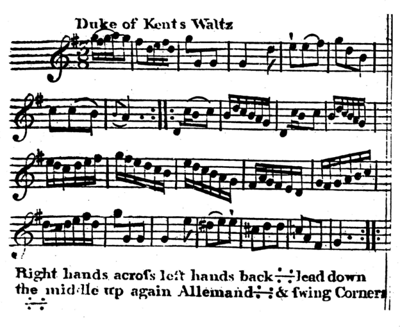
So the swing corners will take the second B. In “Lady Doll St. Clair's Reel” the ones do a right-hand turn with their first corner (on the right diagonal), then left-hand turn with partner, right-hand turn second corner (on the left diagonal), left-hand turn partner. (It's how The Fandango should be danced!) The same version appears in “The Bath Waltz”. But it could also mean: ones right-hand turn partner, left-hand turn first corner, right partner, left second corner. Paul Cooper discusses “swing corners” and says, The Cahusacs however appear to have preferred the first variant
which is what I'm using. He also told me,
I expect that different users of the collection would have danced the same figures differently even if they were attempting to use the figures as printed. These collections found their way around the country/world; it's unlikely that everyone would have understood them the same way.
Allemande had various meanings, but the most likely one here is that the ones link right arms, stretch those hands behind your partner's back to take your partner's left hand and turn once around (paying great attention to your partner), then back with a left allemande. Four bars for each of those, so before that we have the ones leading down (either moving forward with inside hands joined, or moving sideways with both hands joined), leading back, and (implicitly) casting to second place. In fact there are many options here: they may lead down and then lead up into second place as the twos move up. Paul Cooper has identified potentially 19 different variants of leading in the various Cahusac collections — take your pick! He also discusses various meanings of “Allemande”. All of that is the first B. So for the two A's we need a right-hand star for eight bars and a left-hand star for eight bars rather than the four bars of the Simons version — that's really going to fool people! And yet this split of figures ties up with the underlined dots in the instructions — they're not too helpful but they do split the action into three chunks and those are the chunks I'm using as A1&2, B1 and B2. It's very difficult to take the full 8 bars, so originally I suggested a fall back on the last two waltz steps taking inside hand with your neighbour. But people still had great difficulty using up 6 waltz steps for the star, so I'm now suggesting that the stars go round once and a half in 8 bars, which also means I'm not adding anything to the original wording. And actually it doesn't matter if it's not exactly one and a half because you're going back the same amount with a left-hand star — I expect even when dancing the Simons version the star doesn't necessarily go all the way round.
People are scared of being late in the contra corners move so they tend to bend their arms in the turns and get there too soon. I often demonstrate this and show them that provided you give weight in the turns it's perfectly possible to do the move with long arms, and it feels and looks much better.
A triple minor (especially a 48-bar waltz figure) takes a long time if you want everybody to have a chance to be ones, so I originally used the Scottish approach of a 4 couple set. The top couple lead the figure once with the two couples below them, at the end of which they have progressed one place. The same couple then lead the figure with the two couples now below them. At the end of the second turn the new ones and twos are ready to dance together while the original ones cast to the bottom. Eight times through gets everyone back to their original place, having led the dance twice. It's a good system, so don't throw up your hands in horror and say “But that's Scottish” — where do you think Scottish dancing comes from?!
But there's still a lot of standing around, so at Lichfield Folk Festival in June 2026 I taught it as a 3 couple set, with the ones turning to the bottom in their final left-hand turn as the threes cast up. Many people said they really liked it, so that's now my recommended version. I was also asked whether you could call my version to the existing recordings, but no you can't because my version needs two B's. So I've produced a version you can use, with two B's, 6 times through — see below. Other feedback was that having to concentrate on taking the star round once and a half cut down on the enjoyment of just dancing to the music, so I'm being less prescriptive now. And also that you need to take different moves at different speeds, which is certainly true. The stars are slow. The allemande is slow, and a lot of people couldn't manage to go just once around even though I kept telling them it wasn't a spin turn but a flirtatious move — they went round about one and a half, went back a random amount, and were then out of position for turning their first corners. The turns of corner and partner take the same amount of time as the allemande — 4 bars, which is 4 waltz steps — but of course you need to take much bigger steps with those. And why not?! In modern contras you just keep going at the same speed, and if you finish a ladies chain too soon you spin around a couple of times to use up the music, but I don't believe that applies to English.
Duke of Kent's Waltz
Format: 3 couples longways.Interpretation: Colin Hume, 2017 / 2026
| A1: | Ones and twos slow right-hand star about 1½ (8 waltz steps). |
| A2: | Left-hand star to place. |
| B1: | (16 bars): Ones give two hands, Chassé two steps down; two up. Ones wide cast; twos wait for two bars and then lead up. |
| Ones right allemande just once around (see above). Left allemande. | |
| B2: | Ones right-hand turn first corner. Left-hand turn partner 1½. Right-hand turn second corner. Left-hand turn partner 1½ moving down to the bottom as threes cast up to middle place. |
I've produced a MIDI recording of the tune 6 times through which matches my interpretation. Click here and then click “Play MP3”, not “Play MIDI” — you'll have to wait 20 or 30 seconds while the MP3 file is generated but I promise it's worth it. And if you think MIDI is all beeps and clicks, I hope this recording will surprise you.
Easter Thursday
Source: Caledonian Country Dances, 3rd Ed., c. 1733: John Johnson.
Format: Longways duple minor
The first Cu. Back to Back with the 2d. Cu. and then with their Partners . the first Cu. turn the 2d. Cu. then turn their own : Meet all four and sett, then turn single and clap hands all four going quite round . Then the 1st. Cu. go the figure thro' the 2d. Cu. and cross over and turn their own partners :
I know three other dances with exactly the same figures — this happened quite a lot in the eighteenth century.
The Sailor's Delight
Source: Henry Playford, Dancing Master, 1696The 1. cu. back to back with the 2. cu, and back to back with their own Partners. This to the first Strain played once. The 1. cu. turn the 2. cu. and turn their own. This to the first Strain played twice. Meet and set all four, turn S. and clap hands all four, go quite round. This to the second Strain played once. The 1. cu. go the Figure through the 2. cu, and cross over and turn their own Partners. This to the second Strain played twice.
Katherine-Street
Source: John Young, Dancing Master Volume 2, 1st Edition,1710Original wording:
The first Couple Back to Back with the second Couple, and then with their partners. This to the first Strain play'd once. The first Couple turn the second Couple, then turn their own. This to the first Strain play'd twice. Meet all four and Sette, then turn single and clap Hands, all four going quite round. This to the last Strain play'd once. The first Couple go the figure through the second Couple, and cross over and turn their own Partners. This to the last Strain play'd twice.
Charles Bolton has a version of “Katherine Street” in “Retreads, Volume 7”, though he has cut down the action for the ones and introduced more for the twos. He also dances it improper.
Sadler's Wells
Source: John Young: Dancing Master Volume 3, 17th Edition, 1728Original wording:
The 1st cu. back to back with the 2d cu. and back to back with their own Partners . The 1st cu turn the second cu. and turn their own Partners : Meet and sett, all four turn single and clap hands, all four go quite round . The 1st cu. go the Figure thro' the 2d cu. and cross over, and turn their own partners :
With Easter Thursday it's even possible that the figures were put to this tune by mistake — the tune is in 3-time. Bernard Bentley who wrote The Fallibroome Collection is always very honest about what he's added or left out, unlike some other dance interpreters. In this one he says, NOTE.- B1 a clap and hands four has been omitted.
When you listen to the A music it has perfectly clear phrasing — it's obviously three phrases of two bars each. Six steps, six steps, six steps. But the instructions in Fallibroome 5 just say “Neighbours back to back. Partners back to back”. And that's how a lot of callers call it — because they haven't thought it through. I can only see two choices. You can do one back-to-back in one phrase of the music — 6 steps — and the other in two phrases — twelve steps. Or you can do what I recommend, which is to take 9 steps for each back-to-back and accept the fact that the second one starts in the middle of a musical phrase. Here's where it's no use the caller saying “The music will tell you” — it won't!
You could argue that the instructions are addressed to the first couple, so only they should do the second back-to-back and the second turn, and indeed the final turn. Or you could make the case that throughout the instructions the word is “partners” rather than “partner” meaning that both couples should participate. I'm sticking with Bernard Bentley; we're interpreting these dances for present day dancers and in this case I have no hesitation in letting both couples move. There are other cases where I don't feel that way, as you will see when reading through this page.
In B1 Bernard Bentley thought he couldn't fit it all in, so he left out the circle and instead put in a balance forward and back, followed by a set. I know we can fit it all in, provided you go from the turn single immediately into the circle left. Four bars is twelve beats — that's four beats for the turn single and eight beats for the circle — standard timing. In fact I've suggested three and nine in my interpretation, since the music is in threes, but there's really no difference. As usual, “cross over” means “cross and cast”. The half figure eight and the cross and cast are much tighter in “Sadler's Wells” and “Katherine Street” — 4 steps for each rather than 6 — so I prefer Easter Thursday (and I like the tune too).
Since you're dancing a lot with your neighbour in the A part, I choose to do this with the ones improper, as Charles Bolton did in his version.
Twenty years later I learnt that Carl Wittman had produced much the same version, though with the final turn for the ones only, except that he has two beats rest after the clap and then allows only six steps for the circle which seems unnecessarily tight to me.
Easter Thursday
Format: Longways duple minor Improper Note: the tune is in 3-time.Interpretation: Colin Hume, around 1995
| A1: | (6 bars): Back-to-back neighbour (9 steps). Back-to-back partner. |
| A2: | Two-hand turn neighbour (9 steps). Two-hand turn partner. |
| B1: | (6 bars): All set moving forward (RLR, LRL); Turn single (RLR) clapping on first beat (3 steps), circle left (9 steps). |
| B2: | Ones half figure eight down (6 steps); ones cross and go below the twos who lead up (6 steps); all two-hand turn partner (6 steps). |
Ely Minster
Source: Dancing Master 10th Edition, 1698: Henry PlayfordFormat: Longways duple minor
First man go without side the 2. wo. up the middle into his wo. place; 1. wo. at the same time go within side, round the 2. man, up into her mans place; the 2. cu. doing the same : men being on the we. side, 1. cu. slip down into the 2. cu. place, right and left into their own places, men on the we. side; 1. man cross over with the 2. wo. the 2. man cross over with the 1. wo. so turn your own.
Note : Each strain is to be play'd twice over.
The facsimile on the CDSS site is from the 17th Edition of 1721, though bar 4 of the A-music is missing. There's an earlier facsimile at the bottom of playforddances.
The tune is in 3/4 time. Does that mean it's a waltz? No, 1698 is too early for a waltz, but equally it doesn't sound like a triple-time hornpipe such as “Mr Isaac's Maggot” of 1695" or “Dick's Maggot” of 1703, both published by Henry Playford. Is it a minuet? Usually the instructions would say “To be danced to the minuet step” in that case, and the few country dance minuets that I know are from a later date, after John Young had taken over from Henry Playford. And since I'm interpreting this for folk dancers rather than academics, I'll ignore all that and go for a waltz step after all.
Charles Bolton has an interpretation at cdss.play'd twice over
but I suspect he hadn't noticed that the B-music is 16 bars, so two A's and one B would make a standard 32-bar tune. I'm using Rule 6: Follow the spirit of the instructions rather than the letter. Playford gives no indication of how the figures are supposed to fit to the music — there's assorted punctuation but I don't see any logic to it. Maybe the colon at the end of the 2. cu. doing the same:
indicates the break between the A and B sections. That would make sense: the ones do the figure in A1 and the twos in A2. Playford's directions are very clear: the first man is going clockwise round the second woman as the first woman goes clockwise round the second man, finishing in each other's place. I would do this by giving right hand to my partner so that I can hand her down the middle as I set off round the outside. It's a bit of (old-fashioned?) courtesy and it also means we're both going in the correct direction! You find the same start in the traditional “Sussex Bonny Breastknot” — see contrafusion.co.uk/Dances/
And in typical shorthand, the 2. cu. doing the same:
— but what exactly does this mean? We could have the man coming up the middle as the woman crosses over to come up the outside, but I'd prefer the man to take the longer path again, so I suggest giving left hands this time and going anti-clockwise round the ones.
1. cu. slips down into the 2. cu. place
— typically the twos aren't mentioned, but they must move up the outside as the ones move down the middle. I assume the ones give two hands, and it's four side-steps, one per bar. Then we have right and left into their own places, men on the wo. side
so that's three changes with hands in four waltz steps, which is fairly quick, but notice that the third change leaves the first man and second woman facing each other on the diagonal, ready to cross. We've used the first 8 bars of the B-music. First man second woman cross (2 bars); the others cross (2 bars) and we have 4 bars left for a two-hand turn. Usually if no-one is specified the move is for the ones, but this is such an equal dance that I think the twos would also turn. It all seems to fit the music and I haven't had to add anything extra, so I'm quite willing to believe it's correct.
Ely Minster
Source: Dancing Master 10th Edition, 1698: Henry PlayfordFormat: Longways duple minor
Interpretation: Colin Hume, 2024.
Note: The tune is in 3-time and I'm suggesting a waltz step.
| A1: | Ones give right hands and the man hand the woman down as he goes across — the man goes right shoulder round outside the second woman, the woman right shoulder round the second man — 3 waltz steps down, moving on a parallel track and keeping level with each other, 3 waltz steps up — finishing in each other's places and two bars to step right and acknowledge. |
| A2: | Twos give left hands — the man goes left shoulder round the first man, the woman left shoulder round the first woman, finishing in each other's places and acknowledging. All now home but improper. |
| B: | (16 bars): Ones give two hands: four slow chassées down the middle as twos chassée up the outside. Three quick changes with hands, finishing home but still improper. |
| First man second woman cross; the others cross. All two-hand turn. |
Fain I Would
Source: Dancing Master 1st Edition, 1651: John Playford.Format: Square
Lead all out, lead all in again 1. man and 4. Wo. the 1. Wo. and 2. man change places by both hands, the other foure doing the like, then the 1. man and 1. Wo. the 2. and 4. Wo. change by both hands, the other foure doing the like . Then each man hands with the Wo. on his left hand, lead out and in as before, changing places, back again as before :The 1. and 3. Cu. meet, the 2. and 4. falling back, the 1. and 3. Cu. fall back, foure a breast, the 2. man and 4. Wo with the 1. Cu. the 4. man and 2. Wo. with the 3. the 1. man and third Wo. the 3. man and 1. Wo armes and fall into the 4. and 2. places, whilst the 2. man and 4. Wo. the 4. man and 2. Wo. armes behinde, and fall into the 1. and 3. places . The other as much : As in Oxford.
Sides and change places as before . Sides againe, and change places, back againe.The 1. and 3. Cu cast off, and come into you places all again, the 4. Wo. following the 1. man, the 2. man the 1. Wo. the 2. Wo. the 3. man, the 4. man the 3. Wo. the uppermost and lowermost foure, hands round, to your places . The 2. and 4. Cu. cast off, and the other follow, to your places, foure and foure of each side, hands round, to your places.
Armes and change as you sided . That againe, to your places :The 1. and 3. Cu. meet, turn back to back, the other foure hands about them, and go round to the right, and fall into each others places, the 2. man and 4. Wo. into the 1. place, the 4. man and 2. Wo into the 3. place, the 1. man and 3. Wo. into the 4. place, the 3. man and 1. Wo. into the 2. place . The other foure as much :
If you remember that Playford numbering is clockwise — the twos on the left of the ones — you may well struggle with this until you notice that in the diagram all four couples are improper. I've no idea why, and as Cecil Sharp says,
For simplicity's sake this unusual disposition has not been adhered to in the text, the alteration making no difference to the form of the dance.
I'm not claiming any of this interpretation is unique to me, but I want to explain how I teach it. If you've never danced it and you go to the Cecil Sharp book (or even worse, the Playford original above), you're liable to be totally bemused by all the numbers:
First man and first woman, third man and third woman, second man and fourth woman, and second woman and first man, change places in like manner.
I call it without mention of numbers and with hardly any mention of sex, and I use the words “corner” and “shadow”. Corner is well known from American Square, and it's a useful term so why not use it. Shadow comes from American Contra, and refers to a person other than your partner whom you meet repeatedly during the dance. Some American callers use the phrase “trail buddy”, but apart from being two words rather than one it smacks too much of the Wild West — “Howdy stranger, guess you 'n' me gonna be trail buddies” — so I don't use it.
I start by pointing out that you have three important people in this dance. The first of course is your partner. The second is your shadow, who is directly opposite you; you literally do half the dance with your partner and the other half with your shadow. The third is your corner, who manages to stay in position even when you switch between partner and shadow. I think it's a very clever and beautiful dance, and it appeals to my mathematical mind.
In the introduction to the first figure, you will see that Playford explains the move for the top half of the set and then says the other foure doing the like
. I'm confident that he's missed out the word “man” and it should say “the 2. man and 4. Wo.” rather than “the 2. and 4. Wo.”.
The two-hand turns in each of the three introductions are described by Playford as change places by both hands
but I've always seen it done as two-hand turn into side lines, man on the left — to be too precise, it's five eighths for the head men and three eighths for the side men. You don't actually take hands in side lines, but it's a useful reference point. Then you two-hand turn the one in front of you half-way (heads with partner, sides with shadow, though I wouldn't bother to say that), and the middles of the lines need to fall back from each other — I usually say “push back” to produce a more positive movement — to reform the square, with your shadow. If you did the first turn literally as a turn half-way there would be great confusion about who “the one in front of you” was, and the heads now in side place would find it very difficult to do the second turn in four steps.
In the main part of the first figure, some people seem to have great difficulty finding their shadow — some automatically make a grab for their partner as a safe option. And a lot of men can't cope with finishing the arm right on the right of the lady!
In the main part of the second figure when the heads are casting I ask people to imagine a brick wall across the centre of the set, so the sides will have nothing to do with their partner. It doesn't always work: some people still walk through the wall. When the sides are casting, the wall is up and down the centre of the set, and it's the heads who have nothing to do with their partner. Doing a circle left all the way and falling back to home place requires giving some weight and making good circles; you can't just drift through it. I prefer the casting people to keep turning in the same direction to get into the circles; it's very tempting for the man to suddenly reverse directions to get into the circle. Of course Playford doesn't specify any of these details, so it's just my opinion, but I think it looks and feels better to keep moving smoothly rather than turn back on yourself.
By the third introduction people have got the hang of things, and there's a great temptation to spiral straight off from the arming into the two-hand turn with corner. I don't like this blurring of the edges — you should finish the arming facing your partner, then face your corner — which is why I've put in an acknowledgement at this point.
The main part of the third figure is where I disagree with Sharp. Playford says: The 1. and 3. Cu. meet, turn back to back, the other foure hands about them, and go round to the right…
Sharp has the heads doing a back-ring while the sides circle round them, and if you've ever tried that in Playford costume you will agree that it's very awkward if not impossible. I suggest that and go round
refers to the outsides; the people in the middle just face out and stand still. I imagine the circle is to the right because Playford starts with the men on the right of their partners and it's the man leading his partner into the circle. Since I've followed Sharp in having the men on the left, I follow him in making it a circle left. The timing on this needs to be quite precise: four steps for the heads to lead in and face out; eight steps for the sides to circle left, let go of their partner and finish in head place with their shadow improper; four steps for the middles to lead their shadow out to side place and face in improper. I know this is disorientating (even more so with a back ring) and I try to remember to tell people that they will finish the move where their corner is now standing, but some people still can't cope with it, or perhaps can't cope with letting go of their partner.
Yes, I know I've written an enormous amount about this dance, but that's because I think it's worthwhile spending the time walking it through since it's such a beautiful and satisfying dance to a beautiful tune. Why not try it?!
Fain I Would
| First Figure: | |
| A1: | Lead partner out a double; change hands and lead back. Two-hand corner enough to form side lines (man on left of lady); two-hand turn the one you're facing, half-way, middles fall back to reform square (all now with Shadow). |
| A2: | Lead shadow out a double; change hands and lead back. Two-hand (your same) corner enough to form side lines (man on left of lady); two-hand turn the one you're facing, half-way, middles fall back to reform square (all home). |
| B1: | Heads lead in, sides fall back slightly and face partner; pick up your corner and fall back in head lines. All arm right with Shadow, (who is either in front of you or on the other end of your line) with the middles moving out to finish improper in a square. |
| B2: | Same with new heads, all arming left with partner. |
| Second Figure: | |
| A1/2: | As first figure, but siding into line right shoulder to right with partner and left shoulder to left with shadow. |
| B1: | Heads face partner and cast out, sides follow your corner, to place. Circle 4 top and bottom, to place. |
| B2: | Sides cast, heads follow your corner, to place. Circle 4 on each side, to place. |
| Third Figure: | |
| A: | As first figure, but arming right and left. Acknowledge before leaving. |
| B1: | Heads lead in and face out; sides circle left and hang on to Shadow to end in head place (4 bars); middles lead out to side place. [All finish improper, in corner's place.] |
| B2: | New heads lead in; sides circle, all finishing home. |
The Female Sailor
Source: Recüeil de contredances, 1706: FeuilletMusic: Marin Marais from his Opera Alcyon, c. 1705.
Interpretation: Various people
Format: Longways duple minor
I'm not going to reproduce the diagrams here: click the above link and you can scroll through them yourself. Raoul-Auger Feuillet invented a notation for showing the positions of hands and feet, the steps, etc., and he explains all this before giving the dances themselves. In 1710 many of these dances were translated into English in a book called “For the further improvement of dancing” by English Dancing Master and writer John Essex, who translated the title the title “La Matelote” as “The Female Saylor”.
The dance starts with something totally unlikely for an English Country Dance of that period (or indeed any period before the 20th century): action outside the minor set. Feuillet presumably didn't know the rules, being a foreigner! The diagrams are perfectly clear — they don't show the twos moving up at the end of the figure, but Playford and other publishers never mentioned that either.
| A1: | Ones lead up through previous twos, cast to place. Lead down through current twos, cast up to place. |
| A2: | Ones half figure eight down. Ones right-hand turn once around, to finish improper facing neighbour. |
| B1: | Back-to-back neighbour. Two-hand turn neighbour. |
| B2: | Ones back-to-back partner. Ones two-hand turn half-way; cast as twos move up. |
Pat Shaw suggests that both couples do the back-to-back in B2, and then the twos two-hand turn as they move up, but it's still very much a dance for the ones (as they were in those days). He also points out that the original doesn't show taking hands for the leads in A1 but “it is pleasanter to do so”. I agree with all of that, but I still don't want to dance it as a two! So here's the modified “fair shares” version which I picked up from somebody, probably Alan Davies, and this is what I'd use:
| A1: | Ones lead up through previous twos, cast to place. Lead down through current twos, cast up to place. |
| A2: | Twos half figure eight up. Twos right-hand turn once around, to finish improper facing neighbour. |
| B1: | Back-to-back neighbour. Two-hand turn neighbour. |
| B2: | Back-to-back partner. Ones wide cast; twos wait, then two-hand turn half-way moving up. |
Callers have the feeling that they must call this dance in December because “it's a Christmas carol” (even though they don't know more than five words of it), but as you can read in the Wikipedia article, William Morris didn't write the words to “Masters in This Hall” until around 1860.
The Fine Companion
Source: Dancing Master 1st Edition, 1651: John PlayfordInterpretation: Colin Hume, 2003
Format: Square
Hands all and meet a D, backe againe set and turne S. . That againe : Men meet and go back againe, We. as much, men meet hands and go round . We. meet and goe backe, men as much, We. hands and go round : Sides all. Set and turne S. . That againe : The two Cu. against each other meet and back, the other foure as much. The first foure hands and goe round . That againe, the last foure beginning : Armes all. Set and turne S. . That againe : Men meet, turne back to back, the We. go round about, the men to their places . We. meet, turne back to back, men go about the We. :
Playford describes it as a Round for eight, but as far as I can see that's the same as a square. The difference seems to be that in a dance which is actually described as a square such as “Fain I Would” just above, Playford can talk about the couples using numbers, whereas here he has to say The two Cu. against each other
rather than “The first and third couples”.
My version is much the same as Cecil Sharp's until we get to the third figure. There Sharp has the men going in, facing out and doing a back-ring (to a running step) while the women dance round them in the other direction. And then immediately reverse roles. I would find this most uncomfortable and potentially dangerous, and Playford doesn't say anything about the men going round — just Men meet, turne back to back
. I think Sharp makes the same mistake in “Mage on a Cree”. This dance is busy and fun, but not difficult provided people are willing to move! You need to realise that the moves in the first two figures overlap — you don't wait for one lot to fall back before the other lot move in, and I would do a slipped circle, and a skip-change for the single file dance round the outside in the third figure.
The Fine Companion
| First Figure: | |
| A1: | Take hands: in and back. Set and turn single. |
| A2: | Same. |
| B1: | Men in; men fall back as ladies go in. Ladies fall back as men go in and circle left. |
| B2: | Ladies same. |
| Second Figure: | |
| A1/2: | Siding, etc. |
| B1: | Heads in; sides in. Heads circle. |
| B2: | Sides same. |
| Third Figure: | |
| A1/2: | Arming, etc. |
| B1: | Men meet, face out (4 steps); ladies dance single file clockwise around them and then men fall back to place (12 steps). |
| B2: | The same, reversing roles. |
The four Seasons
Source: Thompson, Compleat Collection Volume 4, 1780.Format: Longways triple minor
Foot it all 4 and change places the same back againlead down the middle up again and cast off
fall in bottom and top & foot it
then sides & foot it
hands six round
Allemand right hands then Allemand left hands
I came upon this when researching Trip to Castle Howard further down this page. The tune is a jig. The A-music is 8 bars. The B-music is 4 bars: B1 is fall in bottom and top & foot it
and B2 is then sides & foot it
and then there's one 8-bar C (which is the same music as A) and one 8-bar D, giving 40 bars.
In the two B's the ones have to get into the lines before they can set in them, so two bars to “fall in” and then two bars to set in lines. I believe they would be setting rather than just moving: see my justification in the notes on “Trip to Oatelands” and the same move appears in “Ticonderoga”. I suggest that they set right-left-right while moving in to face each other and rotating a quarter, then left-right-left as they fall back into their new place.
I describe the allemande in Chamberlain Election, Duke of Kent's Waltz, Jackey Tarr, L'Allegrante, The Prince's Favourite, and it also appears numerous times in Thompson's 1788 collection. It would certainly have been for the ones alone, but you might prefer all three couples doing the move.
Again we have to decide whether to keep it as a triple minor or modify it to produce a set dance. I suggest the Scottish approach of doing it in a 4 couple set — in effect a very short triple minor. The ones lead the figure once with the two couples below them, finishing in second place. They then lead the figure again with the two couples now below them while the original twos stand neutral at the top. At the start of the third turn, while the new ones and old twos are doing their foot it and change places, the previous ones cast to the bottom and the bottom couple move up.
The four Seasons
Format: 3 couples in a 4 couple set.Interpretation: Colin Hume, 2025.
| A1: | Ones and twos set to partner; cross over. That again. |
| A2: | Ones lead down the middle, turn in. Lead up and cast to middle place as the twos lead up to top place. |
| B1: | (4 bars): Ones set right-left-right while moving diagonally right (facing each other), set left-right-left while falling back to finish in two lines across, man between the bottom couple, woman between the top couple; set right and left in these lines. |
| B2: | Ones set right-left-right while moving diagonally left, set left-right-left while falling back to middle place on your own side. Set right and left in these lines. |
| C: | Circle 6 left. Circle right. |
| B2: | Ones (or all) right allemande. Left allemande. |
| At the end of the second turn the ones cast to the bottom while the new ones are starting. | |
From Aberdeen
Source: Dancing Master 9th Edition, 1695: Henry Playford.Interpretation: Colin Hume, 2016.
Format: Longways triple minor
The 1. Man cast off below the 2. Man, and take hands and fall down between the 3. cu. the Wo. follows her partner and slips between the 2. cu. This to the first Strain twice.The 1. Man being between the 3. cu. all three take hands and go quite round, the 1. Wo. being between the 2. cu does the same at the same time; the 1. Man being between the 3. cu. hands quite round, the We. do the same at the same time, till he come in the middle and meets his Partner between the 2. and 3 cu. and turn her; the 1. Man does the same between the 2. cu. as before.
The tune is a reel with a 4-bar A and a 10-bar B. The instructions say that the A is repeated, and it's obvious from the length of the instructions that the B also needs to be repeated.
Sharp's version starts with the ones casting, doing a two-hand turn 1½ (though he must have meant 1¾) and then falling back so that the man is below the third couple and the woman is above the second couple. Sharp changed his mind about the timing — originally he gave 4 bars for the cast and 4 bars for the turn, which would be frantic, but in his later corrections he gives 2 bars for the cast and 6 bars for the turn. Some groups stick with 4 bars for each, but they only turn ¾. But that's not what Playford says at all. Maybe Sharp sees “and take hands” as meaning that the first couple take hands, and to fill up the music they must then do a long turn. I see it as two separate moves. The first man has 8 steps in which to cast to second place (second man moving up), face up in the centre of the set and then fall back between the threes and take hands with them. The first woman then “follows her partner”, i.e. does a similar move after he has done his: cast (second woman moving up), face down in the centre of the set and then fall back between the twos and take hands with them.
Now those groups circle left. But following that, Playford says the man circles left with the threes (again) while the women do the same at the same time. I can't see why he would circle twice round with the same couple, and the third woman appears to be in both circles! You could argue that “We.” Should be “Wo.” and the first woman is circling with the twos again, but I think it much more likely that the three men circle as the three women circle. The man has to circle “till he come in the middle and meets his Partner between the 2. and 3 cu.” so he needs to be between the other two men and his partner needs to be between the other two women. How do they get there? I learnt it as “the ones roll away their left-hand person into their right hand to form the circles on the side” but Sharp says the ones pass outside the left-hand person, which would avoid the spin for the left-hand person. On the other hand the roll-away gives both people the momentum to go into the second circle left. Either way it's a busy move: 8 steps for each first circle but with time taken out of one or both for the change of positions. And then Playford adds: and turn her
. It's a 10-bar B-music, so we have four steps left — how far does he turn her? And then what I take as B2, the mirror image of B1: the 1. Man does the same between the 2. cu. as before.
Surely the turn must be just ¼. Sharp says they meet and fall back into the new places, but I would at least touch hands, even though it's not much of a turn. Then the same process as before — the man circles with the twos while the woman circles with the threes, change places with the left-hand person, the man circles with the women, the woman with the man, and this time the final turn is half-way to get the ones back on their own side.
I called this version at the Playford Ball at Chippenham Folk Festival in May 2016, and several people talked to me about it afterwards. They liked my interpretation of the A part, but the rest was all clockwise and made them dizzy. (Sharp's version is even more clockwise for the ones, with their turn 1¾ going immediately into the circles.) Some people also found it boring — all the twos and threes do is circle left repeatedly! They said the roll-away worked better than the ones sliding behind their left-hand person, and in a crowded hall (which that was) as they slid they sometimes hit someone from the set behind them, whereas the roll-away tightens the whole thing up and the ones already have that person in their hand so they only have to get hold of one other person.
From Aberdeen
Format: Longways triple minor| A: | First man cast (second man move up); face up in the centre and fall back between the threes. First lady cast (second lady move up); face down in the centre and fall back between the twos as the twos and threes move in to make circles top and bottom. |
| B1: | (10 bars): Circle once with this couple, ones roll your left-hand person across in front of you to your right hand and pick up your new left-hand person. Circle left on the side (3 men, 3 ladies). Ones two-hand turn ¼, fall back as others move in (2 bars). |
| B2: | As B1, but picking up opposite sex after the roll-away, and the final turn is half-way (to own side). |
This dance is best demonstrated.
You need to push the circles round and be positive in the roll-away; the ones don't stop moving and are effectively making a big clockwise circle round the set.
It's important that the twos and threes move in to make the circles at top and bottom. The twos are always above the threes at the end of the circles on the side — but it's really up to the ones to control the circles and open up when they are in middle place.
Grimstock
Source: Dancing Master 1st Edition, 1651: Playford.Interpretation: Colin Hume, 2020.
Format: 3 couples longways
Leade up all a D forwards and back, set and turn S . That againe : First cu. goe downe betweene the 2, the third come up between the first . This forward and back, to your places :Sides all, set and turne S . That againe : First cu. goe downe under the 2. Cupples armes, the third come up under the first . This forward and back, to your places :
Armes all, set and turn S . That againe : First cu. change places, and go downe the S. Hey . And come up the S. Hey on her own side :
In the first edition the instructions are laid out underneath the music, making it clear that the introductions are two 8-bar A's and the figures are two 4-bar B's.
I don't think there's any disputing that in the first figure Playford is describing a “mirror” hey: the ones down through the twos, the threes up through the ones, the twos down through the threes and so on. I'm a great believer in taking my partner's hand at each end, but who knows whether they did that in 1651?
The wording of the second figure is almost identical to the first, except for the reference to going down under arms. But how many arms?! Sharp's interpretation has:
Same as B in First Part, partners facing each other with both hands joined (sl.s.).
This is really awkward, even more so in the clothes they would have worn in 1651. He doesn't actually mention arches, but if the twos have both hands joined and the ones are going between them, that seems the only possibility. Strangely enough, the Graded Series (which I believe was published after Sharp's death) starts with the ones arching and the twos slipping up under the arch, so it's the reverse track from the first figure and clearly not what Playford says.
As in first part, but partners face each other and slip, those inside taking both hands.
So he's recognised the difficulty and got round it by removing the arches completely and only taking hands as you slip through another couple. But surely the most likely explanation is that you take a single hand with your partner, when it becomes the “dip and dive” familiar from dances such as Waves of Tory, “Kendal Ghyll” and many others — though I don't think they would have done a twirl to swap sides when they reached an end. If it's a stationary arch, as in the earlier part of Waves of Tory, Virginia Reel, Bridge of Athlone and many others, it would be a two-handed arch, but if it's a travelling arch, as in La Russe, Goathland Square Eight, Stoke Golding Country Dance and many others, it would be a single-handed arch.
So the first two figures have exactly the same track, one without hands and one with hands. What about the third figure? Sharp as usual follows the letter of the instructions rather than the spirit.
| B | 1 | First man changes places with first woman, passing by the left (sk.s.). |
| 2–4 | Half the Straight hey-for-three on each side (sk.s.). | |
| 5 | First man changes places with first woman, passing by the right (sk.s.). | |
| 6–8 | Half the Straight hey-for-three on each side to places (sk.s.). |
The first woman will want to go outside the second man unless the caller is very clear — I imagine Sharp starts with an unconventional left shoulder so that the straight part of the hey starts with the conventional right shoulder. The ones are doing a circular hey, passing each other left shoulder, weaving down the opposite line, crossing right shoulder at the bottom and weaving up their own side to place. The twos and threes are doing a complete straight hey with whoever happens to be there. It's quite busy because it's done in canon — the ones do the first change, the twos and threes do the last change, so seven changes are being done although Sharp doesn't point this out. It's ingenious, it can be danced, but is it Playford? I think that instead of “First couple change places and then go down” Playford meant “First couple change places as you go down”. Now the similarity to the other two figures is clear. The ones cross down through the twos to hey on the opposite side, and when they get to the bottom they cross up through the twos to finish the hey on their own side. The twos and threes have exactly the same track as in the other two figures.
Later on, when the triple minor was King, “Cross heys” or “Hey contrary sides” was a very standard figure, seen in “Burghee's Hole”, “The Cuckoo's Nest”, “Duke of York's Fancy”, “The Installation”, “Miss Silvie's Delight”, “Once a Night”, “Prince William”, “Soho Square”, “Maxwell's Rant” — and that's just from my repertoire: there were hundreds if not thousands of others. But that's not exactly the same. In those dances the ones do a complete hey on the opposite side followed by a complete hey on their own side, so the full figure takes 16 bars. I don't know of any old dances where the ones cross both going down and coming up in eight bars. The figure appears in some Scottish dances, where it is known as Inveran Reels, but I don't think any of them is an old dance. Nevertheless, I believe that's what Playford meant.
And one oddity: And come up the S. Hey on her own side
It's unheard of for dance instructions to tell the woman where to go rather than the man, so I imagine “her” is a misprint for “your”.
I'm not pretending that I'm the first person to come up with this interpretation, but it ought to be published somewhere so here it is. At the bottom of the page giving Sharp's interpretation, Hugh Stewart says exactly this, and I know Rhodri Davies teaches the dance this way. Rhodri also suggests that it might have been progressive — 3 x 24 bars is ridiculously short compared with the time the “longways for as many as will” dances must have taken. He suggests that after doing the dance once through, the twos and threes start again with leading up a double and back twice (not going back as far as they went up) while the ones cast to the bottom in time to join in with the second lead. There's no evidence — but maybe it was so well-known that Playford didn't bother to mention it. There certainly are three-couple three-figure progressive dances, including Maiden Lane and Jack Pudding, but I'm not convinced that this was one of them, though I've been known to use this trick in Black Nag.
Grimstock
Format: 3 couples longways. Interpretation: Various people.Music: 3 x own tune
| First figure: | |
| A1: | Up a double and back. Set; turn single. A2: That again. |
| B: | Mirror hey: ones between twos and outside threes, etc. |
| Second figure: | |
| A1: | Siding. Set; turn single. A2: That again. |
| B: | Twos face up and arch: Dip and dive hey. |
| Third figure: | |
| A1: | Arming. Set; turn single. A2: That again. |
| B: | Ones cross down through twos: cross heys, ones cross up through twos to finish home. |
Half Hannikin
Source: Dancing Master 1st Edition 1651: John Playford.Format: Longways duple minor
Lead up all a D. forwards and back . That againe : Sides all . turne your own : First man stand alone, and the last Wo. stand alone, the rest of the men take all the next We. Lead up all as before : Sides all . turne your We. : First man take the 2. man with his left hand, last Wo. taking the next Wo. with her right hand. Lead up as before : Sides all . turne your We. : Then the 2. man stand alone the first taking the third man, the last Wo. take the next. Change thus every time till you come to your owne places.
The tune is a jig with a 4-bar A-music and an 8-bar B-music. My wording is from the first edition. The facsimile I've linked to is from the 7th Edition, by which time the title had changed from “Halfe Hannikin” to “Half Hannykin” with minor changes in the wording, but notice that there are no repeat marks in the music — in fact the first edition has no repeat marks in any of the tunes. We need to be led by the underlined dots in the instructions. “Up a double and back” is 4 bars which fits A1 and “That again” fits A2. Then we have Sides all
and I believe that Siding always comes in pairs — right, then left — so that fits an 8-bar B-music. (I admit that in “The Old Mole” there's a single “Sides” and of course there could be others I haven't noticed.) But then we have turne your own
the first time and turne your We.
all later times (because it's a change partner dance) — how can we make that up to 8 bars? It's tempting to speculate that having had the two standard “Playford” introductions, this should mean “Arm right and arm left”, but that leaves everyone moving in the wrong direction. Playford is very clear that it's a clockwise progression round the whole set, so the original first man and last woman are out for the next turn of the dance, and they then move across to the other side to pick up a partner for the third turn of the dance — the first man is now on the women's side which is why he gives left hand to the second man and similarly the last woman is now on the men's side so she gives right hand to the next woman.
Cecil Sharp ignores the repeat mark and has one swirly siding followed by a two-hand turn.
Tom Cook simply puts in “Set and turn single” before the two-hand turn, but Tom was often very free with his interpretations. Scott Pfitzinger suggests a regular (clockwise) two-hand turn and then a reverse two-hand turn ¾ to put the men above their partners, but then there's a complete change of direction to reach your new partner, whereas a clockwise turn leaves you moving in the right direction and you take just a couple of steps more.
So what is a dance interpreter to do? I believe we really do need that second B. And I know that Playford sometimes leaves things out. So in this case I'm going with the Tom Cook version — we need 4 bars before the two-hand turn, and “Set and turn single” is an excellent filler — saying goodbye to your partner before moving on to the next. Tom makes two further modifications: he makes the dance improper and he has people moving on one position rather than one person, so you pass one person of the same sex (gender in the States) and start each turn with the next person (an opposite sex partner) and no-one out at the top (or bottom if you started with an even number of couples). Tom also suggested that to make the dance more challenging you alternate between leading up and leading down — this always produces some interesting collisions, and surely this dance is supposed to be fun!
I don't know whether a final change to the music was Tom's or mine. The figure splits into three parts, so I've split the tune into three parts (though the third part is just an ornamented version of the second part) — you can see and hear both versions if you click on the Music link above. Just make sure that the band is playing the same number of bars that you're calling! And if anyone has any documentation about Tom's version please let me know; I don't think he published it anywhere.
Mo Waddington adds,
In Cheshire it is often called (e.g. by Rhodri Davies) as a double circle. So everyone in all the time and men always dancing with women.
Half Hannikin
Format: Longways duple Improper — any neutral couple must also be improper.Interpretation: Tom Cook.
Music: Two 4-bar A's, B's, C's
| A: | Up a double and back. That again. |
| B: | Side right. Side left. |
| C: | Set and turn single. Two-hand turn partner, then move on individually to own left to meet next one of opposite sex (going round the corner if necessary). |
To make it more interesting, start alternate turns leading down a double and back.
The Hare's Maggot Updated 10-Dec-25
Source: Dancing Master 17th Edition, 1721: John Young Updated 10-Dec-25Format: Longways triple minor
The 1. Man goes in between the 3. cu. round the 2. Man, and turn the 2. Wo. . His Partner does the same likewise on her side : Both clap sides and cast off, Then Right and Left quite round . Then go the double Figure in the third cu. then turn his Partner :
The dance first appeared in the 11th Edition, so why am I taking the wording from the 17th Edition? Because there's one difference, and I think it's an improvement! I don't have access to the 11th Edition, but the 12th Edition says The 1. man goes in between the 2. cu.
whereas the 17th Edition says The 1. Man goes in between the 3. cu.
and it really is a “3” — compare it with The Merry Milkmaids in Green or Puddings and Pies also from the 17th Edition and I think you'll agree. Or see Hunsdon House from the 9th Edition and no doubt many others. I know it's unusual to make a correction, despite what the publisher may claim, but in this case I'd really like to believe it!
The music is in 3-time: a 6-bar A and an 8-bar B, both repeated according to the underlined dots. Cecil Sharp used this tune for “Up with Aily” (and had to add bits to the dance to make it fit the wrong tune) but he only used one B, so watch out if you have live music. I interpreted the dance in 2019 but the first time I called it was with Keeping Thyme as part of a Raffle Dance at my House Party Weekend in 2024 — I wasn't expecting to call it and I didn't warn them that I wanted two B's — I apologised to them publicly at the end! So I would say A1 has 6 steps for the first man to move down the centre to below the 3rd couple, 6 steps to come back up the outside to place, and 6 steps to turn the second woman. A2 has the first woman doing the mirror image of this, and almost everyone took my suggestion of a reverse two-hand turn. Right and Left must be 4 bars, so that gives 4 bars for clapping and casting. You wouldn't want to clap once and then take 11 steps to cast, so a clapping sequence is indicated, and I've gone for Pat Shaw's first suggestion in the book “Another look at Playford”. For a 6-step cast I would turn in to face my partner and then cast out. Finally in B2 we have an unusual mention of a Double figure eight with no further description seemingly necessary. Pat Shaw obviously didn't believe it, since in his interpretation (in the book “Another look at Playford”) he just has the ones doing a figure eight and notes that the third couples play no active part in the dance
. He converts the dance to duple minor but I'd prefer it as a 3 couple dance: 18 steps for the figure eight and then the ones two-hand turn to the bottom as the threes continue to cast up into second place.
The Hare's Maggot
Source: Dancing Master 17th Edition, 1721: John YoungFormat: 3 couples longways.
Interpretation: Colin Hume, 2019, revised 2025.
Music: 3 x Own tune
| A1: | (6 bars): First man move down the middle, between the threes (6 steps); cast up to place (6 steps); two-hand turn second lady (6 steps). |
| A2: | First lady similarly, and [reverse] 2-hand turn second man. |
| B1: | Ones and twos with neighbour clap: together, together, right, together together, left; ones face partner and then cast, twos lead up. Same couples, four changes with hands. |
| B2: | Ones full figure eight through threes (18 steps); ones two-hand turn to bottom as threes cast up. [You can make it a double figure eight if you wish, though I've now decided that's not what Playford really meant.] |
Her Killing Eyes
Source: Dancing Master Volume 2, 3rd Edition 1718-19: John Young.Format: Longways triple minor
Longways for as many as will. Note: Each Strain is to be play'd twice over.
The first Man points at the 2d Wo's Eyes, then lifts up both his Hand, and turns her quite round, and turn single . The 2d Man and first Wo. do the same : The first Cu. Sett and cast off, Sett across to the 3d Cu. and turn single, lead down the Middle and cast up . First Cu. cast up to the Top, first Man change Places with the 2d Wo. the first Wo. and 2d Man do the same, and turn all four half round, then first Cu. Sett and cast off .
There was some discussion on the ECD List in August 2021 about the jumps that some people put in at the end of each of the four changes in Barbarini's Tambourine. Graham Christian then wrote:
I'll be sorry, but…
To clarify, I agree that it's problematic that we've removed so much texture (clapping, kissing, hopping, waving, jumping) from early dances in many cases, but I think I'd prefer that we place those things where they originally were rather than importing them to, say, Barbarini's Tambourine.Here's to the major revival of Her Killing Eyes.
I expect he was joking, but I took the bait and looked at the original instructions. Charles Bolton has a version in his “Retreads” series which you can read at cdss.
The tune has a 10-bar A-music and a 14-bar B-music which sets it apart from the crowd, and it's a nice notey reel — but can I fit the dance to it?
The A-music seems to split into 4, 4 and 2 bars, and the most noticeable feature is the first bar with two notes each followed by a rest. Surely that's saying “Point! Point!” so I would have the man point with one hand and then the other. But the two-hand turn surely belongs in bars 5 to 8, so I would add the woman gazing at him in bar 2 and then give him bars 3 and 4 to raise and lower his hands (“in admiration and despair”, as Charles nicely puts it). Turn single takes the final two bars, and I agree with Charles that the woman should do this as well, though I don't feel strongly about its direction — you finish the two-hand turn by falling back to place so you should have no problem turning single right if you wish.
The B-music starts with the same motif of two notes each followed by a rest, but I would say that's more for consistency with the A-music than something related to the dance. It splits into 4 bars, 2 bars, 2 bars, 2 bars, 4 bars. I don't think there's any problem understanding the moves, but how do they fit this musical structure? Working from the end of B1, the lead down and cast up is surely 4 bars — 8 walking steps, (though you could be dancing and jumping). Set is 2 bars, turn single is 2 bars. The set at the start is 2 bars, which leaves 4 bars for the ones to do a long (4-bar) cast and the twos to lead up during the second half. But that doesn't make sense musically. The first 4 bars is clearly a single phrase: 2 bars to set, 2 bars to cast — so what do we do in the next 2-bar phrase? Now I see why Charles added a 2-hand turn half-way!
I think it's unusual to finish A2 with a cast up and then cast up again at the start of B2, so maybe there's a set missing. That would make it the mirror image of the start of B1 so I would expect that again to be 4 bars, the twos leading back down as the ones cast up. The corners crossing is 2 bars each, the circle half is 2 bars, and that leaves 2 bars for the ones to set and the final 2 bars for the ones to cast as the twos lead up yet again. This is consistent with the other two places where we have set and cast — but we still don't know what to do in bars 5 and 6 of B1. I asked for suggestions from the ECD List (other than jumping up and down 4 times!) but none was forthcoming. Graham Christian mentioned that the dance had previously been published by Kynaston in 1716 (from an annual “for the year 1717”) so I asked Andrew Shaw for a copy of that in case it shed any light on the interpretation, but it was identical. I was confused when Graham then mentioned Walsh, because I had thought they were both publishers, but I was wrong: Kynaston was a musician and dancing master, Walsh was his publisher, and as far as Graham knows Kynaston didn't do the same for anyone else. Andrew Shaw believes that Kynaston wrote all of those more than 120 dances found in annuals published by Walsh, and Graham agrees that “Her Killing Eyes” was written by Kynaston as it's very much in his style.
So I had some more thoughts of my own. Bars 5 and 6 of the B music are then repeated a tone up in bars 7 and 8, suggesting that they should have a similar move, so how about the first man and third woman setting to each other, then the first woman and third man, then all four turning single? This would mirror the B2 moves where the first man and second woman cross, then the first woman and second man, then all four circle half. I'm willing to settle for that! And I'll follow Charles's lead in converting it from triple minor to duple minor.
Her Killing Eyes
Format: Longways duple.Interpretation: Colin Hume, 2021.
Music: Own tune
| A1: | (10 bars): First man points at second woman, right then left (1 bar), she gazes at him (1 bar); he raises and lower his hands “in admiration & despair” (2 bars). Two-hand turn. Turn single (2 bars). |
| A2: | Second man first woman the same. |
| B1: | (14 bars): Ones set; cast as twos lead up; in new fours, first corners set; second corners set; all four turn single. Ones lead down and cast up. |
| B2: | Ones set; cast up as twos lead down; in original fours, first corners cross; second corners cross; all four circle left half-way; ones set; cast as twos lead up. |
The Highwayman
Source: The London Magazine, 1750.Format: Longways duple
The man casts off, his partner follows him ; she back again, and her partner follows her ; the woman back to back, with the second man, whilst her partner does the same, with the second woman ; the first couple back to back, then all four hands round, and right and left half-way.
The dance was republished by Rutherford in his Volume 1, c.1756, with similar wording:
The Man casts off, his Partner follows him she back again & her partner follows her, the Wo back to back with the 2d man, whilst her Partner does the same wth. the 2d Wo. the first Cou. back to back,the all 4 hands round & right & Left half-way.
First of all let's look at the music. It's in 3/8 time — I've converted it to 3/4 time in my version. According to playforddances.
…at this c.1790 date he was pioneering the use of Waltz rhythms in Country Dances (he published several examples before almost anyone else is known to have done so).
but this is 1750 — 40 years before that. So it could be counted as three walking steps to the bar — but they didn't walk in those days. What steps did they use? According to Anne Daye,
The foundation step by 1700 was the pas de bourée, also known as the fleuret. It comprises three paces, but is completed within one bar.
I believe most English Country Dancers wouldn't want to do a fleuret step, so am I justified in suggesting that they use a waltz step? Otherwise they'll just walk, and they'll get there too soon. I believe the first move is 6 bars (see below) and people really can't take 18 walking steps to do the move, whereas they could take 6 waltz steps, especially with a wide cast. It's the usual dilemma — how much am I entitled to change the dance to make it acceptable to dancers in the 21st century? And the tune goes well as a waltz! So indeed I am suggesting a waltz step, and I'll give the timing in waltz steps rather than bars or beats.
The music is in three sections. The version in The London Magazine gives repeats of each section; Rutherford's version doesn't mention any repeats, and as you can see there are no real clues in the wording — the semicolons might suggest section until you come to the last chunk! And then there's “D.C.” at the end and “:S:” at the beginning (and at the end, admittedly) which says to me that you go back and repeat the A-music once or twice. In fact if you play the tune through you'll realise it doesn't want to finish on the dominant at the end of the C-music; it needs a repeat of the A-music to finish on the tonic.
The man casts off, his partner follows him
could be 3 bars but I think it's more likely to be 6 bars. I can see two possibilities. The man could cast straight down the outside of the set with his partner following, or they could finish in second place improper with the twos moving up on the last three bars. You might think the ones could cast into the place vacated by the next ones down, but that's not how they did things — action was always kept within the minor set. I'm going for the second option, but I'm open to persuasion! That's A1, and A2 is the reverse move with the woman casting up, her partner following and the twos moving back down again. But then we get the woman back to back, with the second man, whilst her partner does the same, with the second woman
and that “whilst” really does mean the moves happen at the same time. I don't know any dance of this period (or earlier) with simultaneous back-to-backs on both diagonals. You could argue that the ones cross over to do the back-to-back, just as they cross while setting to their neighbour in “Dublin Bay” (check out the video), but then they would finish improper and I don't see them getting back proper again while still keeping the twos proper. Or maybe the ones start the dance improper, but that's equally unlikely. There are a few — a very few — Playford dances with the ones improper. I know of “Arcadia” (1686), “Old Simon the King” (1686), “Arundel Street” (1695) and King of Poland (1698), but by 1750 (long after John and Henry Playford's day) things were much more standardised. So I'm going for the diagonal back-to-backs. This must surely be B1, taking 6 bars (6 waltz steps), and the corresponding B2 has just the ones doing a back-to-back. That leaves us with all four hands round, and right and left half-way
to fit into C1, C2 and A3 (and possibly A4) — no, I don't believe it! The C-music is virtually the same 2-bar phrase 4 times through, and I certainly don't want to hear in 8 times, so we'll drop C2 and ignore the suggestion of an A4. That leaves us with an 8-bar C and a 6-bar A3. We can probably use up 8 bars (8 waltz steps) for a full circle left — 2 bars per position — though I think it would feel slow. But then right and left half-way
finishes with both couples progressed and improper. Surely the minimum change is to make it three changes rather than two — 2 bars per change.
I sent my ideas to Paul Cooper, who knows far more about Regency Dance than I do. He said,
How interesting, that dance is a bit unusual isn't it? I've not looked at it before. A mixture of 6 and 8 bar strains, difficult to comprehend instructions, yet the implication that it was printed in this form deliberately.The first figure, at least as you've interpreted it, is effectively the figure that Nicholas Dukes (in 1752) described as “Lead your Partner off into the 2d Cos place improper, the Man with his right hand the Wo with her left hand”. That was clearly a figure that was being danced in the 1750s, so as good a choice for use in this dance as anything else. The published figures seem to suggest that hands aren't joined, whereas Dukes has them joined, so be it.
The back to back figure is also interesting. I wonder if the implication is that the first corners cross then the second corners cross, then the first corners return and then the second corners return? That's a figure I associate with Wilson and the 1810s, but why not an antecedent in the 1750s?
As for the rest, yes, I've no issues with your arrangement. Alternatives could be imagined but this arrangement looks reasonable to me. Maybe the circle would work better with a return to the right, that might depend on the speed of the music. I like it.
George Williams (who did the reconstruction and animation which first made me aware of this dance) said,
Instead of an eight bar circle left how about 4 bars of circling left and 4 of circling right? It is triple time after all, eight bars of going left would be painfully slow, unless people are doing some complicated step…
So that's two votes for the circle going both ways — good enough for me, though Paul admits,
Honestly, no I don't have any real evidence in favour of the circle returning (at least nothing beyond the practical experiencing of dancing).
The Highwayman
Interpretation: Colin Hume, 2024.Note: 3 steps to the bar.
| A1: | (6 waltz steps): First man cast, partner follow, finishing improper in second place, twos moving up in the last three bars. |
| A2: | First woman cast up, partner follow (home), twos moving down in the last two bars. |
| B1: | (6 waltz steps): All simultaneous back-to-back on the diagonal — first woman with second man, first man with second woman. * |
| B2: | Ones back-to-back. |
| C: | Circle left. Circle right. |
| A3: | Three changes with hands (2 waltz steps per change). |
* To do the simultaneous back-to-backs you have to work as a team — it's a case where being early is just as bad as being late. My original thought was: First corners (first man and second woman) pass right shoulder (1 waltz step), second corners the same, all step right (1 waltz step). First corners fall back passing left shoulder, second corners the same, all step left. But my second thought (which really is simultaneous and therefore my preferred choice) is that you all move as if doing a right-hand star without hands half-way but stay facing the same direction throughout (3 waltz steps), step to the right (as you do in a back-to-back) and then fall back as if doing a backwards left-hand star half-way (3 waltz steps). This is what George Williams' animation does: upadouble.info/
Hit and Miss
Source: Dancing Master 1st Edition, 1651: John Playford.Format: 2 couples
Meet all a D. back againe . That againe : Meet all againe, lead each others woman a D. to the left hand . Change hands, meet againe, take your own We. and to your own places : The single Hey all foure : Sides all . That againe : As before : As before : Armes all . That againe : As before : As before :
The above wording comes from the first edition, and is slightly different from the facsimile, by which time the title had also been changed to “Hit or Miss”. Also in the above facsimile the printer has set his standard diagram of four couples in a longways set, whereas the first edition says For foure
but still manages to get the diagram wrong — it should be couple facing couple, each with the man on the left — they got it right for Parsons Farewell. A very simple Playford dance which I've never called, but I was asked to play for it in 2023 and that got me thinking. Cecil Sharp has set it to the tune “Daphne” (also from the first edition) and I don't know why (as is often the case). I would say they're both jigs; the big difference is that the C-music for Hit and Miss is 8 bars (a 4-bar phrase repeated) whereas Daphne has a single 6-bar phrase. Looking at Sharp's interpretation there's nothing controversial until we come to that C-music where he has Circular-hey, partners facing, four changes (sk.s.)
But a single hey is a straight hey, not a circular hey — in fact Sharp invented the term “circular hey” — read my diatribe about this on my page about The Hey. He did the same thing in Parsons Farewell and made the third figure much more complicated than it should be. I don't know whether he realised he was making a significant change here, or whether he thought there wasn't time to do a reel of four in 6 bars, but there certainly is in 8 bars, so here's my version. The two couples start sideways to the caller, first man closer to the caller, which is why Sharp says First man leads second woman up a double, while second man leads first woman down a double
but my wording is shorter and (I believe) clearer. Notice the Change hands
which says to me that they led with nearer hand rather than Cecil Sharp's and Jean Milligan's right hand in right.
Who is the siding and arming with? You're facing your opposite, so you might think it natural to do it with them, but surely it's with your partner, the person you're dancing with, and with whom you did the forward a double and back. Sharp just says Sides all
in the second figure, but in the third figure he says Partners arm with the right
and Partners arm with the left
. I believe there are 11 original Playford dances for two couples. “Cuckolds all a Row” (which Sharp renamed “Hey Boys, Up Go We”) explicitly says that the first siding and arming are with your own, the second with your contrary. The same with “Althea”. In “Glory of the West” it's the other way round. In “Lady in the Dark” it's again the other way round, though Playford confusingly puts the siding and arming at the end of the first and second figures. “Hearts-ease” has siding / arming with partner and then contrary, though after the siding it says That again
which I'm sure is wrong. “Rufty Tufty” just says Sides all
and Armes all
but Sharp says this is with your partner. The other two-couple dances — “Argeers”, “The New Conceit”, “Parsons Farewell”, “Saint Martin” don't use siding and arming. My view is that if Playford doesn't say who you do a move with, it's with your partner.
Hit and Miss
Interpretation: Colin Hume, 2023.| First Figure: | |
| A1: | (4 bars) Lead partner forward a double and back. |
| A2: | That again. |
| B1: | (4 bars) Lead partner in; lead neighbour out to the wall. |
| B2: | Change hands, lead neighbour in; fall back with partner. |
| C1/2: | Women pass right shoulder into full hey for four across the hall. |
| Second Figure: | |
| A1: | Side right shoulder to right with partner. |
| A2: | Side left with partner. |
| B/C: | As before. |
| Third Figure: | |
| A1: | Arm right. |
| A2: | Arm left. |
| B/C: | As before. |
Hobb's Wedding
Source: Dancing Master 17th Edition Volume 1, 1721: John Young.Format: Longways duple minor
Hobb's Wedding: A Kissing Dance in the Country WakeThe 1. cu. cast off half way, the 2. cross over at the same time, then lead up and turn from each other, the Man to the Right and the Wo. to the Left . Then meet the 1. cu. the Wo. the man, and the Man the Wo. then the 1 Man turn the 2. Wo. Left-hands round, the 2. Man doing the same with the 1. Wo. till they come all on a-row with their Left shoulders to each other, the Men with their faces down, and the We. with theirs up : Then pass by till you come to a Square, the Men with their faces down, and the We. with theirs up, then all turn S. to the Left-hand with their faces to each other; then Right and Left three times, the 1. Man beginning with the 2. Wo and the 2. Man with the 1. Wo . The 1. Man pulls the 2. Wo. back, and the 2. Man puts the 1. Wo. from him till the 2. cu. comes back to back, each Man kissing the contrary Wo. then the 1. cu. cast off, the Man to the Left-hand and the Wo. to the Right, the 2. cu. casting up both to the Right-hand till they come in their proper places.
The Country Wake (1696) was a comedy by Thomas Doggett, staged at Lincoln's Inn Fields Theatre and later revived by Cibber in 1711. Dogget originally played the part of Young Hobb himself.
The tune is a jig: four bars for each A and eight bars for the B. The instructions imply that each is to be repeated, giving a 24-bar dance. The instructions give lots of detail and reassurance to an interpreter, but what are we to make of cast off half way
? Presumably the ones cast off but finish level with the twos rather than below them. It will need to be a wide cast, or a meet, move up and then cast, as it takes the 4 bar A1, during which the twos turn half-way, lead up (presumably not very far, to meet the ones) and turn away from each other to face out to the ones. A2 is left-hand turn neighbour, and indeed once around will leave the men facing down and the women facing up as required. So B1 starts by passing neighbour left shoulder so that the women are above the men, then turn single left (presumably half-way) to face neighbour up and down the set. Assuming Right and Left three times
means three changes with hands, this will be up and down the set, again finishing with the women above the men. We could allow four steps for the pass through and turn round, and four steps for each of the three changes. B2 starts apparently with a quarter poussette to bring the four people into a column up and down the set — crowded but possible — four steps for that and four beats for the kiss. But now comes the progression. At the moment the first man is at the very bottom and his partner is at the very top. She can cast off to her right hand, though it seems somewhat forced given that she is already facing down, but he can't cast off anywhere — he needs to cast up. I've given this a lot of thought, it seems to me that the column needs to be across the hall rather than up and down, with everyone proper. So suppose after the pass through at the start of B1 we have the dancers looping one place to their right (clockwise) rather than turning single to their left. I know that's not what it says, but just consider it. This puts everyone proper with the second man and first woman above. The three changes will now be across the set as normal, bringing the other two to the top, and the quarter poussette is also across. Now indeed the first couple can cast off, the man left shoulder and the woman right shoulder, though they have eight steps and not very far to go — perhaps an invitation to linger a little longer on the kiss. The twos somehow need to cross over and move up, and at the moment they're facing out. That's why we get the odd instruction the 2. cu. casting up both to the Right-hand till they come in their proper places
. If they both pull their right shoulders back, the woman can move up as she crosses to her own side while the man starts by turning down and then moving up on his own side. It gets them to the right place, but it is what John Young meant? I think it may well be. How else could he have described it, without using a lot more words?
The timing of B1 is now not so obvious. Four steps to pass through, turn left and move one quarter round? Or should we take eight steps for this and then surge into life to dance the three changes in eight steps as in Indian Queen? I think I prefer the latter — but try it both ways and see what you think.
But the basic problem is that the wording is so precise: all turn S. to the Left-hand with their faces to each other
and yet I need people to loop to their right. As I've said before, I don't know all the answers!
Hobb's Wedding
Format: Longways duple minor.Interpretation: Colin Hume, 2007.
| A1: | (4 bars) Ones meet and then cast to finish outside the twos (8 steps) while twos 2-hand turn half, lead up, turn out to face opposite-sex neighbour. |
| A2: | Left-hand turn neighbour once around, finishing with men facing down, ladies facing up. |
| B1: | Pass through left shoulder; loop right, move round a place clockwise. Face neighbour across the set: dance three changes with hands. |
| B2: | First man pull, second man push until twos are back to back in the middle; kiss neighbour. Ones cast to progressed place, second lady move up and cross to own side, second man pull right shoulder back and follow her to progressed place. |
I've learnt that you don't call kissing dances in the States — they love all that eye contact, but kissing is going too far. In England I often say that it's up to the ladies how and where they receive the kiss — they could just offer their hand.
Hombey House
Source: Dancing Master 17th Edition Volume 1, 1721: John Young.Format: Longways duple minor
Music: Own tune (3-time) by Purcell.
Note : Each Strain is to be play'd twice over. The first Couple go the whole Figure of Eight, the second Couple do the same . Then the first Couple lead down and cast up and turn single, the second Couple do the same : Then the first Man change with the second Woman, and first Woman with the second Man, then Sett all four in, and turn single, and Right and Left quite round . Then the first Couple goes the half Figure of Eight, and the second Couple does the same, then Right and Left quite round :
I'd thought the instructions were so clear that anyone would come up with the same interpretation, but I was wrong: there's a version which starts with a double figure eight.
The music has 8 bar A and B sections, each repeated according to the underlined dots. But it's in 3-time, which means there's less time for each move than you might expect. The figure eight needs 12 steps rather than the usual 16, so don't think of it as a waltz with long-short-short: three even steps and they need to be quite long steps, no mincing about here. In A2 it seems natural that the ones turn single upwards and the twos downwards. What about the timing for B1? Right and Left
will be 3 steps per hand, so that's 4 of the 8 bars used up. The corner crossing needs to be just 3 steps for each, and we have two bars left. A triple-time set with a smooth right-2-3, left-2-3 will use up those two bars, with no time for a turn single. But it says Sett all four in, and turn single
and that “in” is the clue — it's just a balance in, right and close left, and then there are four beats for a turn single to the right. In B2 again you have to move it for a half figure eight in 6 steps, but provided you're ready for it this shouldn't be a problem.
Hombey House
Interpretation: Colin Hume, 2003.| A1: | Ones full figure eight down (12 steps). Twos figure eight up. |
| A2: | Ones lead down, cast up, turn single up. Twos lead up, cast down, turn single down. |
| B1: | First corners cross (3 steps), second corners cross (starting left foot); all balance in: right foot and together (2 steps) then turn single right (4 steps). Four changes with hands (3 steps per change). |
| B2: | Ones half figure eight up; twos half figure eight down. Four changes with hands. |
Humours of the Age
Sources:24 New Country Dances for Year 1710: Nathaniel KynastonDancing Master Volume 2, 1st Edition, 1710: John Young.
Format: Longways triple minor
Note The two 1st Parts once Each Strain of the Jigg twice. The 1st and 2d cu. Set a cross, one step forward and two backward the 1st cu. cast off 1st man takes the 2d man by his right hand an leads him round into his place 1st wo. the same with the 3rd wo. at the same time then the 1st cu. set as before with the 2d cu. and cast up Set in the top and turn S. The first part once
The 1st cu. cross over then cross half below the 3d cu. and cast up then cast up to the top the 1st man change place with the 2d wo. 1st wo. and 2d man do the same all four take hands and go half round then the 1st cu. cast off Second part once
The Jigg. The 1st man goes between the 2d and 3d wo. up to the top the 1st wo. at the same time goes between the two men below the 3d cu. then the 1st man goes in and out the men sides below the 3d cu. 1st wo. the same on the we. side
1st wo. take hands with the 2d cu. 1st man with the 3d cu. Set and turn each quite round then the 1st cu. meet 1st man cast up his partner cast off and turn in the 2d cu. place
I'm giving the original wording from Kynaston, and as you can see the punctuation is limited to a single comma: the dots after “wo” and “S” indicate abbreviations, not sentences. I've added line breaks after “The first part once” and “Second part once”: they aren't in the original. John Young copies this virtually word-for-word; he corrects “an” to “and” and adds lots of commas, one of which I don't agree with. Anyway, what do we make of it?
One thing where Kynaston is perfectly clear is the repeats: each part of the triple time once; each part of the jig twice. Each part of the triple-time is 16 bars. The first part of the jig is 4 bars; the second part is 16 bars, making it a very odd length.
What does he mean by Set a cross, one step forward and two backward
? Philippe Callens ignores it and just has the ones and twos setting to the centre. Pat Shaw says set to centre, one step forward and two backwards (R, l, r, L, r, l)
but what does he mean by this? He's giving six feet movements, presumably two bars of triple-time. Does he mean “forward, back, back, forward, back, back”? Fried Herman actually says this. I suggest (and my wife Renata independently came up with the same interpretation as soon as I asked her) that when Kynaston says “step” he means one triple-time step — the same usage as in “one skip-change step” or “one rant step” — so it takes three bars of triple-time: “forward, two, three, back, two, three, back, two, three”, leaving one bar for the ones to cast and the twos to move up. Then we have 1st man takes the 2d man by his right hand an leads him round into his place
which again can have several interpretations. Whose right hand? Round who or what? Whose place? We have four bars of triple-time: 12 walking steps. Pat has a gates movement, with the ones going backwards. Fried has right hand in right, the ones turning slowly on the spot and wheeling their neighbour all the way round. Both of these involve an abrupt change of direction for the ones — they've just cast into second place and now they're going the other way — and if you really do take three bars for the setting and just one bar to cast this seems very rushed. Philippe has the ones (in middle place) drawing their left-hand neighbour (anticlockwise) around that person's partner, which means the ones continue to move forward after the cast. That strikes me as a more interesting and more flowing move, and will use up the 12 steps without people feeling there's too much music. It's amazing what different interpretations people can put on the same instruction! Whatever the move is, it ends where it started. Then we have the setting as before (however that was) and the ones casting back up to top place. And surely the first part ends with the ones doing a normal triple-time set and a 6-step turn single. All of this adds up to 16 bars, which certainly fits the first part once
.
We know that “cross over” means “cross and cast”, presumably taking 6 steps, but what about then cross half below the 3d cu.
? If Kynaston had means “cross and cast again” surely he would have just said so. My guess is that he means “cross down through the third couple” and maybe the “half” is there because they don't face their partner at the end of the move but immediately cast up to second place improper. Fried does a cross and cast both times, except that she uses the American terminology “go below”. Pat has the same as Fried, with “move below” rather than “go below”. Both have two separate casts up. Philippe has the cross down through the threes, but then he has a long cast up to the top, and surely it's meant to be two separate casts. If you accept my version you may well ask why Kynaston didn't say “half figure eight”, but maybe that's because it's across the music: in the first four bars the ones cross and cast and cross down; in the second four bars they cast up and cast up again.
The second half of the first part is very standard and everyone agrees on it: first corners cross; second corners cross; circle left half-way; ones cast, twos move up. Philippe and I would do a Hole in the Wall cross to use up the six steps; Pat and Fried both just say “change places”. Fried adds Tempo quickens
for this move.
Now we come to the jig, which is obviously meant to be a complete contrast to the stately triple-time. For the first part, everyone agrees on the ones' track, and the fact that it fits the first part of the jig played twice (8 bars in total): they cross (passing right shoulder), the man goes up round the top lady as the lady goes down round the bottom man, they go through the middle, out through their own side, and the man continues down, lady up, round one person, to… To what? Kynaston says the first man finishes below the 3d cu.
and the woman the same, which means above the second couple. Not “between”. And then we have 1st wo. take hands with the 2d cu. 1st man with the 3d cu.
which again could mean several things, followed by Set and turn each quite round
which could also mean several things. Fried has lines of three setting forward and back, so setting right-two-three, left-two three moving forward, then the same backward, taking four bars, then circle left in threes (another four bars). Pat has set in lines, turn single, circle left. Philippe has the three people joining up in a wave, the ones facing each other up and down, the others facing the other way, then set in the wave, right-hand turn right-hand person (6 steps), left-hand turn left-hand person (6 steps). But surely Kynaston doesn't mean turn single — he would have added the “S.” as he has several times before, and he wouldn't have needed to say that the turn single is “quite round” — that's obvious. Let's leave that for the moment and assume that whatever the move is, it ends where it began, with the ones either below and above the set, or in the middle of lines of three. Now we have the 1st cu. meet
so the man is moving up the centre to meet his partner who is moving down the centre, then 1st man cast up his partner cast off
so my guess is they both pull their right shoulder back and go through the gap on their own side, then turn right and go round one person to finish with the man at the top and his partner at the bottom. Pat does it this way, though the ones need to cast as soon as they meet if they're going to manage it in six steps. Fried and Philippe have the ones casting right shoulder into second place, but that's a strange interpretation of the word “meet”. And finally turn in the 2d cu. place
so they meet with a two-hand turn ¾ to finish in second place, ready to start the next turn of the (triple minor) dance.
But what about the timing? Here we hit a major problem. Kynaston is very clear that he wants Each Strain of the Jigg twice
which means the second strain is a total of 32 bars of jig time — the length of the entire figure of “Queen's Jig” for instance. How can we possibly pad the moves out to this length? Nobody has attempted this; all three versions play the second part of the jig just once. And indeed it's possible that Kynaston didn't really mean it: he wanted 16 bars and he'd forgotten that the second strain was already that length so he imagined an 8-bar phrase repeated.
So let's go back to where the ones have finished their solo figure. I think if I told you to finish with the man below the bottom couple and the woman above the top couple and then said “take hands with this couple” you'd all form circles, not straight lines or waves. But what is the purpose of forming a circle? Is it possible that Kynaston meant “circle left”? Or even “circle left and right”? Both Pat and Fried do have a circle left, but that seems to be in lieu of “turn each quite round”. If we start with circles left and right that will take 8 bars. The ones' final move will take 8 bars. That leaves 16 bars for Set and turn each quite round
and maybe “turn each” means “ones turn each member of this couple”. We could set twice, or set and turn single (though Kynaston doesn't say so) before each turn, and that would give us our 16 bars. Admittedly the first is at the end of the first D-music and the second is at the start of the second D-music, which isn't ideal. Another possibility if you're dancing the turns (as they would have been) rather than walking the turns (as we tend to do) is two bars for the set and two bars for the turn; Scottish dancers would happily do this so don't tell me it's too rushed! That means both set and turn moves would fit into the end of the first D-music — but then what do we put into the start of the second D-music?
So here's my provisional interpretation — I've tried it out with real people so I do know it works. And like everyone else, I'm converting it to a three-couple set.
Humours of the Age
Format: 3 couples longwaysInterpretation: Colin Hume, 2018.
| A1: | (3-time): Ones and twos set to the centre: forward-two-three, back-two-three, back-two-three, ones cast, twos lead up (3 steps). Ones (in middle place) draw their left-hand neighbour (anticlockwise) around that person's partner (12 steps). |
| A2: | Ones and twos set as before, ones cast up, twos lead down. Ones set moving forward; turn single. |
| B1: | Ones cross, cast (twos lead up), cross down through the threes. Cast up to second place; cast up to the top as the twos lead down. |
| B2: | At the top, first corners Hole in the Wall cross; second. Circle left half-way; ones cast, twos lead up. |
| C: | (Jig): Ones cross right shoulder, turn left, to the top/bottom of a diamond. Go out through your own side, round to the other point of the diamond, and take hands in circles of three. |
| D1: | (16 bars): Circle left. Circle right. |
| Ones set to right-hand person; turn single. Two-hand turn. | |
| D2: | Ones set to left-hand person; turn single. Two-hand turn. |
| Ones meet, then cast right shoulder through your own side, man to the top, lady to the bottom. Meet and two-hand turn ¾ to the bottom as the threes cast up. |
Irish Lamentation
Source: 3rd Book of The Complete Dancing Master, c. 1735: Walsh.Interpretation: Colin Hume, 1995.
Format: Longways duple minor
First Man dances the Minuet Step to the 2d Wo. & turns her . the 2d Man the same to the 1st Wo : the 1st Cu. cast down & up again then cross over and half Figure . then right hand and left quite round and turn your Partner.
I heard the tune on Bare Necessities' “Take a Dance” album and loved it. The notes didn't say where the modern interpretations were found, so I went to Cecil Sharp House, studied the original wording and produced my version. Then I discovered that Tom Cook had reconstructed it in “Again Let's Be Merry” (1979).
Let's look at Tom's version.
A1 Take hands four. All “step-set” (left foot to the left, cross right foot over and beyond left foot, transfer weight back onto left foot — same to right) twice, then first man and second woman turn, returning to places. A2 Again take hands four and “step-set” as in A1, then the other two dancers turn. B1 1‑4 All move up the set and face their own wall (that is, half turn single, men to left, women to right). Neighbours take inside hand and first couple move round outside second couple in as “assisted” cast, all to progressed places. 5‑8 All move down the set and face their own wall. Neighbours again take inside hand and first couple move round outside second couple in an “assisted” cast up, all to original places. 9‑16 First couple cross and cast down, then go half figure eight up through second couple (who lead up) to progressed places. B2 1‑8 First and second couples, partners facing, circular hey taking hands, four changes. 9‑16 First and second couples dance round each other, returning to progressed places (ballroom hold is suggested).
Tom is at pains to point out that the dance isn't a waltz, and that the basic rhythm should be six beats long not three, but I defy anyone to take ballroom hold and dance round the other couple to this music without waltzing.
So, two questions:
- Is it a good dance — or more personally: Do you like it?
- Is it a good interpretation?
Most English Folk dancers couldn't do a minuet step (and wouldn't want to), so Tom has replaced it with his “step-setting”. Yes, but surely that loses the point that it should be just the first corners involved; the second corners have their chance in A2. I agree with getting rid of the minuet step, but what could the first corners do in four bars before their two-hand turn? The obvious choice is set and turn single — in fact the setting in 3-time turns out to be similar to Tom's step-setting, though I wouldn't want to start it on the left foot. You could say that my way is just as “wrong” as Tom's, but I think it's more in keeping with the original.
By the way, I have actually taught the entire dance with a minuet step; see the page on Country Dance Minuet.
B1 starts the 1st Cu. cast down & up again
— just as you would in the English traditional dance “Soldiers' Joy” or the American contra “Chorus Jig”. In fact because there are three steps to the bar you would get further than in those dances; it's a good strong positive movement. I suppose Tom thought this was boring for the twos, so he's got the twos turning out and helping the ones along — I think it destroys the flow of the movement. Ken Sheffield does the same in “Guardian Angels” where the ones cross and cast, cross and cast — I don't like that either. So let's do it as the original obviously intended.
“Cross over” always means “cross over and cast down a place”, and by implication we're still talking to the ones, so a half figure eight up will bring them to their progressed place proper — no problems with that. The underlined dot says that this is once through the 16-bar B-music, which all fits fine. But what about the second B? then right and left quite round and turn your Partner
Four changes at three steps per change is four bars, and a turn is no more than four bars (12 steps) — total 8 bars. We can slow down the four changes by allowing six steps per hand, but this still gives us 8 bars (24 steps) for and turn your Partner
. This is where Tom puts in the waltz around (and admittedly you are “turning” with your partner) — but that's so out of character! My suggestion is a right-hand turn and a left-hand turn. There's still a lot of music to fill up — four bars (twelve steps) for each turn, but I think it works.
I wrote to Tom and asked him what he thought of my version — that's something I couldn't do with Cecil Sharp. He said in his reply, referring to the dance around:
…I have come to regret my 9-16 suggestion… and have experimented with a whole-poussette + quarter-turns… Your suggestion is much simpler, and of course is just as good.
He preferred the fussy bit because he likes people to take hands when the music allows — which I totally agree with, but I don't think the music does allow this, because the ones should be moving well down the hall. He didn't object to the set and turn single as such, but he felt you needed to be moving to the right immediately before the two-hand turn — that's why he starts the step-setting to the left.
Nicholas Broadbridge has a version condensed to a single B. Perhaps he decided there wasn't enough going on in B2, so instead of the waltz around or the slow right- and left-hand turns he's squashed the whole thing together — instead of the ones doing their long cast down the outside and back, he has a short cast going immediately into a figure eight up. But can you really justify that when you look at the original? Click the image below to see my version being danced at Lichfield Folk Festival.
Irish Lamentation
| A1: | First corners set and turn single. Two-hand turn. |
| A2: | Second corners the same. |
| B1: | Ones cast, go well down the outside. Cast back to place. |
| C1: | Ones cross; go below the twos who lead up. Ones half figure eight up. |
| B2: | Four changes with hands (6 steps each). |
| C2: | Right-hand turn partner (12 steps). Left-hand turn. |
Jack Pudding
Source: Dancing Master 1st Edition, 1651, John Playford.Format: 3 Couples longways.
Interpretation: Colin Hume, 1998.
In the Spring 1998 issue of English Dance & Song (the magazine of the English Folk Dance and Song Society), Audrey Town republished an interpretation of “Jack Pudding” by Freda Tomlinson, and then gave her own change to the third figure to make it move more smoothly. What she didn't give was Playford's original wording, so that the readers could see for themselves which interpretation was the more likely. I realise that there are plenty of dancers — probably the majority — who just want to do the dance, and don't care who the interpretation is by or how faithful it is to the original. But I think interpreters owe it to the dancers to keep to the original as much as possible and tell them when they have changed something. And when I read it through it seemed to me that it wasn't just the third figure that would have the dancers scuttling around — the whole dance with the exception of the three standard introductions seems much too busy. I suspect this would have been more visible if the instructions had specified in more detail how they are meant to fit the music. I don't have permission to reprint the two versions, but let me say that they have a first figure with two (short) A's and one B whereas the second and third figure have two B's. So naturally I went back to the original:
Jack Pudding Longwayes for six (with a diagram showing a conventional 3 couple longways set)In each of the three figures the two paragraphs are actually laid out beside each other, making it clear that the three Playford introductions are for the A-music and the figures are for the B-music. Unfortunately the underlined single and double dots which are supposed to indicate the end of each phrase of music are not much in evidence, so you can't immediately tell how many B's there are in each figure.First and 2. Cu. leade up a D. and fall back, whilst the 3. Cu. leade up to the top betweene the other, first and 2 Cu. leade up againe and back, whilst the 3. lead downe.
Third Cu. leade up betweene the other, and casting off, goe on the out side under their armes, crosse over and under their armes, and fall to the bottome as at first, then the first foure hands and round, and sit while the third doe as much.
Sides all . That againe :Men round and hold up their hands, We. under their armes and turne their own, We. goe round, and each man turne his owne.
Armes all . That againe :Third Cu. leade under the first Cu. armes and come face to the We. hands you foure and round, the first Cu. fall into the 3. place, the third Cu leade under the 2. Cu. armes, and hands round, the 3. Cu. fall into the 2. and the 2. into the first place .
It's certainly not obvious what it all means, and there are several interesting points. For one thing, it's the third couple who are in charge of the dance. For another, it shares with “Step Stately” and a few other dances the fact that it has the three standard introductions of Up a Double, Siding and Arming and yet is apparently a progressive dance which is done from each position in turn. The only other which springs to mind is “Maiden Lane”, and that's a confusing example because in Sharp's interpretation you only do half a hey in the first figure so the set is inverted at the start of the second figure — let's not go into that at the moment! Actually a better example now on my site is “Millison's Jig”. In Jack Pudding it seems absolutely clear that the set ends in the order 2, 3, 1, so Audrey's version (which doesn't) would have to be substantially better than Freda's to convince me to adopt it.
The first question is “How much music do we need?”. One of my rules of dance interpretation is that if in doubt you should allow more time for the movements rather than less. Dancers in 1651 wore heavier clothing than we do, and I don't believe they leapt about the way Sharp's dancers did when he published his interpretations. The three introductions present no problems, except that when Playford directs the first and second couples to lead up a double and fall back, he presumably means this to be without hands, since the threes are leading up between them. Let's look at the main part of the first figure. I can't see any disagreement on the track taken by the third couple: they lead to the top, cast to middle place, cross under both sets of arches, and cast to the bottom. This leaves them improper, so whilst the third doe as much
presumably means they do a two-hand turn either half-way or 1½ to finish proper. How many steps is all that? Freda's version has only one B for the first figure — 16 steps — which seems very rushed to me. Assuming the circle for the ones and twos is on the last eight steps, the threes have a mere eight steps in which to lead to the top, cast to second place, cross over under both arches and get out of the way of the circle. I don't think so. And what about that strange phrase “and sit”? I know some Playford-style callers use the phrase “Have a rest”, but that's normally after the dance is over! What does Playford mean by “then the first foure hands and round, and sit while the third doe as much”? My guess is that by “sit” he means “stand doing nothing” — in other words the circle at the top is first, then the threes have their two-hand turn. And certainly that won't fit into a single B — so why not be conventional and have two B's? This gives the threes a more reasonable 16 steps in which to finish improper in third place. Then there are 8 steps for the ones and twos to circle left, and 8 steps for the threes to turn 1½.
After the siding introduction, the second figure starts Men round
. Freda assumes this means “Men round the women”, and gives her interpretation an air of respectability by relating it to The Phoenix. But in The Phoenix, Playford spells the movement out in much more detail: First man go down on the outside of the Wo. to the last, the rest following. Take every man a wo. by both hands…
Freda's version doesn't specify the timing, but The Phoenix has 8 steps for the men to go half-way round the women. This leaves 8 steps for the two lines to cross over, face, and then two-hand turn all the way — very busy, and the men aren't turning their own partners as Playford directs. It seems more likely to me that Men round
means “Men circle left”. Playford's more usual phrases for this are hands and go round
or hands round to your places
but he often leaves things out, and it's rash to assume that he wrote out the whole book in a standard style — he probably had many contributors and just took what they gave him. This again takes 8 steps, but this time the cross over leaves the dancers improper so the two-hand turn is only half-way — and you do turn your own partner. It's still a busy move, so keep it tight, and it would help if after the first half-turn the third man hands his partner up into the ladies' circle.
And so to the third figure. It seems to be in two halves (presumably B1 and B2) each of which involves the threes leading under an arch, circling with somebody, and finishing in a different place. The threes can certainly lead up under the ones' arch and wheel right to finish on the outside facing the other two ladies. And they can circle left with them — but where do they finish, and how can the first couple end in third place when the man has taken no part in the circle? Freda's version starts the third figure with the set inverted, but I think this unlikely (and again don't quote Sharp's version of Maiden Lane). Neither version has the arch, which is a pity as in Playford all three figures have people going under arches, and the threes finish facing the men rather than the women. And in the second half the symmetry is lost because the first and second men have to change places. Also if the threes keep hold of their partner the whole time, at the end of the second circle they are likely to finish improper. I'm really not happy about this figure at all. Audrey's version is smoother and avoids the asymmetry — but it's even less like what Playford says, and I still find the threes finishing improper.
I'm starting from the standard position. So the threes lead up to the top, under the ones' arch, and wheel round to the right to face the ladies. This sounds like more than eight steps to me, particularly as the man is on the outside of the wheel around. But fortunately the next move is less than eight steps. These four circle left about one quarter, then the third man draws his partner out of the circle so that they are in the middle of the set, proper, facing up, the first lady keeps going to finish at the bottom, and the second lady finishes in top place. If the ones are to fall into the 3. place
the first man needs to cast to the bottom while the second man moves up, and the twos can now make an arch at the top. The threes lead up, wheel round to the left to finish on the outside facing the men — and my inclination is to circle right at this point, since that's the way the threes are moving. But now we're in trouble; I can't see any way of finishing that circle with the threes in middle place and the first man at the bottom.
So is there any answer? John Playford and his contributors certainly made plenty of mistakes, but can we detect the mistake at this distance in time? I'd been writing this article for English Dance & Song in a hurry (as usual), and hadn't actually worked out this figure until I'd written the article up to here — and I really didn't think I was going to work it out! The problem is that B1 gets everyone to their progressed places, and I couldn't get B2 to work — it seems strange that if B1 and B2 are symmetrical there can be a progression in B1 but not in B2. And then I had an inspiration. As I said earlier, I didn't like the first man casting to the bottom in B1 but it seemed the only answer if the first couple is going to finish B1 in the third couple's place. But suppose Playford meant that the first woman was to finish in third place while the men stayed where they were? This means the second arch is now made by the people at the top — the first man and the second woman — rather than the twos as Playford prescribes. Deciding what Playford got wrong is always tricky: I say that other interpreters aren't following what Playford actually said, and now I'm doing the same thing myself! But this way the symmetry is preserved: the women progress in B1; the men progress in B2. And the threes finish in middle place facing up with inside hands joined — just where they want to be to lead up a double at the start of the next turn of the dance. Is it right? I don't know. It's quite awkward for the second woman to finish the circle at the top, ready to arch with the second man — she wants to circle much further.
I published all this in the next edition of English Dance & Song , and finished by saying “If readers have other suggestions for this figure, please write in and give them”. I had an amazing response to this — four letters, no less. And if you think I'm being sarcastic here, you're wrong: I frequently wrote what seemed to me controversial articles and got no response at all!
Mike Rothon, an excellent guitarist from the Beckenham and Croydon Group who also does historical dance, said that I had transcribed Playford's original instructions wrongly, and that in the final figure it says that the first couple fall into the 2. place rather than the 3. place. He says it's clearly a “2” in the 4th edition — and when I looked at my photocopy of the 7th edition it was a “2” there as well. But if you have the Margaret Dean-Smith facsimile of the first edition, see what you think. I'm pretty sure that it's a “3” with part of the tail missing, and that when they reset the type for the fourth edition they misread it as a “2”.
Mike suggests that in the first figure the third couple lead up to the top, cross and cast, lead through both arches and finish in their own places (8 bars). Then the top two couples circle half-way, then the bottom two couples circle half-way — giving a standard progression but with the top two couples finishing improper. Do this three times and everyone is home. Clever stuff, eh?! In the second figure he has yet another interpretation of the phrase “Men round”, suggesting that the men turn single half-way and hold up their hands (2 bars), the ladies go under the arches and turn back (4 bars) and all two-hand turn partner half-way (2 bars). This is then repeated with the ladies making the arches. In the third figure he has the ones arching and the threes leading under (4 bars), then these two couples two-hand turn partner half-way (4 bars — rather a lot of music there, I would say). Now the threes lead under the twos' arch while the twos lead up to take their place at the top, and the threes about turn to circle half-way with the ones. This gives a standard progression, and twice more will get everybody home, but what's happened to the symmetry? Anyway, Mike is suggesting six B's for the first and third figures, and two B's for the second.
Jennifer Kiek, Historical Dance teacher from Bromley in Kent, prefers a right-hand arch in both halves of the third figure. She has the threes continuing the circle movement after letting go of the two ladies, to finish facing down in middle place. They then lead down through an arch made by second man and first lady, wheel right to face the men, circle left until the threes are in middle place, and again the threes continue the circle movement to finish proper. As soon as I read the part about facing down I decided that it made a lot of sense, so that's the way I now teach it (as you will see below).
Jim Blagden, the man who collects the money when I dance in Ashford, Middlesex, says he agrees with my interpretation of the first figure, but wonders whether the two-hand turns in the second figure should be all the way rather than just half-way. The ladies would then circle on the men's side, and the second two-hand turn would get everyone home. I feel that this would be rather busy. He also proposes a different explanation of the third figure. The threes lead up through an arch made by the ones, then about turn and circle all the way with the two ladies (the second lady moving up into the circle and then falling back again) — leaving the threes at the top. As the ones cast to the third place, the threes lead down through an arch made by the twos, then about turn and circle left with them, finishing 2, 3, 1. In this version the arches would have to move as well, but Jim rightly points out that the original instructions don't say the threes have to come up under the arch. It will certainly work, but to my mind once again we have lost the symmetry.
Andrew Shaw, the well-known caller from Manchester, says he has long had a fondness for this dance and enjoys teaching it, partly because the alternative title from the 4th edition onwards is “Merry Andrew”. He is unconvinced by my interpretation of the first figure, which he feels is based on a very forced interpretation of the phrase “while the third doe as much”. The second and third figures are meant to be symmetrical, and Andrew would much rather start from the premiss that the first figure is also. He learnt this version from Tom Cook:
Andrew points out that there is no instruction that the threes should finish proper at the end of B1 — only that they should finish in bottom place.
B1: Threes lead up to the top and cast around the twos. Ones and twos take nearer hands with neighbour and make arches, threes cross straight over, going under both arches; threes cast to the bottom improper while ones and twos circle left half-way, to 2, 1, 3, all improper. B2: Repeat the whole figure to original places.
He says he has played around with the final figure for years, feeling (as I do) that when faced with seemingly irresoluble problems the best one can do is devise a figure which accords with the spirit of the original, if not with the letter, and is pleasing to dance. The following particularly appeals to his purist tendencies for being as close as he can get to the original wording:
This is very similar to what I have come up with using Jennifer Kiek's correction. I describe the circle as a quarter rather than a half, otherwise the second lady will overshoot and then have to fall back into top place. Andrew also mentions other three-couple dances in the first edition with a progressive third figure: “The Night Piece”, “Millison's Jig” and probably “Shepherds' Holiday” and “Stingo”. All but the last use variations on a crossing figure found also in “Maiden Lane” — where I think Sharp got the progression wrong, and the whole dance should be done from each of the three positions. Sharp is obviously worried by “The Night Piece” ending with a progression, since he gives an alternative third figure
B1: Threes with inside hand joined, man in front, lead up the middle under the ones' arch, turn right and go round outside the two ladies who turn right to face out. Those four circle left half-way; the sides (2nd lady and first lady, first man and second man) move down one place as the threes, keeping inside hands, loop clockwise, moving up slightly, to face down. B2: Threes with inside hand joined, man in front, lead down the middle under an arch made by second man and first lady at the bottom, turn right and go round outside the two men who turn right to face out. Those four circle left half-way; twos move up into top place as the threes, keeping inside hands, loop clockwise, moving up slightly, and fall back into middle place.
in order that the dancers may finish in their proper places. He uses the same trick in “Shepherd's Holiday” but presents this as the actual figure rather than an alternative, and he didn't try interpreting the other two. In Boston in the States they use the progressive version of Maiden Lane, and to me it makes a lot of sense. I noticed Dorothy Frawley complaining in the last issue about callers who go to the States and come back telling people how they do English Country Dancing there, but the fact is that people over there take their Playford very seriously and think hard about it; I don't see why we shouldn't benefit from their fresh ideas.
Andrew says that Freda Tomlinson's version of “Jack Pudding” was evidently widely taught in its day, and many dancers in his area remember learning the dance from Olive Macnamara and William Ganiford. He believes that Audrey Towns' revision addresses the difficulty of the third figure well and will be most useful to those dancers who find it difficult to drastically change the way they are used to doing the dance.
And you can read other opinions on John Sweeney's site: contrafusion.co.uk/Dances/
Jack Pudding
Format: 3 Couples longways. Interpretation: Colin Hume, 1998.Music: 3 x Own tune (two B's in each figure)
| First Figure: | |
| A: | Ones and twos up a double and back twice (dropping hands as necessary) while threes lead up 8 steps, change hands and lead back. |
| B1: | Threes lead up to the top and cast around the ones. Arch on the sides with neighbour (ones and twos take nearer hands with neighbour and make arches), threes cross straight over, going under both arches, cast to the bottom improper and wait! |
| B2: | Ones and twos circle left. Threes two-hand turn 1½ to place. |
| Second Figure: | |
| A: | Side right shoulder to right. Side left. |
| B1: | Men circle left, open out and raise your joined hands to make arches. All cross right shoulder with partner, ladies going under the arches, and turn to the right; immediately two-hand turn partner half-way to place. |
| B2: | Ladies circle left. All cross right shoulder with partner, men going under the arches; two-hand turn partner half-way to place. |
| Third Figure: | |
| A1: | Arm right. Arm left. |
| B1: | Tops (ones) face down and make a single-hand arch while threes lead up under the arch and wheel round to the right. Threes continue wheeling to face the two ladies (who turn to their right to face them), then these four circle left about a quarter, threes continue wheeling clockwise to finish in the middle of the set facing down, first lady keep going to the bottom, second lady finish in top place — and the second man needs to move down to bottom place ready to make an arch. |
| B2: | Bottoms (second man and first lady) face up and arch while threes lead down under the arch and wheel round to the right. Threes face the two men, then these four circle left about a quarter, threes continue wheeling clockwise to finish in the middle of the set facing up, finishing back in a longways set in the order 2, 3, 1. |
Repeat the whole dance twice more, so that each couple in turn lead the three figures.
As I say in “Playford with a Difference”, I am not trying to claim that my version is right and everybody else's is wrong, just that there is more than one possible interpretation.
Anyway, that's my version; see what you think. I've used into-line siding, since I believe that's what they did in Playford's time, but if you're into “banana” Siding that's fine by me.
In 2012, Ann Hinchliffe from Yeovil wrote via this web page:
Have you come across the Lovelace manuscript, the dances in which are likely to date from around 1630-40, according to Carol Marsh's “Preliminary Study” (Freiburg, 2004)? Its layout for Jack Pudding is an eye-opener; I haven't yet worked out all the figures but suspect it may answer lots of questions. Layout also slightly confirmed by MS Sloane 3858 which seems to describe Jack Pudding layout as triangle.A triangle (with the ones and twos side-by-side but separated, and the threes behind them) would certainly allow the ones and twos to lead up a double and back twice while the threes lead up eight steps and back, but I hadn't seen either of the manuscripts she mentions. In 2016 John Sweeney produced his attempt to decipher the handwritten Lovelace Manuscript. You can see his wording at contrafusion.co.
If you want to know more about the Lovelace Manuscript, see fagisis.zeddele.de/
Jackey Tarr
Source: Thomas Wilson: A Companion to the Ballroom. London, 1816.SINGLE FIGURE (Tune played straight thro')
Set & change sides with 2d. Cu: set & back againlead down the middle up again & hands 4 round with top Cu:
OR THUS Set & half right & left with 2d. Cu: set & back again
DOUBLE FIGURE (Each strain repeated)
Hey contrary sidesThis tune with a little alteration constitutes what is now called the Cuckoo's Nest from which it was taken
Thomas Wilson (1774-1854) was a Dancing Master who published many books of dances: read more about him at regencydances.org/paper006.php and other papers on the Regency Dances site. If you want to see the whole book, it's at google.co.uk/books/edition/
The tune is a good lively reel — I'd probably describe it as a rant. In Scottish terms it's a hornpipe — think of the Sailor's Hornpipe, for instance.
Wilson gives three options, as he usually does. The first two are single figures, i.e. one A and one B giving a 16-bar figure. They don't strike me as particularly interesting. I would interpret the first as:
| A: | Ones and twos set to partner; cross over. That again. |
| B: | Ones a short lead down and lead up to second place; twos move up. Ones and twos circle left. |
and the second as:
| A: | Ones and twos set; first corners cross right, second corners cross left. All that again. |
| B: | Ones and twos poussette round each other 1½ times to progress. |
In both of these versions the threes do absolutely nothing.
The description is very clear. As in the first version we have the ones leading down a short way and then up into second place. Finally the ones allemande, meaning they link right elbows. put their right hand behind their partner's back and their left hand behind they own back to take their partner's right hand, and turn once around. It's amazing what contortions people get into these days when they try to do this move!
All well and good, but we'd probably like to convert this from triple minor to a three-couple dance, so I agree with the Quadrille Club that the ones should lead all the way to the bottom and the twos and threes move up. And yes, let's have everyone doing the allemande — which they certainly wouldn't have done in Regency times when it was all about the ones.
Jackey Tarr
Format: 3 couples longways.| A1: | Hey contrary sides. |
| A2: | Hey own side. |
| B1: | Ones cast to the bottom while threes set and lead up to the top. Threes cast to the bottom while ones set and lead up to the top. |
| B2: | Ones lead to the bottom; twos and threes move up. All allemande. |
Jack's Health
Source: Dancing Master 6th Edition, 1679: John PlayfordFormat: Longways duple minor
Honour to the Presence, then to your own. Lead up all forward and back, that again.First Cu. cross over with the second Cu. and back to back, the first man being on the first wo. side, then the first man back to back with the second wo. and first wo. back to back with the second man, the first man leading the second wo. to the Presence, and the first wo. with the second man lead down at the same time, then all four face together, then hands right and left to the end.
Source: Dancing Master 17th Edition, 1721: John Young
Note: Each Strain is to be play'd twice over. The first Cu. cross over and turn, the Wo. leave off on the Man's side, and the Man on the Wo's side . Then the Man back to back with the Wo. and the Wo. back to back with the Man, and both turn hands : Then the 1. Man and 2. Wo. lead to the Wall, and 1. Wo. and 2. Man lead to the Wall at the same time, then lead in again, and all turn single . Right and left quite round, and turn your Partner.
Let's look at the 1721 version first. It must have been a popular dance to be republished at a time when most country dances were triple minor. Notice that John Young (or his contributor) hasn't just copied the old wording — he's put it in his own words which means he was actually thinking about it. The introduction has gone. And the tune is in A rather than G, so that wasn't copied either.
The four lines of instructions fit the four lines of the tune. But instead of John Playford's instruction that one pair lead up as the other pair lead down, we have the more conventional lead to the walls and lead back. That's a pity, but by 1721 the moves were so standardised that I'm not surprised. And then the final 8 bars have the four changes, but followed by and turn Partner
. This phrase often seems to be thrown in at the end of a figure without any time for it, but in this case the first couple (to whom the instruction is implicitly addressed) need to turn half-way to become proper.
There's also a version in “The Compleat Country Dancing-Master” printed by John Walsh (page 111), London c. 1740 with virtually the same wording as the 1679 version although published 60 years later. And there's a version published by John and William Neale in Dublin about 1726 and interpreted by Rich Jackson & George Fogg:
First cu: cross over and turn both hands in 2d cu: place (ending improper:)
1st man back to back with 2d wo: and turn her, his part. ye same att ye same time with 2d ma:
all 4 lead to ye wall, and back again, facing about to one another and each turn single:
then right and left twice.
Pat Shaw interpreted John Young's 1721 version of this dance and it appears in the book “Another look at Playford”. Later Jim Morrison modified Pat's version and set it to a traditional Scottish tune called “Bolt the Door”, and it's very popular in the States. Pat adds a “set” after leading out, and he has four quick changes without hands, then all turn once or 1½ to get proper. But implicitly turn your Partner
is an instruction to the first couple alone. Jim Morrison slows down the four changes, but to do this he splits them between the second half of B1 and the first half of B2, which is so wrong!
Anyway, I want to look at John Playford's original, from which the other versions are presumably derived. The only interpretation of this version that I know is by Charles Bolton: cdss.
The tune is a jig with 8-bar A and B, and let's assume two of each since there are no other indications. “Bolt the Door” is a perfectly good jig but so is the original, and I don't see any reason for a substitution.
It seems clear that the first part is an introduction in which everyone takes part. No problems there, except that it needs just one A and one B.
As I keep saying, “cross over” means “cross and cast”, so the ones cross and cast below the twos who move up. The ones then back-to-back, though modern interpreters might wish the twos to join in this, and the instructions reassuringly note that the ones are now improper. That would be A1. Then the ones back-to-back with neighbour, and I assume these moves take place at the same time, rather than the first man initiating it and his partner doing it afterwards. But now we have the first man leading the second wo. to the Presence, and the first wo. with the second man lead down at the same time
which is absolutely clear — it's not leading neighbour out to the (side) walls as in the later versions — but it seems a bit awkward: I would have preferred a two-hand turn 1¼ to get in position for this. In fact the 1721 version does have a two-hand turn once around, followed by leading out to the walls. But it's certainly not impossible — the men step forward on the inside as the women about turn. However that puts the leading away (and presumably leading back) as the second half of A2, so it's only a double in each direction. Finally hands right and left to the end
— but the ones are still improper, and I can't see anywhere they could become proper again. And the dance is only 24 bars long, which is possible but unlikely and surely Playford would have mentioned it in that case.
So I'm adopting my usual Rule 6: Follow the spirit rather than the letter. Playford often left moves out, and the later versions have a two-hand turn although it's not needed to change positions, so I suspect the two-hand turn was there in the dance from the start but Playford forgot it. And the Dancing Masters who read the book would just have thought, “Oh, he's missed out the two-hand turn”. So now B1 starts with leading up or down — and the underlined dots in John Young's version agree that that's where the leading belongs. But how far do you lead, and how do you come back? If you turn in and lead back with the other hand, when you face across to your partner the ones are above the twos, and the instruction hands right and left to the end
surely means four changes with hands, which always starts from progressed positions. So you lead for four steps, turn as a couple for four steps, lead back for four steps, wheel in to face across to your partner — and the ones realise they're still improper! I think John Playford missed out a turn half-way for the ones, and again this would be obvious to the Dancing Master the first time he taught the dance. You may say I'm totally unjustified in making these two additions, but for this dance to have survived for over 60 years it must have worked! John Playford was a practical man — a music publisher — would he have published dances unless they were currently being danced and enjoyed? Maybe someone will come up with a better interpretation of John Playford's 1679 version, but until they do, here's mine! You can see an animation of it at upadouble.info/
| Introduction: | |
| A: | Step right and honour the presence; same left. Same to partner. |
| B: | Up a double and back. That again. |
| Figure: | |
| A1: | Ones cross; cast below twos who move up. Ones back-to-back, ending improper. [Twos could join in the back-to-back.] |
| A2: | Back-to-back neighbour. Two-hand turn neighbour 1¼. |
| B1: | First man and second woman lead up a double as the others lead down; turn as a couple. Lead back and wheel in to face your partner across the set; ones right-hand turn half-way (and keep hold). |
| B2: | Four changes with hands. |
Jacob Hall's Jig Added 6-Nov-25
Source: Dancing Master 9th Edition, 1696: John Playford Added 6-Nov-25Format: Longways duple minor
The 1. Man turn the 2. Wo. by the right hand once round, then take the 1. Wo. by the left, and all three hands quite round . The 2. Man turn the 1. Wo. by the left hand once round, then take the 2. Wo. by the right, and all three hands quite round : The 1. cu lead down the middle, and then up, then all four hands abreast and lead up, the 1. cu. fall in the middle, and all four hands quite round till the 1. cu comes into the 2. cu place, then lead thro' and cast off :
The facsimile is from the 17th Edition of 1721 and shows three underlined dots at the end of A2 which is most unlikely. My wording is from the 10th Edition of 1698 and in addition to differences in capitalisation this shows the expected two dots. The tune is a jig with an 8-bar A repeated and a 16-bar B. There's nothing controversial except that Cecil Sharp changed one word and made it a very different dance! Playford doesn't say which way the circles go in A1 and A2 but we assume they follow the flow of the previous move. That gives us:
Playford's version
| A1: | First man right-hand turn second lady. Pick up partner, and those three circle left. |
| A2: | Second man left-hand turn first lady. Pick up partner, and those three circle right. |
| B: | (16 bars): Ones lead down, turn individually, lead back, pick up the twos. Up a double and back, bend the line. |
| Circle left. Ones lead up and cast back. |
For the dance to flow, the ones need to lead down four steps and then turn in, otherwise they'll reach the twos too soon and have to pause.
Cecil Sharp switched from the original tune to “Under and over”, a 32-bar jig which belongs to a dance from the second Edition of 1652. Perhaps he did this because he wanted the standard AABB of 8 bars each. More dramatically he changed “take” to “turn”, meaning there are two turns and a circle in 8 bars which is zesty indeed. At The Round in Cambridge they do it with forearm turns, believing that it's impossible to get round with hand turns, but that's not true. The secret is for the women — particularly the woman involved in the second turn — to move forward to meet the man and give plenty of weight; then it works fine. Of course the added turn means that the circles now go the other way.
Cecil Sharp's version
| A1: | First man right-hand turn second lady; left-hand turn partner. Those three circle right. |
| A2: | Second man left-hand turn first lady; right-hand turn partner. Those three circle left. |
| B1: | Ones lead down, turn individually, lead back, pick up the twos. Up a double and back, bend the line. |
| B2: | Circle left. Ones lead up and cast back. |
Some people use a gates movement at the end, but that's not in Playford or Sharp. Hugh Stewart defends Sharp's version, saying that it transforms a very standard 17th century dance into something much more interesting. I've given both versions — the choice is yours. I'm happy to report that at my House Party Weekend in November 2025 the overwhelming vote was for Playford's version — and Hugh was there to see it!
Jacob Hall was a famous Tightrope dancer.
Jamaica
Source: Dancing Master 4th edition 1670: John Playford.Interpretation: Colin Hume, about 2000.
The first man take his wo. by the right hand, then with his left, and so holding hands, change places, then do the same to the 2. wo. the first wo. and the 2. man do the same : Then fall back from your own, the first Cu. being in the second place, go the Figure of 8 . Do this to the last.The music has a 4-bar A-music and an 8-bar B-music, but the underlined dots show that Playford really thought of the A-music as a single 8-bar phrase and that's how I'm choosing to describe it, both here and in my version of the music. I'm ignoring the fact that in the 7th edition (from which I took the above instructions) both figures have the underlined dots the wrong way round — suggesting that the band would play the B music and then the A music!
The first man take hands with the 2. wo. and turn her round, the first wo. and the 2. man do as much : Then the two men take hands, and the two we. take hands, and turn once and a half, and then turn your own . Do this to the last.
In England if you announced “Jamaica” people would line up in 4 couple sets, expecting to do the very popular version by Tom Cook, whereas in the States they would expect to do the longways version by Cecil Sharp. When I looked at Sharp's version I didn't agree with it, so I thought I would publish my version here; I know other people will have come up with the same thing.
In the first B, Sharp has
First man and first woman fall back two small steps, and then go the Figure-Eight…but why would they want to fall back two small steps before a figure eight? I think it's much more likely that they fall back a double, come forward a double and then do a half figure eight which puts them back on their own sides. Sharp then has a footnote:
In the next round the first couple will be proper, the second couple improper. Couples will be alternately proper and improper throughout the movement. If on their wrong sides, partners should change places when neutral.This sounds very unlikely, and without any confirmation from Playford. And he's got it the wrong way round: the twos remain proper throughout and it's the ones who alternate, so the second time through the ones would be turning a same-sex neighbour.
In Playford's day the top couple would have started the dance with the next couple, then they would have progressed to the next, and so on all the way down the set as ones and all the way back up as twos. They would then started the second figure (while other people were still doing the first figure), and again gone all the way down and back, when they would have waited until all the other couples were back to their original places. George Williams has an animation of this and you can see that it takes 6 minutes with only a 5-couple set — we tend to forget how long the dances ran in those days!
Sharp obviously intends to follow the two-part pattern. At the start of the second part he says:
Partners, who are on their wrong sides, change places.But it's only a 16-bar figure, so I much prefer to alternate the two figures (unlike my approach in “The Twenty-Ninth of May”, admittedly). The other decision is for the ones to fall back with their neighbours before the half figure eight, and for everyone to do the final two-hand turn. I imagine both these moves were for the ones alone; if Playford had intended the twos to join in he would have said so. However Feuillet does show the twos joining in the fall back and lead forward, though he reverses these moves.
The dance also appears as “La Bonne Amitié” in Feuillet's “Receuil de Contredances”, 1706 — see the facsimile at hda.
Jamaica
Format: longways duple, double progression.Interpretation: Colin Hume, around 2000.
| A1: | Ones give right hands, give left; turn partner half-way. Same with neighbour. |
| B1: | Fall back a double with neighbour; lead forward. Ones half figure eight up through the twos. |
| A2: | In new fours, first corners two-hand turn. Second corners two-hand turn. |
| B2: | Two-hand turn neighbour 1½ (skip-change). Two-hand turn partner once (walk). |
John the Madman Added 13-Jul-25
Source: Dancing Master Volume 3, 2nd Edition, 1726: John Young Added 13-Jul-25Format: Longways triple minor
Note : Each Strain twice. The 1st. and 2d. Men Sett to their Partners, and turn all four single, and turn sides : Then sett and turn single all four, and turn your partners : Then the 1st. Man change places with the 2d. Wo. and the 1st. Wo. with the 2d. Man, and cast off : The 1st Man take his Partner by both Hands and draw her quite round the 1st cu. and round the 2d. cu. into the 2d. cu. place :
Bernard Bentley interpreted this dance in Fallibroome 2 — see the animation at upadouble.info/
The first move answers a question dancers sometimes ask: if a man sets to a woman is she supposed to set back? In this case it specifically says that the men set and then all four turn single, so the women aren't expected to set — though I wouldn't blame them if they did! No difficulties understanding A1 and A2, except you might wonder who to set to when all four do it. Young doesn't say, and nor does Bentley, but since the men have set to their partner before turning neighbours it seems logical for the second set to be to neighbours before turning partners. However, B1 has three moves which don't make sense to me. When the corners have crossed, the ones are below the twos, both improper. Then it says cast off
which means cast down, not up, and it's surprising to have an 8 beat cast after the 4 beats for each of the corner crossings, though I don't say it's impossible. Bernard Bentley then has the first man drawing his partner round into second place so that they finish proper, with the twos having to do a right-hand turn half-way as they move up so that they also finish proper, and then he invents both couples doing a right-hand turn once around to finish. I think it more likely that after the corners crossing John Young has missed out a circle half-way so that the cast (down) means both couples are progressed and proper. Now we have 8 bars of B2 to account for. The first man certainly can't draw his partner round the first couple, so I think in cases like this it means “the couple now in first couple's place”. But then he finishes with and round the 2d. cu.
and I wonder if he means “the couple now in second couple's place” who are indeed the twos! I believe this is simply a contorted way of describing a full Poussette — not a draw poussette which I believe is a 20th century invention. As usual there are no instructions given to the twos (or threes, in a triple minor), who would quickly have to decide how to fit in with the ones' moves. Remember, in those days a country dance started with just the top two or three couples moving, and possibly the first couple who had chosen the dance were the only people who knew it. I can imagine the ones saying to the twos (while the longways set was forming), “It finishes with a full poussette”, and with reasonably experienced dancers that's all the clue they would need. What do you think? Bentley has reversed the cast, invented a right-hand turn half-way for the twos, and invented a full right-hand turn for both couples. I've invented a circle half-way and interpreted the final move as a full poussette rather than a solo for the ones.
John the Madman
Interpretation: Colin Hume, 2025.Format: Longways duple minor
| A1: | Men set to partners; all turn single. Neighbour two-hand turn. |
| A2: | All set to neighbour and turn single. Partner two-hand turn. |
| B1: | First corners cross; second corners cross. Circle left half-way; ones cast, twos lead up. |
| B2: | Full poussette anti-clockwise: first man pull, second man push. |
A Health to all honest Men Added 14-Jul-25
Source: Dancing Master Volume 2, 3rd Edition, 1718: John Young Added 14-Jul-25Format: Longways triple minor
The facsimile has wording virtually identical to that above.
After I had produced my interpretation of “John the Madman” above, I searched for “A Health to all honest Men” and discovered that Fried de Metz Herman had an interpretation in her book “Choice Morsels” of 1989 — see George Williams' animation at upadouble.info/dance.and turn single
whereas John Young says and turn all four single
. Fried decided as I did that the second set should be to neighbour, but it seems that like Bernard Bentley she couldn't consider the possibility that something had been left out in B1, so she still has the ones cast up rather than down, but she then has them lead down through the twos to second place. Like me she decided that John Young's wording meant a poussette, but to get everyone proper she has half a draw poussette followed by half a push-pull poussette. I'm still sticking to my version!
George Williams later added,
As I was looking at these again I couldn't help but wonder if maybe only the 1s should do the full poussette? Certainly the version of poussette that appeared in ~1760 had both couples active, but is that what Young intended? Couldn't the 2s have just stood still as the 1s pushed around them? (Then the 1s wouldn't have to say anything to the 2s at the start).
I suppose that's possible, and certainly when we come to a quadrille such as La Russe there's a single couple poussette where they do a solo rotating round the inside of the square, but I don't think that would apply to a country dance of maybe 140 years earlier.
Lambeth Ferry Added 13-Jul-25
Source: Dancing Master Volume 2, 1st Edition, 1710: John Young Added 13-Jul-25Format: Longways triple minor
Note : Each Strain twice over. The 1st Man Setts to the second Woman, then turn her with his Right-hand, then your Partner with your Left-hand; then your Partner does the same likewise : Then cross over and Figure in, and Right and Left quite round, then the single Figure at the Top, and Right-hands and Left quite round with the third Couple :
The tune is a jig with an 8-bar A and B sections, each repeated according to the text. Most of it is very standard: the turns go all the way back to Christchurch Bells of 1686 (except that it's the second man leading the second pair of turns), ditto Cockle Shells from 1701. With the second pair of turns led by the first woman it's in Whitney's Farewell from 1695, The Queen's Birthday of 1703 and undoubtedly others that I don't know. The only unusual thing is the setting before the pair of turns. The wording doesn't have a single underlined dot but it's obvious where that belongs — so that's A1 and A2. Then we have an absolutely standard finish: ones cross and cast, half figure eight up; four changes at the top. It all fits the music. But there are more instructions to come! It seems we need another 16 bars (perhaps one A and one B) for the ones to do a full figure eight up through the twos and then four changes with the threes, but I find that hard to believe. And while it's very standard to finish with right and left with the twos — the ones saying goodbye to the couple who are now leaving their minor set — it's most unusual to finish with right and left with the threes, whom they've only just met. So my temptation is just to ignore the extra moves. And that means it can be a duple minor dance. However, see my comments under “Lambeth Wells”: my opinion about what was “standard” changed dramatically while I was researching that!
Lambeth Ferry
Interpretation: Colin Hume, 2025.Format: Longways duple minor
| A1: | First man set to second lady; right-hand turn her (6 steps), left-hand turn your partner (6 steps). |
| A2: | First lady set to second man; left-hand turn him (6 steps), right-hand turn your partner (6 steps). |
| B1: | Ones cross and cast; twos lead up. Ones half figure eight up. |
| B2: | Four changes with hands. |
Don't move forward when setting, or you can't do a good open turn. There's time for the two turns because one flows into the other, so be expansive but give some weight.
Lambeth Wells Added 7-Jul-25
Skip to instructions Added 7-Jul-25Source: Dancing Master 9th Ed, 2nd Supplement,1698: Henry Playford
Format: Longways triple minor
The 1. man clap hands with his Partner and cast off, then lead through the 3. cu. and cast up in the 2. cu. place . Clap hands and cast off below the 3. cu. and lead through between the 3. and 2. cu. into your own places :The 1. man cross over with the 2. wo. and 1. wo. with the 2. man, then all four hands quite round . Right and left with your partners quite round, till the 1. cu. come into the 2. cu. place :
The facsimile is from John Young's 17th Edition of 1721. My version of the wording is from Henry Playford's 12th Edition of 1703 and is identical except for capitalisation. The tune is a reel with A and B sections each 8 bars and each repeated according to the underlined dots.
There's time for the standard clapping sequence: Together, right, together, left, before the ones cast into second place, lead down and cast up. The same timing for A2.
B1 starts with a very standard sequence: First corners cross; second corners cross… and I'd expect circle half-way; ones cast, twos lead up, as in “Hole in the Wall” (Henry Playford 1695) or “Jack's Maggot” (Henry Playford 1703). Instead we get all four hands quite round
which will fit the music but leaves couples progressed and improper. And the equally standard Right and left with your partners quite round
will fit the music — but everyone is still improper. What are we to do with this? I felt sure that the final four changes should start with both couples proper, so my suggestion was that the first part should indeed be the standard sequence. And I've converted it to a 3 couple set dance.
Bob Barrett, who works with Lynn Willson's team, argued that you could follow Playford's words exactly by finishing with five changes rather than four. I replied that you couldn't phrase five changes in 8 bars of music. I assume that dancers of 1698 would be taught by a dancing master who would make them fit the moves to the music, but I have no evidence for this — maybe they were as bad as most dancers of today! I also had the strong belief that four changes with hands was a very standard ending to a longways dance. That was certainly true by 1800, but this is a hundred years earlier and I found it wasn't true at all. Nor was the “corners cross, circle half, ones cast” a standard move then. I don't know of an online copy of the 9th Edition of 1698, but there's a copy of the 12th Edition of 1703 at ks15.
Many progressive longways dances still have three figures, starting with the “Playford” introductions of Up a double and back, Siding and Arming. And many progressive longways dances have two or more figures, though not using these introductions. But both of these appear in the early portion of the book, along with a few set dances. Most of the book is then solidly “longways for as many as will” with just one figure.
There are dances which finish with three changes, such as “Indian Queen” of 1701, a means of progression going back to Haphazard in John Playford's 7th Edition of 1686, but I'm ignoring those because I was looking for dances which finish with four changes starting from progressed positions. There are very few, in a book of 354 dances, the great majority longways for as many as will. These are the ones I found.
 “Hay to the Camp” [67] has for the B part:
All four take hands and go quite round the 1. man cross over with the 2. wo. the other two do the same, then right and left quite round . Till the 1. cu. comes into the 2. cu. place .
This is almost the same as “Lambeth Wells” except that the circle comes before the corners crossing, so it has the same problem that couples finish improper unless they do a fifth change. And I don't think you can trust the underlined dots!
“The Pope's Jig” [70] (called “Dr Pope's Jig” in all other Editions) has my two standard moves, but in the reverse order!
“Newmarket” [100] possibly has four changes at the end of the first figure, though it seems the twos finish improper.
“Damme” [112] has four changes and later three changes — see my interpretation.
“Jack's Health” [123] probably ends with four changes — see my interpretation and accept no others!
“The Rummer” [128] apparently has four changes (with hands, 2 steps each) at the end of both B1 and B2.
Hap-hazard [133]
“Easter Tuesday” [196]
“My Lord Byron's Delight” [251] — It must be four walking steps to the bar and the dot at the end of B1 is in the wrong place — play my version
“Portsmouth” [255] — see my interpretation rather than Sharp's
“The Fidlers Morris” [311]
“Buford's March” [313]
“The Princess's Court” [325] — I don't understand this one.
“Fidlers Maggot” [330] ends with four changes, but it's with the threes — the ones do four changes with the twos earlier.
“Graney's Delight” [335]
“A Trip to Bury” [342] — I don't understand this one.
“The Queen's Head” [345]
“Nobe's Maggot” [358]
“Tunbridge Walks” [364] — looks like another case for five changes — but this time the B-music is 10 bars!
And here are the dances containing “Corners cross, circle half, ones cast”:
“Well-Hall” [110]
“Irish Boree” [212] may end with this sequence, in which case “2 man” should be “2 wo.”.
“Epsom Wells” [216]
“The Hole in the Wall” [234]
“The Temple-Change” [244]
“Jack's Maggot” [343]
It would seem that “quite” just means “sufficiently”, as in “Cook the cake until it's quite firm”. Similarly some dances say “till you come into your own places” but what they mean is “till you come into your progressed places”. See my section on What does “Quite” mean?.
My conclusion is that neither of my two “standard” moves is at all standard so I should beware of making pronouncements! Nevertheless, after that very long interpolation, I'm sticking to my original interpretation:
Lambeth Wells
Format: 3 couples longwaysInterpretation: Colin Hume, 2025.
| A1: | Ones clap: together, right, together, left; cast as twos lead up. Ones lead down through threes and cast back up to second place. |
| A2: | Ones clap as before; cast as threes lead up. Ones lead up through threes and twos who wait 4 beats and then move down the outside — all home. |
| B1: | First man second woman cross; second corners cross. Circle 4 half-way; ones cast, twos lead up. |
| B2: | Four changes with hands at the top, phrased to the music, so the first three changes are 4 steps each, but the final left-hand change with the twos is followed by a right-hand change with the threes — they're both straight down the line so there's no problem with the timing, and the new ones are ready to start the clapping sequence. |
Lambath New Wells Added 7-Jul-25
Source: Dancing Master Volume 2, 1st Edition, 1710: John Young Added 7-Jul-25Format: Longways triple minor
Note : Each Strain twice. The first couple joyn Right Hands, then Left Hands across, turning once around, and lead thro' two couple, and cast up into the second couple's place . Then take Hands again the same way and lead thro' the top couple, then cast down and turn Partners : Then all four Hands round with the top couple and turn Partners . Then all four Hands round with the bottom couple and turn Partners :
This looks a very lively dance! The tune is a jig with an 8-bar A-music but only a 6-bar B-music, each repeated according to the underlined dots. I don't think there's time to take two bars to give right hands and then left, as you would in Jamaica, just one bar for each and then 3 bars for a cross-hand turn once around, for which I would use three skip-change steps. Then surely you wouldn't change the hand-hold to man's left and woman's right; you face down with the cross-hand hold, dance down through the other two couples and cast up to second place (all with a skip-change step) as the twos lead up. That's A1. I don't think you can phrase A2 to the music: again one bar to give right then left, face up and dance up through the twos, cast back to second place and a cross-hand turn. It says Partners
in the plural, so maybe the twos also turn, maybe even the threes join in, though I doubt that. The B part seems clear enough, except that there are only 6 bars instead of the standard 8, so presumably 4 bars for the circle flowing into a quick turn in the last two bars. And this time because you already have one hand joined with your partner I would suggest an open two-hand turn, which also adds variety. Again it says Partners
in the plural, so this time I would have the other couple join in the turn since they're already moving.
It's triple minor, and the ones never stop dancing, so today's dancers might prefer it converted to a 3 couple set dance! The standard way to do this is to get the ones to the bottom somehow, but that's not so easy! The circle with the threes followed by two-hand turn is already very busy, and asking the ones to move to the bottom while doing the two-hand turn is going to be frantic. The other approach, pioneered by Tom Cook, is to wangle a reverse progression, ending 3-1-2. My first thought was to do that right at the start, but later I realised the reverse progression could fit into A2 instead, and that might be easier both to explain and to dance. As soon as the ones have given both hands, the twos cast and the other couples follow to invert the set. Maybe that would feel a bit odd because the twos are suddenly taking the lead — though actually the ones may need to chase them to remind them to move.
As with “Lambeth Wells”, Bob Barrett had different ideas. He suggested that take Hands again the same way
meant take hands and then turn, which would certainly fit the music better, though you would have to leave out the turn partners at the end of A2. He may well be right, so here's our revised version:
Lambath New Wells
Format: 3 couples longwaysInterpretation: Colin Hume / Bob Barrett, 2025.
| A1: | Ones give right hands, then left (1 bar), cross-hand swing once around (3 skip-change steps). Keep hold, face down, dance down to the bottom (skip-change) and cast up to middle place as twos lead up to the top. |
| A2: | Ones again give right, then left, then cross-hand swing. Twos at the top cast and the others follow to invert the set. |
| B1: | (6 bars): Top four circle left (skip-change). Same couples open two-hand turn once around (2 bars). |
| B2: | Bottom four circle left. Same couples two-hand turn. |
And did you know that “Lambeth” was originally “Lambath”? Nor did I, and nor does Wikipedia. I rashly assumed it was a place for bathing lambs, but according to Lynn Willson the Oxford Dictionary of English Place Names says that the earliest recorded name for Lambeth, in the Domesday book, was Lamhytha, a hythe being an Anglo-Saxon name for a landing-place on a river. A good place to land lambs from upstream for city use. Later it became the horse ferry for London. There are plenty of references to “Lambath Palace” on the web, though the official site archbishopofcanterbury.org/
So is there any connection between “Lambeth Wells” (Henry Playford, 1698) and “Lambath New Wells” (John Young, 1710)? Young continued publishing Playford's dance up to his final 18th Edition (post 1728), so he didn't consider the “New” dance a replacement. First of all, the music is completely different: “Lambeth Wells” is a reel with 8-bar A and B; “Lambath New Wells” is a jig with 8-bar A and 6-bar B, and I can't hear any similarity. And really the dance figures have nothing in common except leading and casting which occur in virtually every country dance! The clapping is a feature of the first, and the turning is a feature of the second.
So were there some New Wells in Lambeth? No mention of them in the Vauxhall History Society page, which says,
The Lambeth Wells although never as large and popular as the nearby Spring Gardens (later Vauxhall Gardens) were still flourishing in 1721. An advertisement in the Daily Courant of 18 March 1721 mentions ‘a Consort of good music with French and Country Dancing.’
L'Allegrante
Source: Dale's Selection of the most favorite Country Dances, Reels &c. (London, c. 1800).Interpretation: Colin Hume, 2019.
Format: Longways triple minor.
The three Ladies go round the three Gentlemen; the three Gentlemen go round the 3 ladies: Lead down the middle and up again, Allemande; turn your Partner half round with the right hand, turn corners with the left, your Partner again, and then the other corners.
You can download a facsimile of the entire book from urresearch.rochester.edu/fi
Dale's Selection of the most favorite COUNTRY DANCES, REELS &c With their proper Figures for the HARP, HARPSICHORD & VIOLIN, as performed at the Prince of Wales, Bath & other Grand Balls & Assemblies. NB This Collection contains every Popular Dance & Reel in Use.
Price: 2s 6d
London
Printed & Sold by J. Dale, No. 19 Cornhill, and No. 132 Oxford Street.
I was looking for a dance which used a 1-2-3-hop, and this tune suggested that to me. But it's not like Phillebelula All The Way as used for Nottingham Swing, and later I decided it really wants a Fleuret step, which was used a lot in Regency dances. Instead of a “1-2-3-hop” it's “1-2-3-and” — you do a slight dip (plié) on the fourth beat and the back foot comes forward a little so that you're ready to step out on it at the start of the next fleuret. The music is in three parts, each 8 bars repeated.
The instructions don't say whether you take hands in lines of three at the start, but it seems a good idea to me, particularly as it's triple minor and the new third lady may forget to move! 8 bars (8 fleurets) is plenty of time to get round, and then the men do the same, so that's A1 and A2.
Lead down the middle and up again
is addressed to the ones, and I'm assuming the twos move up during this so that the ones lead back to middle place. I would think 8 bars for that — you wouldn't want to do just 2 fleuret steps down, then turn and lead back. Allemande
I take to be linking right arms and putting your left hand behind your back to take your partner's right hand, turning once around, and back with the left. I would think 8 bars for that too, 4 fleuret steps in each direction, which takes us to the end of the B-music.
Finally a nice clear explanation of the “contra corners” move. Sometimes this starts with right hand to first corner; this time it's right hand to partner. Doing it with fleurets means there's plenty of time, so nice open turns rather than getting in close and finishing the figure with music to spare. 2 fleuret steps for each turn, total 8 bars, C1. But what about C2? The only clue the instructions give on fitting the moves to the music is the semicolons. If a semicolon represents 8 bars we come up with 32 bars. But if we look at the other dances in the book the punctuation seems fairly random. So what can we do? I tried it slowing the contra corners move down to fill up 16 bars, but people found it painfully slow. Maybe there should be just one C-music.
I'm not inclined to convert this to a 3-couple dance; let's do it the way they might have done it around 1800.
L'Allegrante
Interpretation: Colin Hume, 2019.| A1: | Three ladies join hands and dance round the men. |
| A2: | Three men round the ladies. |
| B1: | Ones lead down the middle, turn in. Lead back to second place, twos move up. |
| B2: | Ones allemande right and left. |
| C1: | Ones turn contra corners: partner right, first corner left, partner right, second corner left. |
Allegrante (four syllables — you voice the final “e” slightly) is the present participle of the Italian verb allegrare which means to cheer you up, comfort or console you. So the dance is cheering you up.
Another dance from this book on this page is The Prince's Favourite.
King George's Birth Day
Source: John Young: Dancing Master, 1726.Format: Longways triple minor.
Note: Each strain twice, and Tune twice over The first and 2d. Men and their Partners, all four meet and fall back, and the Men turn off on their side, and Women on theirs . Then the first and 2d. Men Sett to their Partners and turn them : Then the first Man Heys on the Women side and his Partner on the Mens side . Then they Hey on their own side and cast off into the 2d. Couples places :
Then the first Man go the whole Figure with the third Couple at bottom, and his Partner with the 2d. Couple at top . Then the Men do the same at top, and Women at the bottom at the same time . Then the first Man cross on the outside the 3d. Wo. and his Partner on the outside the 2d. Man and meet in the middle, and turn your Partner . Then the first Woman cross on the outside of the 3d. Man and her Partner on the outside the 2d. Woman and turn in the 2d. Couples places :
The tune is a reel with 8 bar A and B sections, each repeated according to the underlined dots. As it says, you need to play the tune twice through to fit the two sections of the dance. The second section starts with the ones in second place, so this isn't like one of those earlier dances with two separate figures — they probably didn't write those any more — it's just a double-length figure. I haven't found a modern interpretation of this dance, so here goes. For modern dancers a double-length triple minor just isn't on — imagine doing The Fandango in its original triple minor form and the dance stops just as you eventually reach the top! So I'm converting it to a three couple set dance.
A1 is clear enough. In A2 the men need to set twice to use up the music. Do the women also set? It's a bit like Sharp's frequent “First and second men turn their partners” though in that case it's obvious the women join in. I'm assuming they join in the setting, and I'm willing to bend the convention a little and allow the threes to join in. At the end of B2 you might expect the ones and twos to simply do “one more change” with the ones leading down and the twos moving up the outside, but there are several dances which specify the ones casting, and it works well so long as everybody is expecting it! You can see that the turns in B3 and B4 need to be half-way, and I've made the obvious addition to convert it to a three couple set.
King George's Birth Day
Source: John Young: Dancing Master, 1726.Interpretation: Colin Hume, 2024.
Format: 3 couples longways.
| A1: | Ones and twos move in to the centre; fall back. Neighbour two-hand turn. |
| A2: | Same people (or all) set twice to partner; two-hand turn. |
| B1: | Hey contrary sides. |
| B2: | Hey own side and ones cast to second place as twos continue to lead up to the top. |
| A3: | Ones go right: hey with this couple (man down, woman up). |
| A4: | Change ends: hey with the other couple. |
| B3: | Change ends, go through the end couple and turn left as if starting a hey across, but ones meet in middle place and two-hand turn half-way. |
| B4: | Change ends, go through that couple and turn right, ones meet and two-hand turn half-way to the bottom as threes cast up. |
Lady Banbury's Hornpipe
Source: Dancing Master 3rd edition 1665: John Playford.Format: Longways duple minor
Lead up and fall back : That again : Set to your own and fall back, that again : The first Cu. cast off into the second Cu. place : The first man and his wo. change places, the first man and first wo. take the second man's wo. by the left hand, and fall on the outside of them : The first man lead down the second wo. and the first wo. lead up the second man and fall back, the second man and second wo. take right hands across, and hold the second man and first wo. with their left hands, and go half way round and change places with your own, the first Cu. being in the second Cu. place : Do this to the rest.Whoever contributed this dance to John Playford's book was very confused! First let's consider the music. It's written out with two beats to the bar, but anyone listening to it without seeing the bar lines will realise it should be three beats to the bar. The link to the original wording is from the 7th edition of The Dancing Master and gives the title as “The Lady Banbury”, but when it was first published in the 3rd edition it was called “Lady Banbury's Hornpipe” (various spellings in other editions) and in Playford's day a Hornpipe was a triple-time tune such as “Hole in the Wall”, not the step-hop of “Nottingham Swing”. But having rebarred it, there's another question. The A-music is 2 bars — 6 walking steps — and the B-music is 4 bars — 12 walking steps. Playford says that each is repeated, but interpreters from Cecil Sharp onwards have ignored the repeat of the B-music. And yet I'm wondering whether Playford was right. Certainly in the introduction (which Sharp omits) a second B makes more sense. In A1 you lead up three steps (two steps and close) and fall back; the same in A2. But what about
The first man take the second man by both hands, and the first wo. take the second wo. by both hands, the first man pull up the second man, and the first wo. put back the second wo. the first man clap the second man and first wo. back to back, whilst the first and second wo. change places on the outside of the first wo. and second man : The first wo. and second man slip to their right hands, then the first man and second wo. change places betwixt the second man and first wo. then give right hands across and go half round, and change places with your own : Do this to the rest.
The first man stand before his wo. then the second man stand before his wo. : Then walk up the first and second Co. behind each other and fall back, the first man slip to his right hand, and his wo. to her left hand, then the second man slip to his right hand, and his wo. to her left hand, then the first Cu. cast off into the second Cu. place, whilst the first Cu. leads up, then change places with your own : Do this to the rest.
Set to your own and fall back? A set in triple-time is not the “bouncy-bouncy” move of jig time, it's a smooth right-left-right, left-right-left which takes 6 steps. I would then fall back for two singles: right-left-pause, left-right-pause which is another 6 steps — that's B1 — and that again for B2. (Note that in my version I've followed Sharp in writing out the two A's as a single 4-bar line.)
The underlined dots don't follow the usual convention, which is one dot for the first occurrence of a strain, two dots for the second. In these instructions every underlined dot is two dots! It's not clear how the figures fit to the music, but let's see what we can make of it all. I'm assuming that it starts with the introduction, done by everybody just once, and then we have three figures, each of which would have been danced all the way down the set and back.
The first figure (if we believe the dots) has 6 steps for the ones to cast (and I would have the twos leading up at this point), then 6 steps for the ones to cross and finish outside the twos. But what do we make of the first man and first wo. take the second man's wo. by the left hand, and fall on the outside of them
? The ones can't both take the same person by the left hand, and why the strange phrase “second man's wo.” rather than just “second wo.”? Perhaps it means “second man & woman”. If the ones have crossed and finish on the outside of the twos, the first woman must be with the second man and the first man with the second woman, and this is confirmed in the next sentence, so let's not worry about what the writer might have been thinking! That's A1 and A2. At the start of B1 these pairs lead in opposite directions and fall back, and we know from the introduction that leading will be three steps in each direction. Then there's what in modern terms might be called a “star promenade” with the twos as the hub and the ones as the rim. But the instructions mention the second man twice! We know the second couple have just met in the middle, so I think what he means is “the second man and second wo. take right hands across, and hold the first man and first wo. with their left hands”. This goes half-way, presumably in 6 steps so that's B1, and finishes still in that formation with the ones on the ends on their original side and the twos in the middle on the opposite side. We have 12 steps left to get everyone proper and progressed, and the final instruction and change places with your own
can surely only take 6 steps — the twos probably retaining right hands and the man handing his partner up as they both cross while the ones move or cast down. Usually instructions are addressed to the ones, and the twos just have to fit in with them, whereas here they seem to be addressed to the twos, presumably because the twos are described as leading the star promenade and the instructions continue to be addressed to them. There seems to be too much movement for a single B and not enough for two B's. Sharp solves this by ignoring the dots (quite justifiably) and fitting the cast and cross into A1 so that the leading up and down is A2, followed by the rest in a single B.
The second figure starts giving two hands to neighbour, then the first man pull and first woman push until they form a column of four with the first woman and second man back to back. I don't believe “clap” means any clapping sequence, but as the Cambridge English Dictionary defines it, “to put a person or thing somewhere quickly or suddenly” (as in “clap him in irons”). But does that take the entire 6 steps? The dots aren't very reliable, but there's a whilst
before the first dots. And then there's whilst the first and second wo. change places on the outside of the first wo. and second man
. This time the first woman gets mentioned twice, so I suspect it should read “whilst the first man and second wo…”. There's only one more set of dots in this figure, so maybe the first corresponds to the end of A2. That suggests that in 12 steps the four people get into a column and then the two on the outside change places by going round the two in the middle: given the way they are moving into the column I think they should move clockwise. We could use 3 steps to form the column and then 9 steps for them to go round the outside, but I would prefer 6 and 6, which means they need to take their time getting into the column — perhaps 3 steps for the ones to meet the twos and acknowledge, then 3 to form the column. Sharp solves this by having the first man pulling somewhat further and then pushing the second man into the column while the first woman pushes and then pulls. Now at the start of B1 the first woman and second man (in the middle, facing their partners) move out to their right 3 steps to form a diamond — I don't think the word “slip” actually means a slip-step, just “go” — the two on the outside change places in 3 steps. B2 is a right-hand star half-way round in 6 steps, but that's still in the diamond formation. On the other hand I've never seen “three-eighths” or “five-eighths” in an early book of dance instructions — they weren't as exact as modern contra composers like Cary Ravitz. In fact Sharp says “rather less than half-way round”. The star needs to goes round until both couples are improper, and then all change places with partner. But that doesn't work — the couples aren't progressed!
George Williams has an animation using mainly Sharp's version, and Sharp solves the problem by having the middles moving left rather than right into the diamond — that's not what Playford says, but who would you rather trust?! He uses a single B.
So what about the third figure? If we believe the first underlined dot, it's 3 steps for the first man to move in and stand above his partner, then 3 steps for the second man to do the same. This would mean the whole set is now in a column facing up in the women's line, and nowhere do we see the set being centred later so surely the women must also move in. A2 would then be all move up 3 steps and fall back, though there's no underlined dot to confirm this. I don't know any other Playford dance with such a move: it's more reminiscent of Thomas Bray's theatrical dances, as are the column and diamond in the second figure. In B1 it's not clear whether the first couple both move at the same time, but assuming they do it's 3 steps for them to move apart and 3 steps for the second couple. I'd prefer them moving separately to use up more music, so those four moves would be the whole of B1. In B2 the ones have 6 steps to cast as the twos move up or lead up, and then 6 steps for everyone to change places with their partner, which would work well as a “Hole in the Wall” cross. But ultimately I don't believe that, and as is often the case I turn to Sharp.
 Sharp's version follows Playford's wording but using one B. It works well, except for the whole set drifting towards the ladies' wall. If the women were also to move at the start we would have the symmetry between the two parts: 3 steps for each couple to move in, 3 steps up, 3 steps down, 3 steps for each couple to move out, then the case and cross. Cécile Laye has a slightly different version on a beautiful video — click the image to see it.
I wrote and rewrote these notes for several days as I went through the process of trying to understand this dance. I started from the belief that there should be two B's, partly because that's what the original music says and partly because I didn't believe the setting in Cécile Laye's video. This is like a scientist setting out to prove a theory — the danger is that when he performs experiments to prove his conclusion he's tempted to ignore any results which don't fit. A good scientist has to be prepared to give up his theory once it becomes clear that it doesn't fit the observed facts, and a dance interpreter must do the same. Sometimes that's how it is — there doesn't seem to be any way to make sense of the original wording so either you give up or you come up with something that works even though it's not what Playford says. Once again I'm amazed at how Cecil Sharp came up with a workable version of a dance whose original instructions simply don't make sense. I was teaching at the New London Assembly in 2016, and Brad Foster told me afterwards that he felt I was being too critical of Sharp, so let me again make it clear that we all owe a tremendous debt of gratitude to Sharp. He was working in a vacuum, with no previous experience, and he did an amazing job of bringing these dance to life and popularising them so that now we can dance and enjoy them.
So my version is mainly Sharp's version with one B, though I would add the introduction with two B's. I'm keeping the formation as longways for as many as will, and I would do the introduction once followed by the first figure a number of times, then the second a number of times, then the third. That's closer to what they would have done in Playford's day, though not taking nearly as long. Another possibility is a 3-couple set, with the figures being done alternately at the top and bottom, running each figure until everyone is back in place. That means once through the introduction and 6 times through each figure. 4 couples would make it longer: once through the introduction and 8 times through each figure, though admittedly the figures are quite short — 24 steps as opposed to the usual 64. I haven't had a chance to call it yet!
Lady Banbury's Hornpipe
Interpretation: Colin Hume, 2021, after Cecil Sharp.Format: Longways duple minor
Music: Own tune — two B's for the introduction (once only), thereafter just one B.
| Introduction: | |
| A: | All lead up 3 steps; fall back. That again. |
| B1: | Set to partner smoothly: right-left-right, left-right-left. Fall back two singles (right-left-pause, left-right-pause). |
| B2: | All that again. |
| First Figure: | |
| A: | Ones cast, twos lead up; ones cross and stand outside the twos. 1M 2L lead down 3 steps and fall back, 1L 2M up and back. |
| B: | Twos take right hands: star promenade half-way. Twos cross up to progressed place, man handing his partner across while ones face partner and then cast. |
| Second Figure: | |
| A: | Give two hands to neighbour: first man pull, first woman push: 3 good steps, then reverse with small steps to finish in a column with 1W 2M back to back. Outsides (1M 2W) move clockwise half-way to change ends. |
| B: | Middles move 3 steps left into a diamond; ends cross. Right-hand star less than half-way till improper; all cross with partner. |
| Third Figure: | |
| A: | Ones move in and face up, man above woman; twos the same. All move up 3 steps; fall back. |
| B: | Ones move out to partner's place; twos the same. Ones cast, twos lead up; all cross with partner. |
Lady Day
Source: Dancing Master 10th edition 1698: Henry Playford.Interpretation: Colin Hume, 2016.
Format: Longways duple minor
First man take hands with the 1. and 2. wo. half round ; wo. break hands, and cast off ; turn the 1. wo. into the 2. wo. place, 1. man at the same time turn the 2. man into his place, than the 2. man take hands with the two women, and do as before ; first cu. being in their own places, slip down, the we. within-side, and the men without-side into the 2. cu. place, they slip up at the same time ; turn single all four, right and left into their own places, then slip down as before, the man within-side, and the wo. without-side, turn single, and men turn by themselves, and wo. doing the like at the same time.Note : Each strain is to be play'd twice over.
This is interpreted by Douglas and Helen Kennedy in the Country Dance Book New Series, and some years after I had worked out my interpretation I found out that Andrew Shaw also has a version. But let's look at what Playford says.
The music is a reel with two parts of 8 bars each, both repeated. It's the first move which invites various interpretations. The circle half is clear enough, and then the two women let go of each other, but what does “cast off” mean here? Usually it means “cast down” as opposed to “cast up”, but I suggest that it means “cast away from each other”. This takes them back to their own side of the set, leaving room for the first man to move between them back to his own side. But then what does turn the 1. wo. into the 2. wo. place
mean? Who is turning the first woman — it must be the second woman, but why give an instruction to her? I take it to mean that the first woman turns into the second woman's place, and implicitly the second woman ends in the first woman's place. They're already roughly in these places, so it's a full turn, which fits the music: 4 steps to circle half-way, 4 steps to cast back to their own side, 8 steps for the turn. The instruction for the men is clearly directed at the first man, as we would expect, and if he moves straight across the set to meet the second man the turn would be about 1¼. I probably wouldn't specify the fraction when teaching this; I just say “All two-hand turn neighbour into progressed place”, though if someone queries it I would say that the women turn once and the men about 1¼. So that's A1, and A2 is the same move led by the second man — I'm confident that “than” means “then”. At the end of this all are back in home place, as Playford confirms.
But now we get slip down, the we. within-side, and the men without-side
which doesn't make sense. Could the ones be improper? No, because the final instruction seems to be a turn with same-sex neighbour. In fact if you look at a later version at cdss.org/elibrary/dancing-
Lady Day
| A1: | First man circle half-way with the two ladies; move between them to meet second man as they cast out away from each other, back to their own side. All two-hand turn neighbour to finish progressed. (Men about 1¼). |
| A2: | Second man do the same (all home). |
| B1: | All Chassé to change places with neighbour (four slip steps) 1M and 2L behind neighbour; cloverleaf turn single out. Three changes with hands. |
| B2: | Chassé back with the others behind; cloverleaf turn single. Two-hand turn partner (as written, neighbour). |
Lilli Burlero
Source: Dancing Master 8th edition 1690: Henry Playford.Format: Longways duple minor
The 1. Man lead his Partner down thro' the 2. cu. and cast up to his own place, and the 2. cu. lead up thro' the 1. cu. and cast off into their own places, then the 1. Man cross over with the 2. Wo. and the 1. Wo. with the 2. Man, then fall back and meet and turn S. then cross over, and the Men back to back, the We. at the same time doing the like, then the two Men right and left, the We. at the same time doing the like till the 1. cu. comes into the 2. cu. place.The dance appears in the 8th to 18th editions; the only change I can see is one note in the B-music. The music consists of a four-bar A and an 8-bar B, and since the instructions have no underlined dots to show how they fit the music I start by assuming that each is played twice. (In fact in my printed music I've combined the two A's into a single 8-bar line.)
Various people have had a go at interpreting this, probably because they don't believe Cecil Sharp's version. There's no problem with the ones leading down and casting up, then the twos leading up and casting down, which will fit A1 and A2. It's a lively jig, so I would dance that with a skip-change or single-skip. But how do we fit the rest of it to the music? Corners cross is 4 steps each. Fall back and meet is 4 steps each, so that's B1. Turn single is 4 steps; cross over is 4 steps; back-to-back is 8 steps — that's B2 gone! Admittedly you can consider “meet and turn S.” as a combined move, but that means B2 would start with “cross over” and the back-to-back would be across the music, and still only 4 steps left for the two Men right and left, the We. at the same time doing the like till the 1. cu. comes into the 2. cu. place
.
Sharp gets round this by interpreting “the Men back to back, the We. at the same time doing the like” as “all cross backwards with neighbour”, but I don't believe that and I don't suppose he did either. When the Playfords or John Young say “back to back” (as they do in Country Courtship, The Merry Milkmaids in Green, A Trip o'er Tweed, Camberwell, Childgrove, Dick's Maggot, Indian Queen and many more), they mean what you think they mean! I know Pat Shaw took this figure (sometimes called a “right and right through”) and used it in some of his dances such as “Little Hunsdon” and “Long Live London”, but the only Playford dance I've seen it in is Spring-Garden where Playford adds the vital word “change”:
Men change back to back, and we. the like, change each with his own . That again :
My other objection to Sharp's version is that he starts the three changes by giving right to partner, whereas Playford says the two Men right and left, the We. at the same time doing the like
which surely means that you start the right and left with your neighbour — otherwise he would just have said the absolutely standard “right and left”.
So let's look at it with fresh eyes. After the corners have crossed the ones are below the twos, all improper. The cross over gets them into their progressed places where they want to finish. Four changes would leave them where they are — but it's all impossibly rushed. Maybe something is there which should not be. And I think it's the “cross over”. If we leave that out, and do the turn single as we lead forward, we can then start B2 with “back-to-back neighbour”. In fact that makes more sense of the turn single. Sharp standardised a turn single to be to the right, but there's no evidence for this, and if you're leading forward with your neighbour and turning single at the same time I think it's more natural to turn single away from your neighbour. This means the turn single is only ¾ to leave you facing your neighbour, ready for the back-to-back. And you stay facing your neighbour to dance three changes.
Other people may have come up with this same interpretation, but if so I don't know about it. (In fact 10 years later I discovered that Diana Cruikshank had produced the same version.) After working this out I saw Pat Shaw's interpretation of La Lirboulaire in the book “Another look at Playford”. The original was published by Feuillet in his “Recüeil de Contredances” 1706 which uses his own notation. The tune is clearly a version of Lilli Burlero, as is the first figure of the dance, and in the diagrams you can see the dancers falling back with neighbour, coming forward into a turn single away ¾ and doing a back-to-back with neighbour!
A couple of years after I'd published this, Bob Lilley wrote to me:
During the 2013 Playford Liberation Front workshop at Halsway Manor, we were divided into groups, given the original instructions for Lilli Burlero and told “go away and make this work, ignoring all existing (i.e. Sharp's) fudges”.Speeding up the corners-cross move allows everything else to fit in comfortably, thus:
A1, A2 bars 1-4: lead and cast just as it says in the book. No problems.
B1 bar 1: 1st corners cross.
2: 2nd corners cross.
3-4: Fall back a double with neighbour;
5-8: Turn single and cross with partner — all are now progressed and proper. Face neighbour.B2 1-4: Neighbours back to back.
5-8: R & L 4 changes, starting with neighbour.
 I must admit I hadn't thought of doing the corners cross in just two steps each, and I still don't believe it, but it's certainly another interpretation.
In 2010 I watched the Early Dance Circle's Annual Festival on Zoom and Facebook, and saw a video of the Bath Minuet Company doing almost exactly this version — the only difference was that they fell back a single and forward a single rather than doing the turn single while moving forward a double. I asked about this and learnt that Diana Cruickshank taught it to them. They have been performing it since 2008, but could have been taught it earlier. Click the image to see them.
Lilli Burlero
Interpretation: Colin Hume, 2014.| A: | Ones lead down through twos (skip), cast up to place. Twos lead up through ones, cast to place. |
| B1: | First corners cross; second corners cross. Fall back a double with neighbour; come forward turning single away from neighbour ¾. |
| B2: | Back-to-back with neighbour. Starting with neighbour, dance three changes with hands. |
Love's Triumph
Source: Dancing Master Volume 2, 1st edition 1710: John Young.Format: Longways triple minor
Original wording:
All four meet and turn single, then Hands half round . The first Couple meet the third Couple and turn single, then Hands half round : The first Couple being in the third Couple's Place, cast up into the second Couple's Place, then Back to Back with your partner, then turn single, and Right and Left quite round with the second Couple . The first Couple being in the second Couple's Place, the first Man turn the third Woman, and the first Woman the second Man, then the first Man turn the third Man, and the first Woman turn the second Woman, then Back to Back with your partners, then lead thro' the second Couple and cast off, and lead thro' the third Couple and cast up :The music consists of an eight-bar A and a 16-bar B, and the instructions indicate that each is played twice. Looking at the similarity of A1 and A2 we conclude that A1 starts with first and second couple meeting. Even that has two possible meanings: each couple leads to meet the other couple, or all four people move towards the centre of their foursome. I would incline to the first interpretation, since the next part says
The first Couple meet the third Couplerather than
The first and third Couple meetbut I don't feel strongly about it. However,
Hands half roundsurely means the two couples circle left half-way, which is not very far to go in eight steps. Leaving this aside for the moment, the two A's finish with twos at the top improper, threes improper, ones proper. Bernard Bentley interpreted this dance in Fallibroome 1, published in 1962, and he does the first turn single with people turning towards their partner and the second with them turning away. This strikes me as unnecessarily fussy and likely to go wrong, and has no justification that I can see; I would suggest a turn single right to go into the circle left both times.
The start of the B is surely directed to the ones alone — cast up to the middle place, back-to-back and turn single. Bernard Bentley has everyone doing the back-to-back and turn single, which may make it more interesting for the twos and threes but is less likely. This is also one of the many cases where he gives instructions without explaining how they fit the music.
1st couple cast up into middle place. All back to back and turn single. 1st and 2nd couples four changes of a hey.The full stop (period) after “place” suggests that there are eight steps for the cast up, then eight steps for a back-to-back with a turn single tacked onto the end. But is this likely? What is the usual purpose of a turn single (when it's not part of the composite “set and turn single”)? Surely it's a device to use up two bars of music without going anywhere, as in the A part! So it seems more likely to me that it's four steps to cast up, eight steps (across the music, admittedly) for the back-to-back and four for the turn single. Then there are four steps for each of the four changes at the top, as we would expect. Whatever the timing, we now have the ones proper in middle place, as is very common in a triple minor dance — but the twos and threes are improper. And looking at the rest of the instructions, they never have a chance to get back to their own sides. Bernard Bentley gets round this, and at the same time converts the dance from triple minor to a three-couple set, by changing the ending (the ones leading down through the threes and casting back up to middle place) to:
Lead through the 3rd couple, who move up. All half-turn with the left hand.He has the ones improper at this point, so it works — but is that a cop-out ending or what?! I just can't accept it. I think things went wrong right at the start — the twos and threes got improper in the circle left half-way, and there seemed far too much music for that. So instead of a spurious left-hand turn at the end, how about doing a circle left half-way followed by a two-hand turn partner half-way in A1 and A2? Of course you can say this is just as spurious as Bentley's half left-hand turn, but to my mind it has two major advantages: it fits the music much better, and it's more conventional. By 1710 English Country Dances had become much more standardised than they were when John Playford started publishing them in 1651. The “longways for as many as will” was king, and there were no dances with the quirkiness of Dargason, Newcastle or many of the other early set dances. It's just so unlikely that the twos and threes would spend the majority of the dance improper, that I'm prepared to say it must be wrong.
So, let's have everyone proper at the start of the B section. The second half is a perfectly standard finish: the ones lead up through the twos and cast back to middle place, then lead down through the threes and cast up to middle place. We can be confident that this will take sixteen steps — the second eight bars of B2. So we have sixteen steps available for the turns and the back-to-back. Notice that this time Playford describes the back-to-back as with your partners
rather than with your partner
as earlier, implying that all three couples do it. But how can we fit the move in? I can see one possibility, which is to do two-hand turns and drift from the first to the second. So the first man goes down to do a two-hand turn with the third woman until he is below her, leaves her and turns her partner about half-way to finish where all this started. The first woman is doing the mirror image at the other end. But again it's such an unconventional move that I find it hard to believe, and it would be very busy to do all that in eight steps and have everybody ready for the back-to-back. Bernard Bentley presumably felt the same way — he just leaves out the back-to-back without mentioning the fact. So if we leave it out, we can do what I feel is more likely — a right-hand turn with the first person about three-quarters and a left-hand turn with that person's partner about one and a quarter. However this leaves the first woman moving down the set, and the next move is the ones leading up. Bernard Bentley's version has the turns on the other sides, since the twos and threes are improper, and this finishes with the ones coming in to meet from side positions. My solution, for which I have absolutely no justification, is for the ones to meet after the two turns with a gipsy left three-quarters to finish facing up, proper. It will work, and I suggest flowing from one turn to the next to the gipsy without worrying about how many steps you need for each move. Do I think it's right? Probably not, but I think it's more right than the Fallibroome version! I agree with Bernard Bentley that for today's dancers it's a good idea to convert this from a triple minor to a three couple set, so instead of the ones leading down and casting up at the end I have the ones leading down and turning single away while the threes cast up to middle place.
Another approach is to switch hands for the turns. The ones would then be going through the couple to start each of the turns — left with first corner, right with that person's partner — and would meet coming in from the side of the set, ready to lead up through the top couple. But it seems natural to start with the right hand, especially having just done four changes which finish with a left hand. And as usual the woman has the awkward transition; she's just done a left change with the top woman and she has to turn back on herself to turn the top man — she really doesn't want to think about giving the same hand twice in a row. So I still prefer a right-hand turn first, even though we need the gipsy left to get the woman in position for the lead up.
Love's Triumph
Format: 3 couples longways.Interpretation: Colin Hume, 2007.
| A1: | Ones and twos lead towards neighbour, acknowledge; turn single right to place. Circle left half-way; two-hand turn partner half-way. |
| A2: | Ones and threes the same at the bottom, finishing 2, 3, 1. |
| B1: | (16 bars): Ones cast up to middle, threes lead down (4 steps); ones back-to-back partner (8 steps); ones turn single right (4 steps). |
| Ones and twos: four changes with hands. | |
| B2: | Ones right-hand turn first corner, left-hand turn that person's partner, ones gipsy left ¾ and face up. |
| Ones lead up through twos; cast back to middle place. Lead down to bottom place (threes cast up); turn single away. |
Mad Moll 
Source: Dancing Master 9th Edition, 1695: Henry Playford. Format: Longways duple minor
The 1. cu. take hands and draw into the 2. cu. place, the 2. cu. at the same time hands to the 1. cu. place; then each cu back to back with their Partners . The 2. cu. does the same, which brings the 1. and 2. cu as they began : All 4 Right-hands a-cross half round, then Left-hands a-cross back again to the same . Then the 1. cu. cross over above the 2. cu. to the 2. cu place, then go the whole Figure of Eight, which brings the 1. cu. to the 2. proper
I hadn't heard of this one until I played the “Interesting Times” CD by Momentum. It's a good lively slip-jig, so before my next booking with them I looked at the original instructions. It didn't seem complicated. The music has two A's and two B's, each of which is twelve beats (four bars). I know that “Draw poussettes” are fashionable these days, but I believe they are a twentieth century invention (or rather misunderstanding) — see my essay on Poussette — so I'm using the normal push-pull poussette, though either would work. Three steps to push, three to pull and six for the back-to-back sounds fine to me. For the stars I would just specify six steps each, and not worry that with a walk or skip you will actually get more than half-way round in that time. So what about the final twelve steps? For once the phrase “Cross over” is qualified by “to the 2. cu place”, so there's no arguing about it — it's a cross and cast, which is tight in six steps but can be done if the twos move as required. I would probably dance this with a single-skip — not a skip-change which doesn't fit a slip-jig. But then Playford says whole Figure of Eight
. This is certainly not possible in six steps, and anyway would leave the ones on the wrong side; having crossed over they need to do a half figure of eight to finish proper. Usually Playford says Go the figure
and leaves the interpreter to decide whether it's a half or a whole, but in this case he's been very specific and yet it's not possible. My conclusion is that whoever contributed the dance got it wrong — possibly he had forgotten that the ones would start the move improper. To me this seems the minimum change necessary to make the dance work, and I really don't believe anyone is going to come up with a better version!
My thanks to Bob Messer of Michigan for pointing out (in 2015) that I had put a G rather than an F in bar 2 of the B-music. Interestingly, Momentum play an F♯. I asked Thomas Bending why, and he replied:
Like many old, simple tunes, there are lots of slightly different versions of this tune in various traditions under various names: Mad Moll, The Peacock followed the Hen, Cuddle me Cuddy, Yellow Stockings, Brose and Butter, etc, etc. There are versions published by Playford as “Mad Moll” and “The Virgin Queen” (and arguably “Up with Aily” is a major version of the same tune), by Thomson as “Mad Moll”, by Neal as “Yellow Stockings”, in the Northumbrian Minstrelsy as “Peacock followed the Hen”, and probably lots of others too. Some of these versions have F natural, some have F#, and early editions of Playford have G natural.
So maybe my G wasn't a mistake after all, just a variant!
Mad Moll
Interpretation: Colin Hume, 2007.| A1: | (4 bars): Half poussette, first man pull (6 steps). All back-to-back partner. |
| A2: | Half poussette, second man pull. All back-to-back partner. |
| B1: | (4 bars): Right-hand star (6 steps). Left-hand star, and I suggest at the end of this the ones give left hand to partner so that they can pull by (left shoulder) into the next figure. |
| B2: | Ones cross and cast; twos lead up (6 steps, single-skip). Ones half figure eight up (single-skip). |
Mage on a Cree
Source: Dancing Master 1st Edition, 1651: John Playford.Format: Square
Hands and meet a D. back again, set and turn S. . That again : Men meet in the midst, turn back to back, come to your places, and turn the Co. We. ·: We. meet, turn back to back, come to your Places and turn your own : :
Sides all, set and turn S. . That again : Men go towards the left hand before the Co. We. and behind the next We. meet and turn S. ·: That again to your places : : Then the We. as much : :
Arms all, set and turn S. . That again : Turn all the Co. We. turn all the next We. ·: Turn all the next, turn all your own : :
Most of the interpretation is straightforward and other people have come up with the same version. In the first figure, Sharp interprets Men meet in the midst, turn back to back
as a slipped back-ring, which is a move I would hate to do. I think Sharp makes the same mistake in “The Fine Companion”. If the men turn to their right as they move out after meeting in the middle, I believe it's natural for them to move towards their corner, whereas if the ladies turn to their right as they move out it's natural for them to move towards their partner. The other instruction which divides interpreters is in the second figure: Men go towards the left hand before the Co. We. and behind the next We. meet and turn S.
— it depends how you punctuate the sentence (or sentences). John Playford always uses a capital W for We.
which makes it look like the start of a second sentence — and as it happens, in the first edition this starts a new line. But he's already used the plural for “contrary women” so I see this as one sentence, all directed at the men. I'm happy to say that Pat Shaw agrees with me, but Mike Barraclough doesn't, nor do Cecil Sharp or Scott Pfitzinger and I'm sure there are others. Sharp also leaves out the women repeating the figure, wishing to standardise the dance to two A's and two B's for each figure — understandably for someone trying to teach something totally new.
Mage on a Cree
Interpretation: Colin Hume.Note: In all three figures (not introductions) it's Corner first, partner last.
| First Figure: | |
| A1: | Take hands: in a double and back. Set and turn single. |
| A2: | All that again. |
| B1: | Men meet and acknowledge; about turn to the right and go back to place. Corner two-hand turn. |
| B2: | Ladies meet and acknowledge; about turn to the right and back to place. Partner two-hand turn. |
| Second Figure: Note: 4 Bs. | |
| A1: | Side right shoulder to right. Set and turn single. |
| A2: | The same left. |
| B1: | Men dance in front of corner; behind the next. Men to the centre; turn single back. |
| B2: | Continue to place. |
| B3/4: | Ladies dance in front of corner, etc. |
| Third Figure: | |
| A1: | Arm right. Set and turn single. |
| A2: | The same left. |
| B1/2: | Men swing corner just over once round with two hands, then the next, then the next, finally partner 1¼. Ladies hold position. Men leave ladies in centre each time. |
Maids Morris Updated 10-Dec-25
Source: Dancing Master Appendix to the 7th Edition, 1688: Henry Playford. Updated 10-Dec-25Format: Longways duple minor
The two men take hands and fall back, then meet their Partners and turn S. the two we. doing the like afterwards.The tune is a reel with a 4-bar A and an 8-bar B, so let's assume that the first paragraph is to the two A's and the second is to the two B's. To fit the first part to the music the turn single must be done while moving forward. Cecil Sharp standardised a turn single as being to the right, and I don't blame him at all — country dancing was unknown then and people wanted rules to follow. But more than a century later, surely we can admit that this isn't always the best way. If you're leading forward with someone and turning single at the same time, I think the natural thing to do is to push away from that person and turn single away from them — what is now called a cloverleaf turn single. I adopt the same aproach in Rufty Tufty, Lilli Burlero and probably others, and also Hunsdon House though the turn single there comes after the lead forward rather than during it.
All four take hands and go half round and turn S. then half round and back again, then the double Figure and the 1. cu. lead down the middle.
In the B part, surely then half round and back again
means “then half round back again”, and surely there's again a turn single. I would expect to do a turn single left out of a circle left and a turn single right out of a circle right, though I know some people will disagree with me. So that's B1, and for B2 we have then the double Figure and the 1. cu. lead down the middle
. I believe the Double figure eight as we know it is a 20th century invention, and when Playford uses the phrase he just means a full figure eight. Cecil Sharp has four changes — 3 steps per each, which is totally across the music, and on the last four steps the ones lead down and the twos cast up. I don't believe this and a double figure eight is far more convincing — start with the ones crossing down and the twos moving up the outside, and it just flows into the progression — but now I've decided it's actually a full figure eight for the ones alone.
Incidentally there's no apostrophe in the title until the 16th Edition when it becomes “Maid's Morris”, and while I know that there are solo Morris jigs I think it more likely that the maids would have been dancing in a set, so I would expect “Maids' Morris”.
Maids Morris
Interpretation: Colin Hume, 2014, modified 2025.| A1: | (4 bars): Men fall back a double; come forward with a cloverleaf turn single. |
| A2: | Ladies the same. |
| B1: | Circle left half-way; turn single left. Circle right half-way; turn single right. |
| B2: | Ones full figure eight down through the threes — at the end the ones lead down and the twos cast up to progressed places. |
| My earler interpretation had a double figure eight and you're welcome to continue using that: ones cross down, twos move up the outside to start, and at the end the twos continue moving up to progressed places. |
Les Mariniers
Source: Recueil de nouvelle contredances, Paris, 1712: DezaisInterpretation: Colin Hume, 2025.
Format: Longways duple minor
The music is a 24-bar jig. A is 4 bars repeated, B is 8 bars, C is 4 bars repeated, so I'm choosing to write out the instructions with A, B and C each 8 bars.
The dance is clearly derived from Playford's “Row well ye mariners”, and the music is virtually identical, though in D rather than G.
You can see facsimiles of the original diagrams on my Siding page, and there's no point in repeating them here, so I'm just giving my interpretation. I'm relaxing my usual rules and letting the twos join in the first 20 bars. You can see an animation of this version at upadouble.info/
| A: | All side right with partner. Side left. |
| B: | Gipsy right half-way; gipsy left half-way. Two-hand turn. |
| C: | Clap right with partner, own together, left with partner, own together; turn single away from neighbour (ones up, twos down) to finish facing neighbour. Clap similarly with neighbour; pass through right shoulder. |
| In the original, all the twos did was clap with neighbour and pass through. | |
The Mask
Source: Dancing Master Appendix to the 7th Edition, 1688: Henry Playford.Format: Longways duple minor
Original wording:
Note: The first Strain twice, and the last but once over.The first man goes above the first woman into the second womans place, the second woman into the second mans place, and the second man into the first mans place ; then all four turn single.
The first woman goes above the second man into the second womans place, the second man into the first womans place, and the second woman into the second mans place ; then all four turn single.
All four hands across half round ; then fall back, and hands across half round. Back again. Then lead to the wall the two men, and the two women at the same time. The other do the like. Then all four meet and jump, and clap hands , then take hands half round, and so cast off; then lead down, and the other lead up; then all four meet and jump, and clap hands all together ; then turn their own Partners.
The tune is a notey jig, which suggests to me that it should not be played too fast, with an 8-bar A, an 8-bar B and repeat marks for both (despite the instructions saying the last strain is played but once over). The first paragraph seems straightforward, though busy for the first man. The second is straightforward once we realise that place
means “current place”, and we finish with the twos above the ones, all improper. It's odd that although there are horizontal lines dividing the three paragraphs, the first two seem to be 4 bars each and the third must therefore be the remaining 24 bars, but I don't see how we could elongate the first and second paragraphs to 16 beats each. All four hands across half round
presumably means “right-hand star half-way”, then fall back on the side. If we remove the full stop and capital “B” from hands across half round. Back again.
it means “Left-hand star back again”, and presumably having fallen back you need to lead forward before doing this. Then the men lead to the wall, and the women do the same — but who are The other
who are supposed to do the like? I feel inclined to miss out the jump, and clap hands
— maybe that's just personal prejudice. Take hands half round
presumably means circle left half-way, which gets everyone home, then and so cast off
is directed at the ones, giving the progression. In total, Lead out, lead back, circle half, ones cast
sounds like eight bars, so we provisionally assign this to B1. The phrase then lead down
is directed at the ones, and this time it's clear that the other
means the twos. So the couples lead away from each other, lead back, and turn partners, giving B2. I had envisaged this as being a very short lead, acknowledging new neighbours before turning and leading back, but when I called the dance both sets decided that the ones would lead down the centre and the twos would move individually up the outside, so I think I will stick with that version.
The Mask
Interpretation: Colin Hume, around 1992.
| A1: | First man cross, go round partner to second lady's place while twos move one place clockwise; all turn single. First lady cross, go round to second man's place while twos move round one place clockwise; all turn single. |
| A2: | Right-hand star half (home); fall back with neighbour. Lead forward; left-hand star half-way. |
| B1: | Lead neighbour out to the wall; change hands, lead back. Circle left half-way (home); ones cast, twos lead up. |
| B2: | Ones lead down, twos move up the outside; come back. All two-hand turn partner, fall back. |
I have missed out “jump, and clap hands” half-way through B1 and B2.
The Merry Milkmaids in Green
Source: Dancing Master 17th Edition, 1721: John Young.
Formation: Longways triple minor.
The first and 2. Men fall back to the Wall, and the Wo. fall back at the same time, and change sides . Fall back and change into their own places again : The first Man change place with the 2. Wo. and the first Wo. with the 2. Man, go all four round and cast off, lead thro' the 3. cu. and thro' the 2. and back to back with your partner and turn.
The A-music is 8 bars; the B-music is 12 bars. The underlined dots in the instructions indicate that the A-music is played twice but there are no dots for the B-music, though it doesn't seem possible to compress the moves into a single B.
This isn't my interpretation; I learnt it as a 3-couple dance many years ago. I don't think there are any ambiguities to be resolved. I take go all four round and cast off
to mean that after the corners crossing the ones and twos circle left half-way and then the ones cast and the twos lead up — a very standard sequence to achieve a progression. After the ones lead through the threes I assume they cast back rather than lead back, and the same through the twos.
But what about the timing? It says the ones and twos fall back, and it doesn't mention coming forward, just “change sides”. This is to the first A, and repeated to the second A. How do we pad each out to 8 bars? We could add a lead forward, and then a “Hole in the Wall” cross for 8 steps, but that seems horribly slow. The tune is a lively jig, originally used in the first edition for The Merry Merry Milkmaids and surely it needs lively dancing. Pat Shaw in “Another Look at Playford” just rewords the original: All facing partner, fall back a double and come forward and change sides
with no indication of the timing — but the book was published long after his death and if he'd published his notes he might well have changed things. The version I learnt was to dance a right-hand turn 1½ the first time and left 1½ the second. To me that follows the spirit of the dance if not the letter, and I'm sticking with it! From that it flows more smoothly if the first corners cross left shoulder rather than the default right shoulder. The rest of the dance clearly needs two B's. I'm sure the back-to-back and turn was for the ones only, but on this occasion I'm happy to let the twos and threes join in — and Pat Shaw lets the threes join in with the A part, so you could certainly do that. It's a typical triple minor — the ones are moving the whole time, the twos move some of the time, the threes don't move at all and only get a mention because the ones lead through them!
So we come to the usual question: do we leave it as triple minor, do we convert it to a 3-couple dance with the ones casting to the bottom in B2, or do we convert it to duple minor? I'm going for the third option, with the ones at the bottom of the longways set imagining a third couple to lead through and cast around. Try it and see what you think.
The Merry Milkmaids in Green
Formation: Longways duple minor.| A1: | Fall back with neighbour; lead forward. Right-hand turn partner 1½ (dance). |
| A2: | Fall back with neighbour; lead forward. Left-hand turn 1½. |
| B1: | (12 bars): First corners cross left shoulder; second corners cross right shoulder. Circle left half-way; ones cast, twos lead up. Ones lead down through next twos; cast up one place. |
| B2: | Ones lead up through original twos; cast one place. All back-to-back. All two-hand turn. |
Millison's Jig
Source: Dancing Master 1st Edition, 1651: John Playford.Formation: 3 couples longways.
Lead up all a D. forwards and back . That again :First man take his wo. by both hands and four slips up, and stand, the 2.as much, the 3.as much, turn all S. . Third Cu. four slips down, the 2.as much, first as much, turn all single :
Sides all . That again :First Cu. change places, the 2.as much, the 3.as much, turn S. . Third Cu. change places, the 2.as much, first as much, turn all single :
Arms all . That again :First man change places with the 2. Wo. first Wo. change with the 2.the last change with his own, turn S. . First man change with the last wo. first wo. change with the last man, tother change, turn single :
No difficulties of interpretation, and I'm sure other people have come up with exactly the same version. In the third figure it seems obvious that first Wo. change with the 2.
means “first Wo. change with the 2. man” and that tother
(or “t'other”) means “the other couple”, in other words the twos who are at the top. The dance is very similar to “Black Nag” (which first appears in the 4th edition of 1670), but it's progressive — the ones finish at the bottom and the twos and threes have moved up. This means you need to do the whole dance three times through (nine times through the tune) to get everyone home, so it's ideal for a Zesty Playford session, though actually I like doing “Black Nag” three times through with the ones casting to the bottom instead of leading up a double at the start of the second and third turns.
Millison's Jig
Interpretation: Colin Hume, 2011.| First Figure: | |
| A: | Up a double and back. That again. |
| B1: | Ones give two hands and slip up; twos the same. Threes the same; all turn single. |
| B2: | Back in reverse order. |
| Second Figure: | |
| A: | Side right shoulder to right. Side left. |
| B1: | Ones change places; twos the same. Threes the same; all turn single. |
| B2: | Back in reverse order. |
| Third Figure: | |
| A: | Arm right. Arm left. |
| B1: | First man second lady cross; first lady second man cross. Threes cross; all turn single. |
| B2: | First man third lady cross; first lady third man cross. Twos cross; all turn single. |
Mr Beveridge's Maggot
Source: Dancing Master 11th Edition, 1701: Henry Playford.Formation: Longways duple minor.
Original wording:
Note: The first Strain twice, and the last but once over.The 1. Man cross over and go back to back with the 2. Wo. then the 1. Wo. cross over and go back to back with the 2.Man at the same time . Then meet and turn S. then 1. Man turn the 2. Wo. with his Right-hand, and 1. Wo. turn the 2. Man with her Right-hand at the same time, then 1. cu. take Left-hands and turn into their own places : The 1. cu cross over into the 2. cu. place, and go back to back with their Partner, then all four lead up hands a-breast, then go the Figure through, and cast off into the 2. cu. place .
Mr Beveridge was a well-known Dancing Master of the time — indeed if you look at this version of Henry Playford's 9th Edition you'll see at the end a supplement of 24 dances most of them made by Mr. Beveredge
, though “Mr Beveridge's Maggot” appears on page 180 earlier in the book.
The tune is in three-time: four bars for each A and eight bars for the B.
The two best-known interpretations are by Cecil Sharp (with two B's) and Pat Shaw (with one B). Playford says there is only one B and I see no reason to doubt him. It also seems clear that the back-to-back in the B section is for the ones alone, whereas Sharp has both couples doing it.
A quick look at Playford's instructions might lead us to think that the first man does the move and then the first woman does it, but then we notice that A1 ends with at the same time
. Sharp says First man and first woman cross over and change places
but one assumes there would be some kind of acknowledgement to fill out the six steps. Shaw's version uses a “Hole in the Wall” cross — three steps for the ones to cross and face, finishing close together, and three steps to fall back from each other. This can be a beautiful and satisfying movement, but I don't know any historical justification for it; Playford's instructions for “Hole in the Wall” just say The 1. Man cross over with the 2. Wo. and the 1. Wo with the 2. Man
. There's also the odd feeling that having done this intimate movement with your partner you immediately abandon them to dance with your neighbour.
Sharp gives six steps for the ones to turn single and do a right-hand turn all the way with their neighbour, which I simply don't believe. To me the most worrying part in Shaw's version is that the right-hand turn with neighbour is across the music: three steps for the ones to turn single, six steps for a right-hand turn with neighbour, three steps for the ones to do a left-hand turn half-way to place. There's another version where the ones do a turn single on the end of the back-to-back with their neighbour — but why would they do this? Surely Playford would have indicated such an unusual move more clearly. And that would also ignore Then meet
which Playford puts before the turn single.
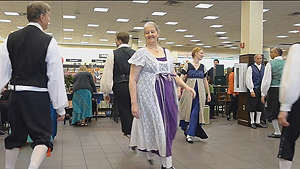
For the B part I have no argument with Pat Shaw's version except that he specifies the ones crossing right shoulder and after a left-hand turn I find it more natural to cross left shoulder. It also means that if your partner has forgotten or is late you can give a little tug. This time Playford actually says that the one are crossing into the twos' place, and now we see the symmetry of the two halves — they both start with the same move, then the first half has ones back-to-back with neighbour while the second half has ones back-to-back with partner. Obviously the twos need to move up in order for the ones to move into their places, and one of my principles is that you shouldn't suddenly have to turn back on yourselves, so after the twos moving up it's surely better for them to keep moving forward and casting onto the end of the line rather than separating and falling back. Using the same principle I would suggest that when the twos lead up at the start of the A figure they should turn out to flow into the symmetrical back-to-back. Three steps to lead up and three to lead back leaves us with six steps for the final move. The phrase “go the Figure through” means a figure of eight or half a figure of eight; the question is whether to bend the line as it falls back so that it's a real half figure eight, or whether the ones start the move from the centre of the line. If it were eight steps I would vote for the first option, but with only six steps the second seems a better bet.
By the way, if you're calling this dance (whichever version) I have two recommendations.
- Walk it through for everybody from both positions, since the ones and twos have very different tracks.
- Stress that after the right-hand turn with neighbour the men go very positively to their partner (without a twiddle) for the left-hand turn half-way. If you don't they'll be late, and then they won't believe they really have to cross again, and general confusion will reign!
Mr Beveridge's Maggot
Format: Longways duple minor.Interpretation: Colin Hume, 2007.
| A: | Ones cross and cast below the twos, twos meet, lead up and turn out to face down (6 steps); symmetrical back-to-back neighbour, ones leading up the middle to start (6 steps). Ones meet (3 steps), turn single downwards (3 steps); right-hand turn neighbour half-way (3 steps), ones left-hand turn half-way to place (3 steps). |
| B: | Ones cross left shoulder and cast below the twos, twos meet and lead up (6 steps); ones back-to-back while twos cast to the end of a line facing up. Lead up three steps and back; ones cross and cast while twos move in and lead up. |
And then in 2018 I called Red-House using the version I picked up in the States where there are moves added for the twos, after which David Ashworth wrote to me:
I am an occasional caller at various clubs in Essex. I have called your interpretation of Mr Beveridge's Maggot a couple of times, very successfully. The dancers seemed to find it an easy dance to perform whereas in the past when I have called the Shaw version the dancers have found the dance much harder to do. I think that means that it is likely that your interpretation is closer to how it was originally danced.After the first time I called your interpretation it struck me that there were some minor tweaks that could be added to make the part of the twos more interesting (as per your comment last weekend at Chelmsford concerning 'Red House') and thus more suited to the way we dance nowadays with only 6 or 7 turns through a dance.
These tweaks do not affect what the ones do, only what the twos do. In my opinion they also improve the symmetry and balance of the dance.
I didn't like the idea at all, but I can't really explain why not! Charles Bolton and Andrew Shaw quite happily add moves for the twos and threes to make a dance more interesting for them, but I very rarely do that, so it's unfortunate that David caught me at it! Anyway, see what you think. He's taken Victoria Bestock's suggestion and gone further, adding two crossings for the twos. Changes are in bold.
| A: | Ones cross and cast below the twos, twos meet, lead up and turn out to face down (6 steps); symmetrical back-to-back neighbour, ones leading up the middle to start (6 steps). All meet partner (3 steps), ones turn single downwards while twos turn single upwards (3 steps); right-hand turn neighbour half-way (3 steps), all left-hand turn partner half-way (3 steps) (ones are back to place, twos are in place but improper). |
| B: | Ones cross left shoulder and cast below the twos, twos meet and lead up (6 steps); ones back-to-back while twos cross and cast to the end of a line facing up. Lead up three steps and back; ones cross and cast while twos move in and lead up. |
Incidentally, David also wrote the dance All Saints.
Mr Clayton's Facer Added 20-Sep-25
Source: Twenty four new country dances for the year 1711: Nathaniel Kynaston Added 20-Sep-25Format: Longways triple minor
Note The first Strain twice the last once The 1st man take the 2d man by his right hand lead him round the 2d wo. the 1st man cast above his partner into his place the 2d man cast off below the 2d wo. into his place
the 1st and 2d wo. do the same only the 1st wo. with her left hand take the 2d wo. by her right
the 1st man turn the 3d wo. quite round the 1st wo. turn the 2d man at the same time then turn partners the 1st man take hands and go half round with ye 3d cu and back again 1st wo. do the same with the 2dcu at the same time clap hands partners and turn S

You can see facsimiles of Kynaston's books for 1711, 1714, 1716 and 1718 at nick-barber.net/wp-
The tune is a notey jig with an 8-bar A repeated and a 20-bar B-music, though listening to the B-music it's clearly two 8-bar lines and a 4-bar tag. The music has been recorded by The Assembly Players on their album “A Kynaston Ball” and I believe the dance instructions are included, though I don't know whether the interpretation is the same as mine.
The phrase by his right hand
at the start might suggest a right-in-right lead as promulgated by Cecil Sharp and through him by Miss Milligan and the RSCDS, but the instructions to the women make it clear that it's an inside-hand lead. My understanding is that the first man is actually “in the lead” — he's going all the way round the second woman drawing the second man behind him, presumably until they both get back to place. Then we have the word “cast” which seems unnecessary — the men are already facing across to their partners so perhaps it just means “go”. But that doesn't take the men into their places; they are now behind their partners and would have to lead through them to get back. And if there's to be a lead through I think it makes more sense to do that first, so the men lead between their partners and now they can certainly cast to place. That will fit the 8 bars of A1, and the women's similar move fits B2.
When I see “turn” I normally assume a two-hand turn, but this looks like the start of “turn first corner, turn partner, turn second corner, turn partner” which appeares in many places including Lady Doll St. Clair's Reel (and see my comments there on “The Fandango”) — but it isn't — after turning first corner and partner the ones go off to do different things. Yet I still think it should be right-hand turn with first corner, then the ones left-hand turn, which leaves the man going down and the woman up ready for the next figure. You could argue that then turn partners
means that all three couples do the turn, in which case they would all be two-hand turns, but that isn't going to flow into the next move for the ones (and it's unlikely anyway) so I'm discounting that possibility. That's the first 8 bars. In the next 8, I don't know why many dances specify “half-way” — particularly stars, such as in The Merry Meeting, and I'd be inclined to circle all the way to the left and back to the right. And that leaves the final 4-bar tag: clap hands partners and turn S
. Again it's “partners” in the plural, and while I suspect this was again just for the ones I'm willing to let the twos and threes join in. In fact I would convert it to a three couple set dance, so the ones can cast to the bottom instead of turning single.
Mr Clayton's Facer
Formation: 3 couples longwaysInterpretation: Colin Hume, 2025.
| A1: | First man draw second man all the way round second woman. Those two men lead between partners and cast back to place. |
| A2: | First woman the same round second man. |
| B: | (20 bars): First man (going first) right-hand turn third woman, first woman right-hand turn second man. Ones left-hand turn in second place. |
| Ones go right (man down, woman up): circle left with this couple. Circle right. | |
| All clap: together, right, together, left; ones cast to the bottom. the others turn single, threes moving up as they do so (so I suggest the turn single is upwards, i.e. left for the man). |
And in case you're wondering what the title means, one definition of “facer” is “a serious difficulty with which one is suddenly faced”.
Mr Isaac's Maggot
Source: Dancing Master 9th Edition, 1695: Henry Playford.The 1. man turn the 2. wo. with his Right-hand, and cast off below the 2. man, the 1. wo. turn the 2. man with her Right-hand, and cast off below the 2. wo. :The two men take hands and fall back, the two we. doing the same at the same time, all four meet and turn S. then go the whole Figure thro' then all four hands a-breast, and then lead thro' and cast off :
Note: Each Strain is to be play'd twice over.
Here's another one where it's difficult to see how Sharp came up with his version. I've run Dance Interpretation workshops where (without giving the title) I've read out Playford's words and invited the dancers to follow them, and they tend to come up with my version without any prompting — I just remind them that the instructions are usually addressed to the ones and that go the whole Figure through
means a figure of eight. So why did Sharp have the first man turning the second lady until she was home but he was below the second man, then casting up rather than off, to finish in his original place? I don't know. And then having established this odd procedure, he had to change the first woman's turn from right-hand to left-hand to make it symmetrical.
Garth Notley has pointed out that the original says each strain is to be placed twice — I had misread this (and mispublished it) as once. His interpretation can be seen at regencydances.
The A-music is 8 bars of three-time, the second half clearly related to the first half but resolving on the tonic rather than the dominant. Twelve steps for a turn all the way and a cast seems perfectly reasonable. Notice that the dance is not as symmetric as it appears on paper, because when the first woman turns the second man he is directly opposite her rather than diagonally below her — maybe that's why Sharp changed it.
The B-music is 12 bars of three-time, clearly in three chunks of four bars. Sharp has neighbours falling back for six steps (usually problematic), leading forward for three and moving forward turning single for three. Another possibility is to fall back for three, lead forward for three, and turn single for six. Either way, that will fill the first chunk of four bars. The second chunk is then go the whole Figure thro'
. Notice that in the first and third chunk it actually says all four
— the default is that instructions are addressed to the ones, so they alone do the second chunk. This gives them twelve steps for a full figure eight — possible with a skip-step (not a skip-change, which goes across the phrasing of the bars), though not comfortable with a walk step. I assume that they have to go slightly further, to finish in the middle of a line facing up. It's certainly busy, which is why I would not want to go into it from a turn single while moving forwards, so my money is on taking six steps to do the turn single and be ready for the figure of eight. Another suggestion is to fall back for three steps, come forward turning single for three steps, and then use the second half of the C music and all the D music to give a comfortable six bars (eighteen steps) for the figure of eight. I really don't think this makes musical sense — surely the figure eight needs to start at the start of a line of music. The C music is in two identical halves, making it even more unlikely that you would start something so different for the second half. In fact the D music is in a different style from the rest of the tune — it's busy and dotted whereas the rest is smooth and flowing, as if the music were saying “You need to get a move on here”. Then hands a-breast
I would take to mean lead up three steps and fall back three steps. The final instructions are addressed to the ones: they're not exactly leading through the twos, but they're leading up from the line before casting off.
I've split the instructions into four-bar chunks.
Mr Isaac's Maggot
Format: Longways duple minor.Interpretation: Colin Hume, 1996.
Each paragraph is four bars of three-time.
| A: | First man right-hand turn second lady (all the way), then cast to second place, second man moving up. |
| B: | First lady right-hand turn second man, then cast to second place, second lady moving up. |
| C: | All fall back three steps with neighbour; lead forward. Turn single (6 steps). |
| D: | Ones dance a full figure eight up through the twos (skip-step), finishing between them in the middle of a line facing up. |
| E: | Lead up three steps and back (stay in the line). Ones lead up and cast while twos meet in progressed place. |
Mrs. Savage's Whim Added 7-Aug-25
Source: Dancing Master Volume 2, 1st Edition, 1710: John Young Added 7-Aug-25Format: Longways duple minor
The first Man Sett to the second Woman, then turn the second Man, and go Back to Back with his own Partner, This to the first Strain play'd once. Then the second Woman do the same. This to the first Strain play'd twice. Then the first Couple cross over, and go Back to Back with your Partner then go the Figure above into the second Couple's Place. This to the second Strain play'd once.
The music is in 3-time — a strong tune in the minor mode — with an 8 bar A and B, and the instructions say there are two A's and one B. Bernard Bentley interpreted this in Fallibroome 1 and I'm sure we both have the same understanding of John Young's very clear instructions, but despite that my version has a few differences. He has replaced “set” by “step and honour” but I prefer a set, provided this is done smoothly in 3-time and not the bouncy-bouncy version that some dancers always use whenever they are told to set. He doesn't specify what kind of turn but I would expect a two-hand turn unless the original specified otherwise. His dancers obviously moved fast and therefore had difficulty with a long back-to-back so he adds a turn single after this in the A section, but I see nothing wrong with a long back-to-back — 6 steps out, 6 steps back — particularly as the active person may be slightly late finishing the two-hand turn. He has both couples doing the back-to-back in the B section but the instruction is obviously addressed to the ones. And apparently his dancers couldn't cope with the final half figure eight in 12 steps rather than the standard 8, so he adds a turn single on the last bar. To my mind this presents an obvious way to convert the dance from duple minor to a 3 couple set dance: the ones use those extra four beats to continue down to bottom place.
Mrs. Savage's Whim
Format: 3 couples longwaysInterpretation: Colin Hume, 2025
| A1: | First man set (smoothly) to second woman; neighbour two-hand turn. Ones long back-to-back (6 steps each way). |
| A2: | Second woman set to first man; neighbour two-hand turn. Twos long back-to-back. |
| B2: | Ones cross and cast, twos lead up (6 steps); ones short back-to-back (6 steps). Ones half figure eight up and continue to the bottom as threes lead up. |
Never Love Thee More
Source: Dancing Master, 7th edition 1686: John Playford.Format: Longways duple minor
Honour to the Presence, then to your own. Lead up all forward and back, that again.
The first man back to back on the right of his wo. and back to back on the left hand of his wo. to their own places, then cross over the second Cu and the Hay through the second Cu.
Next, hands half round and fall back all four, then side over to one another's places, then right hands being across, go half round, then left hands being given across, go half round.
This is not particularly controversial or original, but someone was looking for it on my website so I thought I might as well put it here.
The musical notation is an unbroken tune of 16 bars with no repeats, but I find it easier to think of it as one A and one B of 8 bars each. The horizontal lines in the instructions suggest that there are three figures, but most people would accept that the first is an introduction and would be performed once only. I have always seen the dance finish with the introduction in reverse, so I have followed this practice in my interpretation, though I don't know any historical justification for it.
So the first real figure starts with the ones doing a back-to-back right shoulders and a back-to-back left shoulders. We assume the woman moves too, particularly as Playford ends to their own places
rather than “to his own place”. These days the twos would expect to do the move as well. I'm not arguing with that, though it's worth pointing out that dances which have everyone doing a back-to-back or a two hand turn can be very crowded, and in Playford's day it would have been just one couple doing the move and the other couple watching. That's 8 bars, fitting what I'm calling the A-music. As usual, we remember that “cross over” means “cross and cast”, so the ones cross and cast below the twos who move up. Eight steps for that, leaving eight for and the Hay through the second Cu.
. They certainly can't do a hey (reel of four) with the second couple in that time. They could do half a hey, but I think Playford would have given more instructions for such an unusual movement, and it would also finish with the twos improper. My guess is that by “Hay” the instructions mean “half figure eight”, giving a very standard sequence of moves to produce a progression. It would be clearer if the book had said “go the figure”, but there were many contributors to Playford's book and they didn't all phrase things in the same way. Certainly this works, fits the music and gets the ones and twos to their correct progressed positions. Sharp ignores the “cross over” and has the ones doing a full figure eight down through the twos, leaving them unprogressed.
The second figure starts with circle left half-way and fall back (presumably with neighbour). The phrase then side over to one another's places
is unorthodox, and for many years I didn't believe it had any connection with “siding” or (as Playford would have phrased it) “Sides all”. Sharp's interprets this as “Partners cross over and change places”; I would prefer four steps to come forward, hesitate, then four to cross right shoulder and turn to the right to face partner. But in 2018 John Sweeney suggested that this could mean four steps to side into line right shoulder to right, but turning on the fourth step to face each other in a column, and then four steps to fall back into partner's place. I haven't tried this, but I'm now changing my interpretation to siding into line right shoulder and then continuing across: that gives a little more interaction with your partner than just walking past each other. Whichever way you do it, all of that fits the A-music. The B-music then has right-hand star and left-hand star. It's quite common for the original instructions to specify “half round”, and this may be because of the steps they were using; with a walk or a skip-change I would certainly opt for the stars going all the way round.
In Playford's day they would have done the first figure all the way down the set and back, then the top couple would have started second figure (while couples below them were still doing the first figure). Because each is only 16 bars long, Sharp has joined them together into one 32-bar figure. But (of course) each figure has a progression, and in Sharp's day no-one had heard of a double progression. I imagine that's why he changed the B part of the first figure to the ones doing a full figure eight down through the twos and thus starting the next move with the same couple. I'd prefer to admit that these were originally two separate figures and do a double progression dance.
Many years after I had come up with this version, I discovered that Pat Shaw did it the same way — and I expect other people have come up with the same version independently.
What about the speed? First of all, let's be clear that this is just a matter of opinion — nobody knows what speed they danced it in Playford's day. Some callers take the dance very slowly. I take it fairly slowly. In Cecil Sharp's day everything was fast, so in his interpretation he uses a skip step for the figure eight, a slip step for the half circle, and by default a running step for all the rest. But I don't believe all these dances were fast. The tune is a jig, but I envisage it as a slow jig. I think of this as quite a formal dance, particularly with that introductory figure, and I had assumed that the title meant “I could never love thee more than I do”, which also suggests “romantic” rather than “energetic”. However in 2019 the assiduous Mo Waddington pointed out that the tune fitted the poem “I'll never love Thee more” by James Graham Marquis of Montrose. He was a Scottish nobleman, poet and soldier, whose spectacular victories are remembered in military history for their tactical brilliance. The poem (see the words here) is not at all what I expected — it's a jealous man demanding that his love be true to him alone, or “I'll never love thee more”. In the last verse, having made all the threats, he then tries flattery:
But if thou wilt prove faithful then,
And constant of thy word,
I'll make thee glorious by my pen
And famous by my sword;
I'll serve thee in such noble ways
Was never heard before;
I'll crown and deck thee all with bays,
And love thee more and more.
History does not record whether she fell for this or not. And in 2020 Neil Stuart pointed out that in their 15-minute epic “Montrose”, Steeleye Span sing the second half of this verse at the end.
Never Love Thee More
Format: Longways duple minor.Interpretation: Colin Hume, 1996 / 2019.
Double progression
| Introduction: | |
| A: | Step right and honour presence; and left. Partner same. |
| B: | Up a double and back. That again. |
| Figure: | |
| A1: | Back-to-back partner. Back-to-back left shoulder. |
| B1: | Ones cross, go below twos; twos lead up. Ones half figure eight up. [First progression] |
| A2: | With the next couple, circle left half-way; fall back with neighbour. Move forward into line right shoulder with partner; cross over and turn right into… |
| B2: | Right-hand star. Left-hand star. |
| Finale: | |
| A: | Up a double and back. That again. |
| B: | Step and honour partner. Step and honour the presence. |
My Lady Winwood's Maggot
Source: Dancing Master Volume 3 2nd Edition, c. 1726: John Young.
Format: Longways triple minor
Note: The first Strain is to be play'd twice, and the last but once. The first Couple Sett and cast off, and lead through the 3rd Couple . Then the first Man goes the whole Figure with the third couple, and his Partner with the second at the same time, being in the second Couples place : Then Hands all six quite round, and all Back to Back Partners, then the first Couple lead through the third Couple, and through the second, and turn your Partner.
I've doubled the number of bars so that there are two beats to a bar rather than four. The musical notes aren't quite what John Young published, but I think they're what he meant! The tune is then a reel with an 8-bar A (repeated, according to the instructions) and a 16-bar B.
The instructions don't seem difficult to interpret. I assume that lead through the 3rd Couple
implies “and cast up again”, though I suppose it could mean “lead through and then lead back”. But when I looked at the B part I thought “This is going to be frantic”. Four bars to circle 6 all the way? Eight bars for the ones to lead to the bottom, cast up, lead to the top, cast to middle place and turn your partner?!
Sharp accurately transcribes the original wording, though he abandons what I think is a really good tune (I'd describe it as a march) and substitutes “Nobody's Jig” (which is actually a reel, and he ignores all the tied notes). I'll be sticking with the original.
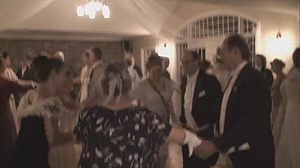
The second (which now in 2023 is unavailable — it says it's private) is converted to a 3 couple dance, with reels of three rather than just the ones doing figures of eight, and the dancers (a display team this time) are livelier than the first lot. It has the circle 6 half-way only, which certainly allows time for the back-to-back, but the rest of the dance bears no resemblance to the original instructions. I discovered later that this is Charles Bolton's version, and he admits: I have treated the last half of the B very freely.
Maybe you can justify changing the figure of eight into a reel of three on the grounds that the original says “Then the first man goes the whole figure with the third Couple” rather than “around” or “through” (though I'm doubtful), but what can you do with that circle?
I suggest a version which interprets “Then hands all six quite round” as two circles of three — I don't suppose it's right, but with a slipped circle it can certainly be done and it flows nicely into the back-to-back for everybody. The fact is, John Young's original does not make sense and something has to be changed. I've also converted it to a 3-couple dance and left out the final turn for the ones. I suspect the dancers would complain if I did the triple minor version, because all the twos and threes do is a circle left and a back-to-back — OK, the twos also get to move up!
Pat Shaw's version (which I discovered after I'd written all this) is the same as the original but with reels of three, and he too has converted it to a 3-couple set. But in the second half he dodges the issue of timing. In the A part he splits it into 4-bar chunks (8-bar chunks the way I've written the music out) but the B part is just in 8-bar chunks and after the circle left he adds “(fast)”!
My Lady Winwood's Maggot
Format: 3 couples LongwaysInterpretation: Colin Hume, 2016.
| A1: | Ones set; cast (twos lead up). Ones lead down, cast up. |
| A2: | Ones go right (man down, lady up): reels of three across with this couple. |
| B1: | (16 bars) With the same couple, circle left (slip). All back-to-back. |
| Ones lead down, cast up to middle place, lead up to the top, cast to the bottom as the threes lead up. |
Newcastle
Source: Dancing Master, 1st edition 1651: John Playford.Format: Square
Meet all, back againe, set to your owne, and to the next . That againe :Rather to my surprise, dancers in both England and the States seem quite willing to have a go at Mike Barraclough's interpretation of “Nonesuch” published in my book “Playford with a Difference”, and some of them have said they prefer it to the Cecil Sharp version. So again I'm rushing in where angels fear to tread — this time looking at that other classic Sharp dance, “Newcastle”. Again, I'm sure some people will be horrified. You get the same response from people who go to church regularly, believe themselves committed Christians or whatever, yet refuse to listen if anybody questions any article of faith. They're saying: “This is what I've been taught; how dare you question it?” That's not real faith; it may be comfortable but it doesn't have any solid foundation. Anyway, we wouldn't want to make a religion out of Sharp's interpretations — would we?Armes all with your owne by the right, men all fall with your left hands into the middle, We. go round them to your places . Armes againe with your owne, and We. left hands in, men goe about them towards the left to your places :
Sides all with your owne, and change places with them . Sides with the next, and change places with them :
The first man and 3. Wo. take hands and meet, the first Wo. and 3. man, lead out againe then holding up your hands, the other foure cast off and come under your armes to their places . The other foure the like :
Armes all with your We. and change places . Armes with the next and change places : Now every man is with his owne Wo. in the Co. place.
Fall back from each other, foure and foure a brest to each wall, turn and change places with your opposites . Fall back from each other foure and foure along the roome, turn S. change places with your opposite : So each falls into his place as at first.
One problem is that “Newcastle” is so well-known that you can read through the original wording and convince yourself it actually says what you expected it to say — that's why proof-reading is such a difficult job. So let's actively look for other possible meanings.
The tune is a reel with a standard 8-bar A- and B-music, so we would assume each figure to be 32 bars unless there were good reasons to think otherwise.
You may want to open a separate tab showing Cecil Sharp's version.
The first introduction doesn't say whether you take hands in a ring, take just your partner's hand (as in “Up a double and back”) or do it without hands. I'm not disagreeing with Sharp — I think it's a gesture of solidarity at the start of a challenging dance, and the fact that you are all “meeting” rather than “going forward a double” makes the joining of hands a natural thing to do — but can you afford to be dogmatic about it?! Set to your owne, and to the next
— which next? Well, of course he means your corner — that's how I learnt it! But if I said in an American Square: “Swing your partner, and swing the next”, you'd probably pass your partner by and the man would swing his right-hand lady. In fact that's what I believe “the next” means in the second and third figures. When I wrote these notes I wasn't saying that's what it means in the first figure, just that it's an interesting possibility, particularly when we discover that the second and third introductions (most unusually) are where the progressions occur. But that was in 1996…
In 2016 Andrew Swaine pointed out to me that the first time it could mean “set to your partner and the next one round the square” and then That againe
would mean “set to your opposite and corner” — working your way round the people you are going to meet in the second and third figures. I'd never thought of that, which again shows that it doesn't do to be too dogmatic! I've tried it and it works really well (provided you don't move forward towards these people), so now that's in my version. Interestingly, when I called this at the New London Assembly in 2016 someone said that it was awkward because in my version it was difficult to arm right with your partner after the set to corner, and I had to point out that Sharp's version does exactly that. It's very tempting to assume that something new is awkward whereas something you've been doing for years is easy and natural.
Arm right
we think we understand (but who knows — maybe it actually meant a right-hand turn), and men all fall with your left hands into the middle
must surely mean a left-hand star. We assume the men take their star round rather than just standing there while the women dance round the outside — but Playford doesn't actually say so. If he'd written “Men left hands across” I'd be more comfortable about it — but these are all minor issues, just to get you thinking about other possibilities behind these seemingly straightforward words. He does however say to your places
which means to me that the star and the single file are once around rather than half-way as some people have suggested. For some reason Sharp doesn't want to use the phrase “arm right”, even though that's what Playford says; instead he has Partners link right arms and swing round once
.
However, now we come to a serious disagreement with Sharp. If the men are doing a left-hand star and the next instruction is Armes againe with your owne
the natural, obvious thing would be to arm right again. If Playford had really meant “arm left”, wouldn't he have said so? Then he says: Women left hands in
which nails it down. And finally, to make absolutely sure that no-one could be in any doubt, he says that the men goe about them towards the left
. That's not ambiguous, the way some of the things I've mentioned earlier are; it's perfectly clear. Sharp dismisses it (in the introduction to part VI of “The Country Dance Book”, 1922) with:
The second half of this figure was intended no doubt to be complementary to and symmetrical with the first; but it is not so noted. The last sentence should of course read: “Armes again with your owne by the left, and We. right hands in, men goe about them towards the right to your places.”Who would have dared to question Sharp about this? But times have changed, and I'm always suspicious when someone uses phrases like “no doubt” and “of course”. Sharp has deliberately changed it to an arm left, even though this makes an awkward transition from the previous movement. So why did he do this? I think there were two reasons. First, he wanted the symmetry of an arm right followed by an arm left. And if it was in the introduction to the third figure I would totally agree with him — but it's half-way through the first figure, which is quite a different context. And second, if the women do a left-hand star and the men go round clockwise you end in your partner's place facing the wrong direction. Perhaps Playford was aware of this, and that's why he again specified
to your placesto make sure the dancers realise they've got to get home. There really isn't a problem; you just do a gypsy right half-way as you meet, and in fact the second arm right is only half-way so there's time for it. But to go from that into Cecil Sharp siding is an abrupt change of direction. Guess what — if you side into line right shoulder to right, one movement flows perfectly into the other.
In fact Dick Shilton has pointed out to me that in the first (1911) and second (1913) editions of Part II, Sharp does use arm right both times. It's not until the 3rd edition (1927) that it becomes arm right and then arm left. The first and second editions say
B2 1 — 2 Partners link right arms and swing round three-quarters of a circle.
3 — 8 Women left-hands-across, counter-clockwise, to places (sk.s.); while men skip round them, clockwise, to places, not joining hands.
whereas the third edition says
B2 1 — 2 Partners link left arms and swing once round (r.s.).
3 — 8 Women right-hands-across, clockwise, to places (r.s.); while men skip round them, counter-clockwise, to places, not joining hands.
So the siding is with your owne
which confirms that the first figure is non-progressive. Is it just right shoulder, or is it right then left? In the first figure, both A1 and A2 started with forward a double and back, so I would expect the second figure to work the same way: right shoulder in A1, left shoulder in A2. The difference this time is that instead of setting to partner and “the next” we're actually changing places with our partners to that we can side with the next
— of course we all know who “the next” means even though it isn't the same “next” as Sharp means in the first figure! We could pass through in two steps, stretch it out to four if necessary, but we can't really take eight steps for it. Sharp puts in Partners go a single to the right and honour
which is arguably the decent thing to do before abandoning your partner for the rest of the dance. I agree that something is needed to fill out the music — I'm just saying it's not in Playford. However Sharp's approach means that this is the only slow movement in the entire dance, so maybe it's not a good choice. To be more consistent with the first figure I would put in a set rather than a step and honour, though you shouldn't move forwards in the setting or you will then get to the next person too quickly.
Michael Barraclough had an interpretation on his website called “Newcastle United” which is no longer there (though he does now have an interpretation at michaelbarraclough.
I believe that one should adopt a starting point of assuming that what is required is not new. The first question to ask, therefore, is “is there any well known choreographic unit that takes four bars for you to change places with the person you are dancing with” and the answer is YES. The movement known as a “Hole in-the-Wall” change (which I prefer to call “paunch-to-paunch”) meets the requirements exactly, doesn't cause us to invent something new, doesn't cause us to do things that we aren't told to do, and even more importantly, seems to echo the music perfectly.I just don't believe this. The modern interpretation of “Hole in the Wall” indeed has a move where you cross with someone in three steps, finishing close, and then fall back. But there's no justification for this: the original (Henry Playford, Dancing Master 9th Edition, 1696) just says:
The 1. Man cross over with the 2. Wo. and the 1. Wo. with the 2. Man— and that's in a longways set, where you have room to fall back, and it's only six steps. I've tried Mike's version, where you're in a square, using eight steps with nowhere to fall back to, and I'm not convinced.
In the arching and casting figure I don't have any argument with the moves as Cecil Sharp described them, except for the unnecessarily fussy lead forward a double, change hands, and lead back a double
. Playford doesn't mention changing hands, but Sharp believed that leading was right hand in right and for some reason he wanted people to lead back left hand in left. I'm glad to say that (at least in England) we've now got back to an inside hand lead, which is what I believe they did in Playford's day, though the RSCDS under the influence of Sharp's follower Jean Milligan are so entrenched in a right-in-right lead that Scottish dancing can never change. What I do argue with is the timing. It looks straightforward enough: four steps for the heads (now in side position) to lead in with their original opposite, four steps to lead out again, then eight steps for the original sides to cast away from their current partner, meet their original partner, lead under the nearer arch and fall back to places with their current partner. But in my experience that final section needs more than eight steps — especially if you're wearing period costume. It usually looks rushed — and remember, having flung themselves back into head places they immediately need to lead forward again. Playford doesn't specify any timing beyond saying that the whole arching and casting figure takes eight bars, and then eight for the other couples. So I prefer the sides to lead out as the heads start their casting movement, and vice versa.
And so to the third figure. Note that Playford says with your We.
rather than with your owne
just to remind you that you're not with your original partner. But then note how similar the introduction is to the second figure. Quite clearly it's the same pattern, with siding replaced by arming — as you would expect. So, arm right, set, move on to the next. Arm left, set, move on to the next — and there you are with your original partner, half-way round the square. But what does Sharp do? He sees a way of getting rid of that step and honour, which he felt guilty about because it wasn't in the original — Sharp follows the letter rather than the spirit of the original wording. Siding — whether Sharp-style or Playford-style — is a there and back movement: you always finish where you started. But with arming you can arm right and left, push round a bit faster on the arm left, go once and a half rather than once — and you've followed the letter of the original wording: Armes all with your We. and change places
. With a set of good dancers you can even make it look very convincing. But can you tell me any other genuine Playford dance where the arming movement as an introduction to the third figure gives you a progression, or where you arm right, left, right and left?
And then that really awkward movement: arm left one and a half, and finish with the woman on the man's left (strange how it's always the women who have to make the awkward turns) in side lines close together, ready to fall back. Yes, I can do it — I can even throw the woman into the correct place and catch her in my left hand ready to drag her backwards with the next phrase of music. And some people who have spent years perfecting “Newcastle” bitterly resent me saying that it shouldn't be done like that at all. But Playford doesn't say that the introductory movement for the third figure finishes in side lines. It finishes — like the introductory movements for the other two figures — in a square (or round, if you prefer). Can you really give me any other interpretation of the line: Now every man is with his owne Wo. in the Co[ntrary] place
? But it wasn't until 2024 when I was creating the entry for Round Reminders that I discovered Sharp doesn't say that either, even though people who think they're teaching Sharp's version always do. It's what Palmer says, for instance. But Sharp says:
Each man arms with the right, then with the left, with the next woman on his right and changes places with her. (Partners are now side by side, but in opposite places.)
So we're in a square (not two facing lines close together — all three introductions start and finish in a square), and we've met our original partner after the progressions in the second and third introductions. Then, at the start of the body of the figure, we fall back in side lines, since wall
always meant the wall at the side of the dance hall. Presumably we fall back a double: four steps. Do the lines then lead forward? Playford doesn't say so. The difference between B1 and B2 is that the first says turn
where the second says turn S.
and I agree with Sharp that Playford missed out the S.
the first time — I'm sure he meant “turn single” both times. So, four steps to fall back, four steps to turn single. That gives us a whole eight steps to cross over and form those new lines across the hall — it's not nearly as frantic as people make out. It's not really a difficult dance at all. If you ask people what the hardest part of “Newcastle” is, what do they say? Forming the lines — both times!
But when you cross over with your opposite, should you finish in those second lines? Surely at the start of B2 you should be in the same formation as at the start of B1 — in a square. Then you fall back into head lines. If you're teaching this version, make sure both times that everybody falls back in the lines, though of course the ends have to fall back further — in my experience the middles just can't believe that “all fall back” applies to them.
So that's my reconstruction. Would I call it this way at an evening dance? In 1996 I said “I'm not sure”, but twenty years later, yes I would! As I said at the start, I've been surprised by the positive response to a “new” interpretation of “Nonesuch”, and I've certainly had people requesting my version of “Newcastle”. But to many long-term dancers, “Newcastle” is the pinnacle of Playford dancing. They're proud of the fact that they can do it, and they'd be horrified at the thought of me changing it so that a bunch of amateurs could get through it. I've met the same resistance to my interpretation of “Step Stately” in “Playford with a Difference” — “Oh, we got through it for the first time ever, but it wasn't the real thing — Colin Hume was teaching his simplified version”!
However, for those of you who are willing to be open-minded, here it is.
Newcastle
Format: Square (or round, if you prefer).Interpretation: Colin Hume, 1996, modified 2016.
| First figure: | |
| A1: | All join hands, move forward a double and back. Set to partner; set to the next (right-hand lady or left-hand man). |
| A2: | All join hands, move forward a double and back. Set to opposite; set to corner. |
| B1: | Arm right with partner, then men left-hand star once around while women dance round the outside clockwise. |
| B2: | Arm right half-way, then women left-hand star once around while men dance round the outside clockwise, finishing with a gypsy right half-way into original place. |
| Second figure: | |
| A1: | Side right. Set right and left (without moving forward); pass on (right shoulder) to the next. |
| A2: | Side left. Set; pass on to the next. |
| B1: | Original heads (now in side place with original opposite) lead in (inside hand); as they change hands, lead out and make an arch, original sides cast away from current partner, meet original partner, lead under the nearer arch and fall back to place with current partner (6 bars). |
| B2: | The same led by the original sides. |
| Third figure: | |
| A1: | Arm right. Set; pass on to the next. |
| A2: | Arm left. Set; pass on to meet original partner on the other side of the square and all join hands. |
| B1: | Heads break from partner and all fall back into side lines; turn single right. Cross right shoulder with opposite to reform the square and all join hands. |
| B2: | Sides break from partner and all fall back into head lines; turn single right. Cross right shoulder with opposite to reform the square in original places. |
Nobe's Maggot
Source: Henry Playford — Dancing Master 12th Edition, 1703Format: Longways triple minor
The 1. cu. set each right Elbow to one another, and then with their left Elbows, and cast off, then the first cu. lead through the 3rd cu. and cast up and clap hands, then the first man Hey with the second cu. and the first wo. with the third cu. at the same time, then right and left with the 2. cu. quite round.
I first thought “set” meant “set right and left while touching right elbows together”, but then I realised it just meant “put” as in “Set this down on the table”. But when I originally interpreted this I missed out the “left”, so this is the revised version of 15-Mar-25.
The tune has two A's and two B's, each 4 bars long. It's a slip-jig (written in 9/4 though I've converted it to the more usual 9/8), meaning there are three beats to the bar and you only get 12 steps rather that the usual 16. So A1 is 3 beats to touch right elbows, the same left, 6 steps for the ones to cast and the twos to lead up. A2 is 12 steps for the ones to lead down through the threes and cast up — that's rather too much, but what about and clap hands
? My suggestion (which you may hate) is 6 steps to lead down and cast up, then ones with partner clap together, together, right, together, together, left. B1 is 12 steps for the Heys across, which will work fine provided you move with a bit of energy. It's unusual that the man Heys with the twos and the woman with the threes — the standard is the other way round — but maybe there was no standard in 1703. B2 is four changes at the top. Some American callers will tell you there isn't time to take hands, but that's just not true. As always it's a dance for the ones, so I would convert it to a three couple set dance. But I wouldn't rush the ones' move to the bottom to fit it into B2 — that isn't necessary. Three steps for each change, fitting it to the music. Then as the new ones start elbowing the old ones do a fifth change with the threes. I'd probably run the dance six times through, and point out that it's not necessary for the ones to scamper to the bottom at the end of the last time through — just stay where you are in second place!
Nobe's Maggot
Source: Henry Playford — Dancing Master 12th Edition, 1703Interpretation: Colin Hume, 2024.
Format: 3 couples longways.
| A1: | (4 bars): Ones touch right elbow to right (2, 3) then left (2, 3). Cast to second place, twos lead up. |
| A2: | Ones lead down through threes and cast up to second place (6 steps). Ones clap with partner: together, together, right, together, together, left. |
| B1: | (4 bars): Ones go left [man up, woman down]: hey across with this couple (12 steps). |
| B2: | Four changes at the top (with hands): 3 steps per change. Then as the new ones start elbowing each other the old ones do a final change right hand with the threes. Do not do this final change the last time through! |
The Old Mole
Source: John Playford — Dancing Master 1st Edition, 1651Format: 3 couples longways
This really isn't my interpretation — I saw it on two videos, an English one by Vale Islanders and an American one by the Walpurgisnacht group and they were both doing something quite different from what I expected so I thought I should look into it. I have no quarrel with Sharp's version except for the start of the second figure (A8-A11 in my instructions below), so that's all I'm discussing here; the rest is pretty much as Sharp except that I would use into-line siding in A16.
For some reason Sharp doesn't split the instructions into the three figures that Playford specifies. The tune is a single 8-bar phrase, which is perhaps fortunate since the figures go through it 7, 7 and 8 times so if there were also a B-music the musicians would have to be on their toes to start each figure on an A. We could speculate that there's one missing line in the first and second figures, but there's no evidence for that. Playford's dots are consistent in the first figure. In the second figure he has one dot after the first arching, but after “Do this change four times” he has four dots, although the first has already been given. And then after the diagonal crossing back he again has four dots rather than seven. In the third figure the dots make sense until The D. Hey twice over
which is surely 5 dots for the first time and six for the second. And then no dots at all for the final two moves.
Lead up a D. forwards and back, set and turn S. . That againe : All a D. to the left hand back again, set and turn S. .: As much to the right : : First man and last woman meet a D. back again, meet again and change places .: : First Wo. and last man as much .: .: the second man as much with his owne .: .: .
The two first We. hands, and the two last men hands, lead forward and back to the odd one against them, let the odd one go under your armes . Do this change four times, over to the place where you began it : : The first and last change as before to your places : :
All the men hands, and all the We. hands, meet all forwards, and back the first and last, last on each side turn each other, the 2. turning his own . Sides where you turned and turne your own : Men the S. Hey .: We. as much : : The D. Hey twice over .: : Cast off all and come to your places. That again.
My facsimile is from the first Edition. The one on the CDSS site is from the 7th Edition which has got mangled slightly — instead of “Do this change four times,” it says “Do this change : : ” — I also notice that in the final figure the seventh Edition says the Double Hey is thrice, which seems overkill!
The first question is what Playford means by The two first We.
. The fact that he mentions them before the two last men
suggests that he means the two women now at the top of the set, who are actually the second and third women since everyone has crossed on the diagonal at the end of the first figure. That's what Sharp decides and what the Vale Islanders use, whereas the Walpurgisnacht group use the original numbers. I'm with Sharp. So the top two women and the bottom two men lead forward to meet the spare person, fall back, then arch and change places with them. But then Sharp has the top two men and the bottom two women leading the move, and then he repeats both. Surely what Playford means is that having done the first cross everybody turns in a quarter, so the second time the moves are up and down rather than across. That makes complete sense of Do this change four times, over to the place where you began it
.
The Old Mole
| First figure: | |
| A1: | Up a double and back. Set and turn single. |
| A2: | That again. |
| A3: | Lines lead to the men's wall a double and fall back. Set and turn single. |
| A4: | Lines lead to the ladies' wall a double and fall back. Set and turn single. |
| A5: | First man third lady forward a double and back. Cross over. |
| A6: | First lady third man same. |
| A7: | Middles same. |
| Second figure: | |
| A8: | Middles lead left-hand neighbour forward and back. Arch and cross with the opposite person, then all wheel ¼ to face up and down. |
| A9: | Same up and down. |
| A10: | Same across. |
| A11: | Same up and down. |
| A12-14: All cross back in same order as A5-7. | |
| Third figure: | |
| A15: | Lines lead forward a double; ends fall back. Ends two-hand turn other end (same sex), twos turn partner. |
| A16: | Side right with the same person. All two-hand turn partner. |
| A17: | Men reel of three (top two men pass right shoulder). |
| A18: | Ladies the same. |
| A19: | Twos face down: Circular hey — twos and threes pass neighbour right shoulder to start as ones pass partner right shoulder. |
| A20: | And again. |
| A21: | Double cast: Cast to bottom, touch partner's hand, cast up again to place. |
| A22: | That again. |
Old Noll's Jig Updated 5-Feb-26
Source: Henry Playford — Dancing Master 11th Edition, 1701 Updated 5-Feb-26Format: Longways duple minor
Longways for as many as will.
Note: The first Strain is to be played twice, and the second but once.The 1. Man turn single into the 1. Wo. place, and the first Wo. does the same at the same time, and Set to their Partner, and cast off . The other cu. do the same : Then Right-hands a·cross and Left-hands back again . Then the figure through the 2. cu. and make two Hops, and cast off and turn to their own side .
The tune is quite a driving jig, with an 8-bar A-music (repeated, according to the note) and a 16-bar B-music which I've written out as an 8-bar B and an 8-bar C.
A1 is clearly not just the first couple changing places, so they must turn single 1½ to finish in each other's place facing each other. Presumably 2 bars for this, then 2 bars to set, but then the energy is dissipated as they take 4 bars to cast below the twos. A2 for the twos to repeat this, leaving everyone home and improper. Right-hand star and left-hand star will surely take 8 bars, but what do we make of the final 8 bars? the figure through the 2. cu.
means a half figure eight or a full figure eight, and there's not enough time for a full one. The instruction make two Hops
is very unusual, but it's possible to dance a half figure eight in 3 bars (6 skip-steps) and then hop twice in bar 4, where the 6 notes to the bar suddenly change to two (and an upbeat). But that gets the ones proper. 4 steps to cast, and then 4 steps to turn all the way? And at no point do the twos become proper. I know the instructions often leave the twos to fend for themselves, so they are never told when to move up, but in this case are they really expected to move up and change sides (or turn half-way) without any instruction? Time to see what Cecil Sharp made of it. Like me he splits the music into B and C, and for C he has:
| 1-4 | First man crosses over, passes clockwise round second woman and returns to the same place, jumping on the second beat of the fourth bar; while the first woman crosses over, passes counter-clockwise round second man and returns to place, jumping on the second beat of the fourth bar. |
| 5-8 | First man and first woman cast off into the second place, turn each other half-way round and change places, second couple leading up into first place and turning in like manner (progressive). |
So the ones do a half figure eight down but then cross back to the improper side, and even Sharp's athletic young dancers couldn't manage two hops as well, so he cuts it down to one jump. As usual, Sharp tries to follow the letter rather than the spirit of the original instructions. I think Playford got it wrong! I've already mentioned that it seems odd to have that slow cast in the A part after the preceding activity. It's quite unusual for both couples to stay improper for any length of time. And for me the clinching argument is that the instructions finish with and turn to their own side
rather than just the very common “and turn”. Surely this implies that the ones start the turn improper. So my version gets round all these objections by having each couple cross over following their cast in the A part.
Old Noll's Jig
Format: longways dupleI originally described this as 3 couples longways, but I didn't mean that!
Interpretation: Colin Hume, 2022.
| A1: | Ones cross while turning single 1½; set to partner. Cast to second place as twos lead up; cross to own side. |
| A2: | Twos do the same. |
| B: | Right-hand star. Left-hand star. |
| C: | Ones half figure eight down (6 skip steps), hop on right foot then left. Ones cast as twos lead up; two-hand turn half-way. |
First called by Sally Vernon at The Round in February 2022, to a group including many inexperienced dancers, and it worked really well. Make sure you explain that the two hops are at the end of the half figure eight, not at the start of the next phrase of music, or the final move will be very zesty indeed! You could also do the half figure eight with three skip-change steps, and if you start these on the right foot the hops would be Left and Right: the mantra is “Right 2 3 and | Left 2 3 and | Right 2 3 and | Hop! — Hop! -”.
The Opera, or The Apes Dance Updated 19-Jul-25
Source: John Playford, Dancing Master 5th Edition, 1675. Updated 19-Jul-25Format: Longways duple minor
Longways for as many as will.Honour to the Presence. Lead up all forwards and back . That again :
First man and 2. wo. change places, then first man and 2. wo. and first wo. and 2. man take hands and walk round till you have just changed places, then fall back, then all four cross over in each others places, then take hands and do the same thing again, and at the second crossing then men take hands with your own and put back, then right hands to your own, and left to the other wo. then first man go down behind the 2. wo. and the first wo. in the middle, the man up in the middle, and the wo. up behind the man, set then to each other and cast off. So to the bottom.
The tune has an eight-bar A and an eight-bar B. Once again Playford gives us the underlined dots where they're obvious but not where they might help an interpreter! It seems clear that we have an introductory figure (for which I would use one A and one B) and then a progressive figure. So let's go through it. The first man and second woman change places, so the men are now below the women. But what does the next instruction mean? It's tempting to think that it means “circle left one place” which puts everyone proper again, ones below the twos. Fall back with neighbour (one step) and cross over with partner. And indeed if we do all that again (the first corners are still in first corner positions, so the same people cross) it gets everyone back home at the end of A2. But why then is Playford so specific in naming the four people for the circle — why not just “hands all”? Surely it's because he doesn't mean a circle but two pairs of people doing a two-hand turn half-way. And yet that doesn't make sense — the two pairs are diagonally across from each other. So maybe he got it wrong and meant it to start with the ones crossing. Then you can turn your neighbour half-way (I would use a symmetrical turn, so the ones continue down the outside). Step back and cross with partner is fine, which leaves the twos improper at the top, ones proper at the bottom. The phrase do the same thing again
suggests that this is A2, but note the subtle difference in the repeat: all four cross over
rather than just the ones, so the ones finish in their own place but the twos are improper. I didn't notice this when I originally tried to interpret the dance!
Now the second half. Put back
always means poussette in my experience, and a half poussette will put the ones below the twos, the men indeed “putting back” their partners to start. This is followed by two changes with hands which puts the ones improper above the twos proper, and because the twos start improper the men do indeed give right hands to your own, and left to the other wo.
That will fit into eight bars, so it's B1. Now the ones can do their solo as in “Mad Robin” — first man down the outside and up the middle and first woman down the middle and up the outside, though it would actually flow better if it were the other way round. Finally the ones set and cast — but they're still improper! I suggest that John Playford knew there was something before the final cast to fit the music, but forgot what it was and hadn't realised the ones were improper at this point.
I abandoned my interpretation in 2007 and was drawn back to it in 2025 by an email from Jacob and Nancy Bloom with a link to their article at dancehistoryalive.First couple change sides
just as I had guessed. The second half is quite different, and presents difficulties of interpretation which they discuss rather than just gloss over, but they've come up with a danceable version which was their intention. So here's my interpretation.
The Opera, or the Apes Dance
Interpretation: Colin Hume, 2007, completed 2025!| Introduction: | |
| A1: | Step right and honour the presence; same left. Up a double and back. |
| B1: | All that again. |
| Figure: | |
| A1: | Ones cross; two-hand turn neighbour half-way (ones continuing in the same direction). All face partner, one step back, cross over. |
| A2: | All cross and do the same (home, twos improper). |
| B1: | Half poussette: men push. Two changes with hands. |
| B2: | First man cast down outside, lady down middle, round neighbour to place. Ones cross and cast, twos lead up. |
Oranges and Lemons
Format: Square.Source: John Playford, Dancing Master 3rd Edition, 1665.
Meet all and fall back, that again : : Men honour all to your own we. then honour to the contrary, men meet in,& take hands and go half round and fall into your co. places . Then we. honour to your left hand, and then to your right, we. meet in & take hands and go half round & fall into your co. places by your men : do all this back again till you come all into your own places.
Sides all with your own . That again : Men and we. give right hands to your own and then left, change places with your own then change with the next . And then give right hands to the next, and then left, then change places, and then change with the next, and meet your own : Do this back again till you come into your places.
Arms all with your own . That again : The first and second cu. and the third and last cu. honour to each other, then honour to your own, the first and second cu. take hands and go half round, and the third and last cu. take hands and go half round : Then the first and last cu. honour, and the second and third cu. honour to each other, and then honour to your own, the first and last cu. take hands and so go half round, and second and third cu. take hands and go half round all at one time : Do this back again till you come into your own places.
The facsimile is from the 7th Edition. The title is “Oranges and Limons” though the spelling varied through the editions. It's described as “A Figure Dance for eight, thus:” and there's a diagram of a square set with the ones on the left (which is the top, where the presence is in Playford's diagrams) and the set numbered clockwise unlike the later American numbering.
The 7th Edition contains five squares in a row: “Buckingham-house, or Chelsey-reach” (page 151), “Parthenia, or Fain I would” (152), “Hunsdon-house” (153), “Dull Sir John” (154) and “Oranges and Limons” (155). Each is described as “A Figure dance for eight”, but “Fain I would” and “Dull Sir John” come from the 1st Edition of 1651 where they are described as “A square Dance for eight”. The “s” of “square” is a long squiggle, and “q” can look very much like “g”, so I think it's simply that the compositor misread the word! See what you think. Here's “Fain I would” from the first Edition followed by a later Edition — not the 7th, as you can see from the page number.
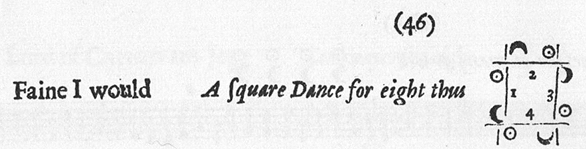

The music has a 4-bar A-music and a 6-bar B-music which starts with two very distinctive upward runs (mirrored in each of the three figures) and then repeats the 4 bars from the B-music. But actually this facsimile has many discrepancies from the version which Cecil Sharp transcribed from the 3rd Edition of 1665 — notably that this one is in triple time and the second upward run isn't an upward run! I don't have access to the 3rd Edition but no doubt Sharp transcribed it accurately and there was a drastic modification somewhere between the 3rd and 7th Editions of The Dancing Master. The underlined dots in the instructions are very confusing, but given the length of the instructions it seems likely that each figure needs two A's and four B's. I've written out the B-music twice (as did Sharp) so my instructions specify B1 and B2, each 12 bars.
I shall be referring to Sharp's version which you can see here.
I would take my partner's hand and lead in for “meet all”, though Sharp doesn't say that. “Honour” can mean many things, but doing a step and honour in two bars and then turning to do the same to your corner is actually quite difficult — it requires control and awareness of how to get from one move to the next. This is an easy dance to do badly! And it's so easy to get there too soon in the next move: 4 steps for the men to circle left half-way but then 4 steps to fall back in the opposite man's place, and the same for the women. And what about do all this back again
? Sharp assumes that this time the circles are to the right, but looking ahead to the second and third figures the same phrase “back again” is interpreted as “continue this in the same direction” so I believe that's what Playford meant in the first figure as well — not “do this going back the other way” but “continue doing this until you're back in your own places”. There's certainly no indication that the grand chain in the second figure will reverse.
I called this for the first time at Southam in 2019, using Sharp's version where you give right hands, raise them and step right and then the same left, and found that many dancers let go with a flourish. They said that's how they had learnt the dance, so I'm adding that option. Again the move is harder than it sounds: two bars to give right hands, step right and release; two bars for left. And then there's two changes of a slow grand chain, and it's hard to get people to do four walking steps per change. Sharp specifies “running step”, so it must have been even harder then.
For the third figure I want to compare Sharp's version with the version in Palmer's Pocket Playford. It's not often I prefer Palmer, but Sharp makes the final figure much more awkward. To paraphrase Playford, head couples honour the couple on your left, honour partners, and circle four half-way with that couple. Implicitly you must open up so that the heads can face their new left-hand couple, and the move is repeated three more times, ending in home places. It seems clear to me that the honours are done on the diagonal, but Sharp wants to keep everything square, so after the first circles (which must be on the diagonal) he has the side couples falling back to head places as the head couples lead in to face them up and down. You then circle half-way in these new fours, and at that point Sharp just says: Movement continued as in…
I'm afraid I can't work this out! I'll go along with Palmer's diagonal lines. and you need to make the first lines at the end of the arm left so that you're ready for the honour at the start of the B-music. And can I make a plea that you circle four half-way and then open up to a line on the other diagonal, rather than the head men drawing out to a line as you would in an American Square.
Oranges and Lemons
Formation: Square.Music: 3 x own tune — I've written out the B-music twice, so play 3 x AABB.
| First Figure: | |
| A1: | (4 bars): All lead partner in a double and back. |
| A2: | Same. |
| B1: | (12 bars): Men honour partner, corner; men circle left half-way; fall back (4 steps) into opposite place. Ladies the same with current partner and corner. |
| B2: | All that again. |
| Second Figure: | |
| A1: | Side right shoulder to right. |
| A2: | Side left. |
| B1: | Partners take right hands, raise them, and step to the right, letting go with a flourish, the same left. Two slow changes of a grand chain (curving rather than just pulling by). Same. |
| B2: | Same. Same. |
| Third Figure: | |
| A1: | Arm right. |
| A2: | Arm left, then heads face left, sides face right and join up in diagonal lines. |
| B1: | Honour opposite, honour partner; with the opposite couple circle four half-way, then open up into lines on the other diagonal. Same. |
| B2: | Same. Same, finishing home. |
Parsons Farewell
Format: 2 couples. Dance and Music: John Playford, 1651.
Meet all, four slips to the left hand . Back all, four slips to the right hand : Men rise once, We. rise once, rise all foure times, turn each others Wo. . We. rise once, men once, rise all foure times, turn each others women : Meet all, leade each others Wo. a D. to the left hand . Change hands, meet againe, take your owne We. and to your places : Men meet, crosse right hands, then left passe over. turn each others Wo. with your right hand, crosse to you place againe, and turn your owne . We. as much with the Co. hands : Take your own by both hands, and meet with four slips, take the Co. We foure slips to the left hand . Meet again, take your own and to your places : Turn your own with your right hands, men crosse, and go all the S. Hey to the Co. side and turne your owne . Turne your owne with the left hands, We. cross, go the single Hey to your places, and turn your owne :
There's a 4-bar A-music and an 8-bar B-music — each repeated, to judge by the underlined dots in the instructions. It comes from the second of a pair of bourrés published in 1612 by Michael Praetorius in Terpsichore, his collection of over 300 instrumental dances. You can hear several performances on-line, including youtube.
I don't believe that it's about a vicar going away — there's no apostrophe in the first edition — I think it more likely that it's dedicated to a Mr Parsons, and usually “farewell” meant “execution”!
Playford is often unreliable in his set diagrams. “Hit and Miss”, another two-couple dance, shows the two men on one side and the two women on the other, yet the instructions make it clear that the formation is couple facing couple, each with the man on the left and the woman on the right. “Confesse” shows three men on one side and three women on the other, yet the dance is for two men and four women. From the instructions it's clear that “Parsons Farewell” is also couple facing couple, and they are sideways on to the presence with the first man (naturally) nearer the presence as in a longways set. Cecil Sharp knew this, which is why he says in the first figure bars 3 and 4, First man and first woman move sideways four slips up; while second man and second woman move sideways four slips down.
But Sharp was committed to a right-hand-in-right lead, and I'm glad we've mainly got away from that. (Miss Milligan followed Sharp in her vision of Scottish Country Dancing, and the RSCDS still uses a right-in-right lead.) In all three of the dances I've mentioned, we have change hands
before leading back, which is obvious with a nearer hand lead but unnecessarily fussy if you interpret it as leading out right hand in right and then leading back left hand in left.
You can read Sharp's version on The Round website. The Round are adamant that it's no hands to start the first figure, one hand for the second figure and two hands for the third figure, but I don't see any justification for this belief. Playford says Meet all
in both the first and second figures. Sharp says Couples advance a double and meet
in the first figure and Couples move forward a double and meet
in the second, which as far as I'm concerned mean the same thing. I would certainly prefer to take my partner's nearer hand and lead forward — and since she may then want to slip right rather than left I keep a firm hold!
The B part starts Men rise once, We. rise once
- Sharp elaborates this by giving the timings, but neither says which way people face or whether they acknowledge anybody. I only noticed this when writing these notes — it's so easy to see what you expect to see! It's an odd move, probably suggested to the choreographer by the rhythm of the music. The way I've always seen it done is that Men rise once
means the men go up on the balls of their feet and acknowledge each other, but perhaps they should be acknowledging their partner (or indeed their opposite) who then acknowledges them back. No-one knows, but some acknowledgement (a quick nod) seems more sensible than just bobbing up and down so I'm happy to go along with this; I'm just pointing out that it doesn't say so anywhere. Equally there's no mention of whom people are honouring (if anyone) in rise all foure times
— Sharp again spells out the timing but that's all. I learnt it as three rises — “opposite, diagonal, partner” — and it's only when I started dancing with The Round that I found there are actually four, so I now do “opposite, diagonal, partner, opposite again” which has the advantage that it leaves you facing your opposite, ready for the two-hand turn. I suggest you dance the turn with a skip-change step, as this will get you ready for the second and third figures which really do need to be danced rather than walked.
The A part of the second figure seems clear enough. Playford says to the left hand
because as always he's talking to the men. Sharp spells it out in great detail, though he finishes by falling back right hand in right, which is consistent with his right-in-right lead but not the way I see it.
The B part has baffled people for over a century, and I'm afraid I'm not going to throw any light on it by twisting the meaning of Playford's words! I simply forget about the hand slapping, though I don't object if some people do it. I don't believe there's time for the men to dither about changing hands before getting on with the figure, and I've not yet seen any convincing interpretation of Playford's words. In fact it's an open men's chain followed by an open ladies' chain, and as usual in such a move, while the chaining people are starting the chain their partners need to move across to their place ready to flow into the turn with the person coming towards them.
The third figure has the “two hands” start and I go along with the way Sharp interprets it except that he again finishes with a fall back right hand in right, whereas surely for consistency it should be a slip back with two hands.
And now we have the trickiest part of the dance — which I feel is what a finale should be. Let me first tell you how I explain Sharp's version. I start by emphasising that you need to keep looking at your partner. So it's a right-hand turn once around — and you need to dance all of this or you simply can't get there in time. The men come out slightly wide so that you pass each other right shoulder but keep looking at your partner even though the other man blocks your view for a moment. Two changes with hands — partner right, neighbour left — and no courtesy turn. Some men are so wedded to courtesy turns that they don't even realise they're doing them. In my opinion there's hardly ever a courtesy turn in a two or four changes: that came in with the quadrilles in the 19th century. Any time you finish a move looking out of the set, you've had it! I explain that it's just a miniature grand chain — partner right-2-3, neighbour left-2-3, two-hand turn your partner half-way and stay facing them. The orientation of the set has changed: you've rotated left one quarter so the ones are nearer to the presence. This can disorientate people if they have time to think about it. Now we reverse the whole thing. Left-hand turn your partner, the women come out wide to cross left shoulder but keep looking at your partner. Two changes without hands, two-hand turn your partner half-way, and you're home!
I usually get people to dance this figure through on its own, slowly, then a bit faster, then I put the whole dance together. Even if people don't get the final figure right they enjoy the challenge — and it's over in a flash so you can dance it through three times — with gaps between them!
But that's Sharp's version — what does Playford say? Turn your own with your right hands, men crosse, and go all the S. Hey to the Co. side and turne your owne
. “S” means “single”, and in the second half Playford actually uses the word “single” — later editions abbreviated it but I have the Margaret Dean-Smith facsimile edition and I promise you that's what it says. Not “circular hey” — that was a phrase invented by Sharp in an attempt to conflate two different figures: the right and left which finished a large proportion of 18th century longways dances, and the interweaving straight hey which goes back to pre-Playford times. (Playford does actually use the phrase “circular hey” but it only appears in three dances — see my page on The Hey.) Sharp made the same mistake in “Hit and Miss”. So what do we make of it? After a right-hand turn with partners, the men are certainly in position to start a hey across the set. We've used 4 bars for the right-hand turn, so we have 4 bars left for the hey and turn your partner. Clearly it can at most be half a hey — indeed Playford says to the Co. side.
Men pass left shoulder, all pass opposite right, women pass left shoulder — and as you meet your partner and Playford says and turne your owne
there's time for a turn about one quarter to finish in the other couple's place (the “contrary side”) with the man on the left and the woman on the right. Not rotated one quarter as in the Sharp version. Then (as in the other two figures) we do the reverse. The left-hand turn leaves the women ready to pass right shoulder into the hey: women right, opposite left, men right — and surely it needs a left-hand turn a quarter to place, which means the turn at the end of the first hey is a right-hand turn rather than a two-hand turn.
I'm certainly not the first person to come up with this interpretation of the final figure. See for instance pbm.com/~lindahl/
Parsons Farewell
Formation: 2 couples facing each other across the hall.Music: 3 x own tune (jig).
| First Figure: | |
| A: | Lead in a double to meet the other couple; 4 slips to the left with partner. Fall back a double; 4 slips to the right. |
| B1: | Men rise and honour each other, ladies same; all rise and honour opposite, diagonal, partner, opposite again. Two-hand turn opposite (skip-change). |
| B2: | The same, with the ladies honouring first — and yes you do turn your opposite again, not your partner. |
| Second Figure: | |
| A: | Lead in with partner; lead out with opposite. Change hands and lead in with opposite; fall back with partner. |
| B1: | Open men's chain: Men cross giving left hands, right-hand turn opposite. Men cross back giving left hands, right-hand turn partner (all skip-change). |
| B2: | Open ladies' chain: Ladies cross giving right hands, left-hand turn opposite. Ladies cross back giving right hands, left-hand turn partner. |
| Third Figure: | |
| A: | Two hands to partner: slip in; slip out with opposite. Slip in; slip out with partner and stay facing. |
| Cecil Sharp's version: | |
| B1: | Right-hand turn partner once, men come out wide and cross right but keep facing partner. Two changes with hands: right to partner, left to opposite, then two-hand turn partner half-way and stay facing. |
| B2: | Left-hand turn partner, ladies come out wide and cross left but keep facing partner. Two changes, then two-hand turn partner half-way. |
| Colin Hume's version: | |
| B1: | (All danced with a skip-change step) Right-hand turn partner. Men pass left shoulder: half a straight hey, finishing with right-hand turn partner ¼ into the other couple's place, man on the left. |
| B2: | Left-hand turn partner. Ladies pass right shoulder: half a straight hey, finishing with left-hand turn partner ¼ into home place. |
And just when I thought I'd finished with this, I came upon Andrew Swaine's transcription of the Sloane Manuscript (dated 1679 or later) at andrewswaine.
The Men goe in, take first the right hand, then the left; and both held turn about and turn their Owne:The Women goe in take first the left hand &C.
If this were written before Playford's publication I would wonder whether Playford had got it wrong. But it's about 30 years later, and my guess is that by this time people had no more idea what Playford meant than we have now! Someone might have reasoned that if the men take right hands and then left they have a cross-hand hold — indeed Playford uses the word crosse
— and the obvious thing to do is a turn. The music seems to be saying “Give right — give left” (as you do in “Jamaica”), so that's two bars accounted for — no time to dally with the opposite woman — the turn leaves the men facing their partner, so turn her. It's an interesting interpretation but I don't believe a word of it!
On the other hand the description of the third figure completely agrees with my understanding of it.
The Man turnes his Woman about and walks the hay his woman following him: to the other side:Then the Woman turnes the man &C.
Paul's Alley Added 5-Sep-25
Source: Dancing Master Volume 2 1st Edition, 1710: John Young Added 5-Sep-25Format: Longways duple minor
The first Couple take both Hands and turn down the middle into the second Couples Place, while the second Couple cast up slow and meet above. This to the first strain play'd once. The same again, that is the second Couple turn down the middle and the first Couple cast up. This to the first strain play'd twice. The two Men lead out to the Wall quick, then change Hands and lead in again, then both turn round single and Floor it, or Foot it twice, the Women doing the same at the same Time. This to the last Strain play'd once. Then beginning with your Partners, go Right-hands and Left half round. This to the last Strain play'd twice.
The tune is in 3/2 — a triple-time hornpipe much favoured in earlier editions of The Dancing Master. In Fallibroome 1 Bernard Bentley converts this to a jig, and it makes a perfcectly good jig — I've given both versions in the music link above — but surely it's wrong. I know there are many tunes notated in 6/4 which we convert to 6/8, but both have two beats in the bar. Similarly some old books notate waltzes in 3/8 and I would write them in 3/4, which is fine because they both have three beats to the bar. But changing 3/2 to 6/8 is quite another matter — the original has three beats to the bar, not two. I agree with Bernard's understanding of the figure, except that his dancers were very lively so he says the two-hand turns should be twice around, but in 3-time it's a different dance. And I agree with him that the final move must be three changes rather than the half round
specified.
Paul's Alley
Interpretation: Colin Hume, 2025.| A1: | (4 bars of 3-time): Ones two-hand turn down the middle as twos wide cast up (12 steps). |
| A2: | Twos turn down the middle as ones cast up. |
| B1: | (4 bars): Lead neighbour out (3 steps), change hands and lead back. Set (smoothly) to partner. |
| B2: | Three changes with hands. |
I imagine “Paul” is Saint Paul's Cathedral which is half a mile away: there's a dance in Playford's first edition called “Paul's Steeple” where the connection is more obvious.
The Pleasures of the Town Added 12-Aug-25
Source: Thompson's Compleat Collection Volume 4, 1777 Added 12-Aug-25Format: Longways triple minor
The 1.st 2.d and 3.d Gent.n take hands & go round their Partnersthe Ladies the same
cross over and right and left

This dance appears in “The Apted Book” but for some reason the editors rejected the original tune (which I think is a great tune) in favour of “The Fair Maid of the Inn”. This is admittedly a similar tune, from the same Thompson book, but it's the wrong length! They've given one 8-bar A and two 4-bar B's, which makes the dance absolutely frantic — I've danced this to the recording and the music stopped half-way through the dance because we couldn't believe the men had only four 1-2-3-hops to dance all the way round the ladies and then the ladies the same to dance round the men. Now I've looked at the original I feel the need to present this version to the world, though I doubt that it will have much effect.
So the first part presents no problems of interpretation. I would use a gentle bourrée step as explained (with video) at regencydances.org/steps.php, not travelling too fast as you have eight of these rather than four, so I tell the leader to check that after four they're half-way round and make a mid-course correction if necessary. Officially the bourrée step starts on the upbeat but once you've started you can think of the step as 1-2-3-plié, and indeed the video doesn't have the initial plié.
But what about the first Cu: go round with the Allemand
? I searched the web for this phrase and found regencydances.org/paper004.php where Paul Cooper says,
A 1787 Thompson dance named The Romp contains the instruction “the 1st couple go round with the allemand till they come to their places again, the 2nd and 3rd couples follow”. This hints at a promenading figure with an allemande embrace, presumably with crossed hands joined behind the dancers' backs.
Paul updated this after I gave an earlier dance. Later the promenade was simplified by crossing hands in front rather than behind — Paul quotes Thomas Wilson around 1820 boasting that he had invented this much more elegant version. So it depends on your dancers: if they're Regency experts I'd go for the hands behind; if they just enjoy dressing up I'd go for the hands in front which is the way country dancers in England (and Modern Western Square dancers all over the world) would do it. And again the ones can make a mid-course correction if they're not ready to lead up the middle half-way through the phrase of music.
And then for the final 8 bars we have cross over and right and left
which adds further confusion. “Cross over” means “Ones cross and cast” as the twos move up, so the ones are improper in second place. “Right and left” I'd expect to mean four changes for the twos and ones, but how does that fit the music and how do the ones become proper? If it were “cross over and half figure eight up” followed by “right and left” that would be fine, but it would require twice as much music. Did they use 40-bar tunes at that time? I doubt it. You may quote me “Once a Night” from the Apted Book, but that comes from the same edition of Thompson, which pretends to fit figure down contrary sides then on your own sides
into a single 8-bar phrase — it looks like a 32-bar tune until you realise that it can't be danced! So my view is that Thompson's instructions don't make sense and any interpreter will have to change either the music or the figures. The interpreters of Apted Book changed the length of music for “Once a Night” and the figure for “Pleasures of the Town” and I agree with them both times. In this one they ignore the “Cross over”, so the ones and twos do three changes to progress and then the ones cast as the threes lead up to convert it from triple minor to a 3 couple set dance.
On YouTube you will see several versions. youtube.
The Pleasures of the Town
Format: 3 couples longwaysAll danced to a bourrée step: 1-2-3-plié (or 1-2-3-pause)
| A1: | Men join hands and dance round the ladies — 8 bourrée steps. |
| A2: | Ladies round the men. |
| B1: | All promenade round to the left and up to place — historically with hands crossed behind backs; more comfortably with hands crossed in front of chests. |
| B2: | Ones and twos three changes (two bourrée steps per change), ones do a fourth change with the threes. |
Powell's Fancy
Source: Charles and Samuel Thompson — Twenty Four Country Dances for the Year 1765Formation: Longways triple minor
Music: Own tune (slip-jig) — each line is 4 bars.
Turn right hands and cast off one Cu:
turn with your left hands the Man casts off and the Wo: cast up
foot it three at top and bottom
foot it three Contrary sides
foot it corners and turn
lead out sides and turn
I've added line breaks after each of the marks, and it seems clear that once through the dance is twice through the tune. This isn't my interpretation; it may be by Pat Shaw who introduced it into the Welsh Folk Dance Society who published it in a leaflet “Four Social Dances” in 1971. The Welsh call it “Hoffed Ap Hywel” (since Powell is a Welsh surname). Anyway, I like the dance and want to bring it to a wider audience.
The first few lines are clear enough, but remember that if you're already facing in the direction you want to go you don't spin round when you hear the word “cast” — you just go. So after the right-hand turn (in 6 steps — this is a slip-jig) the woman just moves down the outside into second place as the man casts into second place and the twos move up. Similarly at the end of the left-hand turn they're both facing the right way to go outside one person and curve round into lines across.
Foot it
isn't a specific move like “set”; it's an invitation to the dancers to do any steps they wish. However, foot it three
surely means some kind of stepping with hands joined in lines, the first man between the third couple and the first woman between the second couple, so some kind of consensus seems advisable to avoid injury! I use Tom Cook's “Step-setting” which he explains in his book “Again Let's be Merry” where he uses it for three dances including “The Fairy Prince” — in fact I now see that the first half of that until the last bar is identical to this interpretation. So you step right, left across in front of the right, transfer weight back to the right foot, then repeat to the left. There are four bars for this, so it needs to be done twice — but the next line starts foot it three Contrary sides
which surely means stepping with hands joined in side lines — so how did they get there? The obvious approach is that while everyone else continue the stepping on the last three beats (step-setting to the left), the ones instead move out to their left (stepping left, right, left) to finish in middle place on their own side. This will certainly work, and is how I learnt the dance — but Contrary sides
suggests that the ones are improper. And yet you have much the same move in “Miss Sayers' Allemande” (1781) and the traditional “Bonny Breastknot” (Devon and Somerset version) in both of which the ones finish on their own side, so I'm going with that unless someone shows me a more convincing interpretation! Again after three lots of step-setting the ones need to move forward to face their first corner — the man facing the third woman and the woman facing the second man — and with only three steps I suggest the ones pass each other left shoulder rather than trying to go round each other right shoulder.
When you foot it to your corner you can use any steps you like for two bars — you may prefer the same step-setting but it's up to you. Following that I'm going for a two-hand turn, but it might have been a right-hand turn with your first corner and a left with your second corner.
Lead out sides
is a figure I've gone into in great detail when I talk about The Black Boy and other dances from the Ashover Book and also in Lady Doll St. Clair's Reel on my Connections page. With a slip-jig I don't think there's time for a turn after leading through the men (and the version described by Dukes doesn't have it anyway) so I'm going straight into the lead through the ladies, and I'm also converting it from a triple minor to a 3-couple set dance by having the ones turn to the bottom as the threes move (or cast) up the outside.
Powell's Fancy
Formation: 3 couples longwaysMusic: 6 x own tune (slip-jig) — each line is 4 bars.
| A1: | Ones right-hand turn (6 steps); cast to middle place. |
| A2: | Ones left-hand turn; man down the outside, lady up the outside, round one person to lines across the hall. |
| B1: | Take hands, step R, L across, back on R, then L, R, L; R, L, R, ones move to own side, others step L, R, L. |
| B2: | Step as before 3 times, ones pass L to face first corner. |
| A3: | Step to first corner; two-hand turn and ones pass each other left shoulder rather than going round each other. |
| A4: | Second corner same, and finish facing the men with the man on the left and the lady on the right. |
| B3: | Ones lead between the men, cast back to the middle, lead between the ladies. |
| B4: | Cast back to the middle, two-hand turn 1¼ to the bottom. |
The Prince's Favourite
Source: Dale's Selection of the most favorite Country Dances, Reels &c. (London, c. 1800).Format: Longways duple minor.
The first Cu: sett to the second Lady and hands three round; the same to the Gent: Lead down the middle, up again, cast off and Allemand.
I was looking for something suitable for a Regency wedding dance. This one is simple — which they mainly were by 1800 — except for the allemande, which people always enjoy struggling with. And it's dedicated to the Prince, though who knows whether the Prince Regent liked it or even danced it?
The timing seems perfectly clear, except that there's too much music for the setting in the first half. What should we do? The simple answer is to set twice. Some interpreters would change it to the ones setting to partner first, as people have added in “The Hop-pickers' Feast” (1786) or “The Shepherd and Shepherdess” (1799). Some would change it to a set and turn single, though I don't think that was nearly as common then as it was in John Playford's day. I'm choosing to replace it by a set and honour (which we tend to call “step and honour” these days) as a nice contrast to the slipped circle which follows. It's a move which appears in “The Shrewsbury Lasses” (c. 1775) — or does it? The wording in the original is First man set to the 2d Wo: and turn
I believe “set and honour” was a Cecil Sharp invention to fill out a 4-bar phrase. Sharp used it in Chelsea Reach, but the original just says 1st Wo: do the same with the 2d Man set to your own
. And in “Epping Forest”, but the original says Honour all to your own, and kiss her
. Nevertheless I'm choosing to keep it. I would encourage the person being honoured to give a low bow or curtsey. And since the twos don't have that much to do, I would bend the rules a little and let both couples do the allemande.
The Prince's Favourite
Formation: Longways duple minorMusic: Own tune.
Interpretation: Colin Hume, 2020.
| A1: | Ones step right and honour second lady; same to the left. Circle left with her (slip-step). |
| A2: | Ones step and honour second man. Circle left with him. |
| B: | Ones lead down the middle. Dance back and cast around the twos who lead up. |
| C: | Ones (or let both couples do it) allemande right and left. |
Allemande had various meanings, but the most likely one here is that the ones put your left hand behind your back, link right arms, stretch those hands behind your partner's back to take your partner's left hand and turn once around (paying great attention to your partner), then back with a left allemande.
The music has “da capo” at the end, meaning it was played AABA, but I've written the A-music out again as a C-music to make it easier for the musicians.
Another dance from this book on this page is L'Allegrante.
In 2022 there was some discussion on the ECD List about “The Savage Dance” which was published in “10 Favourite Cotillions, 8 Country Dances and 2 Minuets for 1784” by Francis Werner. This is the same dance and tune as “The Prince's Favourite”! Susan de Guardiola writes about the dance at kickery.com/
I believe the Savage Dance was used in the documentary because it's probably the only dance ever notated by Jane Austen. Dr Anne Daye, chairman of Dolmetsch Historical Dance Society, was researching the Austen family papers at Chawton for her teaching at the 2012 DHDS Summer School. She came across a scrap of paper headed “Savage Dance” and the figures mentioned above, in what the curator confirmed as JA's writing. The Austen papers have plenty of tunes written in the handwriting of JA and her family but no figures given except for this. I gathered from the anecdote that the curator hadn't recognised it as dance notation, and (therefore?) hadn't published its existence to the historical-dance world.
The Princess
Source: Henry Playford, Dancing Master 11th Edition, 1701.Format: Longways duple minor
Original wording:
The two first men and two first women fall back, and meet and turn all single, the 1st couple lead down the middle and set to their partners, the Second couple do the same. First strain twice.
The first man and woman take hands, and the second man and second woman take hands and draw their Partners into each other's place, the 1st man and 1st woman lead through the second couple and come into the second couples place, then right and left quite round, and turn their own Partners till the Tune is done. The second strain twice.
The tune is in jig time, though I certainly hear it as a slow jig, with an 8-bar A and B music, and the instructions say that each is repeated. The dance was interpreted by Cecil Sharp in Part 6 of the Country Dance Book, and I mainly agree with his interpretation, but there are two points where I don't. The first is that I see the ones as being the active couple in A1, so I would have the ones leading down and setting while the twos take eight steps to cast up, rather than the twos doing a quick cast up and then joining in the setting. In A2 the roles are reversed. My main disagreement is with the draw poussette. Sharp doesn't use that phrase, but he spells it out clearly enough:
First man, joining both hands with his partner, falls back, pulling his partner after him, bears to his right and falls into second place (improper); while second woman, joining both hands with her partner, falls back, bears to her right and falls into the first place (improper).
As I say in my essay on Poussette, I think the Draw Poussette is a 20th century invention. I know Playford uses the word “draw”, but who does the phrase “and draw their partners” apply to? He doesn't specify that the first man and second woman are the “drawing” people, and he uses the word “draw” in situations where we now do a normal poussette.
Possibly Sharp used (invented) a draw poussette here because it finishes with the two couples improper. That means he can use six bars for the four changes and then the final two bars for a two-hand turn half-way. I don't think this fits the music, and it's possible to do four changes in four bars. Sharp used this in “A Trip to Kilburn”, though he hedged his bets somewhat — originally he specified four bars for the four changes and four bars for the two-hand turn, but in the later set of corrections he was deliberately vague and specified eight bars for the whole thing. So here's my suggested version — you may well think I'm being unnecessarily fussy and Sharp's version works perfectly well!
The Princess
Format: Longways duple.Interpretation: Colin Hume, 2009.
| A1: | Fall back a double with neighbour; come forward turning single. Ones lead down and set, twos do a long cast up. |
| A2: | Fall back a double with neighbour; come forward turning single. Twos lead down and set, ones do a long cast up. |
| B1: | Half poussette: first man push and second man pull to start. Ones lead up through the twos; cast back to progressed place. |
| B2: | Four quick changes without hands (two steps per change). All two-hand turn partner. |
The Punch-Bowl
Source: Henry Playford, Dancing Master 11th Edition, 1701.Original wording:
The 1. cu. cross over below the 2. cu. and lead through the 3. cu. and hands half round with the 2. cu. and cast off .
The 2. cu. do the same :
The 1. wo. change places with the 2. man, and the 1. man change with the 2. wo. hands half round, and cast off and turn your Partner, the 2. cu. turns above at the same time.
The last strain played once.
The tune is in three-time, with an A and B music of eight bars each, and the instructions say that there's only one B — it's assumed that there are two A's. Pat Shaw's version starts: Ones cross, go down outside the twos, lead down through the next twos and cast up while the twos wait for one bar, move up outside the ones above them, turn in and lead down to face their original ones. Then in A2 the twos repeat this. I've danced this version and find it very confusing because everyone is moving — and it's clearly not what the original says. Pat presumably wanted to keep everyone busy, but surely this is a dance where the ones do the movement while the twos admire them, then the twos have their moment of glory. And what's wrong with that? (He does the same thing in Holborn March — giving the option of the two-hand turn to both couples both times, and I don't like that either.) So let's look at the original. The threes are just posts for the other couples to lead through, and I'm not such a purist that I would keep it as a triple minor dance: I agree with Pat that it's better as duple minor. What do we make of The 1. cu. cross over below the 2. cu.
? Pat interprets it as “The 1. cu. cross over and then go below the 2. cu.”. But in my experience cross over
always means “cross and cast below the next couple”, so for this interpretation the wording would be redundant. I suggest that it means the first couple cross while moving down through the twos and cast below the next couple — the threes (or for a duple minor version, the next twos). They then lead up through the threes, ready to circle left half-way with the twos and then cast off. Pat has them leading down through the next couple, and then has to invent a cast up which is not mentioned in the original wording.
A1 finishes with the twos improper at the top and the ones proper below them. After the twos have done the same movement in A2 the ones finish above the twos, both couples improper.
The B part seems straightforward except that if the final turn is all the way everyone finishes improper. Maybe A2 is supposed to finish with everybody proper, but I don't see how. In fact the wording spells out who crosses first, and it's the first woman and second man which is certainly the easy option with both couples improper (they're in first corner positions), so maybe it is right. What about the timing? If the corners do a “Hole in the Wall” cross this will take two bars for each, then two bars to circle left half-way and two bars for the ones to cast and the twos to lead up, leaving no time for any turn. So we assume the crosses are three steps each. Now there are two bars (six steps) left for the turn half-way, which is rather a lot, so I would finish the turn close to partner and then fall back on the last couple of steps.
The Punch-Bowl
Format: Longways duple.Interpretation: Colin Hume, around 1995.
| A1: | Ones cross moving down through the twos (twos move slightly up and in), down outside the next twos, meet and lead up through them (12 steps). With original twos circle half-way; ones cast, twos lead up. |
| A2: | Twos the same. [All now improper] |
| B: | First corner positions (first lady, second man) cross; second corners cross (3 steps each); circle left half-way. Ones meet, then cast, twos lead up; all two-hand turn half-way finishing close to partner and then fall back. |
I taught this at Buffalo Gap at English/American Week in 1998, and Sharon McKinley was so taken by it that she decided to use it at the forthcoming Ball in Washington DC, even though they had already started teaching the Pat Shaw version.
Pye Corner
Source: Henry Playford, 1695.Format: Longways duple minor
Both cu. set their Partners, and turn S. then 1. man cast off to first improper, and 2 man cast off and follow him to second improper, (we changing over at the same time;) the we. do the same, which makes all most proper: First man set 2. wo. and turn S. then single hands with her and turn to the same: First wo. and 2. man the same, and then turning single, the 1. wo. cast off to the second proper, (1 man at the same time to second proper.)
The tune is in 3/4 time: 16-bar A and 16-bar B, both repeated. This was before the waltz had been invented, but I was still thinking three walking steps to the bar and didn't see how the figures could possibly use up so much music. Eventually I realised the tune needs to be played much faster, one beat to the bar, as if you had glued pairs of bars together and written it out as a 6/8 jig. That will be a real challenge to many bands!
This is a much more equal dance than many, so in A1 both couples set and turn single. In Playford's day it would have been a left foot lead, so if you did a set and turn single twice the first would be to the left and the second to the right. I realise modern folk dancers have great difficulty setting left and right, but I'd like to retain that in this dance because it flows so well into the casting move. May I make a plea that the second man actually follows the first man rather than waiting until he has gone past. And I would suggest skip-change or single-skip for the cast. Playford is very clear about where everybody ends up, and it's quite possible to get there in eight steps. The women need to wait for four beats and then move straight across to the improper side. Then in A2 I would do the set and turn single to the right — or would I? The women are now on the men's side so they will also be casting left shoulder, which means again setting left and right. This is an example of me trying to make the moves flow from one to the next, but if people have difficulty setting left and right I'm really not helping the flow of the dance at all, so I'll just put it in as a suggestion. But looking at this three years later (still never having called it) I've had another idea. Let's make both lots of setting “up and down”, so men left, women right in A1 and reversed in A2. The men finish A1 dancing up on the women's side, so turning single right would flow better for them. At the end of A2 everyone is back home — “most proper” as the author phrases it. I've now called it, and it worked.
B1 starts First man set 2. wo. and turn S. then single hands with her and turn to the same
and I'll assume that the second woman also joins in the set and turn single since that's what happened in the A part. “single hands” I take to be a right-hand turn, and “to the same” I take to mean “to the same place”, in other words once around (and therefore setting right and left flows better into the turn). There seem to be lots of oddities in both wording and punctuation in this dance: perhaps it was contributed by a different person and Henry Playford just took it as it was. In B2 surely “the same” just means “set” — there's no time to repeat the entire B1 sequence for the second corners. So after the set and turn single there's an 8 beat cast for the ones, which seems a slow finish to the figure but I don't have any other suggestions!
Pye Corner, just outside London's ancient city walls, is where the Great Fire of London eventually stopped.
Pye Corner
Source: Henry Playford, 1695.Interpretation: Colin Hume, 2020, updated 2023.
Format: Longways duple minor
| A1: | All set up and down; turn single up. First man cast (skip-change or single skip), second man dance up and then follow him, round below the ladies who move across on the second four beats, all finishing in partner's place. |
| A2: | The same led by the ladies, all finishing home. |
| B1: | First corners set and turn single. Right-hand turn. |
| B2: | Second corners set and turn single. Ones a wide cast; twos lead up. |
Red and All Red
Source: Thompson, 1757.Format: Longways triple minor
Original wording:
The 1st. man foot it and turn his Partner .John Riley (dancer and caller from Bedford) gave me a sheet of paper on which he had written out his objections to Charles Bolton's version of “Red and All Red” — particularly that Charles had moved some of the instructions for the A music to the B music to fill this out. John produced (what seems to me) an equally spurious version in which he had condensed the moves to a single B. This made me think about the dance, and I came up with my own version — I'd say it's much closer to the original than Charles's, though I've been forced to add in “Lines fall back and come forward” to use up some of the music. Charles's version has a nice move where the circle six is followed by the middles stopping and the ends continuing half-way to finish proper, giving a reverse progression, but as you can see it's not there in the original. What do you think? Do you care whether a dance is an accurate interpretation of the original? Charles's version is available in his collection “Retreads 5” on the CDSS website cdss.
then set to the 2d. Wo. hands all three round :
1st. Man leads his Partner behind the 2d. Man and Hands three with 2d. and 3d. We. and the Wo. Hands three round with the 2d. and 3d. Men .
Hands six round and turn your Partner :
Graham and Maureen Knight suggested that the dance would flow better if the ones and second lady circle right rather than left, so I've now changed my instructions. In B2 I originally had the circle first, but then I decided it was much better to have the lines fall back and come forward before the big circle — both to vary the texture and because it fits the music better. It's also been suggested that the circles on the side should be right and then left, since that's the way the first man is moving, but that means he's doing an awful lot of moving right!
Red and All Red
Format: 3 Couples longwaysInterpretation: Colin Hume, 2003.
| A1: | First man step and honour partner right and left. Ones two-hand turn. |
| A2: | Ones step and honour second lady. Those three circle right. |
| B1: | (14 bars) First man draw your partner behind the men, leave her there, go round the threes, finish behind the ladies (12 steps, finishing with the descending octave). In those threes, circle left. Circle right. |
| B2: | Lines of three fall back a double; lead forward. Circle 6 left (12 steps). Ones cast, the others two-hand turn (threes moving up); ones two-hand turn half-way. |
Red-House
Skip to instructionsSource: Henry Playford, Dancing Master 9th Edition, 1695.
The 1. cu. meet and set and cast off into the 2. cu. place . Then meet and set again, and cast off into their own places : The 1. Man cast off below the 2. Man, and go above the 2. Wo. into the 2. Man's place, his Wo. follow him at the same time . Then the 2. Wo. cast up above the 1. Wo. and go below the 1. Man into her own place, the 1. Man following her at the same time : Then the 1. Cu. and 2. Man go the Hey, till they come into their own places . Then the 1. Cu. and 2. Wo. go the Hey on the other side, and so cast off into the 2. Co. place :
The dance appeared in the 9th Edition of the Dancing Master and in every edition thereafter; the facsimile link above is to the 10th edition. It has a great driving 48-bar tune consisting of three lines of 8 bars, and the instructions say that each is repeated; there's no problem fitting the instructions to the tune. As usual it's very easy to see what you expect to see, and if you know the “English” version you may well say that this is exactly the way you do it. But perhaps if you knew the “Scottish” version you would say the same thing — and having danced that I found it so different that I felt compelled to study the original wording more closely. Of course there's nothing Scottish about the “Scottish” version (published in RSCDS Book 7, 1931) — they got it from The Dancing Master just as Douglas and Helen Kennedy did for their interpretation (published in the Country Dance Book New Series, 1929). The Kennedys got it from John Young's 1728 edition, but the wording is virtually identical, and yet they came up with a very different dance.
In the first part, the underlined dots show that the meet, set and cast are A1 and the reverse is A2 — it seems clear that it should say “cast up” rather than “cast off”, since the ones finish in their original place. The Scottish version leaves out the “meet” and just has set and cast, set and cast up, so they condense the whole thing to 8 bars and only have one A-music. That seems wrong to me: A1 and A2 are a matched pair, as are B1 and B2, and C1 and C2. There are two more likely possibilities. Either we have two bars to meet, two to set and a long cast of four bars, or we follow the Kennedys and put in a fall back after the meet. I'm with the Kennedys; there are dances which have a lead up and make no mention of falling back though the dancers obviously need to return to place, and I think this falls into the same category.
In the second part the instructions don't seem to make sense. In the first eight bars the first man casts below the second man, crosses up through the twos, down behind the second lady and across to second man's place, and his partner follows him to her progressed place. But in the next eight bars the second woman is supposed to lead the opposite version of this — casting up and crossing down — yet it's the ones who are below, and it's said that she is followed by the first man, yet she is directed to go below the 1. Man into her own place
. The most likely explanation is that it's the first couple doing the move; the person notating the instructions was imagining that the lower lady was the second when in fact she is the first. And that's what the Scottish version does, which means the twos do nothing for a whole 24 bars (and it would have been 32 bars if they hadn't compressed A1 and A2 into a single 8 bars). Once again we hit the question: why are we interpreting these dances? I believe the Scottish version is correct, but I much prefer the English version where the move is shared out equally between the two couples — though I've no objections to dancing it using the Scottish formation of three working couples in a four couple set.
Fredrick Cotton from New York is inclined to take Playford's instructions literally, so unlike other interpreters he accept that the dance is not meant to be symmetrical. His reconstruction is:
| A1 | 1-2 | 1st couple meet (English: in a double, Scottish: advance for two). |
| 3-4 | 1st couple set. | |
| 5-8 | 1st couple cast to 2nd place, 2nd couple step up on 7-8. | |
| A2 | 1-2 | 1st couple meet |
| 3-4 | 1st couple set. | |
| 5-8 | 1st couple cast back up to 2nd place, 2nd couple step down on 7-8. | |
| B1 | Chase: 1M followed by 1W. | |
| 1-8 | 1M casts below 2M, crosses up between 2M and 2W, dances down behind 2W and crosses the set into 2M's place. 2M steps up on bars 7-8. 1W, following 1M, crosses the set, dances down behind 2M, crosses up between 2M and 2W and loops (2 bars) into her own place. | |
| B2 | Chase: 2W followed by 1M. | |
| 1-8 | 2W casts up above 1W and dances across the set and then loops to dance back across the set below 1M as he dances across the set. She ends back at her own place. 2W and 1M loop (2 bars) into their own places. | |
| C1 | Hey (Reel): 1M, 1W, 2M. | |
| 1-8 | 1W dances a hey (reel) on the men's side passing 2M left shoulder to begin. All end at home. | |
| C2 | Hey (Reel): 1M, 1W, 2W. | |
| 1-6 | 1M dances a hey (reel) on the woman's side passing 2W right shoulder to begin. All end at home. | |
| 7-8 | 1's cast to 2nd place; 2's dance up to 1st place. |
He suggests that there is a story line that has been lost. Perhaps the first man leads his partner on a merry chase until she is exhausted and is left at home while he goes chasing after the second woman before being left back at home himself. With that kind of a story, the Playford instructions make sense as a flirtatious dance. He says that the A1 and A2 in his reconstruction are also more flirtatious (meet, set, 4-bar cast) in that the setting occurs while the couple are close together.
In the third part the reels in the Scottish version seem bizarre to me. Playford's instructions say Then the 1. Cu. and 2. Man go the Hey, till they come into their own places
. They don't say whether the hey is across or up-and-down, so there are two reasonable possibilities. The second man could go up through the ones to start a hey across, as in the Fallibroome interpretation of “Top and Bottom”, or the first woman could go down through the men to start a hey up and down as in the Sharp interpretation of “Jack's Maggot”. But in the Scottish version, although the hey is up and down it starts with the two men passing each other left shoulder as the first lady crosses down below them to join the hey passing her partner right shoulder. Why?! Presumably so that the men can finish progressed and then the corresponding second hey will progress the ladies. But this is in defiance of till they come into their own places
and is really awkward. In her book “Won't you join the dance”, Jean Milligan says “The reels in this dance are difficult” and devotes 18 lines of explanation and two diagrams to them. Surely if it were that obscure Playford would have given some indication. And the second reel is described as on the other side
implying that both reels are on the side rather than across. How would that work? The first reel leaves everyone back in place. The second reel, started by the first man going down between the two ladies, would finish with the first man reaching the top and looping left back to his own side while the two ladies cross right shoulder to their original places. The first man could keep going to loop behind the second man who moves up, and the two ladies could continue to loop right shoulder round each other, all finishing in progressed places. This seems to fit the instructions better than either of the other two versions. You can dance a hey in 6 bars so there is time for the extra progression.
After I'd written this I realised that there is a third “reasonable” possibility. We tend to be wedded to the idea that heys are either across or up-and-down, but why shouldn't they be diagonal? In fact I sometimes suggest this when calling “Jack's Maggot”, where the heys on the side are usually crowded and unsatisfactory — I probably got the idea from Tom Cook.
So let's start the first hey by the ones crossing right shoulder, the man going all the way over to his partner's place as she passes left shoulder with the second man: a hey on the second corners' diagonal. All finish in home place. Now the ones cross left shoulder and the lady goes all the way over as the man passes right shoulder with the second lady to dance : a hey on the first corners' diagonal. At the end the first man is home facing out: he casts into second place and the second man moves up as the two ladies loop round each other into progressed places.
I've tried this twice, not very successfully, so I won't call it again! And after writing my page on The Hey I realised there's another possibility. If the first man starts the Hey by going through the gap and turning right we have a different hey, again on the second corners' diagonal. But I still think on the other side
means that both Heys are on the side, so that's what I'm now going with — and indeed it's what Fredrick Cotton uses.
For the A part I use a version I picked up in the States which keeps the twos moving as well. (Some callers get round this by having the ones do the A1 part and the twos the A2 part, which ties up with the approach in the B1 and B2 parts, but I like this as being truer to the original.) The ones do exactly as in the Kennedys' version, but the twos do the opposite. It works well provided people remember that it's always the ones who cast and the twos who lead, otherwise there will be collisions!
Red-House
Format: Longways dupleInterpretation: Colin Hume, 2024 (and others).
| A1: | Ones meet and fall back as twos fall back and meet. All set; ones cast into second place as twos lead up. |
| A2: | Ones meet and fall back as twos fall back and meet. All set; ones cast up as twos lead down — all home. |
| B1: | First man cast, lady follow, below the second man, up through the twos, round the second lady into second place — twos lead up on the last four beats. |
| B2: | Second lady cast, man follow, below the first lady, up through the ones, round the first man into second place — ones lead up on the last four beats — all home. |
| C1: | First lady go between the men and turn left: reel of three up and down, all ending home. |
| C2: | First man go between the ladies and turn right — reel up and down, four changes, then first man loop across to own side as the ladies pass right shoulder (home), ones cast, two lead up to first place. |
And it flows beautifully into the next turn of the dance: the ones have just cast so they're coming in to meet, while the twos have just led up and are ready to fall back. Note that when I say “ones cast” in C2 they're both already facing out so they don't have to spin round, they just keep moving out and then down.
The Ridicule
Source: Skillern & Challoner: Country Dances volume 5, c. 1808.Interpretations: Alan Winston or Anne Daye.
Formation: Square.
Original wording (see page 4)
I was asked to run a Regency Evening for my local Folk Dance Club, The Hitchin Staplers in 2017 and I decided that in addition to the usual country dances (triple minor or converted to a 3-couple set) I would teach a cotillion, since we know Jane Austen liked cotillions and was not so keen on the later quadrilles. In my “200 Years of American” workshop I have a cotillion called George Washington's Favourite but I thought this unlikely to have been danced by Jane Austen! I asked Alan Winston from California for advice, and he sent me his interpretation of The Ridicule — don't ask me why it's called that. Each cotillion has its own unique figure, plus a standard set of “changes”. You dance the figure after each change, and Alan suggests the same five changes that I use in George Washington's Favourite, though he adds that if he were doing a second cotillion in an evening he would substitute allemande/allemande reverse for the fourth change.The Ridicule — A Cottillion
The top and bottom Couples chasse into the opposite places and rigadoon, each Gent: and his Partner go back to back in each others places, lead up the middle and moulinet to their places, the side Couples do the same.
We have an A-music of 8 bars and a B-music of 16 bars, both repeated. We would expect the changes to be danced to the A-music and the figure to the B-music.
So what do we make of the figure? We could have the first couple giving two hands and slipping across into the third couple's place while they slipped outside them into the first couple's place. But cotillions were symmetrical rather than having a leading couple, so Alan suggests that the two head couples face partner and slip across to the other couple's place, ladies between the men. That would be two bars — four slip-steps. Then there's a rigadoon (see below) which also takes two bars. Back-to-back we would expect to take four bars, so that's 8 bars in total — the first line of the B-music. But then we have lead up the middle and moulinet to their places
. The head couples could move in and then do a right-hand star half-way, but you couldn't very well pad that out to 8 bars and it would leave the men on the right of their partners. There's another interpretation by Paul Cooper at regencydances.
You can read Paul Cooper's essay about cotillions at regencydances.org/paper011.php. Paul takes issue with my statement about cotillions being symmetrical rather than having a leading couple. He says:
The meaning of the term 'Cotillion' evolved over time, someone dancing in the 1800s would not have shared the same understanding as someone writing in the 1760s; by the 1800s the Cotillion was the proto-quadrille. It's notable that this Cotillion has the heads doing something followed by the sides, that's an essential characteristic of the early Quadrille.
But surely in a quadrille each couple in turn would lead the figure, which would therefore be done four times. I've danced a cotillion like that with Anne Daye — reminiscent of The Lancers, forming lines and then casting off — and it was a long figure! Paul has it with just two of the four couples leading the figure.
Paul says that he has studied most of the Skillern & Challoner publications, and The Ridicule is the only Cotillion in the whole collection. The Cotillions were definitely dropping out of fashion at this date; very few of any kind were published in the early 19th Century, not until the Quadrille became popular.
He also says,
My interpretation of the figures for The Ridicule is probably wrong. Looking at the text anew, I'm wondering about a completely different interpretation:B1 1-2 heads chasse croise (but no dechassez) into their partner's place,
B1 3-4 heads rigadon
B1 5- 8 heads dos-a-dos with partners
B1 9-12 heads “lead up the middle”
B1 13-16 heads demi moulinet
B2 repeat for the sidesIt solves some problems, but introduces others. It's not uncommon for the phrase “chasse cross” to be used as an Anglicised version of “chasse croise”. It's just about plausible that “chasse into the opposite places” is a further corruption of that. That improves the timing issues, but yeah, it requires a quirky interpretation of 'opposite'. Quite what “lead up the middle” means is open to interpretation too. It could be a demi-promenade, but since 'leading' is often a sideways gallop movement at this date, I'm quite liking the idea of joining two hands with partners and galloping past the opposite couple (and if they start improper, they'll be proper on arrival).
So again my conclusion is that there's a mistake in the book, and I decided to leave it at that and find another cotillion for my Regency Evening!
Stepping
Each of the changes starts with four bars of stepping. The easy option is to set twice. The second option is to set and then Rigadoon. Alan also offers a:
Fancy step: Four hops on the left foot while the right foot (without touching the ground) goes behind, out to the right, in front, out to the right and step on it; four hops on the right foot while the left foot moves behind, out to the left, in front, out to the left.
which you can read about in more detail here.
In the figure it specifies a rigadoon. This is a step which I couldn't demonstrate with any conviction for many years, but I've now got much better at it — see the explanation and mantra on my Regency Dance page. If you watch an experienced historical dancer it looks really good — indeed it was supposed to impress people. It takes two bars, and you can just set right and left if you prefer. There's a simplified version of the step which I've seen people teach in England, where (in 4 beats) you jump on both feet, hop on the left while sticking your right leg out to your right, jump on both feet again and then hop on the right while sticking your left leg out to your left. Alan thinks this was invented by Jim Morrison, and he usually teaches it himself, since to do the real thing you need five actions in four beats, which he always finds difficult. In the real rigadoon, both legs go out in the first bar.
I also asked Anne Daye, Director of Education and Research of the Historical Dance Society, who gave me this description:
Rigadoon Step in two bars of duple or compound duple time:Starting in first position, in bar 1, beat 1 hop on the L foot extending the R to the side and replacing it to first; on beat 2 open the L foot to the side (without hopping) and replace it to first; conclude the step with a jump in first position on the first beat of the second bar. Then make a preparatory step in the direction of travel.
Anne pointed out that her book “More Dances for Jane Austen” gives guidance on cotillons. You can read about and order it by clicking the link and it comes with an accompanying CD of the music.
She also offered her own interpretation of the dance, so here are both.
Alan's interpretation
| Introduction: | |
| A1: | Honour corner and partner. |
| Changes: | |
| A1&2: | Take inside hand with partner and step (see above). Slip circle left. Step. Slip circle right. |
| A1&2: | Men step. Men right-hand star. Men step. Men left-hand star. |
| A1&2: | Ladies step. Ladies right-hand star. Ladies step. Ladies left-hand star. |
| A1&2: | All face partner and step. Grand chain half-way round. Step. Grand chain to place. |
| A1&2: | Take inside hand with partner and step. Slip circle left. Step. Slip circle right. |
| Figure: | |
| B1 (16 bars): | Head couples face partner and slip across to change places with the other head couple (ladies between the men); rigadoon to partner (or you could just set). Back-to-back partner. |
| Heads lead in to meet the opposite head couple; right-hand star half-way. Right-hand turn partner 1½ to place. | |
| B2: | Sides repeat. |
Anne's interpretation
Anne warns that there is a half-bar upbeat in the melody — the three repeated notes — with the danger that dancers not used to historical dances will start too soon. This is a characteristic French feature, as in gavot music. It's a good reminder that the cotillon was always considered fashionable and French in England, even though its origins lay in the English country dance.
Anne agrees with the description of the Changes, with the following differences:
The step should be 2 pas balancés and a rigadoon.
The circles in the first change go right and then left. I queried this, since it's different from country dances, but Anne says “Yes, the grand round in cotillons always goes to the R first, then L, no ambiguity about that. Small circles of four usually go L then R.”
The Figure is very different and Anne thinks there should be a second rigadoon step before the half moulinet (star). I queried her interpretation of the chassé in only two bars (four slip steps) but she said “Cotillons are vigorous dances!” and when we put it to the test a few days later (admittedly with just two couples) it seemed possible.
My understanding of the Pas balancé is that it's quite like setting but more gentle and balletic (though I'm open to correction on my description). Counting 4 beats to the bar, it starts with a sink on beat 4 (remember Anne's warning about the upbeat), then step out onto the ball of the right foot on beat 1, move the left foot close to it (without touching the floor) on beat 3, sink on beat 4,step out onto the ball of the left foot on beat 1, move the right foot close to it on beat 3.
| B1 (16 bars): | Head couples take inside hand (man's right, lady's left) and with the man in the lead slip across, passing the other head couple face to face, to end in the other head couple's place with the man on the left; rigadoon to partner. Back-to-back partner. |
| Heads lead in to meet the opposite head couple; rigadoon to opposite. Right-hand star half-way and fall back to place. | |
| B2: | Sides repeat. |
The Rose in June
Source: Chas & Sam Thompson — Twenty Four Country Dances for the Year 1802, London.Formation: Longways triple minor
First Cu: Lead down through the Second Cu: to the top and Hands four Round lead down the Middle and Swing Corners.
I was looking for some simple dances for a Jane Austen evening for The Round in 2018, and went through this book from 1802. As others have said, I found the figures very formulaic and in most cases they didn't seem to bear any relation to the music. The title page says With figures to each as they are Performed at Court, Bath and all Publick Assemblys
but I take this as mere publisher's hype. At least this dance is in waltz time, which makes it stand out.
The music as printed has a 16-bar A-music and an 8-bar B-music, both repeated, and at the end it says “D.C.” which stands for “Da Capo” meaning “Go back to the beginning”. The Wikipedia article explains: The word Fine (Ital. 'end') is generally placed above the stave at the point where the movement ceases after a 'Da capo' repetition. Its place is occasionally taken by a pause
and indeed there is a pause marked at the end of the A-music. That makes a total of 64 bars.
The instructions have no punctuation, with capital letters put in where you don't expect them and missing where you do expect them. I assume that after the ones lead down they cast up to get back to the top, so I would allocate 4 bars for this and 4 bars to circle with the twos. Similarly after leading down the middle they must lead back again. Opinions vary on whether they lead back to the top and then cast into second place, or whether they lead back to second place as the twos lead up. Every one of the 24 dances contains “lead down the middle” (I told you they were formulaic). Almost all add “and back again”; the exceptions are “Lady Charlotte Campble's Reel” which says lead down the Middle up again to the top and cast off
, “Trip to Cromer” which says lead down the middle one Cu:
and “The Rose in June” and “The Bucks Motto” which just say lead down the Middle
. Since there is one dances which mentions casting off, I assume the others don't do that. I would expect 8 bars for the move, whether it's a reel, jig or waltz, though in waltz time with three steps to the bar you would probably travel further.
“Swing corners” appears in four of the dances. This can have various meanings, and is covered in Susan de Guardiola's article in Capering and Kickery. She also has a follow-up article where she quotes a book “Country Dancing Made Plain and Easy” published in 1764:
To Swing Corners This is performed by three Couple, thus: the dancers being in the second CU's place, the man advances to the third woman, and the woman to the second man at the same time, and swing them by the right hands, parting before you have completed a full round, or as soon as you face partners, whom you must swing in the middle by the left hand, rather more than a full round, or till the man faces the second woman and the woman the third man; whom you are again to swing by the right hands, till you again face partners; who are to swing again, by the left hands in the middle, so far round as to end proper.
That is the version I'm using, and it's likely to be 16 bars, giving a total of 32 bars — a good round number, but only half of what the music seems to be saying. I don't believe that once through the music is twice through the dance — I've never seen that. (You do get the opposite — once through the dance being twice through the music — of which probably the best-known example is “The Fandango” from around 1775.)
My solution is to drop the repeats, and to follow the B-music with the second half of the A-music — that's what I'm giving in the music link above. If you don't feel this is justified, by all means let me have your suggestions.
The dance is triple minor, and it will certainly work — the ones can lead down a long way in four waltz steps, turn and lead back into second place as the twos move up. But we don't do many triple minors these days, and because of the contra corners move it would be tricky to cut it down to duple minor (though that's what modern American contras do), so I would convert it to a 3-couple set dance. But then you need a suitable progression. Originally I had the ones moving down to bottom place on their final left-hand turn, but that's a bit awkward, so in 2019 I decided to go for a reverse progression as in The Bath Waltz and Chamberlain Election — it also gives the threes a little more to do, though as in most dances of the period it's all about the ones. What I came up with was:
| Ones lead down the centre, the others come up the outside and follow them to invert the set. Ones cast up to middle place as twos continue leading down to third place. |
I was hesitant about the ones casting up at the end of A, when in fact they would have simply turned in and led back, but since I was adding moves for the twos and threes I thought I might as well improve the flow and use up the music better!
But on calling it in October 2019 I could see that the second half of A really didn't work particularly well — people were doing mincing steps to use up the music. This is often the dance interpreter's predicament — I want to stay as faithful as possible to the original and yet produce a dance that will work well for today's dancers. I want to the dancers to finish in the order 3 1 2, but I want the ones to have a good lead down and back rather than mincing down to the bottom of their 3-couple set. So here's version 3 which I've tried and works well.
The Rose in June
Formation: 3 couples longwaysInterpretation: Colin Hume, 2018/2019.
| A: | (16 bars): Ones lead down through the twos and cast back. Circle left with them. |
| Ones lead well down the centre (4 waltz steps). Ones turn in: threes and ones lead up (to top and middle place) while twos cast to the bottom. | |
| B: | (16 bars): Ones with first corner, right-hand turn. Ones left-hand turn partner 1½. |
| Ones with second corner, right-hand turn. Ones left-hand turn 1½ to finish in middle place. |
The Royal Traveller Added 12-Aug-25
Source: The Cotillons made Plain and Easy… Thomas Hurst, 1769 Added 12-Aug-25Format: Square
The Figure The1.st Man and 3.d Wom. the 1.st Wom. and 3.d Man advance and Back to back, and immediately the same four hands round in the middle and finish proper.
The 2.d Man and 4.th Wom. the 2.d Wom. and 4.th Man advance and back to back, and immediately the same four hands round in the middle and finish proper.
The title page announces:
The Cotillons made Plain and Easy in an Accurate and Practicable Manner. By which any Person may become a Proficient with little Trouble: exemplified by the Instructions and Directions herein contained. The Whole demonstrated by Sixteen New English Cotillons, upon a plan never yet attempted by any other Master. Addressed to the public by Thomas Hurst of the Theatre Royal in Drury-Lane, late pupil and assistant to Mr. Grimaldi, Ballet-Master of the said Theatre.Rather than just telling you that Hurst pours scorn on all previous books on the subject, I feel I need to quote the entire first paragraph of the Preface.
From the great number of Cotillon Books already published, it should seem that more on the same Subject would be unnecessary: but as these Books have not answered the Expectations of the Readers, I have ventured to present the Public with the following Trifle; and hope that its Novelty, as well as Utility, will be some Recommendation in its Favour, as it is composed on a different Plan from any of the same Denomination, it being designed to facilitate the Performance of these entertaining and admired Dances. It is obvious, that the French Cotillon Books already published cannot be of Service to any but great Proficients, on Account of the numerous and difficult Terms and Steps therein made Use of; nor even to those, as they are seldom executed with Propriety, for the Dancing-Masters themselves account them unintelligible; and it is therefore impossible that Technical Terms, used only by Performers of the Theatres, should be understood by Ladies and Gentlemen, who dance only for Amusement. — From the general Objection, therefore, made to these Books, on account of these unintelligible Terms and incorrect Directions, I have been induced to publish a Set of Dances, which were originally composed for the Use and Exercise of my own Scholars, without the Stage Steps, and to the most sprightly English, Irish, and Scotch Airs now in Vogue, being better adapted to gay, brisk Dances, than the greater Part of the French Tunes now in Use: And I have also given such Directions and Instructions as will render them easy and familiar to every Capacity, insomuch that any Person, who is well acquainted with the Figures of the English Country-Dances, may perform them with much Facility.So this is a determinedly English book. No mention of Balancé and Rigadoon, or any other steps. He expected people to choose their own steps — no doubt the steps they would have used in the English Country-Dances. He was writing for ordinary people who knew how to dance English Country Dances well enough but were intimidated by the fact that these new French Cotillions which were becoming popular with the upper classes were quite different: different formation, different terms and steps, and particularly that they had to know the figures and changes in advance, rather than picking up the figure of a Country Dance as it came down the longways set towards them. Historical Dance experts will tell you that Balancé and Rigadoon always punctuate the Grand Rond and the various Changes, even though that's so well-known that they sometimes aren't mentioned. That doesn't seem to be so in Hurst's cotillions! But presumably if you then went to a Ball other than one organised by Thomas Hurst or one of his followers you'd be in real trouble!
I must point out that Anne Daye of the Historical Dance Society totally disagrees with me about the steps. She says,
Balancé and rigaudon were never 'stage steps' but completely routine for social dances, including country dances.
She accepts that if the A-music is only 4 bars you leave out the Balancé and rigaudon, but with an 8-bar A such as this you would put them in for the Grand Rond and all the Changes.
The Figure seems simple enough. I would do it all to a skip-change step, except a slip-step for the Grand Round, which is what they would have done then. The music is a jig and consists of A and B sections, each 8 bars, allegedly repeated. The Figure is danced to the B music — I'll come on to the Changes later. Heads do a back-to-back with their opposite, and I take immediately
to mean that they don't then fall back to place but instead circle left once around and fall back to place. That's B1, and the sides do the same figure to B2. But I must point out that the book is riddled with mistakes! The time signature for this tune is which means 2/2, and yet the tune is obviously a 6/8 jig. The key signature is one sharp which is G major and yet the tune is obviously in D major with two sharps — the C naturals would sound completely wrong. He actually says in the preface,
… I fear there may be many errors, which the Hurry of Business would not allow me Time sufficient to examine into…which sounds pretty weak to me, though actually I say the same in the corrections to Dances with a Difference, Volume 5. But at least I don't have a lengthy preface saying how terrible everybody else's books are and how wonderful mine is! The first dance I looked at from this book was “The Windmill”, and I really don't believe you can dance the star promenade in four bars. Next I looked at “The Mad Doctor” and after a while realised that this time the music is 4 beats to the bar rather than 2, but I still don't see how the figure fits the music. A full figure of eight in this case would take 4 bars (16 walking steps or 8 skip-change steps), a circle once around would take 2 bars, and what do you do in the remaining two bars? Then I looked at “The Devil upon two sticks” (again claiming to be in 2/2 but actually in 6/8), but would they really do a full right and left in just 8 bars? I haven't felt inclined to study any others.
And yet he says (somewhat patronisingly) in the preface,
I hope this will be Direction sufficient for any Person, of however indifferent a capacity, to perform all the Dances in this Book
He published the book himself — there was vanity publishing in those days too — and I'm wondering whether only a handful were ever sold and one of them just happens to have come down to us — but I should leave that sort of speculation to the real historians.
Enough of the Figure — what about the Changes? The principle is that the Changes are (somewhat) standardised — you do “The Great Ring” or in French “Le Grand Rond” (which for some reason isn't considered to be the first Change), then the Figure, then every Change in turn each followed by the figure, and generally finishing with Le Grand Rond. Most authors give 5 or 6 Changes; Hurst amazingly gives 14. He justifies this:
And as the Changes in these Dances have given great Pleasure from their agreeable Variety, I have, on that Account, added several new Ones, to those now in Use; so that a Set of four Ladies and four Gentlemen will find as much Exercise, and greater Variety, in one of these Dances, as in going down a Country-Dance of twelve or fourteen Couple; which, I flatter myself, will render them amusing to such Persons as may think proper to practise them…
This will undoubtedly give you much exercise, but he also adds that if the performers have had enough they may call out for “the great Ring” and finish the dance at that point! I'll do the first four of Hurst's Changes, preceded and followed by Le Grand Rond, which means we do the Figure 6 times.
He explains that there's an extra A for honours, which is fair enough and also applied to the Quadrille which superseded the Cotillion. But the music shows both A and B as 8 bars repeated, and yet the changes (such as “Right-hand turn. Left-hand turn”) could only be padded out to 16 bars by the addition of Balancé and Rigadoon. Surely these are the “Stage Steps” which he has condemned and therefore removed — if he expected people to do them he would have explained them in great detail.
Further analysis provides the explanation. If you look through the book you'll see that every strain in every tune is surrounded by “repeat” marks. In fact each tune ends with “:||:” which should mean “end of this repeated section and start of the next repeated section” — but there isn't one! This confirms my belief that Hurst was no musician — the marks just signify the start and end of a strain and don't say how many times a strain is to be played — the musicians had to work that out for themselves, presumably by studying the underlined dots in the instructions. Sometimes there are words, as on page 19: Play this as it is mark'd. Each strain twice
but make no assumptions otherwise.
He describes the honours:
The Gentlemen take off their Hats, and all make their Obeisances, as if beginning a Minuet, but somewhat quicker; and falling back to their Places, the Gentlemen put on their Hats. During this Time the first Strain is play'd once over, by Way of Introduction, and then the Dance begins…
You'll see on my Regency Dance page that Anne Daye (who knows a lot more about these things than I do) suggests 4 bars doing nothing and 4 bars for a slow step right, bow or curtsey to partner, and be ready for the circle.
Paul Cooper has an excellent article on “Cotillion Dancing in England, 1760s to 1810s” at regencydances.org/paper011.php which includes many references to Hurst's book.
The Royal Traveller
All danced to a skip-change step except The Great Ring.| A1: | Honours: Nothing for 4 bars, then a slow step right, bow or curtsey to partner. |
| A2: | “The Great Ring”. All circle right (8 slip steps) and left. |
| B1: | The Figure: Head couples back-to-back with opposite. Same four circle left once around and fall back to place. |
| B2: | Side couples the same. |
| A: | First Change: “Swing Partners”. All right-hand turn partner. Left-hand turn partner. |
| B: | The Figure as before. |
| A: | Second Change: “Turn Partners”. All two-hand turn partner clockwise. Repeat anticlockwise. |
| B: | The Figure as before. |
| A: | Third Change: “Ladies Hands across”. Ladies move in, give right hand to diagonally opposite lady, and dance once around in a star formation. Back with the left. |
| B: | The Figure as before. |
| A: | Fourth Change: “Gentlemen Hands across”. As directed for the Ladies. |
| B: | The Figure as before. |
| A: | Final Change: “The Great Ring”. As before. |
| B: | The Figure as before. |
Anne Daye tells me All cotillon information says that you finish with the figure — it is modern expectation to finish with the circle.
And if you want to know all his other Changes, here they are.
| Fifth Change: “Ladies Hands round”. Four ladies circle left in the middle. Circle right. | |
| Sixth Change: “Gentlemen Hands round”. As for the ladies. | |
| Seventh Change: “Ring Top and Bottom”. Sides separate and join the nearer head couple. In these fours circle left and right. | |
| Eighth Change: “Ring on each Side”. Heads separate and join the nearer side couple. In these fours circle left and right. | |
| Ninth Change: “Hands across Top and Bottom”. As the seventh Change, but hands across rather than circle. | |
| Tenth Change: “Hands across on each Side”. As the eighth Change. | |
| Eleventh Change: “Right and Left all round”. Give right hand to partner, pull past, give left to the next and continue giving right and left hands alternately until you're back to place. This is fast: one skip-change step per hand. | |
| Twelfth Change: “The Promenade, or Walk”. All give left hand to partner, gentleman put right hand round lady's waist, and they dance once around the set moving to their right (anticlockwise). | |
| Thirteenth Change: “Beat all round”. Single file round the set — I would suggest to the left (clockwise) — clapping hands in time with the beat of the music. | |
| Fourteenth Change: “The Great Ring”. As before. |
Rumford Assembly
I was booked for the Romford & Brentwood Folk Dance Festival in Essex in March 2003: displays by local dance groups in the afternoon followed by an evening dance. A dance called “Rumford Assembly” (“Rumford” is the old spelling of “Romford”) had been found in the Central Romford Reference Library, and they were keen for one of the teams to display this and then for me to teach it to everyone in the audience. It was found in a magazine published in 1754 whose title page proudly proclaimed it to be:The Universal Magazine of Knowledge and Pleasure
containingAND OTHER
News Geography Gardening Letters Voyages Cookery Debates Criticism Chemistry Poetry Translations Mechanicks Musick Philosophy Trade Biography Mathematicks Navigation History Husbandry Architecture
Arts and Sciences
Which may render it Instructive and Entertaining
TO GENTRY, MERCHANTS, FARMERS and TRADESMEN
To which will occasionally be added
An Impartial Account of Books in several Languages
and of the State of Learning in Europe.
Also
Of the STAGE, New OPERAS, PLAYS and ORATORIOS.
The first couple cast off hands four round with the third couple . ; cast up hands four round with the second couple .. ; lead down two couple, the second and third couple follows . ; cross over and turn your partners .. ; lead down and cast up, lead through the top, and cast off .. .
You will notice that “Punctuation” was not in the list of contents! The music is an 8-bar A and a 16-bar B, both repeated, giving a total of 48 bars. But when we look at the instructions we see that the underlined double dot (meaning the second occurrence of a phrase of music) appears after cross over and turn your partners
and again at the end of the instructions. It seems to be saying A1, A2, B1, B2, B2.
Let's go through it from the beginning. Eight steps for the ones to cast (twos implicitly moving or leading up) and eight steps for the circle left will certainly fit into A1, and the reverse of this will fit A2. Lead down two couple, the second and third couple follows
is not immediately clear, so let's ignore that. Cross over
in my experience always means “cross and cast”, which suggests that the ones are back in home place and this movement gets them into second place improper. Turn your partner
is likely to be a turn half-way or 1½ to get the ones proper again. And the final section is one of the standard endings (the reverse of that used in “Love's Triumph”, above): ones lead down through the threes and cast up to middle place, then lead up through the twos and cast down to middle place, which is where we would expect them to finish at the end of a triple minor. So lead down two couple, the second and third couple follows
is a move which gets everyone back to place, and the most likely interpretation is that the ones lead to the bottom and cast up again while the twos and threes move up the outside and follow them.
The instructions seem clear enough, but what about the timing of the second part? The lead to the bottom and cast back will be eight bars. I would say there's enough time for a two-hand turn 1½ after the cross and cast, so this pair of movements would also take eight bars. And the final lead and cast, lead and cast will take eight bars. The underlined dots would appear to be eight bars apart, and perhaps the final one should be three underlined dots, meaning three eight-bar B's. Fine, except that the B-music is 16 bars!
At this point we look through it all again, to see whether we've made any unjustified assumptions. I can't see any; the dance will certainly work using the timing I've suggested, and any other timing would not work nearly as well. So what's happened? The musical notation suggests two 16-bar B's, but the underlined dots suggest three eight-bar B's. Looking at the music itself, we see that the second eight bars of the B-music are a repeat of the A-music with the last two bars modified to finish on the tonic rather than the dominant. My conclusion is that the music is printed wrongly. We should play the first eight bars of the B-music twice, and then the final eight bars (which I refer to as the C-music) once. So here's my modified version of the music (with the length of the notes doubled, since that is what folk dance musicians expect these days) and my interpretation — I've modified the final cast to convert it from a triple minor to a three-couple dance. It was danced in costume by my old display team, the Jovial Beggars, and then by the assembled company.
Rumford Assembly
Format: 3 Couples longways.Interpretation: Colin Hume, 2003.
| A1: | Ones meet and long cast to second place; twos lead up. At the bottom, circle left (slip). |
| A2: | Ones meet and cast up; twos down. At the top, circle left. |
| B1: | Ones lead to the bottom and cast up to the top, the others move up the outside and follow them, all finishing home. |
| B2: | Ones cross over; cast below the twos as twos lead up. Ones two-hand turn 1½ (skip-change). |
| C: | Ones lead down; cast up. Lead up; cast to the bottom (threes lead up). |
Softly Robin Added 8-Dec-25
Source: Dancing Master Volume 3, 2nd Edition, 1726: John Young Added 8-Dec-25Format: Longways duple minor
Note: Each strain twice The first Man turn his Partner half round, then making a little stop, turn her into her own place : The two Men and the two Women turn one another half round, making a little stop, and turn into your own places : The first and 2d Man double Figure on the Womens side, and turn one another 'till in your own places; then the first Man cast off : Then the Women double Figure on the Men's side and turn 'till in your own places; then the first Woman cast down.
It's interesting that even in 1726 John Young was still using the underlined single and double dots of John Playford, whereas I think Henry Playford tended not to (though I haven't done a full study of this).
The tune is a reel with a 4-bar A and an 8-bar B, both repeated, and the B-music is really a more notey version of the A-music so it could sound a little same-y. I take making a little stop
as meaning that the two-hand turns are done in two doubles — again harking back to John Playford — with feet together at the half-way point. But what does The first and 2d Man double Figure on the Womens side
mean? If it were what we mean now by a Double figure eight it would presumably mean that as the men start to figure eight through the women, the women move over to the men's side and then cross through the men as they come back — but then it's not on the women's side, it's in the centre of the set. I think it just means that the men do a figure eight through the women, and John Young's contibutor with his very unusual little stop
has not understood what double
means. There's certainly not time for a full figure eight, so it's a half figure eight which swaps the men over. Then turn one another 'till in your own places
will be half a turn, followed by a cast to progress.
George Williams has pointed out that Bohemia from the same Volume uses the same wording:
Then first and second Men doubl Figure on the Womens side, the first Man casting down into the second Man's place . Then the two Women do the same on the Mens side, Then the first Woman casting down :
though that's in triple-time and it must surely be 6 steps to the bar to fit the figure to the A-music, so in this case there would be time for a full figure eight (18 steps) followed by 6 steps for the first man to cast and the second man to move up.
Softly Robin
Interpretation: Colin Hume, 2025.| A1: | (4 bars): Ones two-hand turn, with a close at the half-way point. |
| A2: | Neighbours the same. |
| B1: | Men half figure eight through the women: first man go first. Two-hand turn each other half-way; first man cast, second man move up. |
| B2: | Women half figure eight through the men: first woman go first. Two-hand turn each other half-way; first woman cast, second woman move up. |
Soho Square Added 2-Jan-26
Source: Dancing Master Volume 2, 3rd Edition, 1718: John Young Added 2-Jan-26Format: Longways triple minor
Note: This Tune is to be play'd twice over; and each Strain twice over. The first Man Heys on the We. Side, and his Partner on the Men's Side at the same time . Then both Hey on their own Sides : Change Places all four and go half round . Then cast off and Right and Left quite round : Then first Cu. goes the whole Figure of 8 with the 3d. Cu. . Then with the 2d. Cu. : Then first Man goes on the outside the 3d. Wo. and the first Wo. on the outside of the 2d Man at the same Time . Then they both cast off into the 2d. Cu. place and turn :
The same tune and dance were published by John Walsh (see page 228) a year later.
The tune is a reel with 8 bar A and B sections, and as the note says it needs to be played twice through for each turn of the dance. A1 and A2 are the very standard “Hey contrary sides” and “Hey own sides” which gets everyone back where they started. Change Places all four
probably means “First corners cross; second corners cross”, and that's often followed by circle four half-way; ones cast, twos lead up. And so it is here, but for some reason the ones' cast is in B2 whereas you'd expect the whole of B2 to be Right and Left quite round
so I'd say it's been put in the wrong place. A3 is figure eight through the threes; A4 is figure eight through the twos. B4 is the ones casting from first place to second place and doing a two-hand turn. But what do the instructions for B3 mean? The ones are in middle place, and they could go up or down quite naturally, so they move on the right diagonal, the man going right shoulder round the third woman (his first corner) to finish below the threes and the woman going right shoulder round the second man (her first corner) to finish above the twos. So far the ones' moves have been totally symmetrical, so I can't believe that the first woman now waits at the top for her partner to join her: surely cast off
can't mean they both cast down from top place. And given all that symmetry, I think it far more likely that the ones now do much the same move with their second corners. So the man comes up the middle, the woman down the middle, go right shoulder round their second corner and cast (he casts off, she casts up) to second place where they do a two-hand turn ½ or 1½. But that isn't going to fill up all the music, and for consistency I want B4 to start with the ones crossing and going round their second corner, just as B3 started with them crossing and going round their first corner. So instead of them stopping below or above the other couples they need to continue round the outside to finish in second place where they were at the start of B3. As always, I'm giving you my thought processes as they occurred to me, rather than just saying “This is obviously what it means” — dance interpretation isn't like that! You may protest that what I've done is pure invention, but again I'll quote Rule 6: Follow the spirit not the letter of the instructions.
But at that time dancing was all about the ones, so some people (Christine Helwig for instance in the book “Legacy”) would convert the figure eights to spurious Double figure eights but I'd prefer to keep the dance as it is and do a simple change to convert it from triple minor to a 3 couple set dance.
| A1: | Hey contrary sides. |
| A2: | Hey own side. |
| B1: | At the top: first corners cross; second corners cross. Circle 4 half-way; ones cast, twos lead up. |
| B2: | At the top: four changes with hands. |
| A3: | Ones full figure eight down through threes. |
| A4: | Ones full figure eight up through twos. |
| B3: | Ones cross left, go right, round first corner, across the end and back into middle place. |
| B4: | Ones cross right, go left, round second corner, cast right shoulder to finish improper in middle place. Ones two-hand turn ½ or 1½ to bottom, threes cast up. |
St. Margaret's Hill
Source: Dancing Master Volume 2, 1st Edition, 1710: John Young.Interpretation: Colin Hume, 2016.
Format: Longways triple minor
Note: The first strain once, and the last twice. The first Cu. cast off both together, the Man falls in between the 3d Cu. and the Wo. falls in between the 2d Cu. then fall back, and hands half round . The 1st Man turns the 3d. Wo. and his Partner turns the 2d Man at the same Time, then turn your Partner half round, and lead her through the Bottom Cu. and come up and turn her, then the Wo. turns the 3d. Man, and her Partner turns the 2d. Wo. both at once, then turn Hands half round, and lead through the Upper Cu. and cast off and turn :
The tune is in triple-time, with 8-bar A and B music, and the instructions say there are one A and two B's giving 24 bars.
I was booked for the New London Assembly in July 2016 and one of my classes was on dance interpretation / reconstruction. This was one of the dances I had prepared, but numbers were lower than usual (which may be why I haven't been booked since) so two classes were combined and I only got to run three rather than six, with a lot of material left over, so I've decided to put this one on my website. It's a classic dance in the States — not nearly so well-known in England — interpreted by Bernard Bentley in Fallibroome 1. But try and forget Bentley's version if you know it, and let's concentrate on what John Young actually says.
The cast off must surely be 6 steps — it would be tedious to extend that to 12 steps. But then it says the ones fall in between the other couples to make lines of three across. Bentley follows the cast by a turn ¾ (presumably with two hands) for the ones to finish there, and he's always much more honest about the changes he has made than Sharp or the Kennedys so there's a note at the bottom: “The three-quarter turn in A has been added”. But is it necessary? I think it more likely that after finishing the cast in middle place the ones take three steps to meet, veering right to face each other with the man below the lady, and then three steps to fall back into the middle of lines across. The instructions say then fall back
and I agree with Bentley that after this the dancers must come forward again — 3 steps for each, and 6 steps to all circle left half-way. That will fit nicely into the A music. And it seems clear that the rest of the dance splits into two similar sequences, starting The 1st Man turns the 3d. Wo.
and the Wo. turns the 3d. Man
which will be B1 and B2 respectively. Young doesn't give a single underlined dot to show the end of B1, but it's a reasonable assumption.
Wait a minute though — are we still thinking too much about Bentley's version? We're assuming that “then fall back” means “join hands in lines of three and fall back”, but does it? Or are the instructions still referring to the ones? And that circle 6 half-way without going back again is very unusual — the dances were much more standardised in 1710 than when John Playford published all those quirky set dances sixty years earlier. Nowhere do we see the twos and threes getting back to their own side, or the twos getting back above the threes. Bentley gets round all this by inventing a two-hand turn half-way and converting the dance from triple minor to a 3-couple dance with a reverse progression, ending 3-1-2 after the first turn of the dance. (The term “reverse progression” wasn't used then, and Bentley had to explain the order at the end of all three turns of the dance.) A brilliant solution, but nothing like the original!
If the B1 and B2 figures are complementary sequences, it's reasonable to assume that they both start from the same position. And that they both end in the same position. But the end of B1 is the start of B2, so all four of those positions must be the same — and we know where B2 ends: all proper in the order 2-1-3, ready to start the next turn of the triple minor dance. So somehow at the end of the A-music the dancers need to be in those positions — indeed it's usual to get the ones in between the twos and threes so that they can do figures with both couples, as in “Green Sleeves and Yellow Lace”. Suddenly the instructions look completely different. B1 starts: “Ones turn first corner, then partner” and B2 is the same with second corner — very standard moves except that usually there wouldn't be anything between the two halves. I would say that it's right-hand turn corner and left-hand turn partner both times (and I would quote Lady Doll St. Clair's Reel though other people will tell you they would all have been two-hand turns by then). I take “half round” to mean that the ones do their left-hand turn enough to finish on their own side. Lead down and cast up is busy in 6 steps, as is a two-hand turn all the way. But maybe it's again a left-hand turn for the ones (as though the lead and cast were an interpolation and they're saying “Oh yes, we were doing corner partner corner partner — where did we get to?”), in which case they only need to turn just over half-way to face their second corners. And the mirror image for B2, turning second corners and leading up rather than down — I think for consistency the ones should finish with a left-hand turn, and it will be all the way this time, but the dance starts again with them having 6 steps to cast so I don't think that's a problem. We are now preserving the symmetry that Bentley has lost with his final “All a half turn to finish proper”.
Incidentally, the very next page of Fallibroome 1 contains Love's Triumph where again he finishes with a spurious half-turn to get everyone back on the correct side, and my interpretation gets rid of that by adding turns elsewhere! But it's easy to criticise early interpreters, and Bernard Bentley is a model of propriety compared with many others — particularly the people who interpreted The Ashover Book.
All well and good — but how do we get the ones into second place proper? We're looking at the phrase “then fall back, and hands half round” and we appear to have 4 bars of music — 12 steps. Bentley takes “hands” to mean “circle 6”, but the instructions later say “turn Hands half round” and even the capital “H” doesn't mean it's a circle. My suggestion is that we start as in Bentley's version — lines of three fall back three steps and lead forward three steps — and then the ones meet, two-hand turn just a quarter and fall back into middle place. I know a quarter isn't a half, but I can't think of a single dance where the original specified “turn a quarter” — they weren't as precise in those days! (Or maybe it should be a left-hand turn ¾, but surely that would be unusual enough to be specified.)
And now the usual question: even though in my opinion it's a much more likely interpretation, would I force it on Americans who know and love Bentley's version? No I wouldn't! His version works very well (provided people can cope with “left-hand turn your right-hand person” in B2) and it's so different from any other dance I can think of. But here's my opinion of what John Young really meant! I'm suggesting a very short triple minor set of just four couples, so that eight times through the dance gets everybody home. Alternatively you could convert it to a three couple set by having the ones do their final left-hand turn moving down to the bottom as the threes cast up.
And for those who like to know the background, Saint Margaret's Hill is now part of Borough High Street in Southwark, London.
St. Margaret's Hill
Format: 4 couples Longways (3 working)| A: | Ones cast to middle place (6 steps); meet with the man below the lady (3 steps), fall back to finish with man between the bottom couple, lady between the top couple. Lines fall back (3 steps), lead forward (3 steps); ones move forward to meet, two-hand turn one quarter and fall back into middle place proper (6 steps). |
| B1: | Ones right-hand turn first corner (6 steps); left-hand turn partner to finish facing down on own side and keep hold. Lead down, cast up. Left--hand turn about half-way. |
| B2: | Ones right-hand turn second corner; left-hand turn partner to finish facing up on own side. Lead up, cast; left-turn all the way. |
Scotch Cap
Source: Dancing Master Volume 1, 1651
Lead up, back againe . That againe : The two upper We. fall back, and the two lower men fall back, crosse over, then the first man and the lower Wo. crosse over, then the two upper men fall back, and the two lower We. crosse over, then the other crosse over as before, this three times over .: Sides . That againe : Three men and 3 We. joyning hands, fall all back, and meet all, men turne your faces one towards another, We. doing the like, the two ends on each side armes, while the midle with his owne, then fall back, then turn your backs together, and every one turne his owne. Armes . That againe : Three men slip up and 3. We. slip downe, then the lower man give his right hand to the first Wo, and so goe into your places by hands, then the We. slip up, and the men slip downe, the first and last give hands, to your places as before .:
The music is a lively single jig with a 4-bar A and an 8-bar B — the above wording is from the first edition which never showed repeats in the music. There are other facsimiles online here and here but they are from (different) later editions with slight differences in the wording and the underlined dots. In the first figure the first edition says this three times over
with three underlined dots — the first dot should actually be higher up but that's the best I can manage. The later editions say these three times over
and there are only two dots. But they all say the movement is done three times. And yet Playford's wording doesn't make sense — he has the same people crossing both times, so everybody would be home after doing it once, and what would be the point of doing it twice more? Surely he (or his contributor) was not thinking clearly enough, and it must be the two upper women and the two lower men who cross the second time. Now we need the move three times to get everyone home.
But Cecil Sharp was a great one for standardisation — understandably, since he was teaching moves which had not been danced for centuries and he didn't want exceptions to his rules. So his version ignores the instruction to play the B-music three times and does literally what Playford says, so the same people cross both times and everyone is home. He allows 8 steps for four people to fall back (two steps) and cross over, then 8 steps for those on the long diagonal to cross. That's B1, and the same people crossing back again is B2. But wait — surely that's not what Playford says. Playford allows three B's for this move to be performed three times: that means that each set of crossing over is only 4 bars! That certainly makes for a livelier dance — perhaps a little too lively! Four steps for the four people to fall back one step and cross over, then four steps for the first man and third woman to cross over and immediately do the fall back one step as they start the other role. I'm not saying it couldn't be done, and I've called it that way, but I wouldn't enjoy dancing it!
So if Playford got the people wrong maybe he also got the crossings wrong. I think everyone should start moving at once. So the first man and third woman cross — that gives them eight steps and they can then be ready for the falling back. Meanwhile the others fall back on the diagonal — we can now allow them two steps, and it also means they're getting out of the way of the first man and third woman — then cross over and be ready for the next move. It's the interpreter's usual dilemma — how far can I stray from what the original actually says before it ceases to be an interpretation and becomes a fabrication?! In this case I think I'm justified — but what do you think?
For the second and third figures I don't think I can improve on Sharp's version. No underlined dots this time, so we assume two B's. men turne your faces one towards another
is an odd phrase: it could mean “bend the line” so that the men are in a triangle, but we don't actually want the second couple to be far apart from each other because surely they need to start to arm right before the others can arm right with their neighbour. Again there's a danger of people getting in each other's way, but I can't see any other interpretation. Similarly I can't imagine what then turn your backs together
means, though it seems to be the opposite of turne your faces one towards another
.
And then to confound me, the third figure (like the first) has just a triangle of three dots underlined. The instructions seem perfectly clear, so I'm with Sharp this time — two B's it is.
Scotch Cap
You probably won't find a recording to fit my version, but you can download a synthesised version complete with two note introduction and final honour by clicking the button on the left.| First Figure: 3 B's | |
| A: | Up a double and back. That again. |
| B1: | Top man bottom lady cross while the others take two steps back and then cross (diagonally). Same move on other diagonal — always top man bottom lady. |
| B2: | Same. |
| B3: | Same, to original places — everyone has crossed 6 times. |
| Second Figure: | |
| A: | Side right shoulder to right. The same left. |
| B1: | Lines fall back a double; lead forward. Middles with partner, ends with same sex: arm right. |
| B2: | Lines fall back; lead forward. All two-hand turn partner. |
| Third Figure: | |
| A: | Arm right. Arm left. |
| B1: | Lines four slips to the left; “Progressive Hey”: bottom man top lady give right hands, left to the next, all right-hand turn partner to place. |
| B2: | Lines slip right; top man bottom lady give left hands, right to the next, all left-hand turn partner to place. |
The Shepherd and Shepherdess
Source: Johnson Volume 8, 1758.Format: Longways triple minor.
Original wording:
Set and hands 3 with the 2d. Wo.Set and hands 3 with the 2d. Man
Cross over 2 cu
Lead up to the top and cast off
hands 4 round at Bottom
Right hands and Left at top

I first met the tune attached to Jenna Simpson's dance “Gambols”. Bernie Culkin then told me that it was the first dance she had interpreted.
There are 3 lines of music, each 8 bars repeated, and the symbols in the instructions tie up with this.
Set and hands 3 with the 2d. Wo.
would only take 6 bars. Bernie had the ones setting twice to the second woman; I suggested they set to partner and then to second woman. That's certainly more interesting, but who knows whether it's right?
Cross over 2 cu Lead up to the top and cast off
is a very standard sequence — you'll find it for instance in Bonny Cate, Lady Doll St. Clair's Reel, Loudon, Rockingham Hall… and that's just those on my website! Modern interpretations of dances such as “The Fandango” have the lead up and cast but the interpreters think there's too much music for the cast so they invent a turn single after the ones reach second place.
hands 4 round at Bottom
must be circle left and right to use up the 8-bar phrase. And finally the familiar ending: four changes at the top.
I then realised that the figure was exactly the same as “The Hop-Pickers' Feast” published in Thompson's “Twenty Four Country Dances for the Year 1786”. That doesn't mean it was copied — the standardisation of figures by that time meant that the same set of figures appeared again and again. To convert it from triple minor to a 3-couple dance, the ones need to do one extra change to finish at the bottom of the set. Many callers say “Don't phrase it”, since you now have 5 changes in 16 steps. What they're saying is: “This modified version of the dance doesn't fit the music, so ignore the music”. I really don't accept that! So I suggest four steps for each of the first three changes, and then two steps for each of the last two — which are in a straight line, so that's not difficult — the new first couple aren't involved in these so they will certainly be ready to start the next turn of the dance.
The Shepherd and Shepherdess
Format: 3 couples longways.Interpretation: Bernie Culkin / Colin Hume.
| A1: | Ones set to partner; set to second lady. Circle three left. |
| A2: | Ones set to partner; set to second man. Circle three left. |
| B1: | Ones cross (dance), cast below twos (who move up). Cross again, cast below threes (who stay). |
| C1: | Ones lead to the top. Wide cast to middle place. |
| B2: | Ones and threes at the bottom circle left (slip) and right. |
| C2: | At the top, four changes with hands, one extra at the bottom — four steps for each of the first three, two steps for each of the last two. |
Step Stately
Source: John Playford, Dancing Master 1st Edition, 1651.Original wording:
A long Dance for 3, 5, 7, or 9. CoupleLeade up all a D. change places each with his own keeping your faces still to the presence, the men slipping behinde the We. and the We. before the men, face all to the wall . Men hands and We. hands, first man and 2. Wo lead all the rest round to the bottome, facing all to the presence :
The first man and Wo. being in the middle, lead up all a brest a D. and back . We. slip before the men to the right, and men behind the We. to the left, going a compasse to their places as at first :
The first Cu. lead up a D. change hands and lead down a D. . Take hands with the 2. Cu. and all foure halfe round, first man and 2. Wo. change places :The 2. We. lead up between the 2. man, then crossing over, the first Wo. go behind the 2 man, and the 2. behinde the first . Men change over by the right hands then giving left hands to their owne We. turne the first Cu. in the 2. place and the 2. in the first :
First Cu. crosse over, meet in the 2. place, change places . The three uppermost men, and the three We. hands, fall a D. back 2 and 3. Cu. change each with his owne, while the first Cu. meet, then fall a D. back againe 3. and 3. :Now standing as in Greenwood, the first man between the 2. and 3. Wo. and the first Wo. between the 2. and 3. man, the first Cu. lead up, cast off and meet below, whilest the 2. and 3. We. and the 2. and 3 man change places . The first Cu. being in the 3. place, armes whilst the other foure take hands and go half round to the left :
I was introduced to this one as “The most difficult Playford dance”, and it certainly seems pretty difficult when you listen to most callers explaining it. The blame can't be laid on Cecil Sharp, who did a good job of interpreting it — but since then people have tried to “improve” it. I don't know whether they thought they were making it better or easier, but to my mind they failed on both counts. Someone once told me that it was deliberately made more difficult when it was put into the syllabus of the EFDSS Silver Badge, but I don't know whether that's true. It's also a dance about which people tend to be very dogmatic — so let's look at the evidence.
By the way, the Source link above is to a later edition — what I've given is the wording as it appears in the first edition.
The first thing we notice is “for 3, 5, 7, or 9. Couple”. I had only seen it done for three couples, and each time I danced it I found myself thinking “I wonder how it works for the other numbers”, so eventually I tried it out with five couples. I found it worked really well, and have done it that way ever since. Many people have told me how much they like it that way, because you get a much clearer idea of the shape of the dance, and you can therefore dance it better.
In the first figure, you would think that Playford had been absolutely clear: the men slipping behinde the We. and the We. before the men
— and yet some people will tell you dogmatically that the men should slip in front of the women. I imagine it's because Cecil Sharp decreed that a lead up was done right hand in right — I don't know — but I do know that Playford spelt it out in great detail (quite unlike his usual style), and Sharp naturally follows him. Interpreters have to tread a fine line between slavishly following the original and being too inventive, but in this case the original Playford speaks for itself — though no doubt many people will continue to do it their way. And I can't believe Playford really meant first man and 2. Wo
— that's probably a printer's error — and Playford then says The first man and Wo. being in the middle
which clinches it for me. Later editions changed “2.” to “second”, but that was just the new printer copying the old version and expanding the number to a word.
With five couples, the lines curving round to meet in a line of ten certainly have more difficulty than in the three couple version, and you may have to stagger the sets unless you're dancing in the Albert Hall. The mind boggles at the thought of a nine couple set performing this movement — no, I'm not going to try it!
Most callers do the first figure twice (probably because it gives the dancers a chance to get it right the second time), and I used to follow their example, but producing a book of interpretations forced me to re-examine my attitudes. There are plenty of Playford dances which have an introductory figure — from my repertoire I can list “Once I loved a maiden fair”, “Amaryllis”, “Christchurch Bells”, “The Devil's Dream” (no, not the American contra!), “The Friar and the Nun”, “The Mulberry Garden”, “My Lady Cullen”, “The Opera”, “The Way to Norwich (Hey boys, up go we)”, “The Witches”, “Well-Hall” (though the usual interpretation omits the introduction), Jack's Health, and I'm sure there are many more. But I put it to you: Do you know any other Playford dance where you repeat a non-progressive introductory figure? Nor do I — so I now do it just once at the beginning.
So, the first figure is a “whole set” figure (like “Virginia Reel”). The second figure involves only two couples, and ends in progressed places, so it's duple minor (like the first figure of “Nonesuch”). I would therefore start with ones and threes as active couples, and dance the figure through until everyone is back to place. That's ten times through — but it's only a 16-bar figure rather than the regular 32 bars. Probably in 1651 it would have been started just by the ones, in which case the music would need to be played twelve times.
The first eight bars are perfectly clear, but I find a lot of people rush them as they are scared of being late “because it's Step Stately and therefore impossible”. Notice incidentally the lead up a D. change hands
which suggests that we are correct to use inside hands rather than right hand in right to lead up and left hand in left to lead down. In the second eight bars, people will tell you all sorts of fabrications about the ladies leading up left hand in left, doing a reverse turn half-way and then backing away, which looks and feels very awkward. What does Playford say? The 2. We. lead up between the 2. man, then crossing over, the first Wo. go behind the 2 man, and the 2. behinde the first.
He doesn't say which woman crosses in front of the other, but since the second woman has only just crossed into second place it surely makes sense for the first woman to initiate this movement while the second woman loops round to her right ready to follow her. It's just a half figure of eight, cut short so that each woman finishes behind the other man. If you want to give hands it works best right hand in right, the second woman handing the first woman in front of her, but sometimes Playford says “lead” when he just means “move”. People also rush the next movement, but provided you give weight and step lively (rather than stately) with the women moving in to meet their partner rather than waiting for him to reach them, it's quite possible for the active couples to do a left-hand turn all the way and be ready to lead up again.
The third figure involves only three couples, and is therefore triple minor. Since it ends with the first couple in the third place, it's a double progression — which means it doesn't work with anything but three or five couples! If you had seven or nine couples, there would be two neutral couples at the top after the first turn, and four after the second turn. If the top three of these now started the third turn, there would be a neutral couple in fourth place: not a good idea, so let's stick to five couples. The top three couples do the figure once. The original ones then lead the figure again with the fourth and fifth couples, at the end of which they are at the bottom of the set and the original twos can lead the figure twice — and so on. It's a really good way to do it, because you get to lead the figure twice and you get to watch the other couples doing it while you are neutral.
The first movement can be done in eight steps provided the ones and twos are awake: the ones cross over, go below the twos who move up or lead up, and cross again in second place. I would suggest that you cross right shoulder both times and turn to your right into the lines.
The next movement seems to have too much in it:
The three uppermost men, and the three We. hands, fall a D. back 2 and 3. Cu. change each with his owne, while the first Cu. meet, then fall a D. back againe 3. and 3.
Indeed Cecil Sharp changed his mind about this. His original printed version has:
| A | 5-6 | The first three men taking hands, the first three women doing the same, all move forward a double, first man and first woman meeting, second and third men changing places with their partners. |
| 7-8 | The two files fall back a double. |
So he tried it missing out the initial fall back — but that didn't work, because the first movement is bound to leave the ones close to their partners and they can't reasonably follow this by moving a double towards each other. In his corrections he inserts fall back a double
at the start, and leaves out the fall back a double
in bars 7 and 8 above. Sharp's revised version works, and is the way I've always seen it done, so if anyone waves the Sharp book at you just point out (politely) that they may have an old version or may not have spotted the “Corrections and Additions” at the end of the books. If you have the three-volume set published by EP Publishing in 1972-76, the corrections to parts II, III and IV are at the end of the second volume, and the corrections to parts V and VI are at the end of the third volume. The three-volume set published by Harry Styles in 1985 is a reprint of a later edition, and I believe all the corrections have been incorporated. You can see Sharp's wording here, and as Hugh Stewart notes at the bottom, Remember that the twiddly bits are spurious extra complexity
. You can also see the version in Palmer's Pocket Playford with all the spuriosity, including the men going in front of the women (because of the spurious right-hand-in-right lead up) in direct defiance of Playford.
It's the final movement that gives most problems. People seem to go out of their way to complicate it. Callers explain to each couple what their movement is — often with much waving of hands — involving the top couple doing two tight casts to get nowhere, and the bottom couple facing down and casting up. Eventually they say “Go”, and everybody moves. Then they walk the same thing through from the other two positions. No-one has a clue about the overall shape: they're like factory workers on an assembly line, each adding a wing mirror but with no idea what the finished vehicle looks like. As a result they never learn the figure; it comes at them new every time.
Let's see what Playford actually says. Don't worry about the reference to “Greenwood” — that's simply a three couple dance with the middle couple improper, and anyway Playford then explains exactly where everyone is standing.
the first Cu. lead up, cast off and meet below, whilest the 2. and 3. We. and the 2. and 3 man change places.
My way of explaining this is that the ones, now in middle place, lead back up to the top (the twos standing far enough apart to allow them to do this) and then cast to invert the set. Playford doesn't actually say that the twos and threes follow the ones as they cast, but that seems the easiest way to achieve their change of positions. If the twos were to face down and cross with the threes while the ones were casting, they would probably get in the way of the ones and prevent them from fitting their lead up and cast into the eight steps allowed, and also the set would have moved down a place.
I've found that the only people who get confused dancing my version are those who are determined to ignore me and dance the version they think they know!
Sharp says in the Corrections and Additions: It is customary to conclude the dance with a repetition of the First Part
and I go along with this — particularly as the 5-couple version doesn't end with everybody dancing. A nice touch (not my idea) is to finish the dance in a line of ten and honour the presence — but I feel the caller should tell the dancers that this is an addition and not part of the dance as recorded by Playford.
But is it my version? Have a look at Sharp's interpretation in The Country Dance Book, Part 4 (plus corrections) and see how closely I've followed him. Apart from the final honour in the line, and the question of whether the ladies give hands in the half figure eight, what I've printed here is exactly Cecil Sharp's version! And yet people go away from my dance saying “We got through Step Stately — first time ever — but Colin was doing his simplified version”. What can I say?! Again I give the link to Sharp's version, and again I refer you to the notes by Hugh Stewart at the bottom which conclude: “Remember that the twiddly bits are spurious extra complexity, and don't insist on confused dancers doing them.”
Finally, what about the music? Sharp sets the dance to the tune of “Jack Pudding”, which with its incisive Scotch snaps is a good driving tune for a busy dance. Click here for the original tune, which has 4-bar A's and B's both repeated. I suspect musicians and dancers would be very bored with the original tune after 22 turns, but you can choose for yourself — maybe you would like to use the original tune for the first figure.
Step Stately
Source: Dancing Master, 1st edition 1651: John PlayfordFormat: 5 couples longways. Music: Play the tune 22 times through.
Interpretation: Colin Hume, 1995.
First figure (whole set):
| A: | All lead up a double; slip across four steps (ladies in front of partner), face out and join hands in lines. First man and first lady lead their lines down and round in a “C” shape to meet in a line of ten. |
| B: | Up a double and back. Ones let go of their partners and the lines cross in a curving movement (ladies in front of the men) to original places. |
| Second figure (duple minor): | |
| A: | Ones lead up a double; change hands and lead back. Circle left half-way; first corners cross. |
| B: | Ladies half figure eight up through the men (first lady going first) but cut it short to finish behind the opposite man. Men give right hands and pull by, then left-hand turn partner to finish proper in progressed places. |
| Since this is duple minor, there are always two pairs of couples doing the figure. The ones and threes are the working couples the first two times, then the original ones and the new top couple twice and so on, making a total of 10 times through the figure to get everyone back to place. | |
| Third figure (triple minor): | |
| A: | Ones cross, go below the twos; cross again (right shoulder both times). Lines of three fall back; lead forward and the ends cross over with their partner, all finishing facing partner, with the twos far enough apart to let the ones through. |
| B: | Ones lead back to the top and then cast to invert the set. Ones (at the bottom) arm right while the top two couples circle left half-way (all finishing proper). |
| Since this is triple minor, there is always one group of three couples doing the figure. The ones are the working couple the first two times (first at the top and then at the bottom), then the new top couple twice and so on, making a total of 10 times through the figure to get everyone back to place. | |
| Finale (whole set): | |
| A: | All lead up a double; slip across four steps (ladies in front of partner), face out and join hands in lines. First man and first lady lead their lines down and round in a “C” shape to meet in a line of ten. |
| B: | Up a double and back. Up a double again; step right and honour the presence. |
| This is not in Playford's book, but if you choose to do it I think it makes a good ending to the dance. | |
| Hints on calling | |
| It's easy to sound rather frantic when you're calling this dance, which is not reassuring to people already terrified of the dance by hearsay, and sometimes it's because you're using too many words. In the walkthrough you need lots of words, and provided you've taken your time then and the dancers understand what's going on you can cut it down when actually calling. Also, if you call to the rhythm of the music it sounds more pleasant and less frantic, even though there's still a lot to say. For what it's worth, here's how I probably call it (I've really struggled to write this out and I've changed it several times). I'm putting in “|” for the bar lines. The dashes are where you breathe — that's important! I suggest you try this (many times) to the recording, and try to relax while doing it! I know that's easier said than done. And this wording works whether you're calling it as a 5 couple or a 3 couple set. | |
Second figure:
(ahead of the music) Ones lead up.
|- - Change | hands, lead back | Circle left half- | way. |
|- - First | corners cross | Ladies, half a | figure of eight. |
|- Stand be- | hind that man | - Men give | right |
| Left-hand turn to your | own side. - | Same/new ones lead | up. |
Third figure:
(ahead of the music) New ones, cross.
| Cross and cast and | cross again. | Lines of three fall | back. |
| - Come forward | Ends cross over | Ones - lead | up to the top. |
| Cast - and | follow - | Turn the set up-side | down. Arm |
| right at the | bottom. - Circle | half-way at the | top. Same/new ones: |
I'd have to record myself next time I call it to see if that actually is what I say!
Footnote: A 4 couple version
Hugh Stewart was calling for The Round in June 2026 and we had 16 dancers at the start of the evening, so on the fly he produced a 4 couple version (with some suggestions from the floor). The first figure needed no change, and we did it just once. He pointed out that the second figure is duple minor, so he had the ones and threes leading it at the start — all of which is what I've suggested above. In the final (triple minor) figure when it comes to the cast to invert the set, the threes and twos finish at the top as usual, but the ones cast all the way to the bottom and the fours lead up to third place, in time for the ones to arm right and the threes and twos to circle half-way. He ran the second figure the standard 6 times, so we did 1-6-4-1 instead of the usual 2-6-3-1. We finished with the finale as I do, and it fitted the recorded music!Stourbridge Fair
Source: John Young, Dancing Master Volume 2 1st Edition, 1710.Format: Longways triple.
Original wording:
First cu. cross over and Figure thro' the 3d cu. then cast up and Figure thro' the 2d cu. and cast off . The 2d Cu. do the same : The 1st Man and 1st Wo. cross into their own Places, then the 2d Man and 2d Wo. cross into their own Places, then Back to Back with your own, then Right and Left quite round, and the 1st Cu cast off .I was asked to look into this dance by Honor Ridout, dancer and historian from Cambridge, who has written a book called Cambridge and Stourbridge Fair and wanted to know how the dance worked. Honor says:
Stourbridge or Stirbitch Fair was a big annual event outside Cambridge, of medieval origin and still flourishing in 1710. It is described by Daniel Defoe in his Tour Through the Whole Island of Great Britain (1722). Traders and buyers came from far and wide, and the name would have been familiar across the country. The medieval 'Sterresbridge' (Cattle bridge, probably) got corrupted down the years to 'Stirbitch' and then reformed by academics to 'Stourbridge' because they assumed the stream beneath was originally called the Stour. The stream is now called the Coldham's Brook, and I don't know that it ever had a different name.
At first sight it seemed impossible to fit the first couple's move into 12 bars. Cross
means “cross and cast”, so we'd expect that to be 4 bars. Figure thro' the 3d cu.
means a full or half figure eight, 4 or 8 bars, and then cast up
surely needs a further 4 bars to bring them back where they started. Then we have Figure thro' the 2d cu.
4 or 8 bars, and cast off
4 bars, giving a total of at least 20 bars. But then I had a brain-wave. Maybe then cast up
just means that the half figure eight finishes by casting up, rather than that being a separate move; similarly and cast off
is the finish of the second. So it's cross and cast, half figure eight down, half figure eight up. Then in A2 the twos do the same, all finishing home but improper.
It's clear enough what the B part means, but again it's not obvious how to fit it to the music. 2 bars for the ones to cross home; 2 bars for the twos. 4 bars for the back-to-back, which may have been originally just for the ones, but this seems a “fair shares” dance so I'd be inclined to let the twos join in as well. The music sounds as if the final two bars were tacked on, suggesting that these would be where the ones cast, but that means the four changes would be unphrased which I don't like. I know callers sometimes say “Don't phrase the four changes”, but that's usually because the dance has been converted from triple minor to a three-couple set dance so the ones need extra music to cast below the threes or do one extra change with them. I don't know any genuine Playford dance where the four changes aren't phrased to the music, so I'd prefer to do four quick changes without hands and then give the ones a long cast at the end — and the twos move up on that “tacked on” 2-bar repeat.
The threes do nothing at all — they're just posts to be danced round — so I would convert the dance from triple minor to duple minor and the bottom minor set will just have to imagine their threes.
Stourbridge Fair
Format: Longways dupleInterpretation: Colin Hume, 2020.
| A1: | (12 bars): Ones cross and cast; twos lead up. Ones half figure eight down through the next twos — at the bottom of the set you need to do it with ghosts so that you still change sides. Half figure eight up through own twos. |
| A2: | Twos repeat, all finishing home but improper. |
| B: | (16 bars): Ones cross back to own side; twos same. All-back-to-back partner. |
| Four quick changes, no hands (2 steps each). Ones wide cast; twos lead up. |
The Temple
Source: Henry Playford, Dancing Master 11th Edition, 1701.
Original wording:
The 1. cu. Figure through the 2. cu and turn hands above . The 2. Cu does the same : The 1. man turns the 2. wo . And the 1. wo the 2. man : Then cross over and go the Figure through the 2. cu. the 2. cu. being in the 1. cu place, meet and set and cast off, then the 1. cu. cast off and begin again.
I first heard about this dance from Mike Barraclough, and my interpretation of the dance is similar to his. The tune is a variant of Jeremiah Clarke's famous “Trumpet Voluntary”. In the 14th Edition (see the source link above) the second line of music switches from D to B flat, which is very striking (and most people would say very wrong) — that's the only Edition to do so, and I'm therefore ignoring it. I've also sharpened the G's in bars 1 and 5 of the B-music since that's how everybody knows it today. The links to the music also give Trumpet Voluntary chorded more or less as you would hear it played today, and that's the version of the tune I recommend unless you're a real Playford purist. Playford gives 4 lines of music, the third identical to the first except for one difference in dotting, and we would describe it in modern terms as A, B, A, C with no mention of repeats. But anyone who has heard the tune will know that it doesn't finish with the C-music, which ends in the dominant — it simply has to go back to the A-music. The tune is in rondo form and is played A, B, A, C, A, with or without repeats. Most modern recordings seem to be A A B B A C C A A, though some leave out the second B or the second C. Let's look at the dance and then worry about the music, except to point out that the music needs to be played at twice the speed of most modern performances.
“Figure through” means a full or half figure of eight, so in the first eight bars the ones do a half figure eight down through the twos and then two-hand turn — but how much? Half-way would bring them back proper, once around would leave them improper, one and a half would bring them back proper. The second eight bars (presumably A2) is the same for the twos, so either both couples are improper or both are proper. Now we get first corners two-hand turn, and I don't believe we can stretch that out to 16 steps so I suggest that this is combined with the second corners turning to form a unit of 8 bars. I know Playford has single and double dots after each, but I just don't believe it, and you can see that after that he abandons the underlined dots altogether, so maybe he realised he was on to a loser there! Then cross over and go the Figure through the 2. cu.
means cross and cast, then half figure eight up, which is 8 bars. I assume a new sentence starts with the 2. cu. being in the 1. cu place
and indeed the twos are now above the ones. If the twos meet (4 beats) and then set (4 beats) we will need an eight-step cast to make up an 8-bar phrase. But what about then the 1. cu. cast off
? Does it mean that they do the meet and set before the cast, which would be another 8 bars? Or does it literally mean that the ones simply cast? In that case we could have the twos cast as the ones lead up (4 steps) and then the ones cast as the twos lead up (4 steps) — a familiar sequence often described as “Lead and cast; cast and lead”. We can never be sure, but let's take Playford literally and see if it makes sense. It seems that everyone needs to be proper after the corners turn, so I would turn 1½, though some people would no doubt prefer to turn half-way and then fall back. Either way that's 16 bars, plus 8 bars for the corners turning, 8 bars for the cross cast and half figure, 8 bars for the setting and casting. That's 40 bars — 5 lines of music. I considered making one full turn of the tune fit two turns of the dance, but that's quite awkward. And of course Jeremiah Clarke didn't write it for a country dance — he expected it to go once through and then stop. If I somehow arranged it to start with two A's and finish at the end of the second turn of the dance with two A's, the next turn of the dance would start with another two A's, giving four A's together which I don't think would be popular. Then I realised that by simply playing each part once I got 40 bars. Agreed it would be more logical for the second 8 bars to be the same music as the first 8 bars, but again I'll point out that Clarke didn't write it with a country dance in mind. I'm sure what happened was that the tune became justifiably popular and someone put together a set of figures to fit it — we still do the same thing today. So here's my version: no doubt there are several others.
The Temple
Format: Longways dupleInterpretation: Colin Hume, 2010.
| A1: | Ones half figure eight down. Two-hand turn 1½. |
| B: | Twos half figure eight up. Two-hand turn 1½. [All home] |
| A2: | First corners two-hand turn. Second corners two-hand turn. |
| C: | Ones cross over; cast below the twos as twos lead up. Ones half figure eight up. |
| A3: | Twos meet; set. Twos cast, ones lead up; ones cast, twos lead up. |
The Touchstone
Source: Thompson, 1780.Format: Longways triple minor.
Hey contrary sides
Hands 6 quite roundas circle left and right (though I'm probably wrong), so they have to add a couple of two-hand turns for the ones to fill up the music. But I agree with converting triple minor to a 3 couple set dance. Click the image to watch a good video of this version, though I wish they didn't finish the first hey in 7 bars and do nothing in the last bar — either it needs to flow from one hey straight into the other or they need to do a Jeté Assemblé to punctuate it. Thanks to Robert Messer for pointing out that they do an extra change at the end of the second hey, which means the ones are in the centre for the circle and don't have so far to go in the final leads and casts. These dancers are from a group with a Russian name which translates as Falkor Saratov — Saratov is a city in south-western Russia.
The Touchstone
Source: Thompson, 1780.Format: 3 couples longways
| A1: | “Hey contrary sides”: Ones cross down through the twos who move up the outside, threes lead up the middle, and continue the mirror hey until all are home with the ones improper. |
| A2: | “Hey own side”: Ones cross down through the twos, the others keep going, till all are home. |
| B1: | Circle left (slip-step). Circle right. |
| B2: | Ones lead to the bottom (skip-change step) and cast up to middle place. Lead to the top and cast to the bottom; threes lead up. |
A Trip o'er Tweed
Source: John Young, Dancing Master Volume 2, 1st Edition,1710. Interpretation: Colin Hume, 2008/2013.Note : Each Strain is to be play'd twice over.The dance is interpreted by Bernard Bentley in Fallibroome 2, converted from triple minor to a 3-couple set. The tune is a slip-jig with a 4-bar A and an 8-bar B. Yes it really does sayThe first Couple cast off and fall in between the second and third Woman and Man, and lead backward and forward . Then first Woman cast off and fall in between the third Man and third Woman, the Man cast up and fall in between the second Man and second Women at the same Time; then lead backward and forward : The first Man and first Woman meet and fall back, the Man cast off round the second Woman, and the second Woman cast up round the third Man, then Righ and Lift quite round . Back to Back with your own, then Back with the second Couple, then the Man lead his Partner up round the second Woman into their proper Places, Sett and cast off :
Righ and Liftrather than “Right and Left”, and there are other mistakes. I agree with Bentley that
Back with the second Coupleshould be “Back to Back with the second Couple”, and that
second Woman cast up round the third Manmeans “first Woman cast up” — the second woman can't be casting up while the first man is casting round her. And
second Womenshould surely be “second Woman” — we all make mistakes like this in our books!
Bernard Bentley is always very honest about what he's changed, but sometimes I don't see why he's changed things. Here the original clearly means the lines fall back before coming forward, and he mentions this in the footnote, but he's changed both of these to forward and back. And yet in “St. Margaret's Hill” in Fallibroome 1 he does have the lines falling back and leading forward. I certainly prefer falling back first, and it also means that when the ones meet and fall back that is a different move rather than a pale shadow of the preceding two. He says the tune was in 6/9, but he didn't mean that; the tune was in 9/4 and I agree with him in changing it to 9/8 which is how modern musicians would expect to see a slip-jig. He also changed one note of the B-music from a C to a B, and I've decided to follow him though I'm not sure about it! The Right and Left quite round
would mean four changes for the ones and the couple above them — the twos. The part I really disagree with comes near the end. The ones are in middle place improper, having done a back-to-back with the twos who are above them. The original says the Man lead his Partner up round the second Woman into their proper Places
and Bentley assumes this means finishing proper in second place, so he has 1st man lead his partner up, round the 2nd woman and fall back with her into middle places (proper).
In six steps! I don't believe that can be done except as a mad rush. And remember this was a triple minor. The final move is Sett and cast off
which would leave the ones below the threes — right for a 3-couple dance but wrong for a triple minor. In 2008 I wrote: “Surely the original means that the man leads his partner back up to top place, handing her across so that they both finish proper. That's easy and elegant.” But in 2013 I looked at it with fresh eyes. The word “lead” has more than one meaning. I sometimes hear callers say “The man leads up and the lady leads down” and they don't mean that: they mean “move”. “Lead” means taking hands and moving as a unit. But there are still two possibilities. When we see “lead … up” it's so easy to think of “lead up a double”. But “lead” can also mean “draw” as in “the men lead round the ladies”, and if we think “the Man draw his Partner up round the second Woman into their proper Places” we get quite a different meaning. Notice that Bentley has invented a comma after “up”, so he expects you to lead up the centre and then go round the second woman. Instead I suggest that the first man should draw his partner across, up round the second woman, to their original places. Then we have Sette and cast off
. Bernard Bentley understandably leaves out the set (which in triple time I would expect to use up all six beats). But perhaps it just means a step to the side and acknowledge before casting. It's not clear from the original whether this is at the end of the moving up or the start of the cast, and in my previous interpretation I put the step and honour on the last two of the six beats, having taken four to cross up. Now they're going round the second woman that will take all six beats, so I would go for a quick step and acknowledge (just two beats), followed by four steps to cast to second place which is where they should finish in a triple minor. To convert it to a 3-couple set dance the ones need to cast to the bottom as the twos and threes lead up, which I thought might be too busy, especially as the new ones now start by casting to the middle place so the threes (who have now become twos) immediately lead up again. But I've tried it and it works fine.
A Trip o'er Tweed
Format: 3 Couples longways (or triple minor)Interpretation: Colin Hume, 2023.
| A1: | (4 bars): Ones cast to second place (twos lead up) (6 steps); lines fall back (3 steps) and lead forward (3 steps). |
| A2: | Ones cast right shoulder, the man finishing between the twos, the lady between the threes in lines across; lines fall back and lead forward. |
| B1: | Ones meet and fall back; ones cast right shoulder to finish improper in middle place. Four changes with hands at the top, three steps per hand, ones still finishing improper. |
| B2: | Ones back-to-back; face up, back-to-back with the twos. First man draw partner across behind the second lady and up to original place (twos lead down) (6 steps); ones step right and acknowledge (2 beats), cast to the bottom (twos and threes lead up) (4 steps). |
| For the triple minor version the ones finish by casting into second place as the twos lead up. | |
Trip to Castle Howard
Skip to Tom Cook's versionSource: Thompson, Twenty Four Country Dances for the Year 1775.
Format: Longways triple minor
Foot it 4 and change placeshands six half round and back again
Allemande with your partner

The above wording comes from Thompson's Compleat Collction Volume 4 of 1780, but I imagine it's the same as the 1775 version.
I've converted the music from 4 beats to the bar to 2 beats to the bar, so I've doubled the number of bars. It's a terrific tune — very stately and processional. It's also a very long tune, with an 8-bar A, B and C and a 16-bar D, all repeated, giving an exceptional 80 bars for once through the dance. My first reaction would be that I can't possibly fill up 80 bars from those instructions. Fortunately I don't have to: Tom Cook produced his version before I started doing my own interpretations. Tom's versions are best described as “reinterpretations” — he changed and added all sorts of things as he saw fit. But he's produced a wonderful dance, converted to three couples longways, and it's about time it was more generally available.
However, there's a very different way of looking at it. George Williams (who does the animations) wrote,
But why would you play it at 4 beats per bar, when the instructions fit 40 bars at 2 beats per bar? You don't need any tom-foolery to make the instructions work at 2 beats.
I told him to click on the tune, click “Speed” which is 92, change this to 184 and play it at twice the speed. I don't believe the tune was designed to play at that speed.
He then replied,
It certainly looks to me as if that's what Thompson intended, but perhaps he never actually listened to it.
I believe that's a real possibility, and you don't have to look far to justify it. On the previous page there's a dance called “The four Seasons” with very similar instructions.
Foot it all 4 and change places the same back again
The tune is in 6/8 rhythm — a jig — so there's no disputing that it's two beats to the bar. The A-music is 8 bars and A1 is the same moves as the two 4-bar A's of “Trip to Castle Howard”. A2 is the same moves as the two 4-bar B's of “Trip to Castle Howard”, and once again it's 40 bars. My interpretation of this is earlier on this page; here I'm concerned with producing a very different interpretation of “Trip to Castle Howard”. I've already covered the A and B sections. Notice that the C section isn't the standard “Ones turn your first corners” — they're both turning the threes at the same time, so they must cross over to do this — and then what? George Williams thinks this is a misprint — the first woman should be turning the second man — and now he's pointed this out I agree with him. There are lots of quirky moves in John Playford's dances, but by the time you get to 1780 everything was so standardised that whenever you think “That's an unusual move” you should follow it by “and it's probably wrong”! Go through my page on Thompson's 1788 collection and you can see how standardised they were. Or I've given a couple of links to Thompson's Compleat Volume 4: go through that if you have the stamina.
So where do they finish the turns? “The four Seasons” has what I think is more common: two bars to move into position and two bars to set, first in lines across and then in lines up and down. So I'm suggesting for C1 a right-hand turn about ¾ to finish (momentarily) in lines across, then for C2 four steps for the ones to move across into middle place and four beats to set in side lines. I believe they would be setting rather than just moving: see my justification in the notes on “Trip to Oatelands” and the same move appears in “Ticonderoga” though in these dances there's more time allowed. Now D1 is 8 bars in which to circle 6 left and right — it doesn't matter whether the circle goes more than half-way because it's coming back again. And D2 for the ones to allemande their partner, right and left. In “The four Seasons” it's actually spelt out: Allemand right hands then Allemand left hands
and I believe it would be the same here. I describe the allemande in Chamberlain Election, Duke of Kent's Waltz, Jackey Tarr, L'Allegrante, The Prince's Favourite, and it also appears numerous times in Thompson's 1788 collection. In almost all cases it's both right and left, just as I would expect with siding and arming. So here's my suggested version.
Trip to Castle Howard
Format: Longways triple minor. Music: Some more suitable tune, such as The four Seasons.Interpreted: Colin Hume, 2025.
| A1: | (4 bars): Ones and twos set to partner; cross over. |
| A2: | That again. |
| B1: | (4 bars): Ones lead down the middle, turn in. |
| B2: | Lead up and cast to middle place as the twos lead up to top place. |
| C1: | (4 bars): First man two-hand turn third lady ¾, first lady two-hand turn second man ¾, to momentary lines of three across, man between the threes, lady between the twos. |
| C2: | Ones set right-left-right while moving diagonally left, set left-right-left while falling back to middle place on your own side; set in these lines. |
| D1: | (8 bars): Circle 6 left. Circle right. |
| D2: | Ones allemande right. Allemande left. |
And here's Tom Cook's version.
Trip to Castle Howard
Format: 3 couples longways. Music: 3 x Own tune.Interpreted: Tom Cook, 1980.
| A1: | In lines, double L (L, R across, L, together); double R. Cross right with partner and keep going to make a big loop to the right. |
| A2: | Double R; double L. Cross left; loop left. |
| B1: | Right hand in right, lead down a double starting R; double L. Lead down eight steps, turn the lady under on the last two steps (without changing sides). |
| B2: | Lead up with a cross hand hold: double L; double R. Lead up eight steps, and on the last four the ones cast to middle place as the twos continue leading up to top place. |
| C1: | Ones to the right: Right-hand turn first corner. Ones pass partner left shoulder, left-hand turn second corner, ones finish back to back improper. |
| C2: | Ones step right and honour first corner (who responds); step left and honour second corner. Ones move out to the walls, the others fall back; ones about turn to form a big circle. |
| D1: | (16 bars): Circle left, moving in-2-3-4; out-2-3-4. And again. |
| Circle right the same way, finishing back in the longways set. | |
| D2: | Top man bottom lady meet, box the gnat, fall back to each other's place. Top lady bottom man the same. |
| All meet partner, box the gnat, fall back. Bernard Bentley allemande: All give right hand to partner: Ladies walk forward and back as men walk round them, arching over them. |
 If you're in North Yorkshire (for instance coming back south after Whitby Folk Week), it's well worth taking a Trip to Castle Howard, which has been owned by the Howard family for more that 300 years. The house is currently open to the public from the end of March to the beginning of November; the gardens are open every day except Christmas Day.
Wikipedia article: en.wikipedia.
Website: castlehoward.co.uk
A Trip to Islington
Source: John Young, Dancing Master Volume 2, 1st Edition, 1710.Format: Triple minor
Note: Each strain is to be play'd twice over The first man cast off, and the Woman go through the 2d Couple and cast up and cross over; the 1st Man going the half figure at the same Time being in the 2d Couples Place . The first Woman casts off going the half Figure, the first Man casts up and cross over which brings them both into the third Couples Place : Then they both cast up into the 2d Couples Place, and Setting, all Six together, then Hey on both sides . Then lead through at the Top, and through at the Bottom and cast up and turn :
The tune is a reel with an 8-bar A and a 12-bar B, both repeated. As usual it's mainly a pattern for the ones to traverse, the twos and threes only joining in for B1, but it still has some points of interest. If the first man casts off into the second place and then does a half figure eight up he will certainly finish in second place improper, but what is his partner's track? To make it symmetrical she could also cast and do a half figure eight up, but that's not what the instructions say. She goes down the middle through the twos, come back up her own side, and then my original understanding was that she crosses down through the twos to finish in second place improper. But later (as I was about to print my dance card!) I remembered a point that I'm constantly stressing: “cross over” means “cross and cast”. So after coming back up to the top she goes straight across and round the second man to second place. Notice that at the start they're moving in parallel, and then they cross (I would suggest left shoulder) above the second woman. In A2 the woman has the track her partner was following — cast to third place and then half figure eight up which brings her to third place proper — while the man casts up above the second woman, crosses straight over above the twos and casts below both couples so that the ones finish proper in third place. So I'm ready to print out my dance card — but I'm still not happy with this. In A2 the woman is doing what the man did in A1, so why isn't the man doing what the woman did? Instead he's casting up above the twos, and then having to cast down below two couples without this being mentioned. And then I realise that it should be the same move, but John Young (or his printer) has missed out the first man going through the third couple to start his track! Now I'm happy with the A part. As always, I'm telling it how it is — complete with my wrong assumptions and corrections — rather than just presenting you with my version and saying “This is the dance”.
In B1 the ones cast up to second place and (unusually) all three couples set to partner, which uses up 4 bars. But if you listen to the music it's obviously 6 bars and 6 bars, not 4 and 8, so I would have the ones doing a wide 8-step cast up before the setting, and then 6 bars for the hey. Since the next move is the ones leading up through the twos, I would also start the Hey with the ones leading up through the twos, and because it starts with everyone facing partner I would make it a Morris Hey, starting with the twos at the top doing a tight cast and the threes at the bottom doing a wide cast up. I might suggest that the men setting left and right would flow more naturally into the Morris Hey for the twos and ones, but some men have such trouble setting left and right that it wouldn't help them one bit! B2 is conventional, but again it's danced to two 6-bar phrases, so here's my timing for the whole dance, converted from triple minor to a 3-couple set.
A Trip to Islington
Interpretation: Colin Hume, 2024.Format: 3 couples longways
| A1: | First man cast to second place, first woman move down the middle, twos move up, then first man half figure eight up while first woman cast up round second woman, pass partner left shoulder and cast round second man to finish improper in second place. |
| A2: | First woman cast to third place, first man move down the middle, threes move up, then first woman half figure eight up while first man cast up round third woman, pass partner left shoulder and cast round third man to finish proper in third place. |
| B1: | (12 bars): Ones wide cast up to second place, threes lead down (8 steps); all set in lines (4 beats). Morris Hey: twos at the top do a tight cast, ones lead up, threes do a wide cast up, etc (12 steps). |
| B2: | Ones lead up through the twos; cast; lead down through the threes (12 steps in all). Ones cast up, threes lead down (4 steps); ones two-hand turn to the bottom as threes cast up (8 steps). |
My thanks to Lynn Willson, who leads a group which performs Playford dances in the London locations for which they were named — another is Walbrook. She pointed out that in A2 I had told the first man to cast round third woman (again) rather than third man. Also to Bob Barrett who led the group in their rehearsal and mentioned the changes of pace which I've now noted.
Bob then said,
Re B2. I can see that you have written it out as two groups of 12 steps. But that doesn't exactly match the feel of the figures.A dancer would consider lead up and cast back to be one “thing” and lead down and cast back to be another related “thing”. There's no logical reason to split the second one in two, apart from the unusual phrasing of the music. Hence my comment.
Bob's dancer would no doubt have more problems with “A Trip to Kilburn” where on two occasions the lead is at the end of one whole phrase of music (A1 and A2) and the cast is at the start of the next phrase (A2 and B1). But Bob agreed that it's still a good dance, and I'm looking forward to dancing it eventually!
Walbrook
Source: John Young -- Dancing Master Vol 3, 2nd Ed, c1726.Interpretation (hardly): Colin Hume, 2022.
Note: The first strain is to be play'd twice, and the last but once The first Couple cast off, at the same time the second Couple turn Hands up the middle, the second Couple cast off, the first Couple turn Hands up the middle . Then lead to the wall and back again, all four cross over and turn Single : (Then the Men on the Women side) the first Man change with the second Woman, then the second Man change with the first Woman, and the first Couple lead through the second Couple and cast off .
I really can't claim to have interpreted the instructions, which are absolutely clear, even adding that the Men are on the Women's side to reassure the reader.
Walbrook
Format: Longways duple.| A1: | Ones cast as twos two-hand turn moving up. Twos cast as ones two-hand turn moving up. |
| A2: | Lead out with neighbour; change hands and lead back. Cross over with partner and face; turn single. |
| B: | Second corner positions (1M 2W) cross; the others cross. Ones lead up through the twos and cast off. |
Walbrook is a river in central London, now completely underground — it flows under the Bank of England and joins the Thames.
en.wikipedia.
This is one of several dances I looked at for Lynn Willson of Friday Folk in St Albans who organises people to dance Playford dances in the places they're named after — another is A Trip to Islington. I found it hard to believe they would dance this in an underground river, with no audience except perhaps a few surprised rats. In fact there's a street called Walbrook which runs parallel to the river, and they danced there in front of the city church of St Stephen Walbrook.
Welcome home old Rowley
Source: Henry Playford, Dancing Master 8th Edition, 1690.First and second Men go the Figure round the We. till the first is second improper, and the second is first improper, then the two We. do the same, then clap with your own and turn S. then clap sides, and change places to proper all, then back to back with your own, and Right and Left to the second proper.
The music is a reel, perhaps more of a march, in fact it starts very much like Monk's March with the Wanders. It has a 4-bar A and an 8-bar B, presumably both repeated.
I was introduced to this one by Ido Kons, a caller at The Round in Cambridge who (like me) enjoys finding obscure Playford dances and trying to interpret them. The only interpretation we could find online was at playforddances.com/dances/
Ido wrote,
My logic is that Playford simply says 'First and second men go the figure round the women', with 'figure' most probably referring to a figure of eight. The playforddances version essentially has everyone doing a figure of eight on their own, but that's just absolutely impossible given the time. Thus I thought I might offer a different interpretation, in that the 'go the figure' refers to the first and second men together, rather than individually. Since they are doing the figure at the same time, I reason that if each of them does a half figure eight (slightly modified to fit where they have to end up), they'll be making a figure of eight on the ground together, and thus still sticking to the spirit of the dance. This is what I came up with:A1: The first and second men go in between the two women, with the first man then going all the way around the first woman (up) and the second man going around the second woman (down), then keep going slightly to end up in the second and first women's places, respectively, while the women move across to the other side of the set.
“Go the figure” can mean a full figure eight, but it can also mean a half figure eight. I would start with the men doing a half figure eight through the women and then leading through them as the women move across. But it's still very busy in 8 walking steps — it needs 12 — and immediately the women have to do a half figure eight (though without the leading through) in the next 8 steps.
The B section is also quite busy. Clapping with your neighbour and then crossing with your partner will confuse some people, and then straight into a back-to-back with partner. And then four changes with only two steps per change, and straight into the frantic next turn of the dance.
Later I thought about it some more. Henry Playford is very clear about where people end up after each move, but I think he's struggling to explain an unusual figure. And maybe this unusual figure is a half double figure eight and a bit more, but across the set rather than up and down. So I wouldn't try and split it up into A1 and A2 but just flow through the figure with everyone moving all the time:
Men cross through the women (first man go first) as the women move across outside them, women cross through the men (first woman go first) as the men cast back to their own side, men lead through the women (and turn away from each other) as the women cast back to the men's side.
It may not be what Playford says, but perhaps it's what he meant! In theory you could do this in 12 walking steps, but it might be more comfortable in 16, and everyone is now facing their partner ready for the clapping. Playford just says “clap”, but I would expect four beats for the clap followed by four beats for the turn single, so I suggest the standard clapping sequence.
Ido also asked how any dancer buying the book to learn a few dances could expect to understand the dance. But I don't suppose that would happen: I imagine the book was mainly bought by the Dancing Masters who would then teach it at their classes. It's the same today, after all: dance books are mainly bought by callers and musicians, not by dancers. And Playford was publishing dances which were already doing the rounds, so the Dancing Master would have met this dance and just needed to be reminded how it went. Admittedly when you come to Thomas Wilson he specifically says he has made them all up:
The time of each Tune has been carefully marked against it, in order to render the Dance uniformly complete, and the Figures are written to correspond exactly; and, with a view to render the Work as correct as possible, each figure is written expressly for this Work, calculated equally to suit the Learner and the most experienced Dancer…but that was over a hundred years later — a different world. Henry Playford wasn't a Dancing Master like Wilson, running his own classes and teaching dancing his way — he was a young music publisher out to sell his books.Accordingly, three Figures are generally given to each — the first easy; the second more difficult; and the third for the most part double.
I'm pleased to report that Ido called the dance at The Round in February 2025 and after a lot of explanation and walking through, the dance went well — we started the music quite slow but built up to a good speed!
According to Wikipedia, “Old Rowley” was a nickname for King Charles II, so maybe this dance (published in 1690) refers to him coming back from exile to rule the country in after Oliver Cromwell's death, though that was 30 years earlier and Charles died in 1685. Maybe it referred to him going to heaven! It's certainly a more interesting dance than The Restoration of King Charles.
Welcome home old Rowley
Format: Longways dupleInterpretation: Colin Hume, 2025.
| A1/2: | “Figure!”: Men cross through the women (first man go first) as the women move across outside them, women cross through the men (first woman go first) as the men cast back to your own side, men lead through the women and turn away from each other as the women cast back to the men's side. |
| B1: | Clap with partner: own together, right, own together, left; turn single. Clap with neighbour; cross with partner. |
| B2: | Back-to-back partner. Four quick changes, no hands, two steps each. |
I suggest you explain that the first part is a half double figure eight across the set and a bit more. Tell them they finish progressed and improper — if they look diagonally across the set, that's where they end up. You can't possibly call the first move in time, so when you walk it through you say: “I'm just going to call this first move Figure”. Get them used to that, so when the music starts you just yell “Figure” and they all do it!
Whimbleton House
Source: Henry Playford, Dancing Master 11th Edition, 1701. The 1. cu. cast off and lead up all four with the 2. cu . The 1. Man turn the 2. Wo. the 1. Wo. turns the 2. Man : Set all four to the 3. cu. half figure, and cross over below the 2. cu.Note: The second Strain played once.
I looked at this many years ago and gave up in confusion. The Kennedys have a version in the Country Dance Book New Series. They were using a copy from 1728, but the wording is the same as when it was first published by Henry Playford in the Dancing Master 11th Edition of 1701; the music has one note different and one slight difference in timing. Walsh (page 275) has the same music as Playford. They looked at the music, which was notated in 2:2 time, and decided it should really be in 3:2 time, so they added two extra beats at the end of the A-music to make it four bars of three-time. That seems logical, since the B-music is clearly in 3:2 time, but when I played it I came to the conclusion that the A-music was actually two bars of five-time! I returned to the dance in 2007 when Momentum released their “Interesting Times” CD which has a nice recording of the tune — including the two bars of 5-time.
So what are we to make of it? Five steps for the ones to cast and go round their neighbour into the middle of a line of four, then lead up five steps? Because we're starting from the twos' place it should be possible to do this without hitting the threes above. In practice, for the ones to get into the middle of the line in five steps the twos need to move up a little (to reduce the length of the ones' track) and be willing to separate rather than the ones having to force their way into a small gap. As usual the twos are given no instructions — those are directed at the ones and the twos have to fit in as required — and although I don't usually like extra twiddles, in this case I think it better for the twos to cast onto the end of the line rather than just move up and then separate. But then we have the second A — 10 steps — for the first man to turn the second woman and the first woman to turn the second man. It's not clear whether these turns happen simultaneously, but either way the ones have their partner in the way. And there's no mention of leading down again. Surely we must lead down five steps so that the line finishes where it started but facing the threes. That leaves five steps for the turns, which obviously must be simultaneous, but it's still expecting a lot for the ones to cross with their partner and turn their opposite-sex neighbour all the way in just five steps. I wondered about turning half-way, but this puts the ones on the outside of the line and I didn't know where to go from there.
Let's leave that and look at the B section. Set all four to the 3. cu.
must surely mean the ones and twos are still in a line across. The rest of the instructions are for the ones, since nobody is specified. “Half figure” would be obvious if we bent the line so that the ones were back above the twos, but we can still do it from the line — the ones cross down and then cast up above the twos, back to their starting place. The setting and half figure would take four bars of three-time, and there is a very definite break in the music at this point. So we're left with and cross over below the 2. cu.
— presumably six steps to cross (quite a lot) and six to cast, since “cross over” always means “cross and cast” as I keep saying in my notes on interpretation. A “Hole in the Wall” cross seems indicated, to use up the music and make sure the man faces up before the cast rather than just going. Wonderful. But then we notice that the ones have finished improper!
I struggled with this for a long time, and then realised that I was having the same problem twice. In the first half I was trying to get the ones crossed over, and in the second half I was trying to get them back to their original side. Inspiration struck — maybe the dance is supposed to be improper. I know it doesn't say so in the little diagram, but the printers would have slapped that in without thinking — I imagine every dance in the book had that diagram. There were a few improper dances even in the early editions of Playford, so it's possible. For instance, “Arundel Street” says The 1. Man being improper… The 1. Wo. being improper…
and “King of Poland” says First Man on his Woman's side
— and yet the diagram is the usual one in both cases. The Kennedys have a full figure of eight which cuts across the phrases of the music, so I think my version is more likely.
I agree with the Kennedys that since the threes do nothing except admire the line of four dancers setting to them, it makes sense to condense the dance from triple minor to duple minor.
After writing all this I was shown Pat Shaw's version, available on in the notes to the CD Pat Shaw's Playford by the Assembly Players and now in the 2012 publication “Another look at Playford” compiled and edited by Marjorie Fennessy. Pat also uses two bars of 5-time for the A-music and converts the dance to duple minor. He says the dance can be improper or proper (though the book just says improper), and has a two-hand turn neighbour 1½. He has the half figure eight up rather than down, and he hasn't realised that “cross over” means “cross and cast”, though he does recognise this in his interpretation of “Dick's Maggot”.
In 2011Ian Cutts (musician and historical dancer) read these notes and decided it was more likely that Henry Playford (or his printer) had got some of the note lengths wrong than that the tune was intended to have two bars of 5-time — something I've never seen until the 20th century, though Ian tells me that Chris and Ellis Rogers teach a 5/4 waltz from the 19th century. He pointed out that the last four notes of the B-music (which is clearly in 3-time) are the same as the last four of the A-music, which also suggests the A-music should be in 3-time. Here's Playford's original with no bar-lines for the A-music and the B-music barred in 3-time:
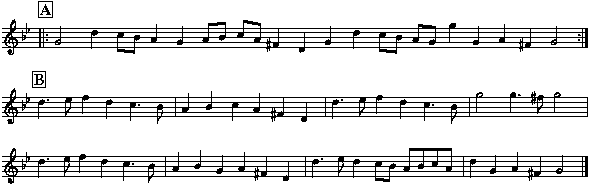
If you look at the second bar of the B-music, above it in the A-music you will see the same 6 notes, except that the first four are half the length. Changing these from quavers to crotchets gives us the first two bars in 3-time with the second bars of A and B identical. Now look at the next 6 notes of the A-music — they're identical to the first 6 except that again the timing is different. Replacing these by the first 6 gives us another two bars of 3-time, and certainly to me the whole thing makes a lot more sense:

The dance instructions can stay as they are, with 6 steps instead of 5 for the moves in the A-music. And if you really want the music with the 5-time bars, here it is.
Whimbleton House
Format: Longways duple ImproperInterpretation: Colin Hume, 2007, revised 2011.
| A1: | (4 bars of 3-time): Ones cast into the middle of a line of four (6 steps) as the twos lead up and cast out onto the ends of the line. Lead up 6 steps. |
| A2: | Two-hand turn neighbour (6 steps) to finish facing down with the man on the right. Lead down 6 steps. |
| B: | (8 bars of 3 time): Set in line to the (non-existent) threes; ones (in the middle of the line) cross down and cast up (twos move in). Ones “Hole in the Wall” cross (6 steps); ones cast as the twos wait and then lead up. |
The Whirligig Updated 23-Jun-26
Skip to instructions Updated 23-Jun-26Format: 3 couples longways
Dance: John Playford, Dancing Master 1651
Music: Cecil Sharp set this to the tune Woodicock, but I've also given the original.
You might want to look at Sharp's version.
Leade up all forwards and back .
That againe :The middle Cu. goe up betweene the first, cast off, and come to your places again, then crosse over betweene them like the Figure of 8. to your places . Then as much with the last Cupple : Cast off all, doe thus. Sides all .
That againe :The 2. man armes with the first Wo. and they three goe the S. hey, while the 2. Wo. turns the last man, and doe the like with them . That againe the 2. cu. changing their ends : Cast off all, doe thus. Armes all .
That againe :First four cast and come to your places, then take right hands a crosse, and goe round to your places : As much with the last Cu. : Cast off all, doe this change.
The music (either of the tunes) is a reel with a 4 bar A and an 8 bar B, each repeated according to the underlined dots in the instructions. But what do we make of Cast off all, doe thus.
at the end of the first two figures and Cast off all, doe this change.
at the end of the third figure? Well, there are plenty of progressive dances in the first Edition, and at the end of figures you will see a phrase such as “Do thus to the last, the rest following”. See for instance “The Saraband”, “A Health to Betty”, “Kemp's Jigg”, “Nonesuch” (first figure), “Skellamefago” and I'm sure there are others. It just means that the ones have progressed at the end of the figure and then they repeat the figure with each couple in turn. But in The Whirligig there's no progression within the figure — to get a progression the ones cast to the bottom and the others move up. I suspect the comma is in the wrong place, and it should say “Cast off, all do thus”. You could do that for the first figure: the ones cast to the bottom, the others lead up, and then the new middle couple continue leading up to start the figure. You could probably do it for the third figure: the ones cast to the bottom, the others lead up and go straight into the cast and lead — tight but possible. I don't believe you could do that for the second figure! Sharp as usual takes the wording literally: Cast off all
so he invents an extra A-music, and an unusual move to go with it. Normally in dances such as “Bridge of Athlone”, “Waves of Tory”, “Barley Reel”, “Hebridean Weevil” and many other traditional-style dances the followers go down the outside and then lead up through an arch with their partners. Sharp doesn't use an arch, but he has the followers leading down through the bottom couple and casting up to progressed place. This always presents problems and people do too wide a cast so then they're late for the next figure. I say “Tops cast, the others follow, take your partner's hand and lead down through, cast up to a new place”. Yes I really do say “take your partner's hand” all nine times: some people seem to need it.
I teach this with no mentions of numbers, and only one mention of sex (“gender” for Americans) which can easily be changed to “opposite person” and I make it clear in the walkthrough that you're going out on the diagonal rather than arming with your neighbour.
When I started dancing, people took literally what Playford said in the first figure: and come to your place again
which Sharp interpreted as and return to places
— note the significance of Sharp using the plural. So people would do the half figure eight and then rapidly cross back to the proper side. Surely Playford didn't mean that — he meant “finish in second place”. The whole purpose of a half figure eight — and notice that Playford actually says like the Figure of 8
whereas Sharp carefully doesn't — is to change places with your partner. That frantic crossing over (twice) has died out now. So no difficulty interpreting the first figure, in which only the middle couple are moving.
In the second figure the middles are again the actives, but everyone else is highly involved. Playford says armes
for the second man and turns
for the second woman, but armes
is a more specific direction so I believe both of them do an arm turn — but which arm? I was calling this in a “Positional Playford” workshop at Lichfield Folk Festival in June 2026 — people seemed really nervous about dancing positionally — and I found that “Middles go left and arm right” was too much for many people. And I'm really not surprised. Imagine you're doing the Great Cast, perhaps people have made you slightly late, you lead up to middle place and think “Oh, it's us! Where am I? Which is my left? Oh, wait — which is my right arm?” And as usual the woman has the harder job: she's just led up but now she has to do a complete change of direction to go down to the bottom man. I expect that's why the middles go left, so the man has it easy — probably almost all the dances were written and taught by men! I co-opted Bill Keyes (excellent dancer and sound engineer) to make up the final set, and afterwards he said that was probably the first time he'd ever danced Whirligig, which really surprised me — obviously it's been out of the common repertoire for quite some time. And then Lorraine Morgan, who's been dancing at my local club much longer than I have, said it used to be a standard part of the repertoire there — but I wouldn't call it there now because I know they wouldn't get through it. So if it's not generally known, why not do the sensible thing and change it to an arm left? That's the nearer arm, after all; it was Cecil Sharp who standardised many things (quite understandably) and decided it should be an arm right. If you arm right you need to turn more than once to get to the other person's partner and start the reel; if you arm left it's slightly less. But there's an even more compelling argument. If you're the second man and you arm right with the first woman you then pass first man left, the ones pass right, you pass the first woman left, then the first man right, and after four changes you're on the outside of the set with a long way to go to reach the other end. But if you arm left you pass the first man right, the ones pass left, you pass the first woman right, and after only three changes you're on the outside of the set and you can pass your partner right shoulder while the ends complete the reel and flow into the arm left at the other end.
I called it this way in St Albans for Friday Folk in September and it worked really well. The middles had to be persuaded to turn right after the hey rather than looping left to continue the hey, but after that it was so easy that people were actually early and waiting to start the Great Cast. It's nothing like as frantic as the Sharp version. One person argued that the twos hadn't done a full hey, but I don't agree. The hey starts after the arm left has gone about half-way, so the second man is improper at the top ready to start the hey passing the first man right shoulder, and the second man finishes the hey when he is again improper and on the outside.
When I was calling it Sharp's way I would add: “And after the second hey you'll find that the top woman is already facing out, so when I say Great Cast don't face up and spin round, there isn't time, just go.” And I would actually delay the call “Great Cast” very slightly, otherwise there's a danger that the second woman will still be at the top and think she's supposed to initiate the move — you can see exactly that the first time through this figure in the video, though they recover beautifully. That simply isn't a problem with my improved version, but you've still got to be on the ball and call everything at the right time, which is difficult if you're reading it off a card — if you can't learn the whole dance, at least memorise the second figure.
The third figure isn't at all controversial, and Playford actually specifies right hands a crosse
so there's no argument — it's a right-hand star at each end.
Isabelle Woodford from The Round in Cambridge — probably one of the few places in the world where this dance is still standard repertoire — thought it strange that the first two figures are led by the middles whereas the third figure is led by the ends. In fact on the video above the middles are in charge — they're advancing menacingly on the end couples to make them cast. I actually taught it that way at Lichfield, but even if you don't want to do that at least click the image above to watch it. After the arming introduction I usually say: “The bottom couple have a vital role now — you stand still!” and after the Great Cast I point out that the new bottom couple are standing still and they continue to stand still, while the top two couples are moving up and the middles are chasing the tops, ready to flow into the next figure. At Friday Folk many people really got into the spirit of “scaring the ends”, though you will meet people (particularly in the States, I suspect) who will protest that Playford is a serious thing and you shouldn't fool about in it. That's nonsense, and I'm sure they didn't think that way in 1651 — they danced these dances because they enjoyed them. And there are a number of Playford dances with “miming” in them. “Her Killing Eyes”: The first Man points at the 2d Wo's Eyes, then lifts up both his Hand
and others which I'll add later.
At Lichfield I explained that “Whirligig” was another word for “Roundabout” or “Merry-go-round” — a device you get at fairs or children's playgrounds where you are spun round until you're dizzy — which seems an apt description of this dance. Afterwards Alain Williams said it was more likely a reference to a beetle which swims around rapidly in circles, and sent me the Wikipedia link. But according to the American Merriam-Webster Dictionary,
English speakers, and particularly children, began spinning whirligigs as early as the 15th century. Since then, whirligig has acquired several meanings beyond its initial toy sense. It even has a place in the common name of the whirligig beetle, a member of the family Gyrinidae that swiftly swims in circles on the surface of still water. The word whirligig comes to us from Middle English whirlegigg (“whirling top”), which is itself from whirlen, meaning “to whirl,” and gigg, meaning “(toy) top.”
So maybe we were both wrong, and it's a children's spinning top.
Finally a note to the musicians. I've written out the two 4-bar A's as a single A, so I say to them: “Play one A and two B's repeatedly, and occasionally I'll shout out A so you'll play a second one.” Some of them don't like that — they feel they need to know exactly what the sequence is — so I tell them, and it doesn't help them one bit! All you need to know as a caller is that when the dancers are doing the third Great Cast, which will bring them back to their original places, you shout “A” so that the band will play an extra A for the siding and the arming, and then make sure the band stop (on an A) after the final Great Cast.
The Wrirligig
| First Figure: | |
| A: | Up a double and back. That again. |
| B1: | Middle couple lead up through the top couple and cast back. Cross up and cast, finishing improper. |
| B2: | Lead down and cast up. Cross down and cast up (home). |
| A: | “Great Cast”: Cast to invert the set. Ones stay at the bottom, the others lead down and cast up to progressed places. |
| Repeat B1, B2, A twice until all are home. | |
| Second Figure: | |
| A: | Side right shoulder to right. Side left. |
| B1: | Middle go left: Arm left with opposite sex, into heys of three across the set, middles end improper and move up or down the outside while the ends finish the hey. |
| B2: | Middles go left: Arm left same sex (same two people), into heys of three across (home). |
| Great Cast, etc. | |
| Third Figure: | |
| A: | Arm right. Arm left. |
| B1: | Middles chase the top couple: mini-cast back to place. Right-hand star. |
| B2: | Middles chase the bottom couple: mini-cast. Right-hand star. |
| Great Cast, etc. | |
Whitney's Farewell
Source: Henry Playford, Dancing Master 9th Edition, 1695.The 1. Man turn the 2. Wo. with his Right-hand, and then turn his own Partner with his left; then 1.Wo. turn the 2. Man with her Right-hand, and then turn her own Partner with her left . The 1. cu lead thro' the 2. cu. and cast up, the 2. cu. lead thro' the 1. cu and cast off, the two Men take hands and fall back, the two We. do the like at the same time, then all four meet and clap hands with your Partners, and then the 1. cu cast off :
James Whitney was a notorious highwayman, and his “farewell” was when he was hanged. I was motivated to look at this dance on reading Graham Christian's excellent article in CDSS News, Summer 2021 (archived).
No difficulties of interpretation — except that the underlined dots suggest that there's only one A and one B. The 1721 edition has no time signature; there's a version at the bottom of this page (purporting to be Playford, though it's actually from Walsh's Dancing Master) specifying 6/4 which usually means a 6/8 jig and that's certainly how I hear the tune, so I'm assuming two A's and two B's. I've used the standard clapping sequence, and I'm glad to see that the twos are specifically allowed to join in with this since Playford says “All four” and “Partners”, so nothing controversial this time.
Whitney's Farewell
Format: Longways duple.Interpretation: Colin Hume, 2021.
| A1: | First man right-hand turn second woman. Then left-hand turn partner. |
| A2: | First woman right-hand turn second man. Then left-hand turn partner. |
| B1: | Ones lead down through the twos and cast up. Twos lead up through the ones and cast down. |
| B2: | All fall back a double with neighbour; lead forward. Clap with partner: together, right, together, left; ones cast, twos lead up. |
The Windmill Added 12-Aug-25
Source: The Cotillons made Plain and Easy… Thomas Hurst, 1769 Added 12-Aug-25Format: Square
The Figure The four Ladies right hands across in the middle once round
This done, the four Ladies fall back to their places and the four Gentlemen advance to the middle and left hands across once round
The Gentlemen still keeping the left hands across, each takes his Partner with his right hand and turn once more round in a large cross, and all finish in their proper places
NB. This tune having three strains the two last are used for the Figure, as are also some others in like manner.


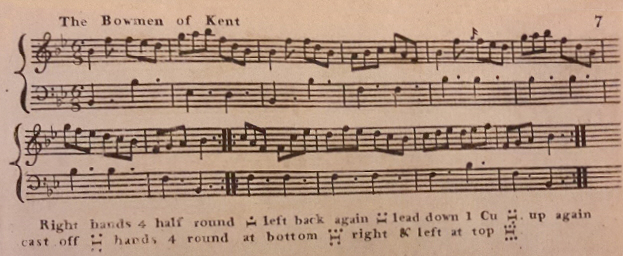
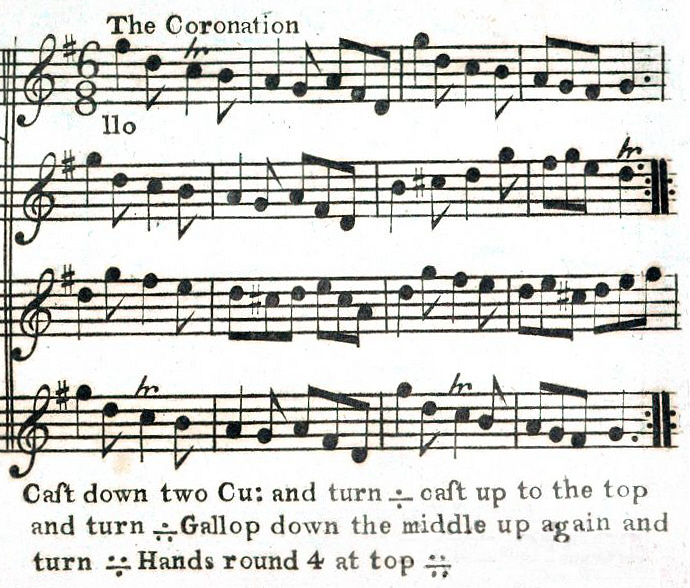
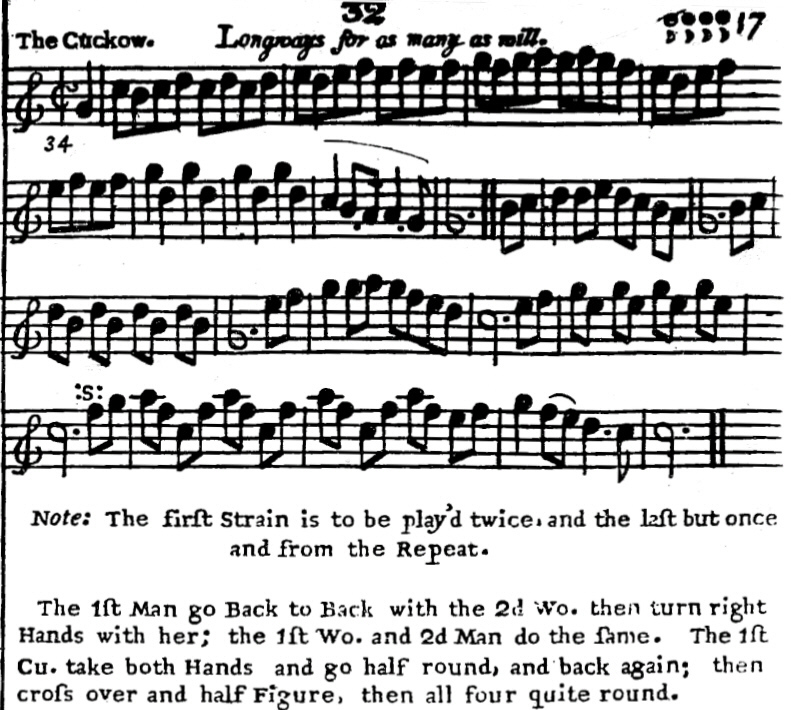
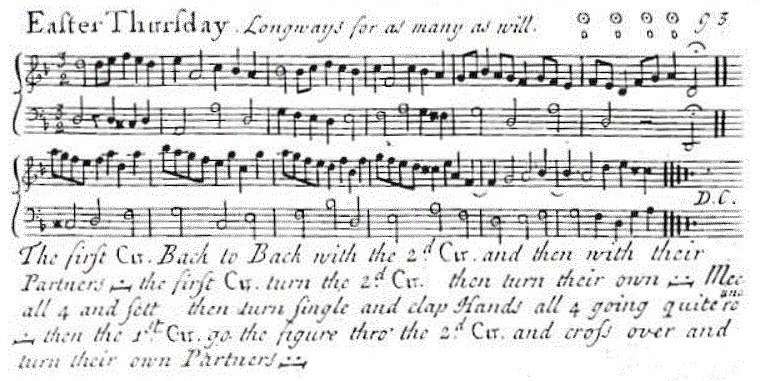

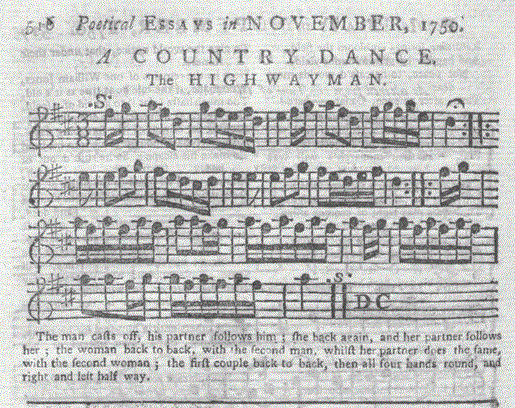
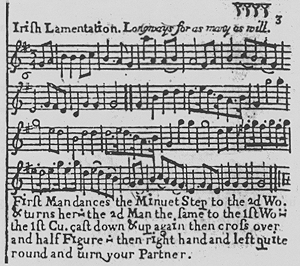
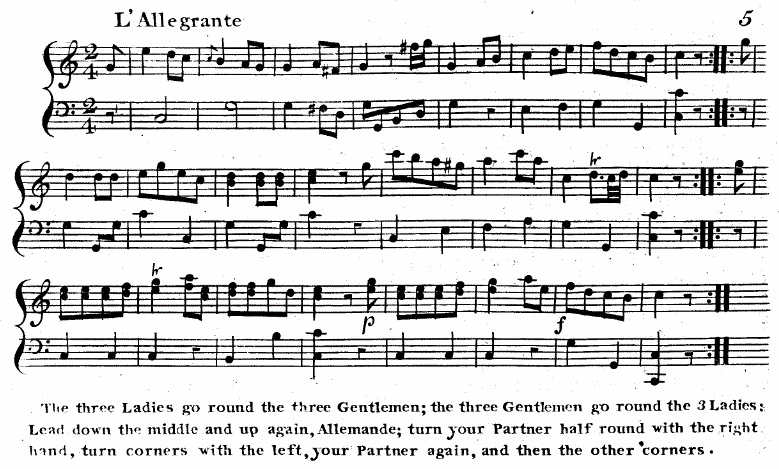


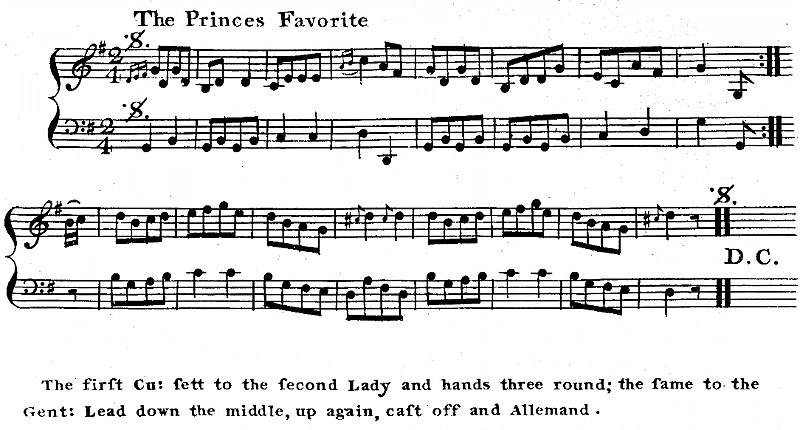
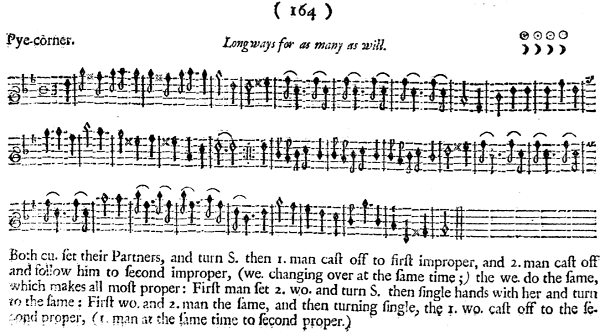

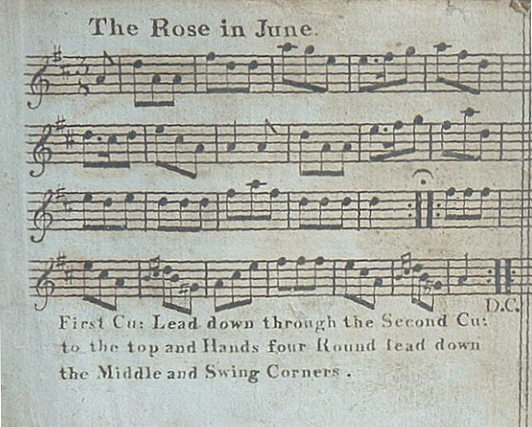
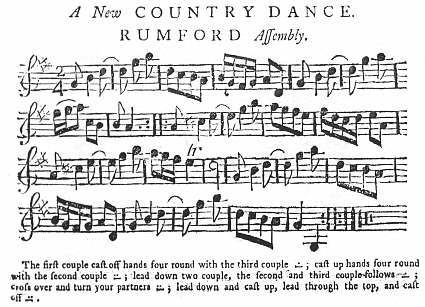
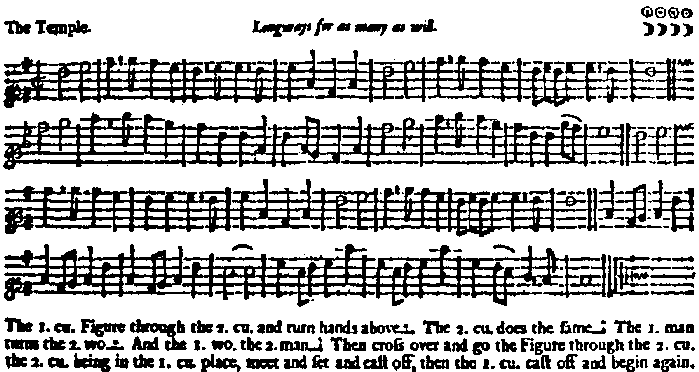
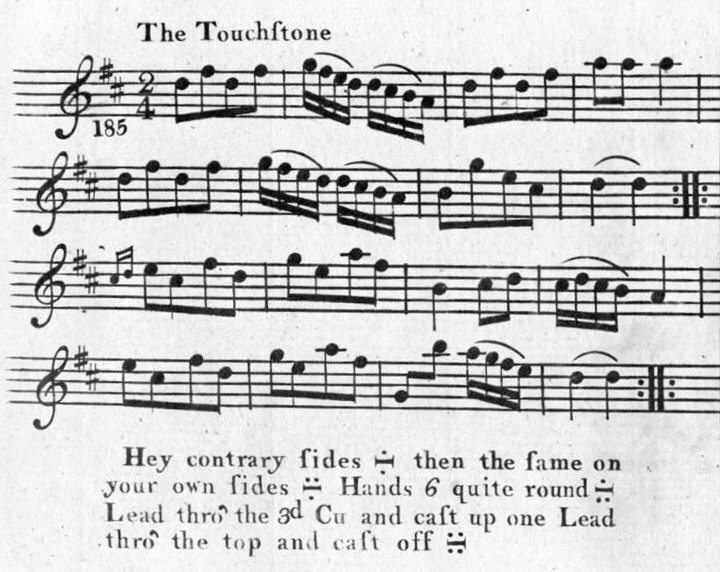
George Williams has an animation of this dance at upadouble.
The Figure seems very simple — indeed the book goes roughly from simple to complex and this is only number 3. I would do it all to a skip-change step, except a slip-step for the Grand Round, which what they would have done then. The music is a jig and consists of A, B and C sections, each 4 bars repeated. The Figure is danced to the B and C music. The single star could be done in 4 bars (4 skip-change steps or 8 walking steps) but it really isn't possible to do the double star in 4 bars, and open out back in square formation. One simple change would be for the star promenade to go half-way. Could this be what Hurst meant?! See The Royal Traveller for more information about this book and my low opinion of it, also an explanation of the Changes and the Figure. If I were doing both these cotillions in one programme I would do the Traveller first and use some of Hurst's later Changes for this one.
Again I must point out that Anne Daye of the Historical Dance Society totally disagrees with me. She says,
I see no problem with this simple figure. Yes, the double star has to press on briskly but far from impossible. The men and women swap places at the same time, as Hurst says, so no issue there. No need to insist on half way round. That would make it very mincy in stepping — good chassées will achieve the travel needed.
| B: | The Figure: Ladies right hands across. Pick up partner with spare hand: star promenade half-way. |
| C: | Men left hands across. Star promenade home. |
The Witches Added 10-Sep-26
Source: Dancing Master 5th Edition, 1675: John Playford Added 10-Sep-26Format: Longways duple minor
Honour to the Presence. Lead up all forward and back . That again : The two first men take hands, the two first we. do the same, and put back till the men fall in the we. places, then right hands to the man, and left to their own wo. then the first man and second wo. clap first their own hands, then each others at the same time; second wo. and first man cast off till you fall in each others places, then all round in a ring, then the second man and first wo. cast off while the other clap and round again in a ring, and then the like to the rest .
My interpretation appeared in the book Playford with a Difference, Volume 1 which I published in 1995 — and I made a mistake which I then had to apologise for in the corrections. Over 30 years later I've looked at it again and made slight changes to both my interpretation and my chords — even Cecil Sharp changed his mind occasionally!
The music is an 8-bar A and an 8-bar B. The underlined dots in the instructions seem to imply that the A music is played twice and the B music once. Honour to the Presence
I take to mean “step right and honour; step left and honour” which is four bars, and this combines with Lead up all forward double and back
to give A1. That again
for A2. But the rest of the instructions cannot possibly fit into a single B — or even two of them. I think what we have here is a non-progressive introduction (as in “Never Love Thee More”) and a progressive figure beginning with The two first men take hands
. So I'd use one A and one B for the introduction.
Once you realise that put back
means “poussette”, you can see that by giving hands to your neighbour a half poussette does indeed put the men in the women's places. right hands to the man, and left to their own wo.
sounds like two changes with hands, again starting with neighbour, which gets you to progressed positions. But now the problems start. The remainder appears to be a symmetrical pair of moves: two people lead it the first time; the other two the second time. But which two? Playford refers the first man and second wo
and then to second wo. and first man
— but these are the same people! The second time he refers to the second man and first wo.
and then the other
(presumably “others”). Since it's very rare for Playford to refer to the woman before the man, my guess is that second wo. and first man
should be “second man and first wo.” — it's not likely that he would say the other
if he meant “the same people”!
My original assumption was that the clapping and casting were done by the same pair, which is quite quick. So the first corners clap — presumably their own hands together and then both hands with each other, one beat for each, and then 6 steps to dance round the outside to each other's places, so I had them moving clockwise since that would flow smoothly into the circle left.
But before publication I showed the manuscript to Tom Cook, who was interpreting dances long before I was. He suggested that at the same time
refers to the second corners casting and should go after the semicolon. In fact the phrase as it stands is superfluous: if you're clapping hands with another person you obviously have to do it at the same time! Virtually all the movements start with the word then
— except when it comes to the cast. And in the repeat he puts the clapping and casting in the reverse order and joins them by while
, so it seems clear that the two movements occur at the same time and therefore are done by two different pairs of people. I had to accept Tom's argument, and in changing my wording I got it wrong as I mentioned at the start. Now we notice that because Playford has reversed the clapping and casting the second time, we have people doing the same thing both times. Maybe it's less change to assume that the first mention of the first man and second wo.
is wrong, but maybe that's the one which is actually right and Playford got confused thereafter. We shall never know.
However, at the end of all this we find the couples unprogressed and improper — not where we wanted them to be at all. My solution is that the circles should be three-quarters rather than all the way, and that the original first corners (now in second corner positions) should cast first so that the first circle ¾ brings everyone back to their starting positions. Playford's contributor doesn't actually say that the circles go all the way and probably hadn't realised that they were only ¾, since they both end with everybody proper; I can imagine that with a lot of EFDSS dancers if you just called “circle left”, that's where they would end up!
Of course there are other possibilities. Tom Cook suggested that right hands to the man, and left to their own wo
might mean “right-hand turn neighbour all the way, then left hand turn partner all the way”. This indeed means that circles all the way would get you to the correct place — but how would you fit it to the music? You wouldn't want to do two full turns in eight steps — you'd need eight for each — and that would force you to expand the half poussette to 8 bars (16 steps) which is far too many. But as I said, Tom forced me to change my mind on who is doing the casting, though I think it's more exciting if the same people do the claps and then the cast — it certainly wakes them up a bit. So that means instead of two quick claps we can have a whole 4-bar clapping sequence! What sequence should we use though? Row well ye Mariners which appears in most Editions of The Dancing Master from the 1st Edition of 1651 to the final 18th Edition of 1728+ has:
Clap both your owne hands, then clap each others right hands against one anothers, clap both your owne hands againe, then clap left hands, then clap both hands againe, then clap your brests, then meet both your hands against one anothers . The same againe only clap left hands first :
I'm happy to use the first half of that sequence.
But now I've changed things so that the people doing the clapping aren't the same ones who are doing the cast off
maybe I should rethink which was the casting off goes. I know some contra dancers in the States like continuous clockwise movement because it gives them a dizzy feeling, whereas many dancers in England dislike it for the same reason! And cast off
suggests going in the opposite direction. After the two changes there isn't any opposite direction so the current second corners could go either way. But after the circle left ¾ there certainly is an opposite direction so I'm now suggesting they cast left shoulder and go round the outside anti-clockwise. And (once again!) I'm publishing my new improved version without trying it out — I'll let you know in November what real people think of it!
The Witches
Interpretation: Colin Hume, 1995-2026.Format: Longways duple. Note: Only one B for the introduction.
| Introduction | |
| A: | Step right and honour the presence; the same left. Up a double and back. |
| B: | All that again. |
| Figure | |
| A: | Half poussette with neighbour, first corners pushing. Still facing neighbour, two changes (giving hands) to progressed places. |
| B1: | Current first corners (second man and first woman) clap: together, right, together, left, together, cross on chest, both while current second corners dance anticlockwise round the outside into each other's place. Circle left ¾ [home]. |
| B2: | New first corners clap while second corners cast left shoulder and dance anticlockwise round the outside into each other's place. Circle left ¾ to progressed places. |