200 Years of American
When dancers in England say “American” we usually mean squares and contras, and perhaps a few dances in other formations — a double contra, a circle, maybe one of Ted Sannella's triplets. Whatever the formation, we tend to think of the American style as a walking step, giving plenty of weight, lots of swings. But when the Pilgrim Fathers reached America in 1620 they presumably brought their dances with them, just like their books and clothes — or if they frowned upon dancing it was later immigrants who brought the dances — and for at least a hundred years their dances were English Country Dances. In 1730 James Alexander, who emigrated from Scotland and made his fortune in New York City, wrote out the instructions for twenty-seven dances in a notebook. You find most of them in various editions of The Dancing Master — a few are from other English sources — and there's nothing American about them: the American gentry were dancing English Country Dances just like the English gentry.
But as time went by people in America started composing their own Country Dances — both instructions and music — so let's start with two which most people class as American. The first is from The Gentleman & Lady's Companion; containing the newest cotillions and country dances; to which is added, instances of ill manners, to be carefully avoided by youth of both sexes. 1798. Norwich, printed by J. Trumbull.
The Young Widow 


Original wordingInterpretation: Colin Hume, 2008.
This was Norwich in Connecticut. John Trumbull was the son of Jonathan Trumbull 1710-85, colonial governor of Connecticut, and you can find on the web an announcement of the Spanish declaration of war on Great Britain printed by him, with comments from Boston and Providence.
The same dance was published with identical wording probably ten years earlier in A Collection of the newest and most fashionable Country Dances and Cotillions The greater Part by Mr. John Griffith Dancing-Master in Providence.
Formation: Longways triple
Original wording — I can't find this on the Library of Congress site since they reorganised it.
Four hands across half round at top, back again, lead down the middle, and turn your partner half way, then up again, and cast off one couple, the first gentleman stand between the second and third ladies, so his partner between the second and third gentleman, balance all six, then all half way round, first couple stand still, when the 2d & 3d couples balance in the middle, and half right and left, so every one come to their former places.
| A1: | Ones and twos right-hand star (skip-change step). Left-hand star. |
| A2: | Ones give two hands and do four slip-steps down the middle; two-hand turn half-way. Slip back, cast to second place (twos lead up). |
| B: | Lines of three balance twice (see “fancy step” below). Circle 6 left half-way (skip-change step). |
| C: | Ones fall back slightly, the others face neighbour and keep inside hand with partner: balance twice. Two changes with hands (skip-change step). |
If you want to convert it to a 3 couple set dance, the ones need to cast to the bottom at the start of C and the twos in third place need to move up while doing the fancy step.
There's a different version (though with the same unusual C) in Asa Willcox's book of figures, a manuscript source from 1793. There's also a version, essentially the same, in Saltator, 1807, and a completely different dance for the tune (without that C figure) in the 1802 edition of Saltator, printed in Boston.
Susan de Guardiola says the circle would have used a late 18th century/early 19th century travelling step, which is almost identical to a skip-change step.
Alan Winston says,
Around 1800, it's likeliest that all travel would be chassé steps, either forward (“skip-change”) or sideways (“slip-step”). Down-the-middle-and-back would be holding two hands, slip in a restrained way down the middle (probably for three, not four), some kind of finishing step (rigadoon, maybe), two-hand-turn halfway sounds plausible (although a baroque dancer suggested turning on the rigadoon), slip up the middle, cast off using skip change to middle place.In my opinion, whenever you see eight counts of setting, it's an invitation to improvise, or show off. It's perfectly adequate to pas-de-basque twice, but you can also do a clever little clog step, “beaten step” (hop on left while bringing right behind, hop again and bring right in front, repeat to right side — looks very Scottish) etc. This is a paraphrase of Jim Morrison's description from his “Twenty-Four Early American Country Dances, Cotillions and Reels for the Year 1976”.
The word “balance” can mean many different things at different periods (and sometimes in the same period). It could simply be what English dancers call “set” (just as Scottish dancers say “balance in line”) in both of these dances.
A much later source, Dick's Quadrille Call Book (1878) says,
BALANCE IN PLACE.— Slide the right foot to the right, bring the left foot in front of the right in third position, count two; slide the left foot to the left, bring the right foot in front of the left in third position, count two; repeat the whole, count four.BALANCE TO PARTNERS.— Danced by each couple independently. Partners face each other; make three short steps to the right, and stop, count four; three steps back again to the left, and stop; count eight. Join hands and turn once around in places; count eight.
In calling this movement, it is sometimes termed set to partners.
Maybe because this is a later publication, the steps have been converted to walking steps.
I'll go with Alan Winston's suggestion and use his “fancy step” in several dances (though you can just set twice if you want to).
If you want more detail, “behind” is behind the supporting leg at mid-calf, “in front” is in front of the supporting leg at mid-calf. In between, the foot goes out to the side (with considerable turnout, so the toe is pointing along the set line). On the fourth beat you step on the right foot, hop and extend the left foot to the left, then repeat the sequence using the other foot.
As Alan says, it looks very Scottish. I'm told that there is a similar step in Welsh dancing, and two ladies who were doing the step really well when I ran the workshop at Southam put this down to their International dancing experience. And at Brasstown someone said it was very like a Russian step. It's strange that lots of people seem to think their chosen dance form sprang into being fully formed, in complete isolation from any other dance form. It's obvious to anyone who looks at them with an unprejudiced eye that English, Scottish, Irish Set, American Square and Contra are all interrelated, and I now have a workshop called Connections where I explore these links in more detail.
Alan also says,
The traditional contras started out (in the 1700s and early 1800s) at a time when the focus of dance interest was footwork, which you went to school for, not choreography. Choreography was simple and straightforward but footwork — chassé steps, dozens of different balance steps — was the focus, and it was what you used to show off. Children got sent to dancing school for years to learn steps, style, and gentility. It isn't until the mid-1800s that the footwork goes out in favor of walking steps. My theory is that we started developing rich people who hadn't grown up rich, and who wanted to dance and not look stupid. But dancing masters start discouraging footwork in country dancing after the mid-18th century. In 1792, random adults who'd never danced couldn't walk in the door and do it well. That was a change that happened after country dancing died out except in really rural backwaters — where, typically, you didn't get a lot of strangers coming in the door.
Money in Both Pockets
Source: American manuscript, circa 1800. There's a different dance with the same title in the aforementioned book, as often happened with a popular tune.Interpretation: Colin Hume, 2008.
Format: Longways duple
The first Cu. sett and hands three round with the second LadyDo the same with the second
Lead down the middle, up again
Cast off and right and left at top


I believe Cast off
should belong to the previous phrase of music, as is very common (and as in Preston's version), so I interpret this as:
| A1: | Ones balance twice to second lady (see “fancy step” above) who acknowledges them. Those three circle left (skip-change step). |
| A2: | The same with second man. |
| B1: | Ones give two hands: slip down the middle and back and cast off. |
| B2: | Four changes with hands (skip-change step). |
“Money in Both Pockets” is one of the dances that appears on the “Caricature Fan” in the British Museum and is dated 1792, and I've now found it in Cahusac's “Twelve Country Dances for the year 1792” which is the wording given above. Another version was published by Preston in 1793 with some differences in the tune and “Foot it and change sides” instead of the ones footing it and then circling. You can see Preston's original here.
George Washington's Favourite
Original publication: 1793. Interpretation: Susan de Guardiola, 2008.Source: Asa Willcox's book of figures
Asa Willcox calls it “G: Washingtons Favourite” (British spelling rather than American) and beside the title he notes that it is a Cotillon. Despite what some people will tell you, it's not called “George Washington's Favourite Cotillion” — click on Image 9 above to see the original wording and Image 5 to see the index (with all three words misspelt).
The late 18th century French Contradanse was in square formation — a French version of the English Country Dance, which then returned to England as the Cotillion or Cotillon and was documented in 1770 by Giovanni Andrea Gallini. It was described in 1802 by Saltator in the States:
The Figures of Cotillions, consist of two parts, the one is termed the change, the other the figure. There are ten changes, which are the same in all regular cotillions, but every cotillion has a different figure, which is performed between every change, and once after the last change.
Quoted in From the Ballroom to Hell by Elizabeth Aldrich. Other sources say there were usually twelve changes, and my example has five changes. These things weren't as set in stone as some writers would like you to think. Hurst in 1769 has fourteen, though he says,
Observe also, that if at any Time the Dances are required to be shorten'd, let the Performers call, and do the great Ring (wherever they have a Mind to curtail it) instead of the Changes that were to have followed, and so conclude it; and, in this Manner, the Cotillons may be concluded at the Pleasure of the Dancers.
| Introduction: | |
| A1: | Honour corner and partner. |
| Changes: | |
| A1&2: | Take inside hand with partner and balance twice (or “fancy step”). Slip circle left. Step. Slip circle right. |
| A1&2: | Men step. Men right-hand star. Men step. Men left-hand star. |
| A1&2: | Ladies step. Ladies right-hand star. Ladies step. Ladies left-hand star. |
| A1&2: | All face partner and step. Grand right and left half-way round. Step. Grand right and left to place. |
| A1&2: | Take inside hand with partner and step. Slip circle left. Step. Slip circle right. |
| Figure: | At the end of each change, heads step in to make lines of four and let go of partner: the figure is danced with your neighbour (corner). |
| B1: | Couples slip sideways to change ends of the line you're in (right-hand couple in front); set right and left. With opposite couple right-hand star half-way; fall back into lines. |
| B2: | Slip sideways to change ends (again right-hand couple in front); set right and left. With opposite couple circle left half-way, let go and meet partner at home. |
In many publications the changes are given as 8 bars not 16, but Saltator in 1802 spells out that there is setting added before each of these, and reconstructors of Early American dance (Morrison, Keller & Sweet, Millar, Ticknor) all use eight counts of setting (or “pas balancé and rigadoon”) before the figure proper. I used to avoid a rigadoon, which I thought was a silly step, but I've now got better at it! See my Regency Dance page.
I've made assumptions above about who does the step and which way they face: this is just my opinion!
The cotillion was popular during the first two decades of the nineteenth century — Jane Austen enjoyed dancing cotillions. It was then gradually replaced by the quadrille, which dropped the standard set of changes and just concentrated on figures (in the plural). In fact the change-over wasn't as simple as that, and some people still referred to quadrilles as cotillions, making for much confusion among researchers. To add to the confusion, the word “cotillion” acquired a second meaning — by the mid- to late 19th century it was a series of dance games and mixers, some quite silly, in which small groups of couples danced by turns. There were hundreds of figures, and these dance-games were known variously as “German Cotillions”, “Cotillions” and “Germans”.
In 1858 Elias Howe wrote Howe's Complete Ball-Room Hand Book. There are lots of good quotes in this — some may seem quaint, but many are still relevant today. For instance:
Every caller should have a good variety of figures, well arranged, but easy, and never, unless on some particular occasion, or request, call wild, crooked and outlandish figures, that mix the company all up together, where they are left to get back to their places the best way they can. In large companies, if there seem to be a number who are not much acquainted with figures, or who do not dance often, which is generally the case at such times, let the figures be simple and easy, and be particular to call the same figures for the side couples, that you do for the first four, or top couples; as those who are not much acquainted with figures, often take their places on the sides, to see how they are performed. In calling, let the voice be natural and easy, speaking just loud enough to be distinctly heard throughout the room.
He also recommends (in effect) taking hands six from the top:
In forming for Contra Dances, let there be space enough between the ladies' and gentlemen's lines to pass down and up the centre. It is usual for those at the foot of the set to wait until the first couple has passed down, and they have arrived at the head of the set; but there is no good reason why they should so wait, as every fourth couple should commence with the first couple.
Susan points out that there were two men called Elias Howe: one was the inventor of the sewing machine; the other was a highly successful music publisher from Framingham, Massachusetts.
For more information see en.wikipedia.
Susan has traced some of the contents of his books plagiarised from other authors. In fact many of the manuals were plagiarised in this era. Charles Durang actually says in one of his books that he lifted sections from other dancing masters who were better writers!
My version of the music is modal, in other words it seems to be in D major but all the C's are natural rather than sharpened. I'm afraid I don't remember where I got it from! The standard version is in the book: “George Washington: A Biography in Social Dance” by Kate Van Winkle Keller and Charles Cyril Hendrickson. This is definitely in D major, with all the C's sharpened, but they don't give a facsimile and Susan doesn't know where to find the original — James Hulbert's “A Variety of Marches” published in Northampton, Massachusetts in 1803.
The Devil's Dream
Elias Howe -- Howe's Complete Ball-Room Hand Book 1858, Image 88Interpretation: Colin Hume, 2008.
Original wording:
Form in sets of six couples. First couple down the outside and back (foot couple up the centre same time), first couple down the centre, back, cast off, (foot couple up the outside and back at the same time), ladies chain first four, right and left.
Since this includes a ladies chain, I assume the top couple are improper, and any couple becoming neutral must change sides, just as in a modern improper contra. Howe says it was danced “fifty years ago or more” which takes it back to 1808, and it would then have been done with steps rather than just walked. There's also the odd business of him specifying “foot couple” rather than “second couple”. They would have started with just the top couple active, and the original twos would have become ones when the original ones started the third turn of the dance. So for the first five turns of the dance it would be the same foot couple starting each time. Presumably for the sixth turn the original ones, having reached the bottom, would rapidly change sides and become the new foot couple, and so would each active couple in turn. You would have three active couples leading down and one foot couple going up the outside. I find this hard to believe, so I'm assuming he meant the second couple. I know that later sources say the same as Howe, but see the bit about plagiarism above! On the other hand Elizabeth Burchenal in her book “American Country Dances” (1918) describes the dance in great detail and still says the same, though she does say that the top couple start improper and explains the end effects:
All couples except the first couple are “neutral” at the beginning of the dance.When a “neutral” couple reach the head of the set, the man and woman exchange places, stand idle during one repetition of the dance, then become “active,” and dance as described for the first couple.
When an “active” couple reach the foot of the set, they become the Foot Couple, dance as described for the Foot (sixth) Couple, then exchange places and become “neutral.”
| A1: | First couple move down the outside while the second couple take inside hands and lead up the inside. Turn and come back. |
| A2: | First couple take inside hands and lead down the inside while the second couple move up the outside. Turn and come back, and the ones cast below the twos who move up or lead up. |
| B1: | Same two couples full ladies chain. |
| B2: | Same two couples full right and left. |
There's a mention of this dance (though not the instructions) in Al Brundage's Little Black Book from the 1950's, and he describes it as “6 couples to set” (though he couldn't tell me why), but I know it as longways duple improper. This is still the most popular contra in England; it was published in the Community Dance Manuals in the 1960s and is often used as the final dance of an evening. It's so similar that it makes me think my interpretation of Howe's instructions is correct (though maybe that's a risky argument), but the leads have been reversed — now the ones start going down the middle rather than down the outside.
| A1: | Ones lead down the middle, twos up the outside. Come back, turn neighbour half-way with the handy hand. |
| A2: | Ones down the outside, twos up the middle. Come back, meet with a left-hand turn all the way. |
| B1: | Ladies chain across and back. |
| B2: | Half promenade. Right and left through. |
Chorus Jig
Interpretation: Community Dance Manual, 1960's.Formation: Longways duple or triple minor, proper
Original wording from The Musical Cabinet Published by T.M. Baker Charlestown [Massachusetts], 1822
Chorus Jigg: First couple lead outside; up again; down the middle; up again; cast off; swing contra corners; balance and change sides.
Susan says of this version,
It's not online; I came across it in a library. It's an entire book of sheet music with dance figures for two of the tunes (Money Musk is the other).I thought this might be interesting in the event that you wanted something to fill the hole between the c1800 stuff and the 1850s stuff. It's close to the mid-century and modern figures; the only difference is the “change sides” instead of turn at the end. I'd probably use a pas de basque setting step with something this early, and do the down the outside and down the middle as sideways glides (holding both hands with partner when down the middle), and the casting as two separate moves: a turn at the top to get behind the line (2 bars) and then sliding sideways down to second place (2 bars). Skip changes for contra corners and the change of sides.
For the mid-century version, if you prefer to stick with that, I'd use the four-steps-to-right-shoulders balance rather than the slide-right-and-left version since the latter is awkward in a country dance set with people on either side of you. I figured that even if you use the mid-century version it would be interesting to have the older one as background color.
Original wording from Howe's Complete Ball-Room Hand Book 1858, Image 85:
First couple down the outside, up—down the centre, up (cast off)—swing contra corners—balance and turn to places.
First we'll try it as they probably danced it, except that we'll take hands six from the top rather than having just the top three couples start. It's a four part tune (though actually the B and D parts are the same) so I'm writing the instructions that way rather than A1, A2, B1, B2.
| A: | Ones down the outside and back. |
| B: | Ones down the centre and back, ones cast off as twos lead up. |
| C: | Ones turn contra corners: partner right, first corner (third lady or second man) left, partner right, second corner (third man or second lady) left. |
| D: | Ones face each other: move into line right shoulder to right; fall back. Two-hand turn to progressed place. |
Then we'll try it in a modern longways duple version. This means that the twos of one first couple are also the threes of the next first couple up the set, so they have to turn people coming in both directions — the original version is an easier introduction to contra corners.
| A: | 1st couple down the outside, turn and come back home. |
| B: | 1st couple down the centre, lead back and cast (progression) . |
| C: | Right elbow swing with partner, left with corner (the man faces down and the girl faces up). Repeat with partner and other corner. |
| D: | 1st couple balance and swing in centre. |
This wording is from Community Dance Manual 4, published by the English Folk Dance and Song Society in the 1960's. In the States this would be duple minor and the ones and twos would put an arm round their neighbour for the cast off. In CDM 4 it's actually in the Triple Minor section, but the book then says:
Note: With more experienced dancers, the set may be duple minor and all may dance simultaneously the right elbow swing (partner) and left elbow swing (with contrary).
I was unaware of this — I don't own the CDMs — until Mike Courthold asked me about it in January 2021. The two crucial differences are that the set needs to have a lot of space between couples, and you're not turning the inactives on their side of the set — there aren't any inactives — all the elbow turns are in the centre of the set. I pointed this out to Mike, and then said:
Of course modern contra-dancers (particularly in the States) would complain loudly about a dance where they do nothing for the first half, which is why modern dances have four in line down the hall rather than the ones' solo. So if you really want to bring it up to date:
Double Chorus Jig
Modification: Colin Hume, 2021.Formation: Longways duple minor, proper
| A: | Ones cast down to the end of a line of four facing down as twos turn up and out to meet them: lead down, turn in towards neighbour. Lead back, then the twos wheel the ones in to finish in a line of four facing down, this time with the ones in the middle. |
| B: | Lead down in a line of four, turn in towards neighbour. Lead back, then the twos wheel the ones round and down to second place. |
| C: | All acting as ones, turn contra corners: partner right, first corner left (in the centre of the set), partner right, second corner left. |
| D: | All balance and swing, finish facing up proper. |
To amplify the C section: All turn partner right three-quarters into one long wave down the middle of the set, so your first corner is in your left hand. Left-arm turn all the way, back to the wave. Right-arm turn partner half-way, so your second corner is in your left hand. Left-arm turn all the way.
Mike said:
I absolutely love your modern variation, which transforms the normally very dull experience for the 2s into something fully inclusive. I will use this variation at the Alcester Zoom Contra on Friday, and credit you with the modern variation. The good thing about Zoom Contras is that the ghosts are excellent dancers.
And finally we'll see how the contra corners movement has been cleverly used by Jim Kitch from Philadelphia in his modern classic “Alternating Corners”, available in his book “To Live is to Dance”, 1995.
A somewhat earlier book than Howe's is by Huestis:
Huestis: The Ball-room instructer, 1841 (this copy is from 1851), “containing a complete description of cotillons and other popular dances — with illustrations — written and arranged for amateurs in dancing: New York, 1841”.
from which I have chosenPREFACE The present little work contains within a small compass, all the information which is interesting to the world of dancing, at the commencement of a winter's season. It has been deemed best to limit the dances described to those which are most fashionable and approved. The author's principal object is to instruct those who have neglected, or have not had an opportunity of attending dancing-schools, in the figures of quadrilles and other popular dances; and even those who are paying for a quarter's tuition will find this an interesting and useful companion at home, giving ample instruction for practice, while the scholar is not subject to the gaze of an assembly.
The author has bestowed considerable pains on the following pages, as he was anxious to render the contents worthy of general approval. His information has been derived from the most unexceptionable sources; and his own observation, during the many opportunities he has had of seeing the best sets of dances in the elite of public and private ball-rooms in this and other cities, had furnished him with the most useful materials in the accomplishment of a task which he hopes will prove satisfactory and agreeable.
There are many unacquainted with dancing, who labor under an erroneous impression, that “the steps” are all that are necessary to be learned to fit a person for the ball-room. In our modern assemblies, scarcely one person in ten is acquainted with them; and if they are, they make use of steps to please their own fancy, or intersperse with them those they have been taught. A person well skilled in graceful and classic, steps, and unacquainted with figures, would certainly make a ridiculous appearance, beside confusing others in the set; while one thoroughly acquainted with figures, would go through without difficulty—strict attention to good dancers being only necessary for an acquirement of movement, of which scarcely two can be found alike; and which even those who attend schools acquire more by practice and observation than by tuition.
Spanish Dance
Original publication: Huestis: “Ballroom Instructer”, 1841. Interpretation: mainly Patri J. Pugliese, 2001.Original wording (1841) (see Image 34)
This can be danced by any number of persons. The couples take their position on the floor in the following manner: first couple at one end of the room, back to the wall—the next couple directly before, and face the first—third couple next to the second, and face the same way as the first—fourth couple next, and the rest in the same manner, till the column is completed, which may go the whole length, or completely round the room, according to the number present. If all have taken their positions right, the couples will be in the following order: first and second couples face each other—and third and fourth, fifth and sixth, and all others in the same manner.The music for this figure must be a waltz, or tune in triple time, as Cinderella waltz, Kate Kearney—the Cachuca and others. It commences with
Balance .—Gentlemen and partners take hands; first and second couples balance forward to each other and back, balance again, and gentlemen exchange partners—first and second gentlemen taking the left hands of the opposite ladies and turn partly round, so that the couples may face each other, but across instead of lengthwise of the columns; balance again, back, forward, and both gentlemen take the left hands of the opposite ladies, (their partners,) and turn so that they may again balance lengthwise of the room, but both couples have exchanged places; the balance is performed four times, by which means each couple will have occupied and balanced from four different positions.
Cross Hands .—The two ladies take right hands, and gentlemen take hands across them, forming a star; the four half round, change hands, face the other way, and back to places. Partners take hands and promenade to the right, in a circle, the first couple passing the second, and stop facing the third, next below, with whom they balance, &c. This completes the description of the figure, as after the promenade the couples balance to those before them as at first. Every two couples in the column balance at the same time. After every balance and promenade, by passing those with whom they previously balanced, the gentlemen and partners will find themselves facing a different couples; so that a lady and gentleman commencing at one end of the room, may go to the other by the time the music ceases; which in this dance depends entirely on how long the company may choose to keep the floor.
I'm not saying this is a specifically American dance, but as you can see it was “most fashionable and approved” according to the preface. The book gives full and clear instructions for the dance, explaining that it can be (in modern terms) longways duple improper or a Sicilian Circle, and I don't see many problems in interpreting it. You can see a very similar version in greater detail by Patri Pugliese archived here.
Formation: Sicilian Circle Music: 32 bar waltzes
| A1: | Give inside hand to partner: balance forward and back towards the other couple; give the other hand to your opposite and the man roll the lady across in front of you so that you have changed places. Keep hold and do the same movement, rolling partner across so that you are in the other couple's place. |
| A2: | All that again, finishing home. |
| B1: | Right-hand star. Left-hand star. |
| B2: | Take a cross-hand hold with your partner and promenade all the way round this couple, the men giving left shoulders, then move on to meet the next. |
There's too much music just to promenade on to the next couple in B2. Two ways of using this up are promenading forward and back to the other couple before promenading past them, or promenading all the way round them and then on to the next, and since Patri has used the latter I'll go with that. Other dance manuals have the couples taking ballroom hold and waltzing one and a half times round the opposite couple — there were lots of variations on this dance. Notice that the dancers chose when the dance was to end, not the MC/Caller or the band. I wonder whether they all waved their hands at the band and shouted “enough”, or whether they just promenaded off the floor! The dance appears on many, many ball cards and in dance manuals all the way into the early 20th century — it was definitely a popular one. It has a commonly-used tune called the Spanish Waltz.
Belle Brandon Set
Original publication: 1858. Interpretation: Susan de Guardiola, 2008.Here's a quadrille from Howe's book.
Source: Howe's Complete Ball-Room Hand Book, 1858. Original wording (see Images 32 and 33):
BELLE BRANDON SET. No. 1. (3 strains.) First four right and left — balance and turn partners — ladies chain — promenade four — side couples the same.
No. 2. (2 strains.) First two forward and back, cross over — chassee cross, back — balance and turn partners — next two the same, and so on.
No. 3. (2 strains.) First two give right hands, cross over, left hand back and form a line — balance forward and back, half promenade — chassee across four — forward and back, half right and left to place — next two the same.
No. 4. (3 strains.) Forward two, back to back — balance and turn partners — four ladies chain — all chassee across — other couples same.
No. 5. (3 strains.) First four lead to the right and form a line — right and left from lines — ladies chain, from lines — all forward and back, and turn partners to places — side couples same.
Susan notes that this (like most mid-century quadrille sets) is a variation on the First Set, with the main variation, typically, coming on the fourth and fifth figures while the first three are essentially the standard ones.
What of steps? As always, dancing masters complained in their books that the dancers weren't what they used to be. Thoinot Arbeau (1520-1595) in France in his Orchesography of 1589 (see Image 57)
Our predecessors danced pavans, basse dances, branles and corantos; the basse dance has been out of date some forty or fifty years, but I foresee that wise and dignified matrons will restore it to fashion as being a type of dance full of virtue and decorum.and I don't suppose he was the first. Or Thomas Wilson in The treasures of Terpsichore in 1869 (see Images 3 and 4):
It is I believe notorious, that if Country Dancing continues to decline as fast as it has done for sometime past, that the once delightful amusement will shortly dwindle into mere running, and that beautiful regularity of movement, which should always be displayed in a Country Dance, be perverted into a chaos of riot and confusion. [And he goes on in this vein for 24 pages.]
In 1858 Elias Howe wrote in his Complete Ball-Room Hand Book (see Image 25):
Fifty years ago or more, the Country Dance was the only one danced in this country, except in the cities and large towns, where several fancy dances were occasionally performed; but even in those places the country dance reigned triumphant.The dances that were at that time the most fashionable were: “Fisher's Hornpipe,” “Chorus Jig,” “Sir Roger de Coverley,” “The Cushion Dance,” “Money Musk,” “Speed the Plough,” “The Devil's Dream,” “College Hornpipe,” “Rustic Reel,” “Six Handed Reel,” “Reel fore and after a straight four,” “Durang's Hornpipe,” “The Sailor's Hornpipe ,” &c.
It was then the custom to take all the steps in each of the different changes, and to introduce the “Pigeon's Wing,” or some other flourish, as often as possible; dancers at that time often boasted that they “put in so much work” as to wear out a pair of dancing slippers in one evening. The walking or sliding through the different changes, so fashionable at the present day, would have filled our forefathers with horror and disgust.
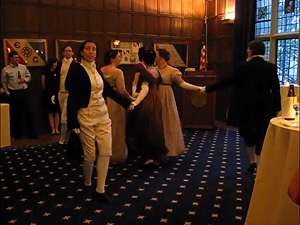
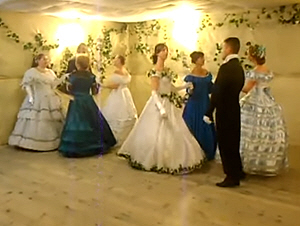
Each figure starts with an eight-bar introduction; for the first figure you honour partner and corner; for the others you do nothing. To give this in more detail: Man step left (2nd position), close right foot (1st or 3rd position), bow and rise. Woman step right (2nd position), close left foot behind (4th position), sink, bending both knees, weight on left foot, lifting right heel slightly, holding skirts of gown (out, not up), then rise bringing the weight onto the right foot and closing left into first position. This takes two bars; repeat in the other direction. Notice that you are moving the same way as your partner, unlike modern English Country Dance.
You will probably recognise the names of all the figures, but they may not mean what you think.
| First Figure: | |
| A1: | Heads full right and left (with hands, the man turning in at the end of each half). |
| A2: | Heads balance to partner (four slip steps right, four left). Two-hand turn. |
| B1: | Ladies chain across and back — no arm round the waist, and the man turns in at the end of each half. |
| B2: | Promenade inside the set all the way, using a cross-hand hold. |
| Sides repeat the figure. | |
| Second Figure: (Ones have their backs to the band, Twos are facing the band, Threes are on the Ones' right and Fours are on the Ones' left.) | |
| A1: | First lady and opposite man forward and back. Cross over and face each other. |
| A2: | Same people chassé four steps to the right (slanting slightly to stay within the set); four to the left. Cross over and face partner. |
| B: | Head couples balance and two-hand turn. |
| Then second lady with opposite man, third, fourth. | |
| Third Figure: | |
| A1: | First lady second man cross giving right hands. Cross back with a left, keep hold, give right to partner in a wave. |
| A2: | Balance forward and back in line twice. Half promenade across, to the other head couple's place. |
| To start the half promenade, second lady just turns in to face the same way as her partner, but the ones need to do a right-hand turn half-way and then the lady turn in while starting to promenade around — there isn't time to turn and then think about promenading. | |
| B1: | Head couples chassé across to change places with partner (lady in front); set to opposite. Chassé back (lady again in front); take inside hand with partner and set to opposite. |
| B2: | Forward and back. Half right and left to place. |
| Then second lady with opposite man, third, fourth. | |
| Fourth Figure: | |
| A1: | First lady second man forward and back. Back-to-back. |
| A2: | Balance and turn partners. |
| B1: | Four ladies chain — men turn in at the end to punctuate it rather than just flowing into the second half. Chain back. |
| B2: | All four couples chassé across to change places with partner; set to the person you have now met. Chassé back; take inside hand with partner and set to opposite. |
| Then second lady with opposite man, third, fourth. | |
| Fifth Figure: | |
| A1: | Heads lead to the right; set to this side couple. Give two hands to opposite and slip away from partner while turning half-way, to form lines across (facing partner); set in lines. |
| B1: | With the opposite couple, full right and left. |
| A2: | With the same couple, full ladies chain. |
| B2: | Lines forward and back. Two-hand turn partner to place — men need to move strongly towards your partner to start the turn. |
| Sides repeat the figure. | |
Lots of unknowns here! After the chassé across, is it a balance forward and back, a set, or some fancier step. The sources don't say. Are you balancing to someone or in isolation? I've made some choices in the instructions above, but other people will tell you differently.
You can see lots of figures here which Americans would think of as typical American Square figures, and others frequently included in quadrilles were a grand chain (right and left grand) and a grand square. But if you know traditional English squares such as La Russe and Yorkshire Square Eight you will find the same figures, and for the same reason: both styles developed from the quadrilles.
Ralph Sweet, who has been calling American Squares for a long time, says that the “First Two” terminology survived into Ralph Page's times in a singing square: “First two give right hands across, Keep your steps in time; Back by the left, take hold of hands, and balance four in line” (forming an “Ocean Wave” line across the square for the head couples). That's exactly what we have at the start of the third figure. I've now found this in Honest John Part Two which Ralph published in his Northern Junket magazine in 1950.
Much of this reconstruction comes from Susan de Guardiola, who says that balancing for this period could be:
- slide to the right, back to the left (slips)
- four little steps forward and back to your partner (siding)
- take cross hands and galop diagonally across the set and back (men in each couple passing back to back)
Of the music, Susan says,
No. 1 is three strains probably played A BACA BACAA strain is usually (but not always) 8 bars, so when Howe says the first figure is three strains he means the music has A, B and C sections — in modern contra terminology a three-part tune. I didn't think I would to cope with this when calling the dance, but at Brasstown I managed to do so. One complication is that the tune I'm using for the third figure has a 16-bar A part, a Coda (which is the first 8 bars of this) and an 8-bar B-part. But if you look at Susan's bet above you see that there are always two A's together except at the end, so those two A's would be the 16-bar A and the final A would be the coda. Another complication is that the tune of Belle Brandon (from the printed song) has only two strains, not the three that are required.
No. 2 is two strains and could be A ABA ABA ABA ABA
No. 3 is likewise two strains and I'd bet on A ABBA ABBA ABBA ABBA
No. 4 is three strains and probably A BACA BACA BACA BACA
No. 5 is three strains and probably A BACA BACA
Figures typically start on the second strain (either the B part of a repeat of the A part) and end with a repeat of the A strain, and generally alternate back musically to the A strain over and over again.
When I looked at the start of the fifth figure, “First four lead to the right and form a line”, I immediately thought of the traditional square dance move, “Heads lead to the right, circle left with this couple, head gents break to form side lines”. Susan didn't agree with this at all, and we exchanged several emails, at the end of which she came up with her third version of this “really obscure figure”. Susan says,
Earlier versions of the figure (1810s-1820s): the heads moving to the sides followed by the chassez apart and into the lines of eight is a standard enough figure to be in manuals as a sequence. Look on the Library of Congress Collection for the books by Strathy and by Gourdoux-Daux for things like “trait for going to the side couples” or “figurer a droit sur les cotes”.Howe himself has the chassez apart in some versions of the figure in his different sets; I think it's an unspoken part of “form lines”. Unspoken bits aren't uncommon — example, “forward two” in some usages is the same as “forward two, cross over, chassez dechassez, cross back”, which is hardly obvious from the call!
I've looked through dozens of quadrilles in Howe and elsewhere and not seen a single one that uses your circling out into lines figure — I just don't see it in the 19thc repertoire. And it doesn't leave partners opposite each other, which is generally part of 19thc “lines” figures.
Susan has written the whole thing up at kickery.com/
The tune (which would be used for the final figure — presumably the climax of the dance) is that of an American sentimental ballad “Bell Brandon” by F. Woolcutt with words by T. E. Garrett, published in St. Louis — if this were live rather than a set of notes I'd sing you the first verse to give you the flavour:
'Neath a tree by the margin of the woodland,
Whose spreading leafy boughs sweep the ground;
With a path leading thither o'er the prairie;
When silence hung her night garb around.
There often have I wandered in the evening,
When the summer winds are fragrant on the lea
There I saw the little beauty Bell Brandon,
And we met 'neath the old Arbor tree.
These two lines were repeated in the original, with a pause on 'don' - I've removed one occurrence and the pause.
Chorus (in four-part harmony):
Repeat the last two lines twice. I've removed that too.
She dies in the last verse.
Here's a link to one of the standard sets of music for the First Quadrille, from Dick's Quadrille Call Book of 1878 (see Images 161-167) and here's the modern musical notation. In fact if you click the treble clef sign at the start of this dance you can download this set of tunes with the fifth one replaced by “Bell Brandon” which will make things easier for the musicians. At Brasstown we used most of these for Belle Brandon, and Foxfire (Daron Douglas and Karen Axelrod) did a great job with the music. The final figure from the above book (which we didn't use, since we were using the Bell Brandon tune) is printed with a four beat introduction — just like the “four potatoes” that contra dance bands in the States almost always use.
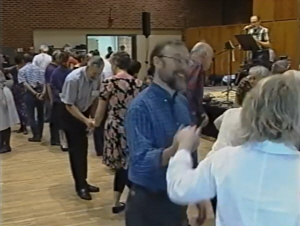
There were hundreds of sets of quadrille music. For instance at gsarchive.net/articles/
Other quotes from the quotable Mr. Howe:
In dancing, let your steps be few, but well and easily performed, the feet should be raised but very little from the ground, the motions of the body should be easy and natural, prefering to lead your partner gracefully through the figure, than by exhibiting your agility by a vigorous display of your muscles, in the performance of an entre chats or a pigeons wing, which may do very well for a hornpipe, but would be quite out of place in a Quadrille or Cotillon.
Persons who have no ear for music, that is so say, a false one, ought to refrain from dancing.
Never hazard taking part in a quadrille, unless you know how to dance tolerably; for if you are a novice, or but little skilled, you would bring disorder into the midst of pleasure.
I'm struck by the similarities to Irish Set Dancing. A quadrille has a number of figures, with a break between each (and different music for each, often with different rhythms). Each figure has an eight-bar introduction before you start dancing. In Howe's book they are almost all called “--- Set”. Even the numbering is similar, though in Irish the threes and fours are usually (but not always) the other way round:
In forming the sets on the floor, the first and second couples stand opposite to each other, and the third and fourth couples opposite; the third couple stands on the right of the first couple, and the fourth couple on the left of the first couple. In the été and all similar figures, the first 2 forward and back, &c., means, first lady and second gentleman; the next 2, second lady and first gentleman; the first 2 on the sides are the third lady and fourth gentleman; and the next or last 2, the fourth lady and third gentleman.
This is not the same as Playford numbering (clockwise) or American Square numbering (anti-clockwise). I had assumed the Irish just wanted to be different, but it seems they had a good precedent. And the last part of the fourth figure, with the chassé across and the setting, is so similar to the Irish “Sevens and threes”.
I've since read Pat Murphy's book “Toss the Feathers”, one of the best-known books on Irish Set Dancing, in which he points out that many of the Irish sets are based on quadrilles, and indeed the first set he describes — Aran Set — has the first side couple on the left of the first top couple, just as in quadrilles. You can see the instructions for lots of Irish Sets and learn much more at web.archive.
Sometimes the music was traditional reels, jigs and marches; sometimes it was taken from popular classical works. Howe gives instructions for the Leonore Set (presumably to tunes from Beethoven's opera), the Trovatore and Traviata Sets (ditto Verdi), and other books give many other examples.
Waltz Cotillion
Interpretation: Colin Hume, 2008.Leaflets of the ball room Being a sketch of the polka quadrilles, the Baden, mazurka figures &c. &c. to which is appended the music of the celebrated Redowa waltz, now first published in the United States. 1847.
Philadelphia, New York, Turner & Fisher, 1847
Original wording (see Image 14):
WALTZ COTILLION. FIGURE.
Places the same as a quadrille; top couple waltz around inside. First and second ladies waltz up to each other and cross over, turning twice; the gentlemen of the top couples do the same—the side couples do the same. The first couples waltz to places: the side couples do the same; the gentlemen take their partners by the right hand with their right hand; all waltz, (four bars) and turn their partners under their arms; all the gents go out right to each lady, executing this figure until in places. Form two lines at the sides, all advance twice and cross over, advance again and recross, and to places; all eight waltz round: the sides execute the same; the whole repeated four times.
| A1: | Honour partner. Honour corner. |
| A2: | First couple take ballroom hold and waltz round the inside of the set to place. |
| B1: | Head ladies go forward and back. Cross into each other's places, rotating clockwise 1½ (or 2½) as they go. |
| B2: | Head men the same, passing right shoulder. |
| C1: | Side ladies same. |
| C2: | Side men same. |
| A3: | Head couples take ballroom hold and waltz back to place. Sides the same. |
| A4: | All give right hand to partner: balance forward and back; change places, men turn the lady (counter-clockwise) under your arm while moving on to your right-hand lady. Same with her but left hand and she turns clockwise. |
| B3/B4/C3: | Continue this grand chain all the way round, but instead of finishing in home place the head men finish on the end of side lines facing your partner. |
| C4: | Lines balance forward and back twice (one waltz step each). Cross over and turn round. |
| A5: | Same, and take ballroom hold with partner in home place. |
| A6+B6: | All waltz once round the set to place using four bars to move each place — plenty of time. |
The figure is now repeated with the second couple (I'm assuming they're on the right of the first), and the lines will be across the hall rather than up-and-down. Then with the third and fourth couples leading, but I'd stop after half the dance! Once through the figure seems to be 14 lines of 8 bars, which is not a good number! Once through a 3-part tune (which a lot of waltzes were at that time) is 6 x 8 bars — and of course there's 8 bars for an introduction which throws everything out (to my way of thinking). And I want to make it easy for the band. So here's my cop-out solution: play the tune as specified: AA BB CC five times and then one extra A. In fact I just say “Keep playing the tune until I stop you” which is the sort of instruction a band likes! When the dancers are half-way through the final waltzing around I say “One more A” and they have a chance to bring the tune to a nice finish.
This is a quadrille, despite the title, not a cotillion with changes and a figure. The formation is even given as “same as a quadrille” rather than “same as a cotillion”. I've added a link to music called “Lady Nelson's Waltz” from a manuscript by William Mittell from 1799. Susan has dug through her 19th century sources and hasn't been able to find any music specifically for waltz cotillion, so she thinks any waltz from the period played in a suitable pattern for the dance is acceptable. My choice is a three-part tune — a good idea because it's quite a long figure — so once through the tune is 48 bars. I'm not saying that the dance is specifically American, but it was certainly popular there.
I wondered whether “waltz up to each other” mean “and back”, but Susan says that's unlikely at this time, though a later source (c.1880) does include this. Dances were slower-paced then. But when I tried it at Brasstown it seemed painfully slow, so on the fly I added the forward and back and I'm sticking with that! Susan also says of the “turn their partners under their arms” part:
Another source gives more explicit instructions for this move: take right hand in right, advance and retire (2 bars), then turn the lady under the right arm and advance to the next person (2 bars); do an entire grand chain (grand right and left) round like this, each change taking 4 bars, thus 32 bars total. Yes, this is another very leisurely figure. They weren't in any hurry, and the women were managing a lot of petticoats, which limits the speed of figures (all paths have to be curved out to give space to the ladies, who can't exactly race along.) Plenty of time to be graceful and make beautiful curvy lines.
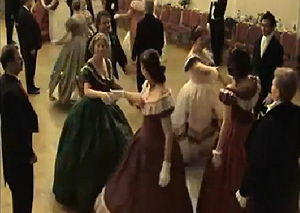
I have since found the following description in The fashionable dancer's casket; or, The ball-room instructor. A new and splendid work on dancing, etiquette, deportment, and the toilet. c. 1856, by Charles Durang whom I mentioned earlier as copying whole chunks of other people's books.
THE WALTZ COTILLION A pleasing little dance — places as in a Quadrille. Leading and side couples. It may be learned in a few minutes, to those who waltz, there being only one figure, repeated by each couple. The figure is as follows:—
The first couple valse inside the figure with either the “plain waltz” step, or Deux Temps, at pleasure, finishing at their places, and occupying eight bars. The first and opposite ladies cross over with a valse step, [ eight bars;] the first and second gentlemen do likewise; the third and fourth ladies repeat this figure, and then their partners; the top and bottom couples then valse to places, [four bars;] side couples do likewise.
Each gentleman then takes his partner's right hand, and they both advance to each other with a valse step, [one bar,] and then retire, [one bar;] the gentleman then passes the lady under his right, and she passes to the next gentleman, and he passes to the next lady in the same manner as the grand chain, in the Lancers, or, right and left all eight — [this occupies two bars with each.] This figure is repeated with every lady, until all regain their respective places, [taking thirty-two bars;] side couples separate, and join hands with top and bottom couples, forming four in a line; all advance and retire twice, [four bars;] then all cross over and turn, [taking four bars;] then re-advance and re-retire twice, (four bars,) and re-cross over to places, (four bars.) The four couples then valse round to places.
This completes the figure, but it is repeated four times, each couple in succession taking the lead.
This, though a most graceful and easy dance, has been put aside by the more fashionable round dances. In England it is very often introduced in private circles. The figures are easily followed; one or two couples knowing them is sufficient to keep it up.
We have occasionally introduced this dance in our Soireés, and varied its character by using the Polka step instead of the plain valse.
This variety has generally given satisfaction, as it makes an agreeable change from the Quadrille and round dances. If danced to the valse step, the music should be moderately fast only, as if too quick, it destroys the gracefulness of the dance.
It's clearly much the same dance, though Durang doesn't have “waltz up to each other” which I want to interpret as a forward and back movement before the two people cross over, nor “turning twice”, so it's difficult to see how this can fill up 8 bars of music for each pair of people. He also has head lines rather than side lines. And he also says that the waltzing back to place is only 4 bars for each pair of couples.
The Gothic Dance
Original publication: 1858. Interpretation: mainly Patri J. Pugliese, 2001.Here's a longways whole set dance from another of Mr. Howe's books.
American dancing master, and ball-room prompter, 1862
Original wording (see Image 129):
Form two lines down the room, the ladies on the right and gentlemen on the left.No. 1. Ladies advance two bars. Gentlemen then advance while ladies retire: gentlemen stop and hold up both their hands, while ladies pass under them to the other side. Repeat the whole to places.
No. 2. Two ladies and two gentlemen hands four round; gentlemen stop across the room and hold up their hands while the ladies pass under and twice round their partners; first and second couple galop down to the bottom and stop. Repeat the whole until into place.
Formation: Longways whole set Music: 32 bar jigs
| A1: | All join hands in lines: Ladies forward four steps; ladies fall back, men forward. Men arch, ladies under (passing right shoulder with partner); all turn round. |
| A2: | All that again, to places. |
| B1: | Top two couples circle left ¾; men make a two-hand arch, ladies lead through the arch and round partner the first lady goes 1¼ and the second lady 1¾ so you both finish facing your partner, facing in original direction. |
| B2: | Those couples take two-hand hold (or ballroom hold), gallop to the bottom and finish on your own side, the others moving up. |
| Repeat the dance until back in original places. | |
This is based on a reconstruction by Patri Pugliese archived here, with further clarification by Susan, who points out that the second lady has further to go and therefore in practice the ones tend to gallop down ahead of the twos rather than four abreast — it doesn't matter that the ones and twos have changed places when they join the bottom of the set. She also warns that there's very little time for the gallop to the bottom, particularly in a long set, and compares this to the trash-compactor scene in the original “Star Wars” movie — the walls are closing in!!! At least in this session the ladies aren't dancing in hooped skirts, which would really have slowed things down. In fact at Brasstown the dancers decided it was more fun with a long set, so people from one set spontaneously moved to the bottom of the longer set after they had done their gallop down and a good time was had by all!
Susan now says (2017): “Further research reveals its Englishness!”.
Howe prints a programme of an actual dance held on January 1st, 1858. It contains a Grand March, 8 Cotillons, 3 Contras, 2 Quadrilles, plus “Waltz and Schottische” in the first half and “Waltz, Schottische and Redowa” in the second half which I assume were couple dances, not called — they were unnumbered and therefore did not appear on the Lady's Engagement Card.
Susan tells me that a redowa is fairly close to a modern Viennese waltz in which counts one and three are a leap and a cut respectively rather than mere steps. It's quite athletic. I'm not going to teach you that, but we might do a free waltz to the tune of one of them!
Leaflets of the ball room Philadelphia, New York, Turner & Fisher, 1847 (See Image 3)
Sociable Set
Interpretation: Colin Hume, 2008.
The ball-room manual of contra dances and social cotillons, with remarks on quadrilles and Spanish Dance. Belfast (Maine) and Boston, 1863
Original wording (See Images 25 and 26)
COTILLONS. Note.—Sets are formed by four couples, all facing the centre of the set. The “changes” are called by the conductor, as they occur to his fancy. The “FIRST TWO” signifies the first lady and opposite gent.; the “NEXT TWO” the second lady and opposite gent., and so on. The double daggar [‡] indicates the place where the “side couples” or “next two” commence the figure.
The words in Italic are to be called the first time only. When repeating from the double dagger [‡] call those in SMALL CAPITALS.
SOCIABLE SET 1. All address corners and partners—first four ‡ right and left—balance four and turn partners—ladies chain—half promenade, half right and left. Sides ‡
2. First four ‡ lead to the right, change partners, and chassé out—half chain across, half chain in line—half chain across, half chain in line—right and left—forward and back, and swing to places—all promenade. Sides ‡
3. First two ‡ right hands across, left hands back, and swing between sides—forward and back six (first two), change places, forward and back again, and swing to places—ladies grand chain—all chassé. NEXT TWO. ‡ The same for 3d and 4th couples.
4. First four ‡ forward and back, half right and left—sides (FIRST FOUR) forward and back, half right and left—all chassé change partners taking corner lady—all promenade to ladies' place in the set. Sides ‡ (repeat from the first)—ladies grand chain—grand right and left—all promenade.
5. First four ‡ ladies chain—side (FIRST FOUR) ladies chain—all chassé—salute partners, give right hand, grand right and left half round—salute partners, and promenade to places—first four (SIDES) right and left—sides (FIRST FOUR) right and left—balance to partners, give right hand, grand right and left half round, salute partners and promenade to places. Sides ‡
Here's my reconstruction. As usual there's an eight bar introduction before each figure. In the first you honour corner and partner; in the others you do nothing.
| Figure 1 | |
| A1: | Heads rights and lefts. |
| A2: | Heads face partner: slip right and left. Two-hand turn partner. |
| B1: | Head ladies chain. |
| B2: | Heads half promenade (across the middle of the set, men passing left shoulder). Half right and left. |
| Sides repeat. | |
| Figure 2 | |
| A1: | Heads lead out to the couple on your right; set to them. Give two hands to opposite: four (small) chassé steps out while turning half-way to form head lines; set in lines. |
| A2: | Half ladies chain up and down. Half ladies chain across. |
| B1: | Same. |
| B2: | Full right and left up and down. |
| C1: | Lines forward and back. Two-hand turn partner to place. |
| C2: | Promenade round the square with a cross-hand hold. |
| Sides repeat, the lines being side lines and the half chains and right and left also being the other way. | |
| Figure 3 | |
| A1: | First lady and opposite man right-hand turn. Left-hand turn, to finish with the man falling back between his left-hand couple and the lady between her left-hand couple in side lines of three. |
| A2: | Forward six and back. Actives cross over, turn alone. |
| A3: | Forward six and back. Actives two-hand turn 1¼ and fall back to place. |
| B1: | All four ladies chain across (open left-hand turn with the man) and back. |
| B2: | All chassé across, men behind partners; set to the one you meet. Chassé back; set to partner. |
| Repeat for each couple in turn. | |
| Figure 4 (The Sociable figure, where you dance with each partner in turn) | |
| A1: | Heads forward and back. Half right and left. |
| A2: | Sides the same. |
| B1: | All chassé across, men behind partners; set to the one you meet. Chassé back and go past partner to corner (left-hand lady); set to corner. |
| B2: | Men roll to the left and take cross-hand hold with corner — promenade to the lady's current place (almost all the way) so that the ladies are half-way round the set and the men are one place to the right from their original place. |
| Heads repeat this, then sides repeat all this twice, until everybody is home. | |
| A1: | All four ladies chain across and back. |
| B1+B2: | Grand right and left all the way round — four walking steps per hand, curving rather than just pulling by. |
| A2: | All promenade once around. |
| Figure 5 | |
| A1: | Head ladies chain across and back. |
| A2: | Side ladies same. |
| B1: | All chassé across, men behind partners; set to the one you meet. Chassé back; set to partner. |
| C1: | All acknowledge partner, then grand right and left half-way round. |
| C2: | All acknowledge partner and promenade all the way round the set to this place. |
| A3: | Heads full right and left. |
| A4: | Sides same. |
| B2: | All chassé across, men behind partners; set to the one you meet. Chassé back; set to partner. |
| C3: | All acknowledge partner, then grand right and left half-way round. |
| C4: | All acknowledge partner and promenade all the way round the set to home place. |
| Repeat with the sides taking the lead. | |
Susan points out that the first figure is the standard First Figure of the original First Set of quadrilles, the figure known as “Le Pantalon”. And she reminds me that the music would not be AABB, but A BABAx2 if you have two strains; A BACAx2 if you have three. I'm still struggling with this concept, though Susan keeps beating me over the head with it, because I'm so used to the AABB structure of 95% of English dances (both Playford-style and traditional), American contras and New England Squares. But this is a dance tradition that developed separately from longways dances. Musician Liz Stell of Spare Parts says,
Most 19th-century classical music is based on the rondo form (and much before and after the 19th century). The most common form (at least for that era?) is ABACA. You'll hear that in almost all ragtime music and some of the earliest tangos; it was common in popular music of the late19th century and early 20th century as well as classical music.
Rondo basically means returning to an original motif — see the Wikipedia article en.wikipedia.org/wiki/Rondo
Susan also quotes Thomas Wilson, The Quadrille & Cotillion Panorama, 1815:
As these Dances are composed as Rondos, they should always finish with the first Strain.
This also explains why Irish sets always seem to be across the music. The musicians have forgotten about the rondo form but remembered that the dance should finish on an A-music, so they play standard AABB 32-bar tunes which means that the figure starts on the second A and then they change tunes for the last 8 bars of each figure, finally finishing with that extra A.
Howe's book doesn't give any music. Susan found the music I've transcribed at levysheetmusic.mse.
It has the Sociable figure as the fifth figure. I am pretty sure that the cover associated with this sheet music in that collection does not actually belong with it, so don't cite the cover info as the source for the music. It's misbound somehow and I haven't had time to query Johns Hopkins about it.For what it's worth, the Cauliflower music in the same set is congruent with a later piece of music for the Cauliflower, so the Sociable tune could well be the name tune for that figure in its incarnation as a free-floating promiscuous figure. In other words, I think this is a plain first set of figures (1 & 2 are first set figures) with some promiscuous figures substituted in for figures 3-4-5-6.
Since the music assumes six figures and the dance has only five I'm leaving out the Columbus music, and my approach is:
- First figure (Fitz James): ABCABCA
- Second figure (The Cauliflower): (ABAC) x 3, A
- Third figure (The Circassian): (ABCA) x 7, A (maybe!)
- Fourth figure (The Sociable): (AAB) x 5. A
- Fifth figure (The Campbells are Comin): (AB) ad nauseam, A
forward and back six, (first two) change places. So it's just the actives crossing over and doing the “swing to places”. Susan also says,
“Ladies grand chain” could be either a standard ladies chain involving all four ladies or the four ladies doing a rights and lefts, often ending with the ladies in the center of the set facing out towards partners. Technically, the former is a ladies double chain and the latter is the grand chain, but different writers in period confused the terms, and this is a notably unreliable source. You could go with either one, but I think I'd lean towards having the four ladies do a rights and lefts (with hands) and end next to their partners. Similarly in figure 4.
The fourth figure is the Sociable figure, because you change partners so that the men dance with all four women. This is specified as being done once for the heads and once for the sides, but it obviously needs to be done four times to get your partner back so I've specified twice for each. I'm also assuming that the right and left grand is 16 bars rather than 8: Susan says 8 bars would be a rush, and it would also make the repeated part 32 bars and the remainder 24 bars which she says is a very unlikely combination.
The fifth figure seems particularly problematic — Susan tells me I have a knack for finding some challenging reconstruction problems, but I know she enjoys rising to a challenge just as I do. There are two kinds of salute — one a bow or curtsey (courtesy) which is done in passing and takes no extra music, the other a more formal one which takes four bars. Read about them on Susan's web site at kickery.com/
Head ladies chain—side ladies chain—chassé—salute, half grand right and left—salute, promenadeand the second half:
Heads right and left—sides right and left—balance to partners, half grand right and left, salute, promenade.Maybe there's a chassé missed out of the second half, and maybe the balance should be a salute. I know this is all conjecture, but it produces a danceable version of the quadrille and Susan says that a 72 bar figure does seem musically and historically unlikely.
I can't resist this quote from Dick's Quadrille Call Book:
This is a very lively dance, and keeps everybody busy. Gentlemen should not attempt to ask their partners any momentous questions, as the ladies have no time to answer, much less to deliberate first what the answer should be; and if a lady should attempt to reply to a confidential question, she would be very likely to tell it to the wrong man.
Valerie Webster points out that by 1863 while they would still have been doing the steps these would have been much flatter; the ladies' corsets meant that they couldn't get so high in the air!
Let's move on to some contras that you might actually see at a contra dance today (though the hot shots wouldn't like them):
Petronella
First published 1892. This interpretation: 1970's.Original wording from Prompter's pocket instruction book by Prof. L. H. Elmwell, Boston's popular prompter, 1892. (See Image 48) Notice the British spelling of “centre”.
First couple balance to side (4); Balance to centre (4); Balance to side (4); Balance to centre (4); First couple down the centre, back and cast off (8); Right and left (8).
We'll dance a few turns to these instructions, but taking hands four from the top rather than having just the top couple start.
Format: Longways duple proper.
| A1: | Ones spin clockwise to own right, to finish with the man roughly between the twos and the lady slightly below the previous twos; set to partner. Spin to partner's original place; set. |
| A2: | Spin to the third point of the diamond; set. Spin home; set. |
| B1: | Ones lead down the centre. Ones lead back and cast into progressed place, twos move up or lead up. |
| B2: | Full right and left. |
As you can see, the twos don't get to do much — and there might have been threes there who did nothing at all. So here's a version from the early 1970's with more action for the twos:
| A1: | Ones spin clockwise to own right into a diamond (the man needs to finish below the twos this time); all take hands and balance in and out. All spin one place; balance. |
| A2: | All spin one place; balance. All spin one place; balance. |
| B1: | Twos spin home as ones lead down the centre. Twos face up as ones lead back, and gate the ones round into progressed place. |
| B2: | Right and left through. And back. [Pass through, then wheel around with the left-hand person moving backwards.] |
David Millstone gives more information on the modification:
It was the traditional English dance Roxburgh Castle that led to the American version where all four dancers turn to the right and balance. Two young New Hampshire dancers had just returned from Pinewoods where they had danced Roxburgh Castle, and when Dudley called Petronella, they decided that they didn't want to stand around, so they inserted the other two dancers into the figure and thus was born the variation that Dudley promptly dubbed “Citronella.”Ted Sannella later gave Dudley a hard time for this, saying that Dudley had encouraged this and he should have stopped them, to which Dudley replied that there was no way you could stop these young'uns from doing what they wanted. Ted really didn't like the four-person balance; it offended his sense of how Petronella was supposed to be done, somewhat in the same way that Ralph Page stopped calling Money Musk because he didn't like the noisy balance that young dancers put in it.
Many modern contra dancers wouldn't be happy doing a right and left through in a proper formation. “Petronella” started as a Scottish dance (indeed it's the first dance in RSCDS book 1) and the RSCDS version has exactly this move (for the ones only), except that the travelling turn single comes first and then the set. So the moving and spinning isn't an American invention.
Susan has found a version of Petronella in the manuscript “Contre Danses a Paris 1818” (which also has notes from 1849, although she believes the Petronella to be part of the 1818 material) which is very similar to the 1890s one — clearly an older version of the same dance. It's a 24-bar dance, and it does indeed have the move-and-set, though it's fast — four moves and sets in only 8 bars of music. That's followed by down the middle and up to second place (8 bars) and poussette with the top couple (8 bars, and would be a Scottish-style leaping-and-turning poussette). That is exactly the RSCDS version except that the RSCDS have expanded the first section to 16 bars. The instructions say to “turn to the right and set”; it's not clear if that implies the spinning or just moving to the right. But the moving is very clearly spelled out, and the spinning is a very reasonable interpretation.
Pat Rugierro queried this:
That part about the Scottish-style poussette is very interesting! I have long understood that the RSCDS poussette was devised by Milligan and Stewart as a hybrid of the historical poussette (couples move out from the setlines, back in; repeat to place) and the “dance around,” in that it combines the older two-hand hold with the movement of the contemporary “dance around” where individual couples (as a unit) rotate clockwise at the same time the two couples travel counterclockwise around each other. From what you say, the RSCDS poussette has deeper historical origins.But there must be differences, because the RSCDS 8-bar, quick-time poussette is a figure of progression, whereas in this 1818 dance, with the 1s already progressed, the poussette is not progressive.
Allison Thompson replied that Thomas Wilson (dancing master writing between 1805 and about 1820) in The complete system of English country dancing notes two poussettes: Image 70 shows the “Half pousette or draw” which is non-progressive and Image 71 shows the “Whole pousette” which is progressive and in which the couples pass around each other twice. (From the diagram and the wording Wilson clearly means 1½ times.) See also my essay on Poussette.
I've had to update all my links (an arduous task) because the Library of Congress changed them all, so this may not be the book Allison is referring to, but it contains the figures she refers to. Allison said originally that this manuscript is in the National Library of Scotland and is considered a Scottish source, despite having a French name and being concerned in large part with French steps for quadrilles. The Auld Alliance really lasted in the area of dance; one of the best English-language sources on early French quadrilles was by a Scot.
Most of the old contras were very unequal — the ones had all the action and the twos just assisted as necessary. Exactly the same as in 18th century English Country Dances, but then the dance ran until everyone had had the same number of turns being ones.
Polka Quadrille
Interpretation: Colin Hume, 2008.Original wording from Prompter's pocket instruction book, 1892 — see Images 33 and 34.
POLKA QUADRILLE.
(Form the same as for Plain Quadrille.)Wait (8); All polka inside the set (16); First four forward and back (4); Four hands around (4); First couple polka inside (16); Sides forward and back (4); Four hands around (4); Second couple polka inside (16); First four forward and back (4); Four hands around (4); Third couple polka inside (16); Sides forward and back (4); Four hands around (4); Fourth couple polka inside (16); Grand right and left half around (8); All polka around the hall.
This is a single-figure quadrille, and no difficulties in interpreting this one except deciding that in 16 bars there's time to polka twice around the set. As usual, there's an 8 bars introduction. The ladies need to start each move on the right foot, men on the left, so that you are on the correct foot to polka. I still haven't called this one.
| A1+2: | All take ballroom hold and polka twice around the set, moving one place to the right every two bars. |
| B1: | Heads lead forward and back. Heads circle left. |
| A3+4: | First couple polka twice round the inside of the set. |
| B2: | Sides lead forward and back. Sides circle left. |
| A5+6: | Second couple polka twice round the inside of the set. |
| B3: | Heads lead forward and back. Heads circle left. |
| A7+8: | Third couple polka twice round the inside of the set. |
| B4: | Sides lead forward and back. Sides circle left. |
| A9+10: | Fourth couple polka twice round the inside of the set. |
| B5: | Grand right and left half-way round the set — two polka steps per change. |
| A11…: | Take ballroom hold with partner and polka around the hall (anti-clockwise) to the end of the music. |
Special thanks to Alan Winston and Susan de Guardiola for their help in interpreting the above dances.
The Ocean Wave
Let's move on to some which look more like what we think of as American Squares.Source: Old Square Dances of America. Neva Boyd & Tressie Dunlavy, 1925.
| Break: | Balance & swing. Allemande left corner, grand right and left, promenade. |
| Figure: | First couple balance and swing. Lead out to the twos. |
| Lead through the twos (4 steps); cast back to the centre (4 steps); swing once around (4 steps, walked). Repeat: lead, cast, swing. | |
| Ones do the same through the threes, twice, twos follow 4 steps behind. | |
| Ones do the same through the fours, twice, twos and threes follow 4 & 8 steps behind. During the final swing, each couple swings home. |
The book is called “Old Square Dances of America”, so the dances were old in 1925. It includes “Bird in the Cage”, “Texas Star”, “Lady Round Lady”, “Right and Left Six”, and many more. Every dance in the book has the same break. In the foreword, Miss Dunlavy says,
The old square dance does not express the stateliness of its aristocratic cousin, the minuet, and yet it does possess its own spirit of decorum and propriety and is danced by the older generation with charm and grace.
I think the implication is that the youngsters don't do it properly — as I mentioned earlier, people have been complaining about that for centuries! For this one they say, “Note: This quadrille is not only difficult to call but difficult to dance; practice, however, will usually make it run smoothly.”
I don't know when the swing changed from being a two-hand turn to a ball-room hold pivot (buzz-step) or walked swing as we know it, but I've read the book “Dances of our Pioneers” by Grace L. Ryan, published in New York by A. S. Barnes and Company in 1926, which says in the Definition of Terms,
Swing partnersThat's as good a description of a swing as any I've seen, so from this point onwards we'll use a “proper” swing. The numbering is also defined the way we would expect it, with the second couple on the right of the first couple, and it uses the term “Heads” rather than “First four”.Boy takes girl in regular dance position, holding her at his right. The “swing” is a whirl, partners keeping right feet side by side, pushing with left foot. Sometimes called the “Buzz Step.”
It also defines:
BalanceThis term has a variety of meanings:
- Partners face. Each takes a short slide right on count 1; swing left foot across right and point, count 2. Repeat left—2 counts.
- Dancers take two steps toward each other, and two steps back—4 counts.
- Balance four. This is executed where two couples are facing each other. Partners join both hands and chassé, or walk across to opposite place, turn and return in the same manner to place.
- Balance one couple to the next couple: Partners join inside hands and chassé or walk to a position in front of the next couple at their right.
The first definition is the way many people in the South of England still do a balance, except that they balance twice before the swing. Contra dancers from the States say “Where do you British get this weird balance from?”. But Dudley Laufman says of Ralph Page teaching Petronella:
The balances were all the step swing kind (as in the woodcut on pg 82 of Tolman & Page)…step on right foot, pass the left foot across in front (4 beats), then step on left foot and pass right across (4 beats). Page uses “bars” for beats.
Lisa Greenleaf thinks the forward-and-back balance came about because dancers from some areas kicked the left foot across first while others kicked the right across first, so when they danced together they kicked each other!
The introduction to the Quadrilles section of the book is also worth quoting.
QuadrillesThe “square dance” has probably had the foremost place in pioneer dancing. The quadrille at one time consisted of four or five different parts, but it was cut down to three changes in practically all communities, and now, where the dances still have a part in the social life of the people, they are being done in three parts or changes. The first change does not vary much, there being two or three rather set figures for it. The second change has greater variety and is the most interesting figure of the quadrille. The third change is called the “Jig Figure” and is the most active figure of the three. The “caller” does not use the three changes in any set form, but uses any first change, any second change and any Jig together.
This book is also the earliest I've seen where the two halves of a figure such as Right and Left through or Ladies chain are considered as separate moves — again as square dance callers would use the terms today. The first change is given the following call:
“Honor your partner,
Corners the same.
Head couples Right and Left through,
Right and Left back.
Promenade across,
Promenade back.
Change your ladies,
Change them back.
Promenade across.
Right and left back.”
The figure is then explained in more detail, with counts for each movement. “Change your ladies” is the same as a ladies chain.
The second change is what I know as the “Grapevine Twist”, a cumulative figure which I thought came from Appalachian Running Set:
“First couple lead to the right
Take your lady by the wrist
Around next lady with a grape vine twist;
Back to the center with a whoa-haw-gee,
And around the gent whom you did not see,
Circle four and lead to the next”, etc.
In fact it does come from Running Set: Click here to see the Berea College Dancers doing some Set Running including this figure — though they got the figures from Cecil Sharp's book.
After the figure there's an allemande left, right and left grand (all the way around) and promenade. Each couple in turn leads the figure.
Another of the second figures involves the heads forming a line across the hall and the sides doing a right and left through, a gallop across and back, and a ladies chain around the line. Yet another is worth quoting because it has many similarities to the “really obscure” figure in “Belle Brandon”:
“Head couples lead to the right,
Change partners and chassé out.
Right and Left.
Balance four.
Ladies chain.
Balance one-half and chassé by one couple.
Forward four and back.
Forward and swing partners to place.”
The fuller description isn't quite full enough for me. It says that Couples I and III lead to II and IV respectively and explains that the description is for Couples I and II and that Couples III and IV are executing the same figures at the same time. But the vital part just says: “Couples I and II change partners, and each leads his new partner to the following position”:
G1 B2 G4 B3
B1 G2 B4 G3
The diagram shows that the two lines are facing each other with the boy on the left of the girl. But how do they get there?! I would guess that they lead out and then turn as a couple, but the call says “chassé” which might mean give two hands and slip out, just as Susan suggested. It also gives eight counts for the heads to lead out to face the sides, which seems too much. But they certainly finish in the same position as in Belle Brandon, and I think you can see the other similarities.
Unlike the cotillions or quadrilles (including those in the above book), the squares in “Old Square Dances of America” are not phrased to the music at all — another revolutionary idea!
Here are two more from Old Square Dances of America, 1925.
Lady Round Lady
| Break | Balance & swing. Allemande left, chain, promenade. |
| Figure: | Ones balance and swing. Lead out to the right. “Lady round lady and the gent fol-low. Lady round gent and the gent don't go.” (He waits while she completes the figure eight.) Circle half. “Do Paso”. Promenade all the way round this couple — twos promenade home, ones repeat figure with threes, then fours. |
Right and Left Six
| Break | Balance & swing. Allemande left, chain, promenade. |
| Figure: | First couple balance and swing. Lead out to the right and circle left half-way with the twos. |
| “Right and Left Six”: Three couples in line move simultaneously, pass through (courtesy turn on ends) till ends are in each other's places, ones in middle (12 steps); ones and threes circle half. | |
| Ones and threes Do Paso: left-hand turn partner ½, men cross right, right-hand turn opposite ½, men cross left, left-hand turn partner all the way (use courtesy turn hold). Promenade round this couple — threes promenade home, ones on to the next (actually it's the twos again), circle half-way. Right and left six till everybody is home. |
“Right and Left Six”, together with “Right and Left Eight” appears in Northern Junket in the dance “Lady round the Lady” (which has no connection with “Lady round Lady” above). When I called that, some people didn't believe my explanation with everybody passing right shoulder — they wanted to weave in and out, and complained that there was “no right and no left”. I asked David Millstone, who said,
Huh? That's like complaining that there's no actual “chain” in a ladies chain. ;-)I think you're correct in your interpretation.
As you know, the original right and left through goes back to four changes of rights and lefts. In New Hampshire when I started dancing in early 1970s, on the right and left through figure we didn't take right hands on the pass through (though dancers did take right hands elsewhere, and I'd say that this is now the norm). In right and left six, there's still passing someone (or someones) by the right shoulder, followed by the courtesy turn on the ends (which is wheeling as a couple around to the left).
And right and left eight is the same thing: you pass through X other people passing right shoulders with them, until you get to the end of the line, when you wheel around / courtesy turn with your partner and head back across the set again. It's like Double Pass Thru, only instead of turning to the right or to the left when you reach the end, you do the courtesy turn and head back again into the scrum!
Good Morning
In 1925 Henry Ford with his dancing master Benjamin Lovett published “Good Morning”, a book of the “old” dances he was keen to revive. Revised editions were issued in 1926, 1941 and 1943: you can see the 1926 version here. The cover said,GOOD MORNING
After a Sleep of Twenty-Five Years,
Old Fashioned Dancing is being revived
by Mr. and Mrs. Henry Ford.
This contained about 60 dances: quadrilles such as “Standard Club Quadrille” and “Waltz Quadrille”, singing squares such as “Red River Valley” and “Hinky-Dinky, Parley-vous”, classic contras such as “Chorus Jig”, “Fisher's Hornpipe”, “Lady Walpole's Reel”, “Hull's Victory”, “Money Musk” and “Opera Reel”, couple dances such as “Varsouvienne Waltz” and “Military Schottische, Barn Dance” and a few other types — the line of descent from authors such as Howe is clear. Interestingly, all the contras are described as “for six couples” rather than “longways for as many as will”. The book even gives brief instructions for the minuet, but says,
The steps are somewhat complicated and require a great deal of practice. It will be found desirable to obtain instructions from a dancing master or other person thoroughly familiar with the movements.
In 1939 Lloyd Shaw published “Cowboy Dances”, which added much information to Ford's work and was equally influential. You can hear Lloyd Shaw and watch his Cheyenne Mountain Dancers at squaredancehistory.org: Film 1, Film 2, Film 3.
In the 1950's, Square Dancing started to evolve. For a wealth of information including lots of calls, a recently created goldmine is the University of Denver Digital Archive's collection of Sets in Order magazine. A useful front-end to these, giving a table with dates and thumbnails of the cover images, is at newsquaremusic.
Kathy Anderson calls many squares from the 1950's, written when things were changing but had not gone so far that you needed a series of lessons before you could do any of the dances. Here's one which you can see is a little different from the previous two, because the head and side couples alternate the lead within one turn of the figure. Again it's danced unphrased.
Milagro Square
Herb Greggerson, 1948. “Milagro” means “Miracle” in Spanish.From the 3rd edition of Dance a While, published in 1950, credited to Herb Greggerson, as taught at Square Dance Institute, University of Texas, March 1948.
Sides separate and swing on the outside while heads lead in, circle left once around and pass through to face the outsides.
Heads again.
Sides again — so end with heads passing through to meet the sides.
Circle left in these fours. Do Paso (turn partner left half-way, men cross right shoulder, turn opposite right half-way, men cross left shoulder, turn partner left) and make the circles again. Bouquet Waltz around the other four (form two circles which move round each other anti-clockwise while circling left about twice around), etc.
Fiddle-Faddle
Jim York, 1950'sOnes go down the middle, split the ring, round one to a line of four. Forward four and back.
First man lead line to stand behind side couple (threes). Join hands, forward six and back.
Lone couple bow and swing. Split the front couple, round one, forming two lines of four facing the same way.
Forward eight a long way, back a little. Those in the middle (still with partners) turn as a couple (man backwards, lady forwards — Jim did it 1½ but I prefer just half-way as men find it an awkward move) and stick out their other hands to make two stars: men left, ladies right.
Turn them, men meshing in behind their partners. Optionally swap to the other star, first couple swapping first (letting the lady go in front), and back.
First man pick up partner, next, next, next. Turn as a couple 1½, star promenade with ladies on inside. Men backtrack, pass partner once, second time swing and promenade.
Jim York didn't originally write it with the swapping stars — that was added by someone later and that was the way I learnt it. And I think the second star promenade was just promenade home and swing — I always vary the ending as I call it.
Trail of the Lonesome Pine
One uniquely American invention is the Singing Square. This one was originally a dance by Ralph Page called “Gents and Corners”. Don Armstrong converted it to a singing square, probably in the 1950's, and it's been popular ever since.Break:
Well, you walk around your corner, then bow to your own
Join your hands and around the ring you roam
Allemande left with your corner and you weave the ring
Weave it around 'til you meet again
Do-si-do, then you take her and swing
Yes you swing - promenade her and sing
“In the Blue Ridge Mountains of Virginia on the Trail of the Lonesome Pine.”
Figure:
Two head gents take you corners to the middle and back
Same four circle left around the track
Make a left hand star, go home, Allemande right your own
Allemande left your corner, then go back home
Do-si-do, but your corner you swing
Yes you swing - promenade her and sing
“In the Blue Ridge Mountains of Virginia on the Trail of the Lonesome Pine.”
Redwing
Another is Redwing (Dip and Dive) which I don't think is as well-known in the States as the previous one. Again probably from the 1950's. The singing calls were all set to popular songs of the time, but in many cases the songs are forgotten now and only the singing call lives on! I didn't actually have time to call either of these at Brasstown, though Bob Dalsemer called “Trail of the Lonesome Pine” on New Year's Eve and made a far better job of it than I would have done.Break:
Oh you swing -- your little Redwing.
You serenade her; you promenade her.
Far oh far beneath the stars her brave is sleeping
While Redwing's weeping her heart away.
Figure:
First couple:
You lead to-the right and circle half; the inside couple arch.
You dip and dive, across you go, the inside high and outside low.
It's dip and dive and dip and dive; you'd better not slow down.
You dive right through to the outside two and circle half-way round.
You dive to the right and circle half; the inside couple arch.
You dip and dive, away you go, the inside high and outside low.
It's dip and dive across the set, and listen while I sing.
You dive on through, go home you two, and everybody swing.
Modern Western Square Dancing
In the 1950's Modern Western Square Dancing (MWSD) grew out of Traditional Square Dancing and a major change was that the figures of the dance could be altered as the dancers were doing them, rather than doing a particular dance the same way every time. This meant that the caller became more important; it also meant that some kind of amplification was necessary. The process is documented in the book “Step by Step through Modern Square Dancing” (2003) by Jim Mayo, who was heavily involved in it all as a caller and organiser. Originally there was live music for the bigger events, but as sound quality and recordings got better and the caller became much more the star of the show, the live musicians disappeared. I believe another factor was that the musicians in the big cities were union members and the union rate made them too expensive. In fact MWSD doesn't want good music — the music is unimportant because it's the caller you're dancing to and he's not working in four-bar or eight-bar phrases — he may even be calling on the “off” beat. The sort of music that you now hear at a contra dance is far too phrased and tuneful for a MWSD caller, who just wants a steady beat.MWSD has a very different ethos from modern contra dancing in the States. You have to go to a club regularly to learn all the figures, and when you graduate at one level you can then go to a dance advertised as being at that level. People tend to stick with one partner the whole time, and often wear matching costumes. And the music is always recorded, because it's unimportant — the caller and dancers just want a steady beat, and something too phrased or too tuneful would just get in the way of the unphrased calls.
If you go to a Western Square Dance Class you start at the Basic level. There are about 50 basics, depending on how you count them — and they include all the square dance movements you would learn at an English club (in England, not in The States!), plus many more.
For instance, the first four on the list I have are Circle, Forward and Back, Do-sa-do and Swing; the last four are Trade by, Touch a Quarter, Circulate and Ferris Wheel.
Beyond the Basic level there are others. There used to be one called Extended, but that's now combined with Basic; there's Mainstream, Plus, Al, A2, Quarterly Selections and now there are Challenge levels — I originally wrote this in 1990 and things keep changing. So you have to keep going to your class or you're out of date.
Western Square callers will walk through a new figure in great detail — but they won't walk through a new dance. They just put on the music and call — and the dancers don't talk to each other, they just do what the caller says. It's wonderful — in some ways. As soon as he says “Bow to the partner” there's complete silence.
Let's see how you take to that. I'll start with figures you all know — but let me make a few points about style.
Allemande left (and right, though they call that a “turn through”) are always done with a forearm grip, because you get round quicker and keep the set smaller.
A swing is normally walked, and it's usually only once around (or even half-way). If you try and do a long swing you'll be late for the next figure — and it's not my fault for calling too fast. Similarly anyone who tries to do fancy stuff like spinning round in a do-si-do or twirling the lady when you don't know what's coming next is asking for trouble.
And by the way, if I say “Right and left grand” that's American for “Grand chain” (and used by traditional as well as Western callers). “Weave the ring” is a grand chain without hands.
Heads forward and back. Right and left through. Pass through, separate, round one to the middle of a line of four.
Forward & back. Pass through, turn right, go single file. Face in, circle left. Men swing the nearest lady (original opposite). Promenade. 2Sides forward and back. Right and left through. Pass through, separate, round two to the ends of a line of four.
Lines forward and back. Pass through, U-turn back. Everybody right & left through. Pass through, turn left, single file circle. Face in, circle left.
Allemande left corner, weave the ring. Do-si-do, swing, promenade. 3Heads forward and back. Head ladies chain across.
Sides forward and back. Side ladies chain to the right.
Head ladies chain across. Side ladies chain to the right.
Circle left half-way. All four ladies chain.
Allemande left corner, grand right and left. Swing at home. 4Heads right-hand star. Back with a left.
Sides right-hand star. Allemande left corner, men right-hand star. Back with a left. Pick up partner: star promenade. Ladies cast off and backtrack, men keep going, look for your corner… do-si-do. Walk past, swing your partner, promenade. 5Ladies right-hand star. Do-si-do partner. Men left-hand star.
Pick up your partner: star promenade. Gents swing out, ladies in, turn 1½ ladies right hands in, star promenade.
Men cast off and back-track, pass your partner once, keep going, look for your corner… allemande left all the way, find partner, swing. Promenade. 6Heads bow and swing. Promenade half-way round the outside. Lead to the right and circle with the sides. Head men break to side lines.
Lines forward and back. Right and left through. All four ladies chain. Promenade to the man's place. [All now with opposite.]
Sides bow and swing. Side ladies chain across. Sides lead right and circle to a line.
Lines forward and back. Two ladies chain across. All circle left.
In to the middle and back. All four ladies chain three-quarters. 7Allemande left, weave the ring. Do-si-do partner. Swing corner. All four ladies chain. Promenade. Put the lady in the lead — go single file. Men turn round, swing the one behind you. Promenade partner home.
You will find this sequence and many others in my notes on Modern Western Square Dance.
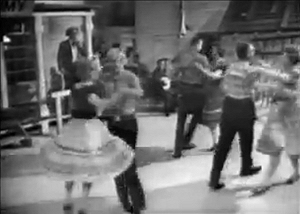
Here's a more recent example from Tech Squares of MIT — young dancers, moving to the music and obviously enjoying it — I fear that's not the norm these days!
MWSD was amazingly popular all over the world, but it is now in a state of sharp decline (certainly in the States, England and Germany) — in his book Jim Mayo explains why he thinks this is. On the other hand, contra dancing which once survived only in a few backwaters has gone from strength to strength. Mary Dart, in her book “Contra Dance Choreography” (1995) asks how it can be that the contra dance has achieved such a remarkable comeback, after coming so close to extinction. Her conclusion is that the contra dances enjoyed in the States today bear little resemblance to the traditional ones. The text of the book is now on the CDSS website at cdss.org/elibrary/dart. Modern contras are almost all longways duple improper, everyone moving all the time, the ones and twos doing the same thing, and (most important of all) with both partner and neighbour swings. Here's an example.
Trite and True
Formation: Longways BecketCharlie Fenton 1995 Music: 32 bar American marches/reels
| A1: | Circle left ¾, pass through up and down the set. Left-hand star ¾ with the next couple (hands across). |
| A2: | Men drop out, ladies left-hand turn ¾ to face partner. Pass right shoulder: straight hey ¾ (6 changes) to face neighbour. |
| B1: | Gipsy right neighbour. Swing neighbour on the side of the set. |
| B2: | Circle left ¾. Swing partner on the side of the set. |
Charlie wrote and called this dance to end a NEFFA contra medley in 1995 going from old to new, fitting as many of the recent “trends” (clichés) as he could into one dance. Fractional figures allow time for two swings!
Becket formation dances are very popular in the States, because the figure can finish with everyone swinging partner. If you wonder why a normal longways dance couldn't finish like this, you've never seen the energetic way contra dancers swing in the States.
In a medley there's no walkthrough — they typically do each dance six times and then the next caller takes over and calls the next dance — for 25 minutes. It works, because people are on the ball and because every move flows into the next, which is one of the hallmarks of modern contras.
If there's time I would add some other recent squares and contras. Squares by Ron Buchanan, in particular Hey-mania and Country Corners Canon. Ron has the trick of using traditional figures in new and unexpected ways, which I like. Possibly contras by Cary Ravitz such as Andes Anomaly or Interstate 75 but probably not Rat Race! I finally hit them with Micah Smukler's “Goody Two Shoes” which I picked up from a 2008 issue of CDSS News — a great example of using two different twirls (Petronella and Rory O'More) twice each in the same contra to produce a very challenging and satisfying dance.
Finally, putting the whole thing into perspective, Allison Thompson wrote,
In America, as in England, the dominant dance of the 19th century ballroom was the round dance: waltz, mazurka, redowa, polka, galop and all the variations thereof. Contras and squares (quadrilles) were being steadily marginalized in the fashionable ballroom throughout the period, until contras, in particular, were rediscovered by Progressive dance educator Elizabeth Burchenal in the 1920s.When dealing with a sweeping survey of historical trends, one must mention that in America as in England, there was a wide range of performance preference and practice: Money in Both Pockets might be danced in an elegant fashion to the music of professional musicians in New York in 1790, but danced in a rough and ready style to the music of a jaw harp or fiddle on the frontier (which at that point was just slightly west of Pittsburgh). You might find contras or quadrilles preserved in quaint hamlets of up-state New York in 1890, but a farmer's daughter who aspired to fashion would do her best to learn whatever round dance had reached the closest big town.
And your survey doesn't address (how could it in so short a time?!) all the sub-groups of America: the dances of the Shakers, the African-Americans, the clog dance (think of Mr Edwards “the wild cat from Tennessee” dancing a clog for little Laura Ingalls), the cowboy dances, the Spanish-influenced dances of the early Californians, the dances of the First Peoples, the reels and jigs long preferred on the frontier by the Scotch-Irish, the polkas still popular in the central states, and the whole range of “folk” dances still supported in many areas (certainly in my town) by church-based youth groups of varying ethnicities — what I mean here is that the Greek kids learn the Greek dances at their church, the Polish kids Polish dances at theirs, etc.
Other sources
For older material, from the late 1700s, three standard collections are:Early American Dance and Music: John Griffiths, Dancing Master, 29 Country Dances, 1788, edited by Chip Hendrickson
A Choice Selection of American Country Dances of the Revolutionary Era 1775-1795 by Kate Van Winkle Keller and Ralph Sweet
Twenty Four Early American Country Dances, Cotillions & Reels for the Year 1976, edited by Jim Morrison
The second and third are available from CDSS.
The History of square dancing by S. Foster Damon, 1957. This is a really good book, well researched and very readable.
From the Ballroom to Hell: Grace and Folly in Nineteenth-Century Dance by Elizabeth Aldrich (Paperback — 31 Dec 1991) — buy from Amazon UK or Amazon US.
Dance and Its Music In America, 1528-1789, Kate Van Winkle Keller. Pendragon Press, Hillsdale, NY; 2007.
Kitty Keller's reflections on publishing Early American dances: www-ssrl.slac.stanford.
The Colonial Music Institute: colonialmusic.org
Videos by David Millstone on contra dance callers and musicians:
The other way back:- Musician and caller Dudley Laufman: commons.cdss.org/s/product/
Paid to eat ice-cream — Musician Bob McQuillen + What's Not To Like? A Community Contra Dance: commons.cdss.org/s/product/