Hornpipes
What does the word “hornpipe” mean to you? Find out more than you wanted to know here!
The original Hornpipe was a musical instrument — in this context it is a cylindrical bore wooden instrument with finger holes like a recorder or tin whistle, an animal horn bell (widening cone at the bottom) and animal horn mouthpiece to accommodate a single beating reed, as used in a bagpipe chanter. It's been around since medieval times, and considered obsolete (in polite society anyway) by 1600 or so.
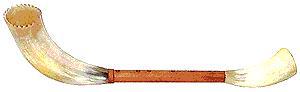
Some medieval and Renaissance hornpipes had the reed fully enclosed by the animal horn, making it a “capped single-reed” instrument, in contrast to that beloved (by early musickers at least) buzzy, the krumhorn, which has a capped double reed (like a bassoon).
If you want to know any more, Click here
In musical terms, originally the hornpipe was a triple-time tune: Dick's Maggot and Mr Isaac's Maggot are hornpipes.
Hornpipe music is found in early Tudor keyboard manuals. It is associated with the North of England and the Lowlands of Scotland. It was 3/2 complex metre until the end of the 18th century, and was then found mainly as 4/4. No real explanation is known, but in the view of Anne Daye (then chairman of the Dolmetsch Historical Dance Society) this apparent change is down to 'hornpipe' referring to both stepdancing and a particular metre, so one form was superseded by another.
You must enable JavaScript to see this email address. runs a workshop on hornpipes from the historical perspective.
Hornpipes and jigs are the vernacular dance forms for solo, footwork-focused dances which can be done in small spaces. Sailors always danced on board ship to make merry and keep fit, so jigs and hornpipes were their choice. Following this it was not long before a stage dancer presented a character solo, one amongst many hornpipes eg hornpipe in fetters.
A Scottish hornpipe is what I would call a rant. My definition of a rant is “a tune which ends dubber-diddy dubber-diddy dum, boom boom”. Think of “Soldier's Joy” or “Morpeth Rant”.
The tune “Sailor's Hornpipe” is a Scottish hornpipe (as you can see from my definition, it's a rant in English terms). It's actually called “College Hornpipe”, and apparently it was the Popeye cartoons which spread the new name. I've given a link to the version I know, but there are many versions old and new — see tunearch.org/
You must enable JavaScript to see this email address. runs a workshop on the Sailor's Hornpipe. In his dance notation sheets he says that the music used in Naval establishments is Pitt's Hornpipe, often referred to as College Hornpipe, which he believes was composed by an 18th century fiddler called Moses Dale. Any tune could have been called a hornpipe if it was played on the hornpipe.
In current English dance circles, a hornpipe is a strongly dotted tune to which you would do a step-hop. Nottingham Swing (often to the tune Phillebelula All The Way) is the best-known example, but there are many others, old and new, though these days they are mainly the province of ceilidh dancers. Note that although it's notated as a dotted quaver followed by a semiquaver it's really played as a quaver followed by a semiquaver — it's really more 6/8 time than 4/4 time. But it doesn't sound like a jig, because the accompaniment is different.
A hornpipe is similar to a Schottische, to which you would tend to dance one-two-three-hop rather than step-hop, step-hop, though in fact you can easily do either to either and Jill Bransby, a well-respected International Dance teacher, says that the standard Schottische step in International circles is 1-2-3-hop, 1-2-3-hop, step-hop, step-hop, step-hop, step-hop. For historical background to the Schottische, see Susan de Guardiola's posts at kickery.com/
There is also an undotted hornpipe. Bob Lilley chose one of these when his dance “The Fast Packet” was published in CDSS News, since Americans expect every English dance to have its own tune. He told me he did this just to be different, and every time I've danced it in England it's been to a dotted hornpipe. I've now written a dotted hornpipe called Another Fast Packet which some callers in England and the States are using for the dance.
In the States, among contra dance musicians the dots have been taken out and basically a hornpipe is the same as a reel. For instance, “Fisher's Hornpipe” is a traditional dance tune dating back to the late 1700's according to this web page.
If you gave this music to a traditional English musician he would certainly dot it, as in the last example on the page (interestingly classed as a “Celtic Hornpipe”).
I had thought the notational difference was that a hornpipe is written with four beats to the bar and a reel with two, but I'm told both can be written either way.
Cammy Kaynor says:
In regards to the contra hornpipe tunes: I always assumed such tunes used to be dotted hornpipes and were adapted to contradancing by playing them as even duple meter tunes. The difference between hornpipe and reel from a contradance musician's perspective is that I can generally play the hornpipes with a dotted (and often slower) rhythm and they sound good if not better (e.g., Fisher's, Woodchopper's, President Garfield's, Lamplighter's) whereas many of the reels don't feel as “meant to be” when I try to play them with the dotted rhythm (e.g., Lady Walpole's Reel, Judy's Reel). We generally do not play a dotted rhythm or slow the tempo for contras. Also, I find it hard to speed up a dotted hornpipe to contra tempo without losing the dottedness. There are many of my favorite hornpipes that I do not play for contras because they just don't sound good to my ear when played up to that speed (e.g., the Gallway Hornpipe, Miriam).
The hornpipe is also known in Ireland. It's used in solo dancing as well as set dancing (and is the best part of the set, in some people's opinion).
Pat Murphy in “Toss the Feathers” says:
The hornpipe is first mentioned in the time of Henry VIII by Chappell. It is generally accepted, except by the most partisan Irish historians, as being of English origin. It is believed to have arrived in Ireland around the beginning of the eighteenth century. Joe O'Donovan, Cork step-dancer and teacher, has a reference [personal sources] to an agreement between Charles Staunton, dancing-master, and William Bailey of Ballincollig, West Cork in 1718, whereby Bailey was to pay him two guineas to teach his children 'jig minnets [minuets], hornpipes and country dances'.
Pat describes the hornpipe steps as…
similar to those described here for a reel, though naturally danced at a slower speed. The movement transferring weight from the ball of the foot to the heel of the same foot is usually a more emphasised 'hop' when dancing to a hornpipe.
In set dancing, the hornpipe figure is usually one of the last figures, and is often a mixer. To confuse matters further, Irish hornpipes are played with a dotted rhythm, but written as straight rhythm, like a reel.
Mo Waddington says:
The hornpipe figure in Irish set dance, when danced 1950s style, is so much slower and more ''laid back'' than any English hornpipe. You relax into the arms of your partner and enjoy the encounter, before progressing to the next.
So my conclusion is: If you ask a band for a hornpipe, make sure they know what you mean. I remember Mark Elvins telling a band that he was going to call “Atlantic Hornpipe” and they nodded agreeably. He was expecting an American reel, but he got step-hop hornpipes — I must say, he carried it off very well!
My thanks to members of the ECD List for much of this information.