4-Couple Dances
By category:
Alphabetically:
Links to dances on other pages
Celebration Dance 

Dance: Pam Warren, 1988.Format: 4 couples longways
Music: 4 x 32-bar reels (for instance, “Twelve Reel” on the “Callers' Choice” recording)
| A1: | Top two men change places with bottom two ladies. Top two ladies change with bottom two men. |
| A2: | In fours, circle left 1½ (6 bars); two-hand turn partner rapidly. (All on original side, with the set inverted.) |
| B1: | First couple lead up the middle, cast back to bottom place and make a two-hand arch. |
| B2: | The other three couples face down, dance under the arch, divide and cast up to new places, giving a standard progression. |
Repeat the whole dance three times more.
First published in English Dance and Song, Autumn 1991. Composed for the wedding of Geraldine and Paul Maitland-Edwards, 25th June 1988.
Pam is well-known in Essex as a caller of Playford, Country, Maypole and Barn Dances. She started the Hatfield Peverel Folk Dance Club in 1967 with two friends, and has been calling ever since.
Cheers for the Happy Pair
Format: 4 couples longways. Dance: Pam Stallworthy, 1986.From the book Dance Search.
Music: 4 x 32-bar sing-along reels (e.g. Get me to the church on time)
| A1: | Ones face down and arch over the others to the bottom, the others coming up the middle, making an arch and following them down, and at the bottom the ones turn in and lead up the middle, followed by the twos and threes, all finishing in original positions. |
| A2: | Fours lead up to the top. All right-hand turn partners. |
| B1: | Promenade round to the left to invert the set (finishing improper in the order 3, 2, 1, 4). All left-hand turn. |
| B2: | Fours (at the bottom) start a progressive grand chain giving right hand to partner and stopping when they reach the top — making sure that when the rest of the chain finishes they are ready to arch to begin the next turn of the dance. |
| Progressed position is 4, 1, 2, 3. Repeat three more times. |
Notes from the original publication, Dance Search '86:
Pam Stallworthy of Havant is leader of the Beaus of the Park Folk Dance Club. The dance was written at the C.H.A. Guest House in Fowey to celebrate the Royal Wedding so the “Cheers” also stands for “C.H.A.ers”.The dance represents:
- A1: Guests going into the church
- A2: The bridal couple coming up the aisle and making vows
- B1: The happy procession, and showing the ring
- B2: Congratulations, and shaking hands with friends.
Come Back to Sorrento 
Format: 4 couples longways.Dance: Colin Hume, 2018. Music: Ernesto De Curtis, 1902.
| A: | Ones and twos do a tight gipsy right with partner all the way (2 waltz steps) and finish facing out; move down the outside two places (individually, no overtaking) as threes and fours lead up two places. New middles (fours and ones) half figure eight through the ends. [3, 4i, 1i, 2] |
| B: | Middles through the ends: symmetrical back-to-back with neighbour, taking partner's hand when possible. Circle left with this couple, and open out to face partner. |
| C: | On the right diagonal (not just in your fours), those who can cross right and turn right; on the left diagonal, those who can cross left and turn left. In fours circle right ¾ (using all 4 waltz steps) finishing improper, and take hands in lines. |
| D: | The leaders (first lady and fourth man), who have just reached the right-hand end of the lines, cast right shoulder to the other end of that line while the others in lines of three: set right-two-three, left-two-three; two chassées right to finish opposite partner. In new fours, right-hand star half-way; step left and honour partner. |
| Progressed position is 3, 1, 4, 2. | |
You can hear the song sung in English at youtube.
English version
Hear the music of the waters, Vows of tender passion sighing.
Like my heart, to which go flying All my thoughts in wakeful dream.
See the lovely dewy garden Breathing orange-perfumed greeting.
Naught can set me heart a-beating Like the fragrance of its bloom.
Now I hear that thou must leave me; Thou and I will soon be parted.
Canst thou leave me broken-hearted? Wilt thou never more return?
Then say not goodbye! Come back again, beloved.
Back to Sorrento, Or I must die!
Italian version
Vide 'o mare quante bello, Spira tantu sentimento,
Comme tu a chi tiene mente, Ca scetato 'o faie sunna.
Guarda, gua, chistu ciardino; Siente, sie sti sciure arance:
Nu profumo accussi fino. Dinto 'o core se ne va.
E tu dice: “I parto, addio!” Talluntane da stu core.
Da sta terra de lammore Tiene 'o core 'e nun turna.
Ma nun me lassa, Nun darme stu turmiento!
Torna a Surriento, Famme campa.
Daffodils
Format: 4 couples longwaysDance: Dave Kerridge, 2002. Music: Dave Kerridge, c. 1996.
| A1: | End couples right-hand turn. With the nearest couple, left-hand star. |
| A2: | Same fours circle right. Balance the rings of four in and out; turn single right. |
| B: | (16 bars): In the same fours: first corners Hole-in-the-Wall cross; second corners the same. All eight circle left half-way. |
| B2: | Bottom couple lead up to the top, and as they pass each couple that couple cast down one place: the first couple a wide cast, the next medium and the last normal, so that all four couples finish together. All two-hand turn. |
Dave Kerridge started dancing at Cecil Sharp House many years ago when Brenda Godrich and I were running the Thursday Beginners. He started calling there and ended up working with Brenda for many years running the Thursday Beginners as well as calling at clubs around the London area.
He met Jadwiga in his early days at Thursday Beginners, He became friends with her and her family and got to know them all very well. He wrote a song for her. Several years later, while recovering from knee surgery, he decided to write a dance. He wondered what music to use, remembered the song stored away in his archive and only needed to alter it slightly to get it to fit the dance.
He decided on the name Daffodils for the dance and music because his mother Freda had been nagging him to sort out his garden and had planted some Daffodils in a couple of rows (not unlike the dancers in the dance), and he tagged on “Freda's Waltz” as a tribute to her.
I think Dave has written a terrific tune, and Graham Beebee has produced a terrific 3-part arrangement of it.
Dance for Audrey
Format: 4 couples longways, 1 & 3 improper.Dance and music: Jill Lawrence, 1974
| First Figure: | |
| A1: | Up a double and back. In fours, first corners (women) cross; second corners (men) cross. |
| A2: | All that again. |
| B1: | Ends with partner, middles with neighbour, two-hand turn 1½ and keep hold while you decide which your inside hand is. Give inside hand to new neighbour and turn half-way (ends through middles); set in lines. |
| B2: | Ends lead in, middles lead neighbour out; fall back. Two-hand turn 1½ to finish 3, 4 improper, 1, 2 improper. |
| Second Figure: | |
| A1: | Sharp siding with partner. In fours first corners (men) cross, second corners (women) cross. |
| A2: | All that again. |
| B1: | End women, followed by neighbour, cross outside the set and move up or down the side to each other's places while the others lead forward a double and back just to get out of the way! End men followed by neighbour do the same. |
| B2: | Those who have just arrived, half figure eight through their partners. The other the same — all now in original places. |
| Third Figure: | |
| A1: | Arm right. Corners cross. |
| A2: | Arm left. Corners cross. |
| B1: | Middle women go right: right-hand star at each end while middle men right-hand turn. Middle men go left: left-hand star at each end while middle women left-hand turn. |
| B2: | Lines 4 slips right; 4 slips left. All two-hand turn. |
Jill says:
Dance for Audrey was written for Audrey Armstrong who, for thirty-two and a half years, was Glos. District Secretary, from which post she retired in May 1980.
Jill describes the dance in Cecil Sharp style, using numbers all the way, whereas I find it clearer to refer to ends and middles.
Double Trouble 
Format: 4 couples longways. Dance and Music: Colin Hume , 1994.
Note: The tune is in 9:8 time.
Each paragraph is 4 bars of 9:8 time
| A1: | First couple gallop to the bottom (6 steps); circle left with the bottom man. |
| A2: | First lady gallop back to the top with either man (her choice); circle right with the top lady. |
| B1: | Ladies line dance round men. [Single skip. If you do a skip-change, you're not dancing to the music.] |
| B2: | Men's line dance round ladies. |
| C1/2: | Top couple strip the willow (fast), and arch at the bottom. |
| D1: | New top couple lead a cast and come up through arch — if the original first man is not making the arch, he gently nudges his rival out of the way. |
| D2: | All swing partners. |
Written for Alison Double, whom I have been friends with at Folk Camps for many years, and first performed at her 21st birthday dance: 11th September 1993.
Notes to musicians: It's tempting to play the music too fast for the dance. It's a slip-jig, not a waltz.
Dunsmuir Road Hornpipe (Old version)
Dance: Colin Hume, 2021. Tune: Gregory Brown.Format: 4 Couples longways, 1 & 3 improper
| A1: | Form an open ring at each end — ends let go of your partner. With a1-2-3-hop: circle left half-way, then original end ladies draw your line up or down to a longways set. In new fours, right-hand star (all the way). |
| A2: | Back with a left-hand star. Again form an open ring at each end — ends let go of your opposite. Circle right half-way, then original end men draw your lines up or down to finish opposite your partner, upside down and on the other side. |
| B1: | Those who can, cross right on the right diagonal (two 1-2-3-hops); left on the left. Right on the right; left on the left (home). |
| B2: | In fours left-hand star half-way; middles right-hand star half-way. All hornpipe swing — right forearm hold, left hands joined above (or below), twice around with a step-hop. |
| Progressed position: 2, 4, 1, 3. Repeat the dance three more times. |
The Dancehall Players from Victoria in Canada produced a CD of beautiful dance tunes in December 2020 called “Out of the Silence” and were looking for people to write dances to them. I suggested that I write something to Greg's tune as I know hornpipes aren't popular in North America. I tried to write something fairly simple but interesting. The first two versions weren't simple enough! Provided the ends remember who they are in each turn of the dance, version three should have worked, but I tried it at Whitby Folk Week in August 2022 and it still didn't. So for version 4 I'm specifying an open ring both times rather than an ordinary circle, in the hope that it will be obvious who is leading up or down to lines.
And I tried it at a local club in September and it still wasn't very successful, so I'll leave this version here for the completists but I've now abandoned it in favour of a different dance in square formation — that one certainly works better!
Emma's Waltz
Format: 4 couples longways. Dance: Colin Hume, 2009. Music: Brian Stone. | A1: | In fours, first corners give right hands, balance forward and back; box the gnat, and keep hold while the others join in. Right-hand star. |
| A2: | Second corners the same left (swat the flea). Left-hand star into… |
| B1: | (16 bars): All eight single file anti-clockwise half-way, to finish proper in the order 3, 4, 1, 2. Join hands in lines, set right and left; turn single. |
| Middles cross with partner (don't turn around), go round one person to end place — ends lead in on bars 3 and 4. All two-hand turn partner once around. (4i, 3, 2, 1i) | |
| B2: | Ends right-hand turn half-way; those facing in (top lady and bottom man) cross left hand on the left diagonal; right hand straight across, left hand on the left diagonal (with each other). |
| New ends right-hand turn half-way; those facing in (the partners of the previous people) do the same move: cross left hand on the left diagonal; right hand straight across, left hand on the left diagonal (with each other). |
I haven't changed B2, but I've learnt that the way I was describing it really confuses people, and Gene Murrow suggested that in the walkthrough you get the ends to do the right-hand turn half-way and then say who is active, so that's how I'm now describing it. Please also read the box below!
I played Brian Stone's tune at a music workshop he was leading and thought it was so good that it deserved a dance. Both were written for Emma Darby (now Emma Wooders), whom I met as a dancer, caller and musician at The Round in Cambridge — she led the band whenever there was a request for live music, which there was whenever I was calling.
This is a tricky dance to walk through, so here's how I explain it, adding in the useful things that some callers mention and some don't.
And for heaven's sake, don't rush the walkthrough. Give them time to finish each movement before you start telling them the next. Watch all the sets, and if necessary go down and take someone's place to show people what you mean. You're not doing anyone any favours if you walk it through too fast, it collapses as soon as they try to dance it, and you then have to walk it through again. I would always walk it through twice anyway, because the middles and the ends do different things sometimes.
Ann Arbor, Michigan
Felicity
Format: 4 couples longways. Dance: Colin Hume. Music: Dave Brown. 2002. | A: | First lady, fourth man cast right shoulder (their neighbours move right into their place); middles gipsy right half-way with new opposite. Middles right-hand star while ends give right hand, balance forward and back; box the gnat — all now improper. |
| B: | First man, fourth lady cast right shoulder (their neighbours move right into their place); middles gipsy right half-way with partner. Middles right-hand star while ends give right hand, balance forward and back; box the gnat — all now proper in the order 2, 1, 4, 3. |
| C: | All back-to-back partner. Circle left half-way. |
| D: | Ends give right hand to partner to start four changes of a grand chain — middles only do three changes. All two-hand turn partner. |
Progressed position is 2, 4, 1, 3. Repeat the dance three more times.
I suggest the middles fall back a little further after the back-to-back to make a good circle, keep the circle shape for the grand chain (which is a circular movement), and then the middles move in for the final two-hand turn. Four bars of waltz time for the turn is plenty, especially as I don't believe people need have to have hands joined at the start of the first bar.
The dance and music were written for Dave Brown's niece Felicity Bird. The tune is recorded 8 times through on Dave's CD “Outside of the Square”, DB003CD: Download this track but people found that a little fast for the dance so he's re-recorded it (4 times through) on “Connections”, DB004CD: Download this track.
Jack's Confusion
Dance: Jack Keen, Music: Viola Keen, 1986From the book Dance Search. Format: 4 couples longways.
Top man go to the bottom, to form a 3 couple set with an extra person at each end.
| A1: | Extras right-hand star half-way with the end couple (3 hands); left-hand star half-way with the middle couple (4 hands). Right-hand star all the way with the other end couple (3 hands). |
| A2: | Left-hand star half-way with the middle couple; right-hand star half-way with the original end couple. Extras dance (forward) to the other end of their own sex line. |
| B1: | Ends pass left shoulder with their partner (skip-change step) to start a reel of three across the hall, then right shoulder with extra, etc. while middles do-si-do right shoulder and left. |
| B2: | Extras join their own line: lines forward and back, moving to the right to put a new extra at each end. Swing new partner (if any), or two-hand turn. |
| Repeat three more times. |
The King's Penny Added 10-Sep-25
Marjorie Heffer & William Porter Added 10-Sep-25Source: Maggot Pie, 1932
Format: 4 couples longways
Music: 3 x Own tune (jig): William Porter, 1932
| First Figure: | |
| A1: | Up a double and back. In fours, half poussette clockwise. |
| A2: | All that again, |
| B1: | Slow progressive grand chain: the ends do 4 changes starting with partners and bring the middles in on the second change. |
| B2: | About turn and give right hands: grand chain home. |
| Second Figure: | |
| A1/2: | As before but Cecil Sharp siding. |
| B1: | Set to partner; in fours, set to neighbour. Women give two hands and slip across into partner's place as men cast into theirs; men give two hands and slip across as women cast home. |
| B2: | Set to neighbour; set to partner. Ends give two hands and slip in, middles cast to nearer end. New ends slip in, new middles cast home. |
| Third Figure: | |
| A1/2: | As before but arming. |
| B1: | Middles almost full figure eight through ends, to finish on the ends of two facing lines (12 steps); lines lead forward a double to meet. |
| B2: | New middles the same; lines lead forward to meet partner. |
Here's one I've never called. The original instructions are just like Cecil Sharp's — verbose but precise. I hope nobody would try to call from the book, especially when you come to sections like:
B2 bars 3-4, those who changed by the right in B1, bars 5-6, now change by the left;I've tried to explain the overall figures rather than say what each of the eight people is doing, but I dare say I will confuse some people.
When Wendy Crouch lived in Cambridge she ran a display group called Kings Penny that did various Maggot Pie dances.
The King's Crown
Format: 4 couples longways, 1 & 3 improperDance and Music: Jill Lawrence — Dances for Gloucestershire, 1973.
| A1: | Middles right-hand star while ends cast to the other end (men passing outside women). All back-to-back partner. |
| A2: | Middles left-hand star, ends cast back to place (again with men passing outside women). All left shoulder back-to-back partner. |
| B1: | In fours: women cross; men cross. Middle women cross; middle men cross. |
| B2: | In pairs make arches on the men's side and cross over with the opposite pair; the others arch and cross back. Left-hand turn that neighbour, so the middles have right hands free to start again with the right-hand star. |
Progressed position is 2, 4, 1, 3. Repeat the dance three more times.
Jill didn't specify left shoulder for the second back-to-back, but out of a left-hand star it seems the obvious thing to do.
The King's Ring The Machine Without Horses
MacHinery's Reel
Format: 4 couples longways.Dance: Bill Kinsman. Music: 4 x 48-bar Scottish reels.
| A1: | Ladies join hands and dance around the men, led by the first lady. |
| A2: | Men dance round the ladies. |
| B1: | On the left diagonal (top three ladies, bottom three men) set; cross over. The same on the right diagonal. [All the men are now at the top and all the ladies at the bottom.] |
| B2: | Men left-hand star while ladies right-hand star. And back. |
| C1: | First man pick up his partner into a star promenade, followed by the others as they meet, and after going once around the ones lead to the bottom followed by the others. |
| C2: | Ones arch, the others lead under the arch and cast up to progressed places (standard progression). All swing partner. |
Repeat the whole dance three times more.
Bill saw a display team dancing “Sir Murdoch MacDonald's Strathspey”, liked the dance, and tried to remember it when he got home! This is what he came up with — I certainly prefer it to the original. The tune I've given is the one suggested by Hugh Stewart in his excellent book “The Country Dance Club Book”.
Parthenia Added 10-Sep-25
Marjorie Heffer & William Porter Added 10-Sep-25Source: Maggot Pie, 1932
Format: 4 couples longways
Music: 3 x Own tune (reel): William Porter, 1932
| First Figure: | |
| A1: | Up a double and back. Gypsy right shoulder with partner. |
| A2: | Down a double and back. Gypsy left. |
| B1: | Set to partner; cross right shoulder, turn right. Single file clockwise half-way (dance). |
| B2: | All that again, finishing home. |
| Second Figure: | |
| A1: | Cecil Sharp siding. Gypsy right. |
| A2: | Cecil Sharp siding. Gypsy left. |
| B1: | Ends lead in while middles fall back to ends of head lines; all set in lines. In fours, dance three changes with hands (4 men, 4 women), into a longways set across the hall. |
| B2: | All that again, but making side lines, finishing home. |
| Third Figure: | |
| A1: | Arm right. Gypsy right. |
| A2: | The same left. |
| B1: | Top four make a circle with a gap at the top, bottom four make a circle with a gap at the bottom: top man bottom woman lead their lines clockwise (dance) to each other's place. Lines fall back; lead forward. |
| B2: | All that again, finishing home. |
No connection with “Fain I would” which was also called “Parthenia” in a few Playford editions.
In the B section of the second figure the instructions say “balance” whereas the first figure says “set”. This is the only use of “balance” in the Maggot Pie book, and other people interpret it differently.
The Queen of Moravia
Dance and Music: Colin Hume, 2011.
Format: 4 couples longways
| A1: | First lady cast to the bottom (other ladies move up), give an inviting look to the bottom man (4th). Swing him. |
| A2: | All circle left half-way. Give left hand to opposite: balance forward and back; swat the flea (change places turning the lady under). |
| B1: | On the right diagonal, those who can do-si-do original partner. First lady (who has been left out) swing the man below her (3rd) to finish in second place (his opposite lady move up the outside). |
| B2: | At each end, right-hand star ¾. Middles left-hand star ¾. |
| C1: | All circle right just over half-way until all proper: men are 2, 1, 3, 4, ladies 2, 3, 4, 1. Lines forward and back. |
| C2: | First lady cast up to the top (other ladies move down), give an inviting look to the top man (2nd). Swing him. |
| D1: | Top couple cast one place, lead down through the next, cast to the bottom, the others following (casting when they reach the top except for the final couple) to finish with the set inverted. |
| D2: | First lady move up to meet her original partner (his opposite lady move down the outside); step right and curtsey to him. All swing original partner. |
| Progressed position is 4, 3, 1, 2. | |
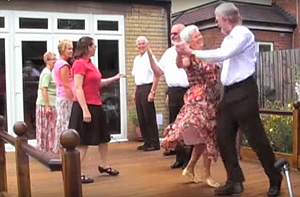
Commissioned by Alan James as a birthday present for his wife Vicky Bursa, who comes from the city of Ostrava in the area of Moravia in the Czech Republic. Vicky is an energetic dancer who likes swinging lots of men — but I made sure she got back to Alan for the final one! On the right you can see it being danced in Vicky and Alan's garden — there was a YouTube video but for some reason it has disappeared.
Probably the best-known music related to the area is Antonín Dvořák's Slavonic Dances, Opus 46. I took the first as a starting point, converted it from triple time and hacked it about to produce my own tune. Alan also wanted a MIDI version to present to Vicky, and you will find that by clicking the third music button above — we used it in the video. Alan says the only problem is that he has now commissioned a work of art, and this is damaging to his street cred.
The Queen of Sheba Added 10-Sep-25
Marjorie Heffer & William Porter Added 10-Sep-25Source: Maggot Pie, 1932
Format: 4 couples longways, Ones and threes improper
Music: 3 x Own tune (jig)
It wasn't written with the ones and threes improper, though there would have been precedents for that in Playford such as Lull me beyond thee where the threes and fours are improper, and indeed in “The Northern Lass” they do have twos and fours improper. I decided to do it that way for two reasons. You gypsy with your neighbour twice in each figure and I prefer to do that with an opposite sex neighbour, though I realise that neither “gypsy” nor “sex” is politically correct at the moment. And it makes it much easier to explain and dance the first two figures. Here's how I do it, and I've given calling suggestions below.
| First Figure: | |
| A1: | Up a double and back. Gypsy right with neighbour. |
| A2: | Down a double and back. Gypsy left with neighbour. |
| B1: | In fours, right-hand star. Middles left-hand star once while ends single file half-way (the way you're facing — men in the lead in all cases). |
| B2: | In new fours, right-hand star. Middles left-hand star once while ends single file half-way — at the end stay facing this way. |
| Second Figure: | |
| A1: | Men move out a double and fall back, women follow partner. Gypsy right neighbour. |
| A2: | Women move out a double and fall back, men follow partner. Gypsy left neighbour. |
| B1: | Ends right-hand turn ¾ to arches up and down (4 steps). Middles skip clockwise round under both arches (8 steps). Arches turn ¼ to place (4 steps). |
| B2: | Middles turn ¾ to arches across, ends skip clockwise round under both arches, arches turn ¼ to place. |
| Third Figure: | |
| A1: | Bomb-burst: Ends lead out, middles lead neighbour out; fall back. Gypsy right with neighbour. |
| A2: | Bomb-burst again. Gypsy left with neighbour and stay facing. |
| B1: | Straight hey till you pass that neighbour for the second time (12 steps); two-hand turn partner half-way. |
| B2: | Face same neighbour: The same home. |
All the gypsies are described as facing outward
as Sharp specifies in “Hey, Boys, Up Go We”, but I don't do that.
In the first figure it seems obvious to me that after Up a double and back the ones and threes should about turn to their right to flow into the gypsy right, and after Down a double and back the twos and fours should about turn to their left, but many people have no concept of thinking ahead and realising how one move relates to the next. The figure flows beautifully, and it flows beautifully into the second figure, so long as people keep moving and don't turn round!
The B part of the second figure is very busy. Four steps for the ends to right-hand turn ¾ and I then recommend that the end women give left hands to form a wave of four up and down the set: this tightens up the formation but don't raise those left hands to make a third arch — you don't want to give the middles a choice! Instantly the middles have to dance under both arches, and then while the ends turn to place the middles have to be ready to start their right-hand turns. If you're calling this you must chivvy them along!
The third figure starts with a Bomb-burst, and some callers say you lead out, turn and lead back, but that doesn't make sense. In the first figure you lead up a double and fall back. In the second figure you move out to the walls and fall back. Logic demands that you fall back in the third introduction — and the Maggot Pie dances are always beautifully logical. Just read the original wording:
1st couple lead up and back a double, while 4th couple lead down and back a double, 2nd and 3rd men lead out and back a double to the left wall, and their partners do the same to the right wall.Of course you can't say all that, so in the walkthrough you say “I'm going to call this a Bomb-burst” and then you explain it carefully.
In the second half don't say “straight hey, five changes” or some people will argue that you're wrong and they've only done four changes. I picked up the right way to call it from Ruth Allmayer, and it involves dancing with people instead of counting. You know who your neighbour is: you've done 6 gypsies with them. Do a straight hey until you pass that neighbour for the second time, then two-hand turn your partner half-way and face that same neighbour. Do it all again.
I've given links to two tunes. The original tune is a not too inspiring jig, particularly the A section where you get the same four bar phrase four times. But the dance and music fit together, and I would always use this tune the first time we dance it.
Brian Stone's band Hoedown (later rebranded as Junction 24) produced a record called “The Electric Effect” in 1987 which includes a wonderful version of the start of Handel's “Arrival of the Queen of Sheba”. Brian Jones had called the Maggot Pie dance “Queen of Sheba” with them — I think it was at the Berkshire Folk Festival — and of course they played the tune from the book, but later Brian Stone made the Handel arrangement. If you call to recorded music, Brian has given permission for me to offer the track as a free download: Arrival of the Queen of Sheba. If you're calling with a good live band, try the Handel tune. I know some callers dispense with the original tune and go straight for the Handel, but I think that's asking for trouble. It's by no means obvious how the phrasing of the dance fits the phrasing of Handel's music, and if people are still struggling to do the dance they will find it much harder. Certainly I'll use the Handel tune for the repeat, but I have to concentrate very hard to make sure I call each move at the right time. Brian Stone says,
We recorded the track for the dance after the caller Brian Jones asked us to play for the dance. We didn't care for the original tune published for the dance so we adapted the Handel tune as a 32-bar version. Brian Jones always counted the beats for the burst figure to help the dancers as the tune goes across the dance phrase.
Round Hill Wedding
Format: 4 couples longways, 1 & 3 improper Dance and Music: Colin Hume, 1997. The tune is in waltz-time.
| A: | In fours, right-hand star. Ladies cast out, men keep turning and pull by into half a hey across (the second change is passing partner left shoulder), ending where your same-sex opposite started — don't overshoot. |
| B: | New middles (original ends) right-hand star. Men cast out, ladies pull by into half a hey (passing partner left shoulder), ending 2 improper, 4, 1 improper, 3. |
| C: | Middles face the ends: gipsy right with neighbour. All gipsy left with partner (plenty of time for both these moves). |
| D: | On the right diagonal: those who can, cross right shoulder (same sex); on the left diagonal: those who can, cross left shoulder. All that again, ending 3 improper, 1, 4 improper, 2. |
Written for the wedding of Albert Blank and Nancy DeVore, September 1997. I was dancing at Pinewoods — in Massachusetts on the East Coast — for two weeks run by CDSS. The Country Dance and Song Society started out as the American branch of EFDSS, but in true American style have now become independent. English Week was first. Having heard what Ruth Anne Fraley had done with “Star of David”, I decided I should make some money for CDSS by putting into the auction “A dance and tune to your specification”. The bidding was ridiculously high, and afterwards Albert and Nancy explained that they wanted a dance for their wedding, in waltz time, celebrating the dance community which had brought them together rather than being a solo display for one couple. The auction was on the Wednesday evening, and on the Saturday I called the dance. A few weeks later Gene Murrow called it at their wedding dance, with Bare Necessities playing the music.
Save the House!
Format: 4 couples longways. Dance and Music: Colin Hume, 1998. | A1: | Ones and threes cross, go down outside one couple while the others move up. All do-si-do partner, those on men's side arching on the way over, the others arching on the way back. |
| A2: | In fours, circle left once. All eight circle left half-way. [Make sure you finish opposite your partner.] |
| B: | All face down and cast up from the bottom. Leading couple arch at the top, the others come up the outside and lead down through the arch. |
| C: | New ones and threes half figure eight down through the couple below. All cross-hand swing partner. |
| All danced to a step-hop. | |
Cecil Sharp House was opened in 1930 as a centre for English Folk Dance, Music and Song, and as a memorial to Cecil Sharp. It is also the headquarters of the English Folk Dance and Song Society. The National Executive Committee of that Society decided in November 1986 that the House would have to be sold to pay the Society's debts. An organisation called “The Friends of Cecil Sharp House” was formed to help the Society by raising money to keep the House open, but it soon became apparent that some NEC members were determined to close the building regardless of the facts of the situation.
“Save the House!” was an immediate response to the decision to close the building — I wanted to write a dance which I could sell to raise money for the Friends, and the title contributes the underlying rhythm to much of the tune. The dance is lively and not particularly difficult, though as often happens in my dances the little “differences” have been known to confuse people.
A record called “Cecil Sharp House” was published by the Friends in 1988. As well as this dance, it contained my complicated Playford-style square “Cecil Sharp House” and the wind quintet version of one of my best-known dances, “Unrequited Love”.
Sicilienne
Dance: Colin Hume, 2004. Music: Gabriel Fauré: the start of his Sicilienne. Waltz time.Format: Four couples longways
| A1: | (16 bars): Ends cross and cast to the middle; middles lead to the end, ones lead down through fours who move up. New ends gate the middles all the way. |
| All circle left half-way. Ends half figure eight through the middles. [3, 1, 4, 2] | |
| A2: | All that again (threes leading down through the twos). [4, 3, 2, 1] |
| B1: | Top couple cross down through the next and behind the next (they move/lead up). At the bottom, right-hand star half-way; turn single left. |
| B2: | All that again. [2, 1i, 4i, 3] |
| C1: | At each end balance in a ring of four; single file left half-way in same fours. Middles the same but go right. |
| C2: | At each end the same, going left. All balance with partner; two-hand turn half-way. [3, 1, 4, 2] |
I love this music, so eventually I decided to put a dance to it. Warning to flautists — it's slower than Fauré wrote it, so it's a real test of breath control.
T.A.G.
Dance: Roger Whynot, 1983. Music: 4 or 8 x 32 bar marchesThis is Roger's wording from his book “More of Whynot”.
| A1: | Top couple down the center Come back, cast out, unassisted |
| A2: | Ladies star right, gents star left (only until top couple meets) Change the stars — the top couple will lead the change, ladies will always cross first — |
| B1: | Change them back When the top couple meets again they lead all up the center in a promenade |
| B2: | Cast off, single file Top couple arches at foot, the rest go under, up to the top |
Repeat 3 times more. If an encore is wanted, try beginning from the foot.Notes:
This use of the old figure 'two stars, one like Venus, one like Mars…' is unique in that there is no need to move couples out of sequence before the figure will work.
I prefer a march for this dance
Make sure that the stars retain their form as long as possible before the dancers change stars.
Shoulder height stars without a wristlock are to be preferred
T.A.G. are the initials of a lady who helped me bake cookies well after midnight at Maine Folk Dance Camp
I've danced this in England to Roger's calling and he did it straight through 8 times, the first four starting with the top couple leading down and the second four with the bottom couple leading up. Kathryn and David Wright were at Chippenham Folk Festival in 2023 where the dance was introduced as a “Scottish Dance that has become a Ceilidh Dance” — and was then taught incorrectly! Alan Brunier (Dance Director of the festival) suggested that they send me the correct version with a view to putting it on my website, so here it is. They checked when they got home, and indeed there's a page scottish-
The original instructions specify leading down and up (with skip change) but slip step is more appropriate in a ceilidh situation.

Roger originally sent it to Kathryn and David in 1983 just after he had written it and at that stage it was a triple minor contra, but he later adapted it into a four-couple dance and that is how in appeared in his book “More of Whynot”. He would probably have been quite chuffed that it had become a ceilidh dance, but he should be credited with it rather than the Scots!
The lady with the initials was Terry Armstrong Graham, the daughter of another well-known caller Don Armstrong.
A Trip to Sweden
Dance and Music: Colin Hume, 1990. Each line of music is six bars long. Format: Four couples longways
| A1: | Ladies' line take hands and dance under an arch made by the top two men, behind the second and third men, and in under an arch made by the bottom two men, to place. |
| A2: | Men's line dance under an arch made by the top two ladies, behind, and out under the bottom arch. |
| B1: | Middle two couples circle left three quarters and then two-hand turn partner (the twos turn one and a quarter, the threes turn three quarters) while end couples two-hand turn (the ones turn one and a quarter, the fours turn one and three quarters) to finish in a double right-hand star, ladies in the middle. |
| B2: | Star promenade all the way round — then the middle ladies keep right hands joined and the ends start to turn as a couple (man backwards, lady forwards), finishing in original places with the ones improper. |
| C1: | While the ends finish their turn, the middle two couples weather-vane half-way and move forward to meet an end couple (2's meet 4's, 3's meet 1's), forming two weather-vanes which go all the way round, and finishing in a longways set (1's and 2's improper) facing the other couple from the weather-vane. |
| C2: | Polka one and a half times round that couple, finishing on your original side. |
By “weather-vane” I mean a right-hand turn as couples — ladies giving right hands and men on the outside. Progressed position is 3-1-4-2.
Dedicated to the band Wild Thyme and the Apertins Herrgård Dancers, both of whom performed it at the Eastbourne International Folk Festival and on a tour of Sweden in 1990.
Ron Mears gave me the idea for writing the dance, so I asked him what he considered typical Swedish figures. He suggested a double star, lines weaving in and out of each other, and a basket where the ladies sit on the men's hands. Aren't you glad I left that one out? The tricky bit is timing the two-hand turns so that all four ladies arrive in the centre at the same time to form the double star for B2. As I hope you can tell from the music, the whole thing is intended to be danced with a polka step. My contribution to International Dance! I asked the display team whether they thought it was Swedish, and they said no. But they agreed it wasn't English!
Underneath the Arches
Dance: Susannah Barnett of Lower Sydenham, London, 1986.From the book Dance Search.
Music: 4 x 32-bar single jigs, e.g. “Lady in the Boat”
Format: 4 couples longways
| A1: | Ends (ones and fours) face in and make a single-handed arch with partner, twos followed by threes lead up through the top arch, cast, lead down through the bottom arch, cast up to place. |
| A2: | At top and bottom, circle left. Circle right. |
| B1: | Face neighbour in these fours, ones and threes arch: Complete dip and dive. [Arch if coming in at the top, duck at the bottom.] |
| B2: | Ones cast to the bottom (fast), followed by the others, ones face up and make a single-hand arch, the others lead up through to progressed places. |
| Repeat three more times. |
Waltzing on Ice
Music and Dance: Colin Hume, 2008-2012.Format: Four couples longways
| A: | First lady cast down, third man cast up, partners follow, to finish improper in third and first place, and stay facing that way. Star with the couple below — ones left, threes right. |
| B: | Men keep hold but pick up shadow as you meet (1M 2L then 3M 4L, 4M 3L, 2M 1L) so ladies go to the other star. Bottom men (1 and 4) let go, first man and his shadow join the top star, keep going round, fourth man and his shadow join as first man and his shadow get to the top, so those two ladies (2 and 3) take right hands, and the double star stops rotating. |
| C: | Middle ladies half right-hand turn, half left-hand turn with the man they meet, men right-hand star ¼ to meet partner in a cross formation. Gipsy left, men keep turning left to a double left-hand star with the men in middle and the fours facing down. |
| D: | Take the star round till the fours are at the bottom, then they lead up the middle followed by threes, ones, twos (6 bars); all step right and honour partner. |
I wrote the tune in 2008 but didn't put a dance to it until 2011. I tried it a couple of times but wasn't happy with the second half, so in 2012 I completely changed the second half and now I'm satisfied. You'll need a good band to play it though!
The Baffled Knight Added 10-Sep-25
Marjorie Heffer & William Porter Added 10-Sep-25Source: Maggot Pie, 1932
Format: 4 couples longways
Music: 3 x Own tune (jig): Chappell, 1859
| First Figure: | |
| A1: | Up a double and back. All face up, cast to invert the set. |
| A2: | Down a double and back. All face down, cast up home — end facing partner. |
| B1: | Men hop into the middle facing down (1 bar), women hop into the middle facing up towards partner; right-hand turn half-way. Four slips right; four left. |
| B2: | Women hop into partner's place, men the same; right-hand turn half-way (home). Four slips right (men down, women up); four left. |
| Second Figure: | |
| A1/2: | Cecil Sharp siding, and casting as before — end facing partner. |
| B1: | Men hop left, women hop left; all turn single to place. In fours, three changes with hands (dance). |
| B2: | All that again to place. |
| Third Figure: | |
| A1/2: | Arming and casting — end facing neighbour in fours. |
| B1: | Ends hop in towards partner, middles hop out away from partner to form a square; change places with same-sex corner, ends going inside. All circle left half-way (slip) and reform the longways set. |
| B2: | All that again. |
The tune was published in 1859 and its rhythm at the start of the B-music obviously suggested the hopping. There aren't any difficult moves in the dance, it's just that some of them are unexpected and that's enough to baffle some people.
Butterfly Wings
Dance: Anne Welch, 1995. Tune: “Bellows & Bows” by Fred GrimshawNote: I believe there is another tune with this name.
Format: Four couples longways, 2 & 4 improper
| A1: | Lines forward and back. Middles gate through the nearer end. |
| A2: | Ends hand the middles into double figures of eight: ends cast to start, middles cross going through them. |
| B: | Ends cast, middles follow — ends meet opposite (1st man with 4th lady, 4th man with 1st lady), face in and make a single-handed arch while middles meet neighbour, lead in under the arch, and lead partner to nearer end. |
| C: | All face the one whose hand you're holding and two-hand turn 1½ (new ends with partner, new middles with neighbour). All partner back-to-back. |
| Progressed position is 2-4-1-3. | |
In 1995 the Beckenham and Croydon Folk Dance Club ran their second “Dance Search” competition with me adjudicating. The first prize went to Anne Welch for “Butterfly Wings”. The composers had the option of calling their own dance, nominating someone to call it, or letting one of the club callers call it. I knew that Anne was one of the club callers, and it never occurred to me that it was her own dance. She called it superbly, and I found it the hit of the evening. Of course, dances are a matter of personal taste, but here it is so you can judge for yourselves.
Anne Welch started dancing in 1985, through working in a school, and decided she would like to take it up for herself. She started dancing regularly at Beckenham, and in 1982 was encouraged by Joan Cornish to call a couple of dances during club nights — gradually it went up to half an evening and then a whole evening. She has never considered herself a dance writer, though she has written some simple barn dance material, some of which can be found in the booklets which go with the “Ring o' Bells” cassettes. This is her first quality dance, and came about because Fred Grimshaw wrote the tune for her and she felt it deserved a dance. In 2007 Anne moved up to Sheffield, and the people in that area soon found out that they had another excellent caller in their midst.
Cascade
Dance and Music: Colin Hume, 1986. Format: Four couples longways
| The first part of the dance is in canon, though only the ones do the set at the end of it. | |
| A1: | (12 bars) Ones cross and face (1 bar), back away (1 bar); wide cast to finish level with twos while twos start. Down the outside until level with the fours while threes start; meet below the fours while they start and lead up through them just as they cross. Ones lead home; ones set as the twos lead home. |
| A2: | Top two couples circle left half-way as the threes lead home; middles (ones and threes) lead neighbour out (1 bar) and turn away from each other onto the ends of lines across (1 bar) as the fours lead home to become the middle of the lower line. Set in lines moving forward; turn single in place. Two-hand turn opposite (shadow) (3 bars), fall back (1 bar). |
| B: | Ends lead in, pass through, separate and cast to top or bottom while middles lead partner out, change hands, lead back (4). Bottom two couples circle left half-way (now in original order with ones and threes improper); threes cast up as twos lead down. |
| C: | Ones start four changes of a progressive circular hey with hands, one change per bar: ones cross right, ones cross left with threes; ones cross right with twos as threes cross right with partner, ones cross left with fours as threes cross left with twos. All right-hand turn partner, finishing close together (3 bars), fall back (1 bar). |
| Standard progression. | |
| Instead of falling back the last time, step back on the left foot, step right and honour partner. | |
| Step throughout Right, pause, Left, Right; Left, pause, Left, Right. | |
First published in the Packington's Pound collection, 1989, and recorded by Wild Thyme.
The Double Helix
Formation: 4 couples longways.Dance and Music: Colin Hume, 2019
| A: | Reel (16 bars): At each end, right-hand star. Pass this neighbour right shoulder: straight hey until the middles meet. |
| Middles left-hand star, letting go early to move smoothly into the next move. At each end, circle left half-way; balance the ring. [2, 4, 1, 3, all improper.]. | |
| B: | 3-time (8 bars): “The Double Helix”: In fours: give hands and cross down, or move up the outside (3 steps), in the middle: give hands and cross up, or move down the outside (3 steps). The lady always crosses first, and you both give the same hand, except the first time when the crossing couples already have inside hands joined. The same three more times, finishing where you started the double helix but proper. |
Make sure the right-hand star goes all the way round in 8 steps, and the first corners need to turn in very positively at the end of it to go into the reel (hey). This is three changes, but the middles only do two, so I've found it safer to say “until the middles meet”, or they may go past each other.
The best way to explain the “Double Helix” move is to start with the mirror reel in Gary Roodman's terrific dance “Charlene's Celebration”. Walk this through slowly, making sure the dancers realise that at the bottom you turn out and up, ready to move up the outside as the next couple lead down through you, whereas at the top you turn in and down, ready to lead down through the next couple as they move up the outside, and that these moves count as a change. Now explain that for The Double Helix, instead of leading through a couple you need to cross through them. Make sure that people move in a curve at the end of the set, as they would in any other reel.
People may also struggle with the timing. Originally I wrote the B-music as 16 bars of 2/2 time, but when Norman Bearon tried the dance out he found that there was too much music, so I cut it down to 8 bars of 3/2 time. When I called it, people found it helpful if I said, in time with the music, “Cross-down, two, three, cross-up, two, three” four times.
I was booked to call the Reelfolk 2019 Day of Dance in Grange-over-Sands in the Lake District. As soon as I heard that the band was DNA (Denise and Norman Bearon and their son Anthony) I realised I needed to write a dance called “The Double Helix”. If you don't know why, I recommend that you read James Watson's book The Double Helix which is a fascinating and controversial account of unravelling the structure of Deoxyribonucleic acid. The signature move presented itself to me immediately; I just had to write the first part to give a sensible progression.
Drive the Monsieur from Fl…Drive the Monsieur from Flanders Dance for Ever
Ellen's Fancy
Formation: 4 couples longways, 1 & 3 improperDance and Music: Ellen Taylor, 1985.
| First Figure: | |
| A: | Lead up a double and back. That again. |
| B1: | 1st and 3rd couples right-hand star, leaving women facing up and men down. 1st woman followed by 3rd woman cast to left and go round 2nd man to places, while 3rd man followed by 1st man cast left around 2nd woman to places. |
| B2: | 2nd and 4th couples repeat. (Men face up, women down) |
| Second Figure: | |
| A: | Partners side right shoulder to right. Left shoulder to left. |
| B1: | Partners set and turn single, women falling back a little. All four men circle left. |
| B2: | Partners set, women moving forward, turn single, men moving back. All four women circle left. |
| Third Figure: | |
| A: | Partners arm right. Partners arm left. |
| B1: | Men two-hand turn your right-hand woman and open out into a ring. All circle left half-way. |
| B2: | Men give right hand to right-hand woman: grand chain to places. |
I believe this is the first (perhaps the only) dance in which Ellen uses into-line siding rather than Cecil Sharp siding.
For Colin: A Dance with a Difference
Dance by Julian Hill. Music by Eileen Muscroft. 2004.
4 couple longways, 1st couple on centre line man at top, lady at bottom 32 bar x 4
| A1 | 1-2 | While 1st & 3rd couple set forward to centre, 2nd & 4th couple set backwards on the diagonal |
| 3-4 | 1st & 3rd couples ½ left hand star (plus a bit) | |
| 5-8 | All back to back right shoulder on diagonal corner (always same person) | |
| A2 | 1-4 | Interlocking ½ diagonal reels of four — begin right shoulder and make left hand stars in middle |
| 5-8 | While 1st & 3rd couples continue for another ½ star and face up (improper) others cloverleaf turn to become ends of lines (tops up and away — bottoms down and away) All face up | |
| B1 | 1-8 | Full single cast (to these places — noting whether you are an odd or even position) |
| B2 | 1-4 | In 4's tops (odds) casting ½ double figure eight |
| 5-8 | All face in, lines fall back and come forward moving ½ place left to reform set | |
This is the first tune Eileen has ever written. She called the dance at my 60th birthday party dance while Julian stood around looking very nervous.
Gambols
Dance: Jenna Simpson, 2011/2014.Music: “Shepherd and Shepherdess”: Thompson, 1799.
Format: Four couples longways
| A1: | Top lady bottom man cast one place followed by partner, move across to finish improper and stay facing that way while middles half poussette (clockwise) to the nearer end. New middles single file to the right (anticlockwise). |
| A2: | All that again from new positions. [All home but improper.] |
| B1: | All circle right. Circle left. |
| B2: | Middle men down, ladies up and acting as a unit: half heys for three across at the ends, all finishing proper in the order 1-3-2-4. All two-hand turn partner, then pull right shoulder back to form lines facing out. |
| C1: | Lead away; fall back and bend the line. In fours circle left, then pull right shoulder back to form lines facing up or down. |
| C2: | Lead away; fall back and bend the line. In fours circle left half-way; cross right with partner. |
| Progressed position is 3-1-4-2. | |
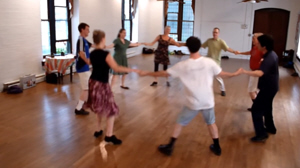

I understand the tune comes from Thompson's “Twenty-Four Country Dances for the Year 1799” though it also appeared much earlier in Johnson's Volume 8 (1758), and Jenna was inspired to write this dance by hearing the recording by Boldwood on their album “Feet, don't fail me now”, though it needs to be slowed down for dancing. She loves Boldwood (though alas, only from afar), and their recordings have inspired a number of her dances. Click the image on the right to see it performed to the recording.
This dance and 17 others are now available in Jenna's book “Under the Influence”. And Jenna's other dance on this page is indeed the title dance: Under the Influence. Jenna's second book “Revelations” is also now available.
The Happy Clown Added 10-Sep-25
Marjorie Heffer & William Porter Added 10-Sep-25Source: Maggot Pie, 1932
Format: 4 couples longways
Music: 3 x Own tune (jig): John Walsh, c.1740
| First Figure: | |
| A1: | Up a double and back. Mini-cast from each end (ends cast, middles follow neighbour, new ends cast, new middles follow to place). |
| A2: | Down a double and back. Mini-cast from each end. |
| B1: | Ends lead in, middles lead neighbour out; lines across fall back. New ends wheel neighbours all the way round, the ends just rotating on the spot, the middles skipping so they dance forwards around their post. |
| B2: | Ends lead in, middles lead partner out; lines up and down fall back. New ends wheel neighbours all the way round. |
| Second Figure: | |
| A1: | Cecil Sharp siding. Mini-cast. |
| A2: | Cecil Sharp siding. Mini-cast. |
| B1: | “London Bridge”: Ones face down, arch to bottom, turn in and come up the tunnel to place, followed by the others. |
| B2: | Reverse: Fours arch and come up, others go down, etc. |
| Third Figure: | |
| A1: | Arm right. Mini-cast. |
| A2: | Arm left. Mini-cast. |
| B1: | Ends slip in (ones give hands, through fours), then back slightly (fours give hands) while middles slip out with neighbour and cast to top/bottom. New ends same while middles slip out with neighbour and turn single out. forming lines across. |
| B2: | Same in this direction (first man again giving hands first). |
I tend to do this with twos and fours improper, but it doesn't affect the instructions. You've really got to move in the “London Bridge” figure!
For some reason in B2 of the final figure they say “lead” rather than “slip”, but I'd prefer to be consistent. And the turn singles would probably all have been to the right, as Sharp decreed.
Helena
Dance and Music: Colin Hume, 1988. Format: Four couples longways
| A1: | Up a double and back. Set to partner; two-hand turn half-way. |
| A2: | Down a double and back. Set to partner; two-hand turn half-way. |
| B1: | Middles half figure eight through the nearest end couple. Circle left in fours half-way; fall back with neighbour. |
| B2: | Face this neighbour: three changes of a grand chain, so that you cross to your own side at the ends of the set. Two-hand turn partner. |
Progressed position is 3, 1, 4, 2. Repeat the dance three more times.
Written for Helena Moss on the occasion of her wedding to Jim Crouch, 26th March 1988, and called by me at the wedding dance with Wild Thyme providing the music.
The Hitchin Diamond
Format: 4 Couples longways, 2 & 4 improperDance and Music: Colin Hume, 2017.
| A1: | On the right diagonal (those who can): set to same sex person; cross over. New middle men (1 and 4) set to each other; cross over and stay facing out. |
| A2: | “Bomb-burst” (with your shadow): Top pair lead up, bottom pair lead down, others lead out on the sides; set to this shadow. Pass by right shoulder (4 steps); two-hand turn partner half-way, into a diamond. |
| B1: | All lead in a double; change hands and lead out. Gipsy right partner. |
| B2: | All circle left half-way (slip) into Becket formation with partner. Fall back in side lines; lead forward. |
| C1: | On the right diagonal (those who can): set to same sex; cross over. New middle men (1 and 4 again) set to each other; cross over and all face the side walls. |
| C2: | Lines lead out; turn towards neighbour and lead back. All two-hand turn partner. |
| Progressed position is 3, 1 improper, 4, 2 improper. |
 Hitchin Staplers is my local Folk Dance Club. The Chairman, Ann Gibson, commissioned me to write a dance for its diamond anniversary in 2018; the club had been going for 60 years. She requested “a dance that everyone could enjoy”, which I correctly interpreted as “not one of your mind-bending creations, Colin”, and the specification was: “A 4-couple longways set, not using the Up a double / Siding / Arming introductions. 'Modern Playford' style. Smooth and flowing. Preferably involving a diamond.” I hope I've done what was required. If you want to know more about how I wrote it, see my Composing Dances page.
You can download an excellent recording by Julia Barnes on flute and Tom Barnes on accordion, who sometimes go under the name “Eclectic Regency” but are more often found playing for Folk Dance Clubs.
Jamaica
Format: 4 Couples longways, 3 and 4 improperDance: Tom Cook, adapted from the longways version published by John Playford.
Music: 10 x Own tune.
| Introduction: | |
| A: | Up a double and back. That again. |
| B: | Set and turn single. That again. |
| Figure: | |
| A1: | Actives (ends) give right hands, give left; turn partner half-way. Same with neighbour. |
| B1: | Lines fall back a double; lead forward. Actives half figure eight through the nearer end. |
| A2: | Active men back-to-back. Active ladies back-to-back. |
| B2: | Actives two-hand turn active neighbour 1½ (skip change). Actives two-hand turn partner half-way (walk); fall back slightly. |
This is the standard version of Jamaica as danced in England. It's Tom Cook's clever invention, but as far as I know it isn't published anywhere and I would hate it to be lost, so here it is. Do the introduction once, the figure 4 times to get everybody home, then finish with the introduction.
The Kind Choreographer
Dance and Music: Colin Hume, 2020.Format: 4 couples longways. Music: 4 x Own tune
| First Figure: | |
| A1: | All lead up a double and back. Set to partner; two-hand turn half-way. |
| A2: | The same but leading down to start. |
| B1: | (12 bars): At each end, circle left. Ones and threes lead down through the couple below and cast up to place. Then lead down into half a symmetrical hey up and down, all taking partner's hand when possible, finishing with the set inverted. |
| B2: | At each end, circle right. Twos and fours lead down and cast up. Twos and fours lead down into half a symmetrical hey, all finishing in home place. |
| Second Figure: | |
| The same but siding into line right shoulder and then left shoulder in place of the leading in A. | |
| Third figure: | |
| The same but arming right and left. | |
One of my favourite Playford dances is “The Merry Merry Milkmaids” so I thought I would write something along the same lines, with an 8-bar A and a 12-bar B. In fact the first four bars are an upside-down version of that tune, and you can use a recording of “The Merry Merry Milkmaids” if you don't have live music.
Most Playford set dances have three different figures, but I decided to be kind to the dancers and use the same figure three times, following the three standard introductions. I find that while the actives are leading down and casting up you need to tell the others to be ready to move up the outside at the start of the symmetrical hey.
The Mock Robin
Dance: Dawn Winskill of Broadstairs, Kent.From the book Dance Search.
Format: 4 couples longways, 1 & 3 improper.
Music: 4 x 48-bar reels.
| A1: | Ends lead in, middles give two hands to neighbour and do two chassées out; half poussette in fours, men pushing first (4 bars); all two-hand turn this person half-way and face the centre of the set. |
| A2: | The same, starting from a longways set across the hall. [The set finishes upside down and improper.] |
| B1: | Middles circle left. Set to opposite; pass through right shoulder. |
| B2: | At each end circle right. Set to opposite; pass through right shoulder. |
| C1: | New middles back-to-back neighbour and then partner while ends lead out 8 steps, turn as a couple and lead back. |
| C2: | Middles cast to nearer end while ends meet and two-hand turn neighbour half-way. That again, and keep hold of this person ready to start again. |
Mr Downing's Challenge
or One in the Eye for HaroldDance: Maureen Christmas of Coolham, West Sussex., 1986.
From the book Dance Search.
Format: 4 couple longways. Music: 4 x The Wee Cooper of Fife (10 bars per line).
| A1: | Lines forward and back. Gypsy partner right shoulder. Turn single left back to place (2 bars). |
| A2: | End couples lead towards the other end couple; fall back. Come forward again and circle left with them. Fall back to place (2 bars). |
| B1: | Middles cast, ends lead in, to form lines across the room; take hands in lines and set right and left. Cross right shoulder with the person facing; immediately turn right to face, take hands in lines and set. Ends gate the middles ¾ to finish back in a longways set in reverse order (2 bars). |
| B2: | Bottom couple lead up to the top of the set, cast, followed from the top by the others to turn set upside-down. Turn single downwards (men right, ladies left) (2 bars). |
Harold Downing from Hastings challenged Maureen Christmas (later Maureen Reed) to write a dance to fit the Scottish dance tune “The Wee Cooper of Fife” as the ten-bar phrasing did not suit any of his usual dances. This is the result.
The Night Crossing
If you picked this dance up before 27-Nov-17 please note that there was an error in the instructions — at the start of B the men should cross left shoulder, not right. Sorry! And a further correction on 23-Apr-18 — I had said that the pause was at the end of the C-music but it's actually at the end of the B-music. The musical notation is correct, so the musicians would play it correctly but it wouldn't be what the caller was expecting! Thanks to Roy Garrington for pointing this out to me.Format: 4 Couples longways, 1 & 3 improper
Dance: Colin Hume, Music: John New, 2006.
| A1: | Lines of four fall back (with conviction); turn single right. Lead forward, hesitate (back in set position for a moment of poise); two-hand turn partner half-way. |
| A2: | All that again. |
| B: | In fours, men cross left shoulder; ladies cross right shoulder and “face the next”: new middles face middle neighbour, ends face partner. Set to this person; two-hand turn half-way and open up to face partner. |
| C: | On the right diagonal, cross right (same sex person) while the two people not involved turn single right; cross left on the left or turn single left. Cross right on the right or turn single right; all single file clockwise one place to finish opposite partner. |
I was at a Folk Camp in Holland in 2006 with Hilary Vare and John New as the musicians. I have done several camps with Hilary, but had not met John before. In the music workshops we played a few of his tunes, and we were all very struck by this one. The inspiration for the tune came when he was on the open forward observation deck on the Val de Loire, crossing from Portsmouth to St Malo. It had been a very congenial evening in the restaurant, with good company and good live piano music, and the sea was flat calm and moonlit.
John wrote it as a slow air, but said he was happy to play it faster for a dance, so I wrote this and tried it out at the end of the week. The tune still needs to be slow, or it loses its style. John wrote a pause at the end of the B-music, and I think a slight pause works well with the dance. The dance needs room for the fall back in the first part, and the dancers must fall back with conviction, otherwise after the lead forward you are too close to your partner to do a good turn.
The other tune of John's to which I have written a dance is Caulking Jig.
The Northern Lass Added 10-Sep-25
Marjorie Heffer & William Porter Added 10-Sep-25Source: Maggot Pie, 1932
Format: 4 couples longways, Twos and fours improper
Music: 3 x Own tune (jig): Chappell / William Porter
| First Figure: | |
| A1: | Up a double and back. Turn single right; cross right with partner. |
| A2: | Lines fall back; lead forward. Turn single right; cross right. |
| B1: | Ones cast below twos, lead down through fours, cast up, lead up through twos while threes lead up and follow. |
| B2: | Fours cast up above threes, lead up through ones, cast, lead down through threes while twos lead down and follow. |
| Second Figure: | |
| A1: | Cecil Sharp siding. Turn single; cross. |
| A2: | Ends with partner, middles with neighbour, siding. Turn single; cross with this person. [Now 1, 3, 2, 4.] |
| B1: | Circle left in fours, and keep hold of neighbour. Ends gate the middles ¾ to lines across; lines lead forward. |
| B2: | Circle left on each side. New ends gate new middles ¾ to lines up and down; lead forward. |
| Third Figure: | |
| A1: | Arm right. Turn single; cross. |
| A2: | Ends with partner, middles with neighbour, arm left. Turn single; cross with this person. [Home] |
| B1: | Ones cast to the bottom, the others half a Grimstock hey started by the twos leading down through the threes. All face down, cast to invert the set. [Home] |
| B2: | Fours cast up to the top, the others half a Grimstock hey started by the ones leading down through the twos. All face up, cast to invert the set. [Home] |
Portesham Breakfast
Format: 4 Couples longways. Dance: Colin Hume, 2002. Music: Richard Jones.Use the alternative A music the second and fourth times.
| A1: | (16 bars): Up a double and back. Cast to invert the set. |
| Gipsy right partner. Back-to-back partner right shoulder. | |
| A2: | Down a double and back. Cast to invert the set. |
| Gipsy left partner. Left shoulder back-to-back partner, and at this point observe your same-sex neighbour in your fours. | |
| B1: | (16 bars): In fours, right-hand star. Middles left-hand star, and finish by facing the neighbour you observed. |
| Reels of four on the side. | |
| B2: | Lines fall back; lead forward. First corners cross; second corners cross. |
| In the middle, second corners cross (the people who crossed first the first time); first corners and the ends cross. All two-hand turn partner. |
I was at a Folk Camp in 2002 where we played this tune all week at music workshops. We also used it on the last evening to parade round the field displaying the wonderful results of the lantern-making workshop. It was definitely the tune of the week, and I loved it, so I decided I'd better write a dance for it and call it on the last night; it seemed to need a Playford-style dance rather than traditional-style.
I called it again the next week at the Morland Dance Week and the band (including Ian Jones and Steve Hunt) all said it was a great tune. Steve told me that Portesham is in Dorset, where he comes from, and is pronounced “Pozzum”. I've since heard Steve playing the tune at Southam Festival, and Ian Jones has also been calling the dance.
So I contacted Richard Jones who wrote the tune to find out more. Richard is really flattered that this tune seems to be so popular. He was in a rock group in the '70's which had a big hit single, but he says this actually feels better!
At the time Richard was fairly new to folk music and was only just starting to get the feet moving. He wrote the tune while messing around on the guitar! He plays with Chris Walshaw (pipes), and the first time they played it in public was at a weekend party which is held in a farm in Portesham. They did it while everyone was having breakfast. Several people came up to them and asked what it was, but he hadn't got a name for it at the time. He has now!
So whether you like the dance or not, I'm sure the musicians will enjoy playing the tune.
In 2006 I was at a contra dance in Ely, and before it started there was recorded music playing. I was very surprised to hear Portesham Breakfast as one of the tracks — and much faster than I had learnt it at the Folk Camp! The recording is by Meridian (Richard Jones, Anna Tabbush and Chris Walshaw). From page chriswalshaw.
Reely Snakey Eighty
Dance: Sue Carter, 2008. Tune: Colin Hume, 2009.
4 Couples rotated clockwise so that there is a spare man at the top and a spare lady at the bottom
| A1: | Middles go left: star left in these fours. Middles cross, star right. |
| A2: | Middles gipsy right, the others circle 3 to the left. Middles swing, the others circle right. |
| B1: | Ends go right: reel of three with this couple (pass same sex right shoulder to start). |
| B2: | Ends reel of four with the middle couple (pass same sex right shoulder to start). |
| C1: | Ends reel of three with the remaining couple (pass same sex right shoulder to start), finishing at end of own-sex line. |
| C2: | Lines go forward moving left; all set. Fall back moving left, to leave new people at the ends; all set. |
| Last time all two-hand turn partner after the lines forward and set. |
Sue wrote the dance her husband Francis Carter's 80th birthday, and I called it at my House Party Weekend with Contradition playing the music. She gave me four versions of the dance: the simplest, called “Eighty” had lots of figure eights in it, and these were replaced by reels in subsequent version until this final version (which is the one they really prefer) has no eights in it at all! Seven months later I called an evening dance for Sue and Francis, again with Contradition playing, and decided the dance needed a tune of its own.
Silver for Gallaghers
Dance: Mavis Pote.Published: 1991
Music: 3 x 48-bar Playford-type jigs or reels, for instance, Pat Shaw's “Miss Bedlington's Fancy”, played with two 16-bar B's. For recorded music, Mavis uses Orange and Blue's “Amaryllis” and repeats the first figure.
Format: 4 couples longways
| First figure: | |
| A1: | Up a double and back. Set and turn single. |
| A2: | All that again. |
| B1&2: | (32 bars): The Lichfield Hey, four times to get back to place: |
| In fours, first corners cross; second corners cross. Middles cross with neighbour; ends cross with partner. | |
| Second figure: | |
| As before, but with Siding instead of Up a double. | |
| Third figure: | |
| As before, but with Arming instead of Up a double. | |
First published in English Dance and Song, Summer 1991. Composed by Mavis Pote for Anne and Frank Gallagher on the occasion of their Silver Wedding, and danced frequently since then by Friday Folk and Crown Hills Folk Dance Group.
The Lichfield Hey comes from the Lichfield Morris tradition, as performed by Lichfield Morris, Stafford Morris and other Midlands sides.
Star of Kintra
Music by Elvyn Blomfield (July 2004) Dance by Trevor Monson (June 2004)
4 couple longways — 3's & 4's improper
| A | 1-4 | All back to back with partner, turning single to the right on the way back |
| 5-8 | In 4's, ½ right and left (no courtesy turn) | |
| 9-16 | Middle 4 right hand star, left hand star back | |
| B1 | 1-8 | The 4th lady following the 1st man (acting as a unit) full reel of 3 across the set with the 2's, the 1st man and 4th lady ending in the middle of the side line. Similarly the 1st lady follows the 4th man for a reel of 3 with 3's. |
| B2 | 1-4 | All circle left ½ way |
| 5-8 | End couples ½ figure 8 through nearest couple | |
| Progressed position is 3-1-4-2. | ||
John Blomfield, one of the founder members of the Folk Dance Band Wild Thyme, died on the Isle of Mull in Scotland on 27th May 2004. On 26th August there was a Memorial Dance at Southam in Warwickshire. It was preceded by remembrances of John, led by his son-in-law Shane Day with contributions from other people who knew him; Trevor Monson gave an account of the funeral service. The Grange Hall was full for the occasion. Shane had also put together a slide show of photographs of John from childhood to his last weeks. The dance was run by Barbara Kinsman who called mainly Playford-style dances, with a couple of American Squares from Colin Hume and this new dance written and called by Trevor which went down very well. Trevor and Elvyn would like the dance to be more widely known — so please call it! Kintra is the area of Mull where John lived.
Summer Reverie
Format: 4 couples longways. Dance and Music: Colin Hume, 2000. | A: | Ones cross and cast; twos lead up. Middle ladies cross (1 and 3); middle men cross. |
| B: | Bottom three couples circle left half-way. Join hands in lines of four and fall back; lead forward. [2, 4 improper, 1 improper, 3.] |
| C: | Middles face the ends: back-to-back neighbour (opposite sex). Two slow changes without hands. [4, 3, 2, 1.] |
| D: | Ones (at the bottom) need to make the second change more of a half gipsy, so that they can then lead up to the top, the others go down the outside and follow them up the middle to invert the set. Ones cast to the bottom, the others continue leading up to progressed place and two-hand turn. [Standard progression.] |
Musicians: as with Winter Memories, slow and lyrical but don't let the tune falter.
A Time to Dance
Format: 4 couples longways. Dance: Maggie Hosking, 1999. Music: Colin Hume, 2002.| First Figure: | |
| A1: | Lead up a double; cast back. Set to partner; cross right shoulder with partner. |
| A2: | Lead down a double; cast back. Set; cross right shoulder. |
| B: | Matchboxes: Ones and threes give two hands and slip down between the next couple who slip up; twos and fours slip down, the others up. All that again. |
| C: | Double matchboxes: Ones and twos give two hands and slip down between both the other couples who slip up; threes and fours slip down, the others up. All that again. |
| Second Figure: | |
| A1: | Side right shoulder to right; cast left. Set; cross right shoulder. |
| A2: | Side left; cast right. Set; cross right shoulder and all face up. |
| B: | In fours, double figure eight: ones and threes cast, twos and fours cross up to start. Ones and threes cast again, into: |
| C: | Reels of four on the side: men pass left shoulder, ladies right shoulder. |
| Third Figure: | |
| A1: | Right-hand turn half-way; turn single left. Set; cross right shoulder. |
| A2: | Left-hand turn half-way; turn single right. Set; cross right shoulder. |
| B: | In fours, right-hand star. Left-hand star. |
| C: | Ends face partner, middles face neighbour: Grand chain. |
| Fourth Figure: | |
| A1: | Lead up a double; cast back. Set; cross right shoulder. |
| A2: | Side right shoulder to right; cast back left. Set; cross right shoulder. |
| B: | Right-hand turn half-way; turn single left. Set; cross right shoulder. |
| C: | Lead down a double; cast back and face up. Set; step right and honour the presence. |
I was booked to call Maggie Hosking's 50th Birthday Dance, and she asked me to write a tune to one of her own compositions. I was pleased to do this, since it's a very nice dance, but I wasn't too sure about the tune I'd written and ended up sending her two tunes. She liked the A part of one and the B part of the other, so I fitted these together (losing a nice key-change on the way, but you can't have everything). The title comes from Ecclesiastes (King James version): “To everything there is a season… A time to mourn, And a time to dance”. She has an interesting gimmick in the fourth figure, which is basically the introductions to the other three figures — I knew that, but it still almost fooled me when I called it! Unknown to her, I had also written my own dance and tune, Maggie's Waltz Square for her.
Under the Influence
Dance: Jenna Simpson, 2013Music: 4 x “Tom Kruskal's” by Amelia Mason and Emily Troll.
Format: 4 couples longways, 1 & 3 improper
| A1: | In two rings of 4, balance; Petronella turn. In a ring of 8, the same. |
| A2: | In a ring of 8 balance; partner quick 2-hand turn. Circle 8 half-way. |
| B1: | Ones down, fours up: (skip-change step): half a dolphin hey with this couple — actives keep hands and change hands as they change leads, pass the other active couple right shoulder, the same at the other end and lead across, finishing ones proper in second place, fours improper in third place, facing the end couple. [Ends just do a full hey across.] |
| B2: | Mirror back-to-back neighbour, actives going between the ends to start. In rings of 4, circle left. |
| Progressed position is I, 1, 4I, 2. Repeat the dance three more times. | |
Jenna says:
Tempo should be upbeat and lively, as on the wonderful, joyful recording by Elixir (to which it was written). The tune, “Tom Kruskal's,” was written by Amelia and Emily as a tribute to Tom as their mentor. Titling my dance “Under the Influence” was a playful nod to that fact, and to my gratitude to my own friends/mentors in the dance world who have influenced my work. (And also, just at the time I was looking for a title, a dear friend and I had been joking about “what a bad influence we are on each other.”)This dance and 17 others are now available in Jenna's book “Under the Influence”. Jenna's second book “Revelations” is also now available. Jenna's other dance on this page is Gambols. The tune is also used for Christine Robb's beautiful dance “Sapphire Sea”.
Wallington Diamond Jubilee
Dance and Music: Ellen Taylor, 1993Format: 4 couples longways, 1 & 3 improper
| A: | Partners lead up a double and back. All set to partner; couples 1 and 3 cast a place as 2 and 4 move up. |
| B: | Partners lead up a double and back. All set to partner; couples 2 and 4 cast a place as 1 and 3 move up. |
| C: | Couples 1 and 2 draw poussette (men moving backwards all the time) to change places, while couples 3 and 4 do the same. Couples 1 and 4 in the middle do the same. |
| D: | End couples lead in between neighbours and cast back to end places. All set and turn single. |
Repeat the whole dance three times more. For the Diamond Jubilee of the Wallington Folk Dance Club.
First published in English Dance and Song, Autumn 1993. Ellen's first dance “The Lincolnshire Poacher” was published in the EFDSS magazine (forerunner of ED&S) in 1977. Since then she has written twenty more, of which the most popular is “Delia” in the “Hunter's Moon” collection.
Wallington Golden Jubilee
Dance and Music: Ellen Taylor, 1993Format: 4 couples longways
| A1: | Ends set to partner; two-hand turn half-way and face neighbour. All back-to-back neighbour. |
| A2: | All set to neighbour; two-hand turn half-way and face partner. Back-to-back partner. (1s and 4s are now in middle place improper.) |
| B1: | Middles half figure 8 through nearer end. Middles half poussette with each other to change places, first man pushing. |
| B2: | At each end, right-hand star. Left-hand star. |
Repeat the whole dance three times more. For the Golden Jubilee of the Wallington Folk Dance Club.
These are mainly on my Scottish Dances page, but I'm putting in the links here in case you'd like to try them.
Aird of Coigach Blooms of Bon Accord The Belle of Bon Accord Corstorphine Fair The Devil's Elbow Double Postie's Jig Falconer Hall Lady Home's Jig The Machine Without Horses Mairi's Wedding Marigold Postie's Jig A Trip to Bavaria