Enjoy Dancing Better
I dance because I enjoy it. Admittedly there are times when I find I'm not enjoying it, and it's interesting to analyse why not. Often it's to do with my expectations not being met. If I'm at a children's dance I'm not expecting them to be brilliant dancers, but I am expecting them to have a go and put plenty of life into it. If those expectations are met, I enjoy myself. At a Playford Ball I expect the dancers to have a reasonable idea of how to get through the dances; at a workshop I expect the caller to do some teaching on how to dance better. If those expectations are not met, I don't enjoy myself. Of course there are other factors — if I'm dancing with a particularly lovely partner I can forgive the caller and band quite a lot!
So what's this about “Enjoy Dancing Better”? I'm afraid some people would see that as contradictory — “I came here to enjoy myself, not to be told how to dance”. But would you say that if you joined a Tennis Club or a Painting Class? Surely you'd expect the coach or teacher to advise you on how to play or paint better — and yet you're still there to enjoy yourself. I believe very strongly that if you dance better you'll enjoy it more — and so will your partner and the whole set you're dancing in. I'm not talking about being flashy, putting in extra twiddles to show people how clever you are, looking superior — a good dancer doesn't do that. I'm talking about five points today:
- Dancing in an appropriate style
- Knowing where you're going
- Fitting it to the music
- Recovering well
- Helping other people when necessary
 Dancing in an appropriate style
There's no one dance style which is right for everything. I see people in England dancing a reel of four in an American contra with a skip-change step, and to me that's totally out of place. Conversely I see people plodding through a Scottish dance which really does need a skip-change step. I see people swinging in hornpipe rhythm — a step-hop — using a ballroom hold, and I think it must be most uncomfortable. If you asked them why they were doing these things they'd look at you blankly — or perhaps angrily — and what would they say? Probably “Mind your own business”. They wouldn't see what you were getting at. No-one's every told them what goes with what; there are so few callers who do any teaching of style or steps these days.
Mo Waddington has pointed out that “appropriate style” also depends on your partner and the other people in your set — it's not appropriate to swing your partner very fast or force the whole set to do an energetic slip-circle if they're clearly not up to it.
Knowing where you're going
Always useful. People who have been dancing a long time usually do know where they're going, and would be surprised that I consider them not-very-good dancers. But if you're a newcomer to all this, knowing where you're going is top priority — the style can come later.
Fitting it to the music
This one baffles me — perhaps because I was a musician long before I was a dancer. I genuinely can't understand why some people do a move which gets them to the right place far too soon and then wait for the band to catch up. I might do it once, but I'd realise it, and next time I'd take smaller steps or use a wider track. Conversely, take a dance where the ones lead down the middle, turn and lead back, then cast around the twos. I know people who will take eight steps to lead down and turn, eight steps to lead back, and then be surprised that there's no music left for the cast. And they do this all seven or nine times through the dance!
Recovering well
A good dancer isn't one who never goes wrong, but one who recovers well. Some people just give up as soon as they've gone wrong — as if they've already failed the exam so what's the point of trying any more? We'll be looking at that. And let's start with a great hint from Alan Winston of California:
Try to smile — this fools your body into thinking you're enjoying yourself! That is, as far as I know, true; it tends to reduce the panic reaction, and it raises smiling as something you're doing for yourself rather than as some kind of obligation to other people.
Helping other people
You're not dancing on your own — you're dancing with a partner, and in a set. Wanting other people to dance better, or even just to do the dance right — that's a much trickier problem. I dance with The Round in Cambridge: it's a university group so they have an influx of new people each academic year. It got back to me that a couple of these had complained about me pushing them around and didn't want me in their set. I was horrified — I'd thought I'd been helping people and obviously I hadn't at all. So maybe I'm not the one to advise you, but the recommended technique (which I have to learn) is to indicate the way to go without touching them or saying anything. Of course if the touching fits into the dance that can be fine — you can hand your partner into a figure eight for instance — but rather than grabbing hold of someone it's much better to point in the right direction or indicate with your eyes. And sometimes they won't get it, and you'll just have to accept that you couldn't help them — better that than getting them through the dance correctly but leaving them feeling that they never want you in their set again.
So let's try dances in various different styles, and I'll see if I can help you to enjoy dancing better.

Moving Pieces
American contra by Dave ColestockSo the style is American, which means basically a walk, but a positive walk rather than a plod. However, it starts with a Rory O'More balance and spin. Callers in the States get to this point and say, “As in the dance Rory O'More…” but I doubt whether many of the people they're talking to have ever danced it. However, the move is used in many new dances. When Americans balance a wave they usually balance right and left (even when the caller says forward and back). They do it with significant eye contact — in fact it can be quite intimidating! And they don't do an English-style setting movement with a “one, two-three and one, two-three”. Instead they come down hard on the leading foot, bring the other foot up to it, and leave out the change of weight on “three”. Try it. The spin in fact is optional — the original dance had a slide across face to face — but most contra dancers do it. In England a fair percentage of people spin the wrong way. It's not a cast, it's the complete opposite; you pull your right shoulder back as you move to the right. It's a travelling turn single if you want to put it in Playford terms. I've heard Philippe Callens say that virtually all the spinning needs to be done on the first two steps, or you find yourself stepping back on the third step which is not helpful. Get your shoulders turning, lean into it slightly, and just go for it. The balance is preparation for the spin; without that it's harder work. And the second half is a balance left and right, so surely you can see that you need to spin by pulling your left shoulder back this time. And yet some people spin clockwise both times.
You can help other people (and yourself) by pushing off their hand to start the spin, and by catching them again with the other hand as you finish it. But don't think of turning them — remember the spin replaces a slide face-to-face, not a turn.
The turns come next: you need to give some weight and flow smoothly from one to the other to the swing. Please swing to the end of the music — it doesn't need to be fast, but it needs to fit the music. And this business of helping other people — the man is usually in charge of finishing the swing, at which point he's moving forwards which is fine for him. But the lady is moving out of the set — it's a complete change of direction for her — and the man can help by bringing her to a stop and steadying her with his right hand on her back. Or he might finish the swing with a twirl (if she's willing), but again he needs to stop her momentum so that she can move forwards for the next movement.
Finally, what about enjoyment? I enjoy the spinning, particularly if all four of us are giving weight and catching each other as I've just described. I enjoy a good swing, and I like the energy in this dance. Can I make you enjoy it? No of course I can't, but at least I hope I've given you some pointers.
Miss de Jersey's Memorial 
Longways waltz by Pat Shaw Let's look briefly at the waltz step.
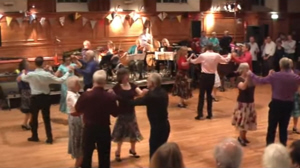
Knowing where you're going: the tricky place is coming out of the second reel into position for the circle in B1. It's actually very logical — it's as if the twos were continuing the reel until they reach the side lines, whereas the ones stop on the side lines rather than moving back into the middle. If you fail to get where you should be, this becomes an exercise in recovering well. Don't shuffle around and make it obvious to everybody that you made a mess of it; just adjust your position when you're sure you know where you should be. I don't think I'd risk doing that during the half figure eight or the back-to-back, but I would know that at the end of the circle right we should all be in original place but improper, and I'd get there somehow. Click the image to watch London Folk doing a wonderful demonstration of English dance. Miss de Jersey's Memorial is the second in the sequence, and I bet you didn't notice Mike Wilson-Jones (the man doing the introduction) going wrong and correcting himself!
Fitting it to the music: there's more time than people think for the 1½ turns, so don't bend your arms and rush round — it's not a contra. The final two-hand turn has a lot of time, so again try not to rush it. Helping other people — mainly working with your partner, and generally being aware of where the other three people are so that you can indicate (delicately) if you think they should be somewhere else! Enjoyment — it's a beautiful tune to dance to, and with a good partner the whole thing can be magic — it's extremely popular in the States. I just love the way it all fits together. And the ones have a great solo, which Ron Coxall also uses in “Turn of the Tide”.
The Devil's Elbow
Scottish dance by J Trevor Stephenson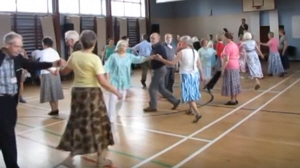
You'll recognise the move that Ron Coxall uses in “The Short and the Tall”. It also appears in the Modern Western Square Dance figure “Spin chain and exchange the gears” and in a double contra called “The Devil's Backbone” — there's a lot more overlap between the various dance forms than some people want to admit. And in the final eight bars we have set and Petronella turn — very similar to the Rory O'More balance and spin, though some contra dancers would never admit this!
Knowing where you're going: Yes, this could be a problem, because it's a busy dance and the ones are constantly moving and changing position. The thing to cling on to is that once the ones have gone to the correct couple for the first star, those people stay together for the snaking movement, the other star and the other snake. So long as you all finish opposite your partner in time for the setting in lines, you should be fine.
Fitting it to the music: just go for it — I doubt that you'll get there early! [Actually I was wrong there — click the image to watch this dance at Lichfield Folk Festival in 2011, and in the stars you'll see me slowing people down!]
Recovering well: not so easy. If you get lost in the stars and snakes, just get into the order 2, 1, 3 with the ones improper and pretend that you meant to do it that way.
Helping other people: it's certainly a team effort, and if you can grab the correct person's hand for the star they'll probably be grateful.
Enjoyment: I like Scottish because you're really dancing — surging around the set. I enjoy this one because it's a clever dance and it flows beautifully. You're dancing with people the whole time, sometimes using hands and sometimes not, unlike some modern compositions where you're just walking round in complicated patterns.
Hole in the Wall
Longways, published by Henry Playford, 1695A classic Playford dance. It's in three-time but certainly not a waltz; I'd say the style is elegant without being artificial, with a slight emphasis on the first step of each bar. I usually go down on the first beat and then keep my heels up on the second and third: I'm not saying that's “correct” but it works for me. An easy dance in terms of figures; I don't think you'll have any problem knowing where you're going. The tune is by Purcell, and would have been played briskly in his day; we do it much slower. Fitting it to the music — I don't think you want six steps for the cast and six for the lead, because the lead is a shorter distance and doesn't involve any turning. I'd say about eight and four — but don't let me see you counting under your breath!
Let's look at the “Hole in the Wall” cross.
And don't rush the final circle: six steps to circle half-way is a lot.
Helping other people: just taking your partner's hand at the right time to lead through the other couple is probably enough — and a meaningful look at the person you're about to do the “Hole in the Wall” cross with.
Recovering well: surely you won't need to do that.
Enjoyment: again it's a great tune, and I just love the moment when after the cast you meet your partner at exactly the right moment to lead home. And the “Hole in the Wall” cross can be an exhilarating move if the person you're doing it with feels the same way about it that you do.
The Devil's Backbone
Double contra by William WatsonYes, it's that move again — or rather half of it. We're back to contra style — you can drop the elegance now! Again, use all the music for the swing, and this will propel the men in for the allemande left: don't dance in stop-start mode. Give some weight here, using an American hold rather than a Playford hand-shake hold, and remember what I said about stopping the lady's momentum after the partner swing, so that she's ready for the lines forward and back rather than still flying backwards.
Knowing where you're going: the Scottish dance we did earlier should help you here, even though it's a different number of couples and in a different direction. And that's something to cling to if you're new to all this — there's a lot of crossover of skills. You don't have to learn an entirely new vocabulary for each dance you meet: the same patterns come up again and again.
Recovering well: at least be aware that each time through the dance you progress one place and change sides with the couple who stay with you — though if you don't change sides it won't affect anybody.
Helping other people: the men can help the ladies from the ladies chain into the star, and by exerting a little pressure on the hand you can remind the leading lady that she needs to break out of the star and into the snake.
Go George, I can't endure you
Down Back o' t' Shoddy, collected by Julian PillingTraditional English — it's one of those three-couple dances where the men join hands and dance round the ladies and then the ladies dance round the men. Julian Pilling who collected the dance specifies that these moves are done with a “Hop 1 2 3” so that's certainly the appropriate style, which means you need to put some life into it! I actually refer to it as a “1-2-3-hop” because the hop comes on the up-beat and it's the “1” which comes on the down-beat, though I agree that the whole sequence should start with a hop — just like a skip-change. In fact both a 1-2-3-hop and a Strathspey are slowed down versions of a skip-change step! The second half of the dance is walked except for the swing. There are no difficult moves, but a surprising number of people can't time the dance around and always get there too soon. Surely there's a simple way to tell: after four bars you should be half-way round. (I point out the same thing in a Grimstock hey.) The four changes are danced unphrased — I'm sure it was originally a triple minor and the ones arching to the bottom was added to convert it to a three-couple set. If you want to count, it's three steps per change, leaving four steps for the ones to arch to the bottom. Helping other people? It's a good idea for the third man to grab the first man at the end of the turn of the dance where the ones have just arched (backwards) to the bottom of the set and the first man thinks it's time for a rest! Recovering well in that situation? Either run to catch up or stand there with a look that says “I didn't want to join in that bit anyway”!
The Shrewsbury Lasses
Thompson, 1774-1779; Apted BookCleverly converted from a triple minor to a three-couple dance. Appropriate style? Some people just can't do the step and honour — I'm not sure whether they don't have sufficient control of their bodies or they find it embarrassing or what. I don't mind you overdoing it, but I do mind you underdoing it!
Let's all practise step and honour.
Originally the twos would not have joined in with this except for an acknowledgement: the ones are doing the honouring to the twos.
Fitting it to the music: some people can't use up enough time for the honouring and just lurch forward into the two-hand turn. Here's a case where the music really does tell you — it's saying “Step right — and honour; the other way and honour” (though I don't want to hear anyone singing that), and some bands will slow down slightly for those bars and then speed up for the two-hand turn. Don't be one of those men who do the two-hand turn in four steps and then shove the lady back in place with a look that says “There — I beat the band”! But it's the second half where some people have trouble fitting it to the music. The cast is only four steps; straight into the circle which takes the standard eight steps, straight into the dance around the outside which takes eight beats (four skip-change steps) then slow down for the two-hand turn half-way in four steps. As you see, the appropriate style varies throughout the dance — and why shouldn't it?!
Helping other people: by being ready to take hands in the circle, and if necessary giving a little pull or push to start the active couple on their dance round the outside — without being rough or making it obvious. If you're the ones, finish the two-hand turn facing down with inside hands joined, to show the threes that you're about to lead down and therefore they'd better cast up. Conversely if you're the threes be ready to cast up which should give the ones the hint. A lot of this is quite subtle; the trick is to help people without making it obvious to everybody else that they needed help.
Enjoyment? I just love the whole dance — the elegance, perhaps the silliness, the interaction between the dancers, the contrast between the dance round the outside and the rest of the moves. And I love the tune, particularly the syncopation.
Let's try the whole dance again without a word from me.
The Ely Waltz
Waltz by Colin Hume — See the instructions here. First I would teach the waltz step.
Note that 2 and 3 are small steps even when you're moving sideways. This dance doesn't have any setting in it, but plenty of waltz-time and triple-time dances do, and as soon as some people hear the word “set” they want to do the bouncy-bouncy. Not in this case. I'm looking for Sibelius rather than Vivaldi!

So that's the appropriate style.
“Circle left” seems such a simple move: how could you possibly do it wrong? You'd be amazed! You need to face somewhat to the left (without contorting your arms or making it uncomfortable for the people whose hands you're holding), and make sure that on the first step of the bar the foot actually passes in front of the other foot; I've seen people do just a series of sideways chassées — left, close, left, close, left, close. I start by crossing the right foot in front of the left, but it's fine to start on the left provided that in each bar the leading foot moves in front of the other one.
Knowing where you're going and fitting it to the music: some people don't put enough oomph into the turns, use up all four bars and then try to progress in the wrong direction. Just because it's a waltz doesn't mean it has to be “floaty” and “drifty” although some Americans will assume it does; you need to give some weight in the turns and get all the way round in three waltz steps so that you can move on in the fourth. Helping other people — just by being there at the right time and dancing with them. Maybe a little pull at the end of the turn if you don't think they're sure which way to progress — but don't do that if they seem confident: helping people doesn't mean mothering them when they're grown up!
Kelsterne Gardens
Triple minor published by John Young in the Dancing Master Volume 3, c. 1726.Much modified and converted to a 3 couple longways by Tom Cook in “Come Let's Be Merry”, 1975.
A lively dance where the twos and threes are also busy. I would say that the appropriate style is a skip-change for the Grimstock hey and the double figure eight, and a walking step for the circles and casts.
Knowing where you're going: in the Grimstock hey I think you just need to start going in the right direction and (particularly for the twos) not stop half-way through. A double figure eight can bewilder people because instead of dancing round a stationary couple, you and three other people are dancing round nobody! The first thing to realise is that (in this orientation) you always go up the outside and cross down the middle. Once you've crossed down you cast up the outside, but don't believe anyone who tells you that the twos need to cast up at the start: they're already facing and moving up so they just keep going. It might help to realise that you're all moving on the same figure-of-eight track, and you're following the same person the whole way: the twos are following their same-sex neighbour and the ones are following their opposite-sex neighbour. Just remember to leave a gap though; somebody needs to get through between you! This is one of those cases where being early is just as bad as being late: you have to watch the other three people and time your moves accordingly.
Fitting it to the music: some of us aren't good at that, and when I once asked a group of people at a workshop why they weren't fitting a Grimstock hey to the music they said “Because no-one's ever shown us how”. The secret is: when it's half-way through the music (4 bars, or 4 skip-change steps) you should be half-way through the figure — the ones at the bottom just about to lead up, the threes at the top just about to meet and then lead down; the twos in their home place but moving downwards.
Let's try that with music (stopping half-way the first time) and make sure we're all confident about it.
And the same is true of the double figure eight: half-way through the music (the same point in that same music) you should be in your partner's place.
So let's try that too.
And of course if you're fitting the Grimstock hey to the music the ones and twos don't need to stop at that point — they just flow straight into the double figure eight.
I was fooled the first time I danced this because the caller hadn't said the B-music was a 6-bar phrase (12 steps) and I had assumed a standard 8-bar phrase. So it's 8 steps to take the circle all the way round — not difficult if you make a good circle — and 4 steps for the ones to cast and the twos to lead up. The same with the threes, and at the end the ones become threes and everyone is straight into the Grimstock hey for the next turn of the dance.
Recovering well: be aware that at the end of the Grimstock hey and at the end of the double figure eight you're all back where you started — so if it goes wrong just get there. At the end it's a standard progression, so again just get there.
Helping other people: I always recommend taking hands with your partner at each end of a Grimstock hey (and letting go in the middle of course). It helps to reassure an uncertain partner and also reminds the middle couple that they need to separate as they approach the end. If I were the first man I might also hand my partner across into the double figure eight — particularly if I thought she was about to continue the Grimstock hey!
Mount Hills
Henry Playford -- Dancing Master 11th Edition, 1701.Bernard Bentley -- Fallibroome 2, 1965.
For me the appropriate step would be a skip-change for the first half, a walk for the rest (which is several short movements) and then a skip-change for the final three changes. I'm not dogmatically saying that's right, and in Henry Playford's day the whole thing would have been danced with steps, but that's my suggestion.
Knowing where you're going: during the walkthrough you should realise that at the end of A1 you're progressed and at the end of A2 you're back where you started. Do you realise that sort of thing? Or do you just blindly do what the caller says without any awareness of the pattern?! At the end of B1 you're again back where you started; the three changes give the progression right at the end.
Fitting it to the music: here I'm going to be dogmatic, and it's about when the inactive couple move up. First of all, Playford never mentions it in any dance. In this one he says: “First couple cross over and go the half Figure. The second couple do the same”. “Cross over” always means “cross and cast”, but A1 is all about the first couple and A2 is all about the second couple yet at some stage the other couple must move up or the whole set would drift out through the bottom of the hall. To me it seems obvious that we have two separate movements here. The first couple cross and cast — where to? Obviously to the second couple's place, so they must move up straight away. Then the first couple do a half figure eight — and where does that take you? To where your partner started the move — it's a complicated way of changing places. And yet some people will dogmatically assert that the twos don't move up until the end of the whole thing. This would mean that when the ones cross and cast they finish in what would be the third couple's place — agreed there isn't a third couple in this dance but there is in some dances. And then their half figure eight starts from the third couple's place but finishes in the second couple's place. That doesn't make sense to me. The reason I'm sometimes given is that the second couple having led up at the very end can then keep moving into their turn at leading the figure. But that's missing the point. The moving up is an essential part of the dance, but it's not supposed to be a showy move — it's just the twos getting out of the way of the ones so that the ones can lead the figure. Then the twos have their turn and the ones are the inactive couple. Similarly I hate what some Americans do in dances like “The Bishop” and “Wakefield Hunt”: the first man casts and as the second man moves up he does a turn single. No! He's not supposed to be saying “Look at me”; he's just moving so that the first man can perform his track. He gets his moment of glory when he becomes a first man.
Brad Foster says it's not an American thing, it's Andrew Shaw's influence! Andrew Shaw denies this: see what Andrew says.
Having said all that though, if the caller specifies when the twos are to move up I will do it his way rather than defiantly doing it my way. If some of the twos move up early and some move up late it becomes an obstacle race for the ones!
Recovering well: again, if you're aware of where each figure finishes you should be able to get there.
Helping other people: if your partner doesn't remember the cross and cast, giving right hand to right and a little tug should do the trick. The man could also give right hand to right to help his partner remember the half figure eight, though I usually just give a gesture to indicate the path. Corners cross: eye contact is all you need. And if your partner forgets the back-to-back and lurches into the three changes, just saying “woh” is probably enough.
Alternating Corners
American contra by Jim Kitch, published in “To Live is to Dance”, 1995The move “Turn contra corners” (under various names) appears in Playford-style, English Traditional, Scottish and American dances. It was originally a triple minor figure, so the twos only had their own ones to think about. When it's condensed to duple minor the twos are apt to get confused.
The appropriate style is a walk — not a “carrying the shopping home from Sainsbury's” plod but a purposeful walk, giving plenty of weight in the contra corner turns. Use an American grip (though without the thumb) rather than the Playford shake-hands hold, and bend your elbows so that you get in closer and therefore don't have so far to move.
Knowing where you're going: when I'm teaching contra corners I always say “Ones, look on your right diagonal — that's your first corner. Make sure they're looking at you. Now on the left for your second corner. Now look at your partner — because that's the one you start with”. I think some callers rush this and don't give people time to see who they are aiming at (or who is coming to them). My advice to the twos is “Stick out your left hand and turn anybody who comes at you”.
Of course the problem (or the great thing) with this dance is that it alternates, and some people are never sure which rôle they're supposed to be performing. Rather than stand there blankly, have a look at what the couple two above or two below you are doing, and do the same thing! If you're not sure how to finish the swing, just remember that you're moving on to meet the next couple, and you know that ones progress down and twos up, so assuming you know what number you are that shouldn't be a problem.
Recovering well: the swing is the time to do that. However badly the figure has gone, so long as you finish facing the next couple (with the man on the left and the lady on the right) you've recovered.
Helping other people: at least look at (or for) the person you're doing the contra corners turn with, and wave if necessary. It may help to know their name: people react to that when they might not reach to “over here”. And after the lines forward and back, if you're sure it's the other couple's turn to do the half figure eight you can give your neighbour a gentle tug.
Fitting it to the music: as with many contras it ends with a swing, so you can catch up if you're late, but for me there's great satisfaction in finishing the contra corners move and getting back to my partner at exactly the right time for the balance. But to do that requires everybody giving some weight on those turns.
Delia
3-couple Dance by Ellen Taylor, published in Hunter's Moon, 1987.I'd say the appropriate style is a smooth stately walk, and I wouldn't do any of it to a skip or skip-change — but other people may tell you differently. I don't think there's much problem in knowing where you're going, particularly as you're dancing with your partner the whole time.
Fitting it to the music: as usual, some people find this a problem. Do the step and honour with conviction, and look at your partner as you do it. Do a good open right-hand turn, using up all the music, and take a cross-hand hold on the eighth beat. Fitting the promenade to the music is up to the ones, since they're leading it, but too often they're afraid of being late and therefore they're early and have to wait for the music to catch up. My usual rule applies: half-way through the music you should be half-way through the promenade, which means that after 8 walking steps the ones are level with where the threes started, facing down and about to start the wheel around. Some people think the ones need to rush it because the twos and threes need more time to get home, but that's not true — you all start moving together, you're moving as a column of three couples around the same track, so you all get home at the same time. The ones' second half figure eight is a rare occasion when I would delay the inactive couple leading up, simply because if the threes lead up as the ones do their second cross and cast they are next to the twos and the ones would have to squeeze through the gap during the half figure eight. Grimstock hey — we've discussed fitting that to the music.
I don't think there's much need for recovering well, and probably not for helping other people; it's a gentle enough dance that people have time to get it right.
Once a Night
Thompson 1774-1779, converted to a 3-couple dance in The Apted Book, 1966.The appropriate style is a mixture. I would use a walk step for the casts, slip-step for the circles, skip-change step for the heys, continuing with skip-change for the ones' final solo and a walk step for the others moving up. I love the contrast between the long walked cast and then the slipped circle.
Knowing where you're going: if you're confident with a Grimstock hey, the only difference in a “cross hey” or “hey contrary sides” is that the ones cross down through the twos to do the first hey improper and then again to do the second hey proper; for the twos and threes it's just two continuous Grimstock heys. The important thing to remember is that the ones always cross down through the twos, not straight over. As first man I would give right hand to my partner the first time and left the second time, and hand her down as I cross behind her. No-one has to know if I exert a little more pressure because she really wants to do something else; that's just between the two of us.
Fitting it to the music: people have real trouble taking 8 steps for a cast; that's why the interpreters added a turn single in dances like “Fandango” and a set in “The Bishop”. What's the secret? First of all, simply being aware of the music and the fact that you have 4 bars (8 beats) for the cast. You can afford to move in towards your partner and loop out upwards at the start of the move — and if there isn't enough space behind you to do a wide cast, take smaller steps. A good slipped circle, with everyone giving weight and drawing the person on their right, will fit the music with no trouble at all.
The final solo for the ones is quite busy. In this situation, some callers will say apologetically, “You'll have to dance this bit” as if that were a great imposition. It's a dance, for heaven's sake — why shouldn't you dance it?!
Recovering well: as usual, it helps to see the pattern of the dance. After the two lots of casting and circling you're all back where you started. After the two lots of heys you're back where you started. If you're not, just get there with the minimum of fuss and anxiety. And whatever contorted path the ones may follow in their final solo, they know they need to finish at the bottom of the set!
Helping other people: taking hands with your partner at top and bottom of the heys, taking hands with people for the circles (but not standing there with your hands out for three bars and waiting for them), and especially the twos and threes waiting until the last four beats of the tune for their move up.
The Bath Waltz
Thomas Wilson — A Companion to the Ballroom, 1816, converted to a 3-couple dance. See the instructions here.Of course a waltz step, but be aware that in the initial grand chain you need to take small steps and make sure each turn is a curving movement rather than a pull by, whereas in the turn contra corners you have to cover a lot more ground. I got this from Valerie Webster, and it has been nicely converted (she doesn't know by whom) from a triple minor to a 3-couple reverse progression dance.
I don't think you'll have any trouble knowing where you're going.
Fitting it to the music: don't rush the grand chain, and please move with confidence in the poussettes rather than the person being pushed doing little mincing steps — presumably for fear of hitting someone. It's up to the person moving forward to look out for obstacles; if you're the one going backwards you just have to trust your partner!
Red-House
Henry Playford, Dancing Master 9th Edition, 1695.If you're interested in the different interpretations, see my notes here — at the moment I'm focusing on you dancing it well and enjoying it.
The appropriate style is a mixture. I would use a walk step for the forward and back (or backward and forward) and the casts, and a skip-change step for the rest, possibly slowing down to a walk for the last four beats of the final reel as the ones cast and the twos move up.
Knowing where you're going: if you've understood the walkthrough this shouldn't be a problem. Of course if you change numbers you do different things: that's why it's a good idea to take in the whole walkthrough, not just the moves you do.
Fitting it to the music: I don't think there's any problem with the A-part — the forward and back, setting and casting. People lose it when it comes to the chase. You don't need to be a musician to know how long a line of music is. 90% or more of this sort of music is in 8-bar phrases — 16 beats. That would be 16 walking steps — but I want you to dance it, not walk it. Usually the active couple get there too soon, and then find that the other couple are where they're aiming for, so they end up below the other couple and then have to shuffle up. Don't do that! If you listen to any of the three lines of music you'll hear that they're in four phrases of two bars each — four beats. The first three are very similar — the fourth is different and you don't have to be a musician to hear that it comes to a full stop. That's the time when the actives dance across into second place and the others move up.
And then the reels of three. You need to be aware that you can't go out so far in the second reel because you have to fit in the progression — again on that same 2-bar phrase which appears at the end of all three parts of the tune. But most people have the opposite problem — they're scared of going out too far so they can't fit the reel into the music — they get there too soon and have to stop and then restart. I believe the whole dance should flow without stopping between the moves — and that includes going from the end of one turn to the start of the next turn. The ones have just cast, so they're ready to move forward; the twos have just led up so they're close together, ready to fall back.
Recovering well: be aware of where you should be an the various points in the dance. At the end of A1 you're progressed. At the end of A2 you're back home. The same with B1 and B2. The reels just flow on, and you know that you need to progress at the end of the dance.
Helping other people: just giving a meaningful look is often enough!
Finally…
So try and remember the aspects of dancing better that I started with: Dancing in an appropriate style, Knowing where you're going, Fitting it to the music, Recovering well, and Helping other people when necessary. I've tried to explain why I enjoy each of these dances, but you may enjoy different aspects of them — don't forget that's the reason we dance. I hope you enjoyed all these dances.Other dances which I've taught at this workshop are:
- Amarillis
- The Northern Lass
- Quite Carr-ied Away
- Mary K