
 Composing Dance Music
Some painters say that they always slap some paint on a new canvas straight away, rather than looking at a blank canvas and panicking because they have no idea where to start. It's just as bad writing a short story, or an article — or a tune. Where do you start?
If you just have a vague feeling of “I'd like to write a tune” (or paint a picture, or build a house, or whatever) it probably won't happen. You need to get specific. I want to write a bouncy Irish-type jig. I want to write a stately Playford-type reel. I want to write a tune for this dance.
But there's an exception to this: when you're sitting at the piano, your fingers wandering idly over the noisy keys… and you think “That sounds good”! Always have pencil and manuscript paper handy, and write it down — it doesn't matter how much of a scribble it is, so long as you can read it. It's very difficult to strike a balance between writing down what you've just played and composing the next bit; many's the time I've composed the next bit and then found I had forgotten the first bit. Try not to be too critical: this is brainstorming, where first you get down all the ideas that might be floating around in your head. Later you can fit them together, improve some, discard others. Incidentally, I use manuscript paper which already has a treble clef and eight bars on each line — it saves time and makes it easier to jump from line to line when I have several possibilities at some points. You can print it out here — just click Print (PDF) and print it from your PDF viewer.
Whichever of these two approaches you adopt, you will know what style you're working with. It might help to start with an existing tune in a similar style. You can copy elements of it — that's how you make sure it's within a particular style — but don't follow it too closely — that's called plagiarism! Don't suddenly switch styles in the middle of the tune — if it's a traditional-sounding tune and you suddenly throw in a couple of weird chords it will make people (including the musicians playing it) uncomfortable. Try lots of ideas. I will often play over a short phrase of music twenty times, making slight changes, until (maybe) I'm satisfied with it.
Most of my early compositions were songs, composed at the guitar. At one time I composed using an electronic organ, and there was a distinct danger that they would turn out as hymn tunes! Now I compose at the piano. Occasionally an idea comes into my mind while I don't have an instrument available, in which case I write it down as best I can.
There are two sides to any sort of creation: the creative and the mechanical. If you're a painter you probably need to know how to mix your paints, how perspective works, how shadows look, and so on. If you're writing music you probably need to know about keys, chords, musical phrases, sequences and so on. The trick is to get this to be part of your vocabulary so that it all happens subconsciously, leaving you free to do the creative part. If you have the discipline but aren't creative, you'll probably come up with something that's technically correct but rather boring. And if you're merely creative, without any discipline behind it, I don't think you'll come up with a good dance tune either. Often I have an initial idea — not necessarily the first few bars; it might be part-way through the tune. If I'm lucky I have some more inspiration later on. The rest of it is often sheer slog, but because I have a background in this sort of music it has more chance of working. Don't try to write in a style that you don't like; you probably won't be successful.
Enough of the generalities! Let me give you some specific rules, and then we'll see what you can come up with.
Tunes
Start with a straightforward format. Choose your rhythm, and write a 32-bar tune consisting of an 8-bar A-music repeated and an 8-bar B-music repeated. Stick to one key, or possibly modulate to the dominant (or the relative major or minor) towards the end of the A-music and get back to the tonic by the end of the B-music.Play through some tunes you like, and try to analyse what makes them satisfying: phrase patterns, rhythm patterns, harmony patterns, chord sequences, bass line or whatever.
Give the tune variety but not too much variety — a good tune has coherence. I once wrote a tune consisting of two-bar phrases from eight Playford dances. It may have been clever, but it wasn't a good tune! A good tune sounds as if it knows where it's going, without being too predictable. It should be reasonably obvious that the A and B parts belong together. Maybe there's a musical phrase or rhythm at the start of the A-music and you can use this at the end of the B-music to tie things together.
It's a good idea if the tune sounds as if it's finishing at the end of the B-music, and doesn't sound as if it's finishing at the end of the A-music, though there are plenty of exceptions to the second idea — some tunes finish the A and B parts with the same two-bar phrase.
Decide if there is any stepping to be done to their tune. This should help with phrasing and rhythm. A good tune announces clearly that it requires a march around or skip or whatever.
Use a gimmick if you think you have a good reason, but don't overuse it.
If you've written a good phrase of music, one obvious trick is to repeat the phrase one note (or more) lower (or higher). This is called a sequence, and it's perilously easy to get hooked on one. Suppose you'd just written the first two bars of “Jenny, come tie my cravat” (Playford's original three-time tune, not the one Sharp used for the dance). It's in D, and it starts and ends on F♯. It would be very natural to repeat the same phrase starting on E, and that's exactly what the composer did. It's then far too easy to repeat it again on D, but that's a bad idea. I think it was Bach who said that you could use a musical phrase twice, but the third time you had to do something different with it. In this case the composer went back to starting the phrase on the F♯, but this time it ended by going up rather than down, and he rounded out the eight bars with something much higher and quite different. You might think the composer did get away with a third occurrence in the B-music of the Christmas carol “Angels from the Realms of Glory”, but don't take this as an example to follow. An even more dubious example is the B-music of another carol (originally a dance tune): “Ding Dong Merrily on High”.

Don't expect to get the tune right first time, and in the early stages be more concerned with getting the notes down than getting them perfect. I can use up a whole page of manuscript paper for just one tune, with several possibilities for each line, and I keep trying them all and changing them until I'm satisfied or I give up completely. And on many occasions I have hit a wrong note and thought “Oh, what did I do then!” — and it's become part of the tune.
If you're writing a tune for a specific dance, think about the dance moves which go to the tune. A musician looked at my tune “Helena” and said “Is there a set in bars 5 and 6 of the A-music?” — and indeed there is. Look at my tune for “Dutch Crossing”. It starts with a 16-bar A-music — because the movement is 16 bars long. The dance starts with two changes of right and left, so I put in a gap between bars 2 and 3, but then four changes of a straight hey, so there's no gap between bars 6 and 7. When it comes to the “Dutch Crossing” part (the hardest part of the dance) I didn't want the music getting in the way of the flow of the dance, so the C-music is absolutely regular four beats to the bar. And the D-music needs to fit two 4-bar moves each time, so there's a gap at the end of bars 4 and 8. I'm not saying that all tunes fit the dances as closely as this, but I certainly thought hard about what I wanted the tune to do as I was writing it. In fact I originally learnt a wrong version of the dance, and had to modify my tune to fit the correct version!
Don't forget that you're writing dance music, and the dancers need to be comfortable with the phrases of music they are dancing to. There are tunes where bars 7 and 8 of the A-music sound as if they are the start of the next line rather than the ending of this line, and people get confused. “The Designing Woman” in Gary Roodman's book “Sum Further Calculated Figures” has a circle left in the last four bars of the B-music — but the tune doesn't come to a close there. The first time I called it I stopped the band, convinced that I'd got the timing wrong. Notice that on the recording by MGM and Reunion, they've changed the music so that it does come to a close at this point! There are tunes in waltz time where some or all of the four-bar phrases start on the bar before the one you would expect. A classic example is the Country and Western “Annie's Song” by John Denver — don't write a tune like this, and make sure bands don't use it!
Think about what key to write it in, and whereabouts on the stave the notes should fall. I never go below the G below the treble stave, because that's the bottom note on a fiddle (though flute and recorder players complain when I go below middle C), and I don't normally use more than one ledger line above the stave. I have no urge to write tunes in E flat since I wouldn't be able to play them, but do try to avoid writing everything in G. Just by starting in a different key you'll find that new ideas come into your head. If you discover that the B-music goes up into the stratosphere you can always change the key later, but while the creative processes are working don't interfere with them by doing a mundane job such as transposition.
Some people talk about graphing the emotional intensity of a tune, but I'm afraid I don't think that way. If you want a rule, try putting the highest note of the tune in bar 4 of the B-music, giving you four bars to get back on a level again!
Chords
This is a whole different area. Let me start by assuming you know nothing… I gave out unchorded versions of the three tunes and asked people to suggest chords.
Major chords
Suppose you're writing a tune in C (major) — that's the white notes on a piano. The scale of C runs C D E F G A B C, and these will be the notes of your tune, though you will probably use the occasional accidental (black note). The three standard chords (often known as the “Three chord trick”) are:- The Tonic (C) which uses the notes C E G
- The Dominant (G) which uses the notes G B D (and often it's the Dominant Seventh which adds F)
- The Subdominant (F) which uses the notes F A C
| Note | C | D | E | F | G | A | B | C |
|---|---|---|---|---|---|---|---|---|
| Chord | C | G7 | C | F | G7 | F | G7 | C |
| Chord | F | G7 | C | F |
But you don't want to harmonise every note of the tune, and people playing the chords (on guitar, piano, accordion or whatever) don't want you to either! It will sound frantic and a complete mess, unless it's very slow and then it will sound like a hymn tune. If it's a reel or jig there are two beats (two walking steps) per bar, and most of the time you will want one or two chords per bar, falling on those beats. The other notes are often called “Passing notes”, and they pass without interrupting the chord sequence. For instance, here's a traditional tune:
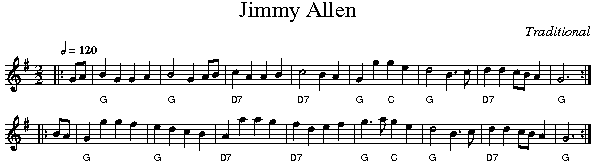
In America they normally put the chords above the line of music; in England we normally put them below.
I've chorded it using just tonic, dominant seventh and subdominant. In bar 1 the A note doesn't fit the chord of G — but that's a passing note so it doesn't matter. The same in bar 2, and in bar 3 it's the B that doesn't fit the D7. The same in bar 4, and even though the B is actually on the beat rather than a passing note it still works — to my ear it would sound wrong to switch to a G chord in the middle of the bar, even though in theory that would fit the notes better. I can't explain why, except to say that I don't like changing a chord half-way through a bar and then starting the next bar with the same chord. I've never read this anywhere or heard anybody else give it as a rule, so other people may tell you differently.
Some people only write a chord where it changes, so you might have G at the start of bar 1 and then no indication until there's a D7 in the middle of bar 4. As a guitarist (not playing or even trying to read the melody) I find this confusing, so I often put a chord at the start of each bar or each pair of bars, and if there's a change of chord part-way through a bar I would definitely put a chord at the start of that bar as well.
Going from the D7 in bar 7 to the G in bar 8 is called a Perfect Cadence, and it's the standard way of ending a tune; it's also quite common at the end of the A-music. To my ear it would sound wrong to finish the A-music with a C chord (and even more wrong to finish the B-music with one), though some bands might do this at the end of B1 as a gimmick (they would call it a musical effect) to indicate that they haven't reached the end of the tune yet. It's a weak ending, and this is a strong tune.
Of course there are lots of other chord possibilities. To my ear a dominant seventh wants to go to the tonic. In bar 4 the C note is the seventh of the chord, so it's there whether you put it into the chord or not, and I would not consider going to a C chord at the start of bar 5. Some people would prefer bar 7 to have G and then D7, but I don't hear it that way. I suppose my rationale is that the tune seems to split naturally into two-bar sections, and I want a chord change at the start of each section to accentuate this. If I did start bar 7 with a G chord and I were playing piano I would give it a D bass note to indicate that it was somehow a “different” G from the one in the preceding bar. Bars 7 and 8 would then constitute a Cadential 6/4 which is much used in classical music and (particularly) hymn tunes.
The chords in the B-music are identical to those in the A-music, which you sometimes find with traditional tunes. What about bar 2 of the B-music? The notes on the two beats are E and C, so why have I used a G chord which doesn't contain these (though it does contain the passing notes D and B)? Because it sounds right to me — and you may disagree! It's all part of the descending scale of G which started in bar 1. If I did use a C chord in bar 2, I would then feel the need to use different chords between bars 3 and 4, for symmetry. Again let me emphasise that this is just my opinion. So if I wanted two chords, what would I use? Here's a suggestion, and it involves a hint of a modulation — going into a different key. I visualise the tonic as being the “present”, the dominant as the “past” and the subdominant as the “future”. You may well think this is weird — I've never mentioned it to anyone before and I don't know anyone who thinks of it in this way. If you modulate to the dominant (in this case change key from G to D) you have gone into the past. But that time also has its own past and future. The future is G, where we just came from. The past is the dominant of D, which is A or A7. So following the G and C chords of bars 1 and 2 I just might use A7 and D for bars 3 and 4. We go from the present to the future, then to the distant past, then to the past. (If the analogy doesn't help you, just forget it.) Perhaps another advantage is that the relationship between G and C is the same as the relationship between A and D. If I were playing piano I would emphasise the A7 chord by playing a C♯ bass note rather than an A — this gives a nice run up of C, C♯, D. You can indicate bass notes against your chords if you wish (though there's no guarantee that anyone will play them): in America it's usually written A/C♯ and in England it's usually a capital A with a lower-case c♯ directly below it. If you go to my 3-couple Dance Instructions page for instance, you will see lots of dances which have music — click the treble clef sign beside the titles. You can then display the musical notation in either English or American format. “The Grandparents' Waltz” has several chords with bass notes.
And then I might use just a C chord in bar 5. I know I rejected that in the A-music, but that was because the previous chord was automatically a D7 because the seventh was there in the tune. This time it isn't, so the possibility exists. Of course, if I was the only chord instrument in the band I could vary things between turns of the tune anyway.
Minor chords
As a generalisation, minor chords are sadder than major chords, but that's not to say you shouldn't use them to accompany a happy tune — just don't overdo it! The Relative Minor of G is E minor, usually written Em but sometimes Emin or even Emi. I've also known a few people write minor chords in lower-case, em, but I don't see the point of that. The relative minor of C is A minor and the relative minor of D is B minor, so you can certainly throw those in where required. Notice that the G chord is G B D, the C chord is C E G, and the Em chord is E G B — in other word it's a half-way house between the two major chords, having two notes in common with each of them. Similarly Am is half-way between C and F.Probably the only minor chord I would put into Jimmy Allen is Am in bar 3 of both the A- and B-music. I would keep the D7 in bar 4: it's much stronger to lead into the G of bar 5 with a D7 than with a second bar of Am. Play the three possibilities through a few times and see whether you agree with me. Having added the Am you might decide to change bar 2 from the repeat of the G to an Em. What do you think? The sequence G, Em, Am, D7 is certainly very well-known.
When I started this I had no idea I would find so much to say about chording a simple tune! Don't let that put you off the idea altogether. The first set of chords I gave are perfectly good — no-one is going to say they are “wrong”. But there are other possibilities, and I wanted to show them to you and try to give some reason for using or not using them. When it comes down to it, the only real question is: Does it sound right? If you're writing a traditional-sounding tune (or chording an existing traditional tune) it's best to stick mainly with tonic, dominant and subdominant. As I've said, relative minors are pretty safe, though watch out that you don't make the tune too gloomy (unless you want a gloomy tune). On the other hand I've written some odd tunes which need odd chords — have a look at my tune for Lucy and you'll see an extreme example which I would not ask most bands to play. It even includes the trick I disparaged earlier, where the listener expects a perfect cadence but instead gets an interrupted cadence (E7 to F at the end of the fourth line), signalling that the tune doesn't stop after 32 bars as they were expecting, but has an extra four bars. But then it's not pretending to be a traditional-style tune.
I'm keen on diminished chords (a musical theorist would say “diminished seventh chords”) but most dance composers don't use them and plenty of bands simply won't play them. On occasions I've used major seventh, augmented, half-diminished though I would describe it as an A minor with an F♯ bass, and it's also known as F♯m7♭5 (F♯ minor seventh with a flattened fifth), suspensions and maybe others. Don't use them just because they're there, but because they bring out the sound you want. And be aware that someone will have to play this stuff! If you really want to know more, here's a video on the 7 Levels of Jazz Harmony — but don't expect me to play it!
Minor key
I've given examples of major chords and then minor chords, but both of these were for a tune in a major key. Suppose the tune is in a minor key. There are one or two additional problems!The relative minor of C major is A minor — they have the same key signature which is no sharps or flats. Music theorists will tell you that there are two minor scales — the harmonic minor scale (used for harmonies, i.e. chords) and the melodic minor scale (used for melodies, i.e. tunes). The melodic minor scale is different going up and going down, and I've never found either of these much use in writing tunes or chords. There is actually a third minor scale, the natural minor scale, which is simply the white notes A B C D E F G A — no accidentals at all. Music theorists don't know about this so they will tell you you're wrong and that the leading note must be sharpened — in other words you must use G♯ rather than G natural. This is not true, and it's particularly not true in folk music. Then they'll say “Ah well, it's modal”. In other words it doesn't fit into their definition of Minor. That's OK — it's just terminology and ultimately (as always) the question is “Does it sound right?”. If you really want to know about modal tunes, try campin.me.uk/Music/Modes
I could draw up a table with one or two minor chords against each note, as I did for the major scale, but that's not really how it works unless you desperately want it to sound miserable. You normally have some major chords to accompany a minor tune, and that means there are a lot more possibilities. I've also added G♯ to the list of notes because you will certainly find a sharpened leading note in some minor tunes.
| Note | A | B | C | D | E | F | G | G♯ | A |
|---|---|---|---|---|---|---|---|---|---|
| Chord | Am | G | Am | G | Am | Dm | Em | E7 | Am |
| Chord | F | Em | C | E7 | C | F | G | F | |
| Chord | Dm | E7 | F | Dm | Em | C | Dm | ||
| Chord | E7 |
Of course you may not use most of these. There are many Irish tunes which (in the key of A minor) just use the chords of Am and G. “What shall we do with a drunken sailor?” is an English example of the same thing, shown here in the key of E minor (or technically, E dorian).
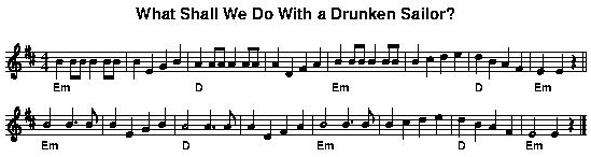
But let's get more interesting.
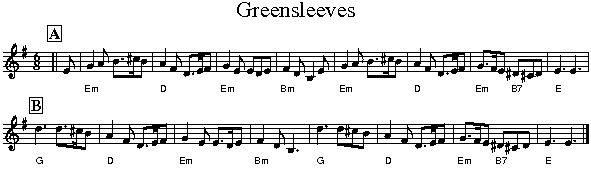
This is a song, a morris dance tune and a country dance tune (Green Sleeves and Yellow Lace) and I've given Vaughan Williams' version of the melody and chords, though I've taken it down a semitone from F minor to E minor.
The first two bars use the tonic (minor) and then the major chord a tone below, just like “What shall we do with a drunken sailor?”. Some versions of the tune would have a C natural rather than a C♯ in bar 1, but it doesn't affect the harmony. Some versions would have a D♯ rather than a D natural in bar 4, which would change the chord from Bm to B7. In bar 7 all the versions that I know have a D♯. Conventional music theory says that the dominant chord of a minor key is a major chord (and probably a seventh chord) but it depends on the tune — here we have Bm in bar 4 but B7 in bar 7. Vaughan Williams has drifted into E major in bar 8, which they certainly did in the old days too.
What about the B-music? Every C is a C♯, so it appears to have modulated to D major, which is quite a good thing to do — it gives a change of feeling and stops the tune becoming too mournful. Yes, we could have thought of it as modulating to Bm and used Bm for bar 1 and F♯m Bm for bar 2, but it needs a bit of a lift at this point. We could also have used D for both bars, which are almost running down the scale of D, but that's not nearly as interesting as going from G to D — try it and I hope you'll agree. Bar 4 really has to be Bm unless you use two chords, and Vaughan Williams is clearly making a point of only one chord per bar except for the perfect cadence at the end of each line. Bar 3 could be C rather than Em, which gives the descending bass line D | C | B, but I prefer Em, which means two bars of major followed by two bars of minor. I might be tempted by D followed by Bm in bar 6.
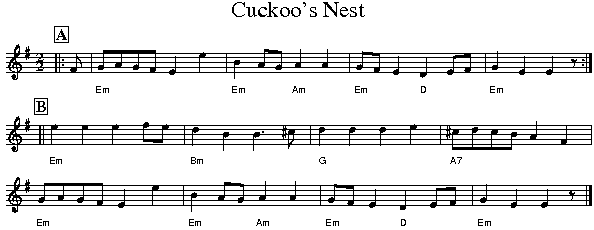
This is a song and a morris dance tune — you'll find lots of different versions and I'm certainly not claiming that this is the “right” one, but it's the one I've chosen. Listen to it here.
In the A-music I've used minor chords except for the D. I've already shown Em — D — Em in Greensleeves (and Drunken Sailor) and you'll come across this a lot. A music theorist might tell you that the leading note should be sharpened, so he would change the D to a D♯ and the chord to B7 (the dominant of Em) giving a perfect cadence. I would certainly start with Em to establish the key. I could have used G and D rather than Em and Am in bar 2. I wouldn't use Em and D there though, because we get this in bar 3. I don't mind using the same pair of chords in bars 1 and 2, or bars 3 and 4, but not in bars 2 and 3, and if you can't hear that I don't think I'll convince you! On the same principle I wouldn't use G as the chord for bar 2 of the B-music because we have a G in bar 3, though I would be happy using the same chord for bars 1 and 2 or bars 3 and 4 of a tune.
The second half of the B-music is the same as the A-music, and I see no reason to change the chords (though Cecil Sharp often did in repeats).
Two other points
One approach to tune writing (which I've never tried) is to start with a chord sequence and then write the tune to fit this — it just might help you if you've been staring at that blank sheet of manuscript paper for far too long.And one final bit of advice: put it away and play it through tomorrow. What you thought was a masterpiece may well be rubbish, but it's difficult to be critical when you're in the throes of composition. Maybe most of it is fine, but there are a couple of points where it just doesn't work. Maybe you can improve these. Maybe you'll just have to lose that really nice phrase because it doesn't fit in with the rest of the tune. This is a vital part of the job. It may take more time that the original composition, but it can make all the difference between a tune that is OK and a really good tune that people will want to play and dance to.
Example
For those who really want an in-depth view of the creative process as it relates to dance music, here's an account of how I wrote the tune to Unrequited Love. (By the way, the reason I'm talking mainly about my own tunes is not that I think they're better than anyone else's, but that I know them well and sometimes remember my creative processes.)On this occasion I started with the first two bars of the tune. Repeated notes on the bar-line can be banal — think of “Twinkle, Twinkle, Little Star” — but across the bar-line they can have an emotional impact. As I played the phrase, thirds below seemed an obvious thing to add to the melody. It was natural to repeat this phrase as a sequence a third below. It was then very tempting to repeat it a third below that, but bearing in mind Bach's advice I expanded it into a four bar phrase which did something different — though again the repeated note across the bar-line.
Here I would demonstrate it without the expansion, and then with it.
That gave me my first eight bars A1, ending with a suspension on the dominant chord. The next eight bars immediately sprang to mind — A2, repeating the first six bars less one note and ending on the tonic note and chord.
Now I had to do something different, but related, as I came to the so-called “middle eight”, so I started with the dominant chord. This time it's a four-bar phrase, but notice that the second half is the original two-bar phrase again. The natural follow-up to this is of course a sequence, but this time a third above rather than a third below, so the middle eight has a rising feeling to it.
My first thought at this point was to repeat A2, giving a 32-bar tune. But that didn't really have enough to it. So again I went for something different, this time starting on the subdominant chord. Although it's different, it starts with a near-variant of the original two-bar phrase, and again in bars 5 and 7. Having added this eight bar phrase (C) I felt justified in copying B as D (with the addition of an augmented chord on the last note) and copying A2 as E.
It didn't all happen quite as logically as this — there were several other attempts. The coda came from a different version of the tune which I'd started, put away and forgotten. It's more dramatic — we meet the only accidental in the entire tune, and this is over a diminished chord. The sound is restless, confused, as if the tune doesn't know where it's going for a moment. I rediscovered this and thought “I've got to use that somewhere”. I once danced “Unrequited Love” to Barbara Kinsman's calling, and she said of the coda, “This is the point where I always think the tune has gone wrong”. Fortunately the band was Wild Thyme, who had recorded it on their “Hunter's Moon” album, and they assured Barbara that it didn't sound as if it had gone wrong to them! Notice that the last two bars are the original motif yet again — consistent to the end.

On Friday, June 10, 2011, Phil Vardy from Australia wrote:
Very helpful. Many thanks. I interrogated Google for chords to a minor key (I needed to know whether to practice (say) Am, Dm, E7 for a simple tune in A minor. I didn't know whether E7 should be Em or E or... The answer, as always, is more complex than one thought. Many thanks again, P.
On Saturday, May 25, 2019, Noah Musser from Lawrence, Kansas wrote:
Nice stuff here! Thanks!