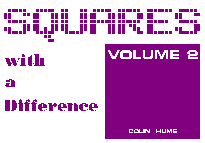
Squares with a Difference, Volume 2
| The Belgian Connection | The Bletchingley Square |
| Coniston Square | The Danish Connection |
| Easter Meet | Face the Arch |
| The German Connection | Goodbye Girls, I'm Going to Boston |
| Grand Tour | Ladies First |
| Log Cabin | Men on the Ends |
| Meriden Square | Recognition! |
| Riding down to Dixie | Salem Square |
| Scintillating Square | The Sheffield Spiral |
| Stamford Square | Time Limit |
| Topspin | Triple Chain |
| Triple Swing Through | Winchester Square |
| The Wrong Star |
The book starts with an introduction in which I encourage people to call squares and help them with the three things which seem to scare people off: the timing, the style and the breaks. You can read much more about calling squares and breaks on my Session 8 page.

Corrections
Meriden Square — page 16Not a correction but a clarification: after Allemande left your corner in B1 of the figure you're no longer in two lines; you're back in your square in home place facing your partner.
Riding down to Dixie — page 18
Again not a correction but a clarification: if you have the original printed music of the Ralph Reader song, the dance fits to the chorus — ignore the introduction and the verse. The printed music is 4 beats to the bar, and the chorus is 34 bars. If you write it as the more normal (for dancing) two beats to the bar it becomes 68 bars, which is the total length of the figure.
The “Dixie style to an ocean wave” in A1 and A2 is quick — just two steps for each turn. The “pass through” is really at the start of the music for the do-si-do.
The Sheffield Spiral — page 21
Susan Taylor couldn't understand the description of the spiral, even though she had danced it to me at Buffalo Gap, so maybe this description of the second part will help you too.
A2: Heads continue the spiral by doing a tight inner loop all the way round while sides start the spiral (going round outside the heads). Heads go single file outside (still in the same direction) to home place while sides continue the spiral by going in and looping all the way round.
Time Limit — page 23
I've decided the do-si-do in A2 is easier left shoulder. You then have to close in to take inside hand with your current partner.
Triple Swing Through — page 26
B1: “In fours” would be more clearly described as “With the opposite couple”.
Not exactly a correction, but a very useful hint for the hardest dance in the book:
In C1, after the ends have done the California twirl they need to let go and the man needs to move to his left. This makes it much more obvious to the middles where to form the outside waves after their swing through in the middle.
July 2009