5-Couple Dances
Links to dances on other pages
Bishops Hey 


Dance and Music: Jill Lawrence, 1979.Format: 5 Couples longways, 1, 3, 5 improper
Music: 5 x Own tune (48-bar reel)
| A1: | Ones face partner, twos face threes, fours face fives: Grand chain 2 changes. Cross-hand turn the next 1½ and stay facing this person. |
| A2: | The same going back: two changes starting with this one and cross-hand turn the next 1½, all finishing home |
| B1/2: | Ones poussette to the bottom (first man push), the others either half poussette or back-to-back or circle left and right. |
| That's how I would probably call it, but Jill spells it out in detail: | |
| B1: | 1st and 2nd couples half poussette, men pushing, while 3rd couple go back-to-back and 4th & 5th couples circle left once around. 1st and 3rd couples half poussette, 1st man pulling, while 2nd couple at top go back-to-back and 4th & 5th couples circle right once around. |
| B2: | 1st and 4th couples half poussette, men pushing, while 2nd & 3rd couples circle left once around and 5th couple go back-to-back. 1st and 5th couples half poussette, 1st man pulling, while 2nd & 3rd couples circle right once around and 4th couple go back-to-back. |
| C1: | Ones at bottom right-hand turn, the others ladies chain. And back (ones with a left-hand turn). |
| C2: | Ones give two hands and slip to the top while the others clap. Ones cast to the bottom and face up (8 steps) while the others set and pass through with partner (stay facing out), then men turn left, ladies right to start again with this person — the twos at the top are both turning upwards so they can then face each other to become the new ones. |
Composed for the Country Dance group at Bishops Cleeve in Gloucestershire.
Closing Thyme 
Format: Square (numbered anticlockwise) + fifth couple in the middle Dance: Colin Hume, 1999. Music: 5 x Wakefield Hunt (jig)
| A1: | Outsides circle left (slip). Circle right. |
| A2: | Middles (fives) half figure eight up through the ones. Half figure eight down through the threes. |
| B1: | Ones, fives and threes half a Grimstock hey, but each couple cross over as they pass through the middle: the ones cross down through the fives, then the threes cross up through the ones, and as the fives cross down through the threes they wheel right to face the twos (with the fifth man on the left of his partner). The same move across the set, involving the twos, fives and fours, and as the fives cross they wheel right to face the threes' position (where the ones are). |
| B2: | The same move up and down, and the fives wheel right to face the fours' position (where the twos are). The same move across, and the fives wheel right to face the ones with everybody home. |
| C1: | Fives arch, ones face down, the others face round the circle to the ones: lead down through the arch with someone, cross over and continue round the circle to a new place and possibly new partner — at the end the fives move up to first place and wheel around. |
| C2: | Outsides join hands: in to the middle and back. All two-hand turn. |
If you remove all the crossing over in the B section, at least some people will get through it!
On November 27th 1999, Wild Thyme had their Farewell Dance at The Grange Hall, Southam, Warwickshire. See my essay The Wild Thyme Legacy. I was privileged to MC the event, and the other callers were Hilary Herbert, Barbara Kinsman and Andrew Shaw. The tickets had been sold out for months, with a long waiting list, and the whole event went very well (except the above dance).
The original line-up had Bob Barrett on bass guitar and Elvyn on guitar, but by the time the band became well-known it was John Blomfield on melodion and percussion, Elvyn Blomfield on keyboard, Dave Brown on fiddle and Tina Brown on bass guitar. Both Bob and Dave were there for the final dance, and the band played wonderfully well. They had chosen all the tunes, which meant in most cases they had automatically chosen the dances — but I wasn't going to let them get away scot-free. I wrote a dance to “Wakefield Hunt” and tried it out there for the first time. It was a real disaster — none of the sets got through it. Since then I've removed the crossing over in the B part and got people through it with no trouble at all. Alan Davies feels it's rather too simple now, and wanted to be sure that I would publish both versions to give people the opportunity to call the harder one if they wished.
The Hunter's Moon album may be no longer available, in which case you can find a recording of Wakefield Hunt on the CD “Dance and Danceability” by The Assembly Players.
The Fifth Dimension
Dance and Music: Colin Hume, 1990. Each line of music is five bars of five-time. Format: 5 couples longways.
| A1: | Right-hand star in fours, bottom couple right-hand turn (8 steps). First corners (1st man, 2nd lady, 3rd man, 4th lady) cast left shoulder (2 steps) into half a reel of five along the line, passing neighbour left shoulder to start (10 steps), turning the set upside-down. All two-hand turn partner half-way (5 steps). |
| A2: | Left-hand star or turn in the same groups. Original second corners cast right shoulder into half a reel of five along the line, passing neighbour right shoulder to start. All two-hand turn partner half-way, to original position. |
| B: | Ones cross and go out beyond twos (5 steps). Ones go below twos and cross again as twos lead up (5 steps). Ones go out beyond threes, go below them and come in slightly, as threes lead up (5 steps). Middle three couples (threes, ones, fours) circle left (10 slip-steps). |
| Note: The ones make a continuous flowing movement rather than breaking it up into three sections, but the twos and threes must move at the start of the bar. | |
| C: | Middle three couples fall back in lines of three and make two circles as end couples lead in to meet (5 steps). Circles of 3, 4 and 3 slip to the left (5 steps) and right (5 steps), finishing in single-sex lines of 3, 2, 2 and 3, all facing partner (though there may be people in the way). All the men arch and everyone take 5 steps forward, the middle two ladies both going under their partners' arch and then separating so that each goes under one of the next arches while the middle lady of the line of three goes under the single arch. Those now facing out cast to the nearest end while the others two-hand turn their partner half-way (5 steps). All are now improper, and again the order is 2, 3, 1, 4, 5. |
| D: | Top couple give right hands to start a progressive grand chain, stopping when you reach the bottom position, the set finishing inverted and proper. Everyone does 5 changes, and 9 changes are done in total. There are two changes per bar, so it's always right hand at the start of the bar, and you can think of it as two steps for a right and three for a left. The final change is the original fives at the top changing places by the right, after which all step right and honour partner. |
| The version published in the book had a back-to-back before the final honour, which made if too rushed, and I really didn't mean that, so I'm glad of the chance to correct it on the website! | |
Progressed position is 5, 4, 1, 3, 2. Repeat the dance four more times.
People find the A part particularly disorientating. Observe your neighbour as you make the right-hand star. Take it once around in 8 steps — the normal amount — then first corners cast out left shoulder to pass that neighbour left shoulder to start half a hey. After the two-hand turn half-way, look for that same neighbour to make the left-hand star. If they were on your right for the first star, they'll be on your right for the second star.
Going at Sixty
Format: Square (numbered anticlockwise) + fifth couple in the middleDance: Colin Hume, 2007, for Doug Young's 60th birthday
Music: 8 x 32 bar American reels. Suggested tune: Richmond Cotillion.
Sequence: Break, figure twice, break, figure three times, break.
| Break: | |
| A1: | Outsides circle left — when they stop, the actives fall in between any two couples. All circle right. |
| A2: | All five ladies chain 2 places, to man number 3 (counting partner as number 1). Chain again, to finish with original corner. |
| B1: | Allemande left new corner, pass by one, swing original partner. |
| B2: | All promenade — at the end the actives promenade in to middle. |
| Figure: | |
| A1: | Actives choose any couple and “Triple chain”: Ladies chain but active man courtesy turn this lady only half-way, ladies chain with the opposite couple, again with only a half turn, ladies chain with the original couple and actives courtesy turn in the middle to face one of the other couples. |
| A2: | Triple chain with the other two couples. |
| B1: | Outsides allemande left corner (it's always the same person unless they're in the middle), grand chain two places, swing original partner while actives balance and swing. |
| B2: | All promenade — actives slot in behind the top couple (fours). Actives finish at top, the others finish where they started the promenade, one place round to the right of their original place, and the fours promenade in to the middle to become the new actives — the actives may need to persuade them that it's their turn to be in the middle. |
The dance was commissioned by Pat Petersen, who writes…
Doug and I married in our mid-40's, both of us for the first time, proving that it's never too late. Former dairy farmer hooks up with ex-rock opera conductor! We can't remember whether we first met playing early music or dancing, but we continue to enjoy doing both, as vocation and avocation. Doug plays old-time music on banjo as well as being a skilled player of recorder, cornetto, shawm, and curtal. I play various early winds, teach recorder and early music, and dabble in banjo-uke. We both love to sing. It's my fantasy that in our dotage, as the last bits of memory fade, Doug will sing yet another song that I've never heard him do before. When we're not dancing or playing music, we're pottering around in the garden.
Golden Dolphins
Format: 5 couples longwaysDance: Sue Carter, 2005. Music: Colin Hume, 2008.
| A1: | All set; top and middle couple cast one place, the couples below them lead up. Ends left-hand star, middles gipsy left. |
| A2: | All set; bottom and middle couple cast up, the couples above them lead down. Ends right-hand star, middles gipsy right. |
| Now in progressed position: 2, 4, 1, 5, 3. | |
| B1: | (16 bars): All two-hand turn, then top three couples face up, bottom two face down. “Morris Dolphin Hey” — end four couples change the leader each time they start moving in (working with same-sex neighbour), middle couple swim alone. |
| B2: | Middle couple cross right, turn right, dance a quick whole figure eight round the entire set while the end couples do four changes with hands starting with partner (4 steps per change), then two-hand turn while middles finish their figure eight (12 bars). Lines fall back; lead forward. |
To expand upon the “Morris Dolphin Hey” in B1, same-sex dancers, for example man 2 and man 4, act as one and they keep the same relationship to each other throughout: man 2 is always above man 4. Their cast is an individual turn out of the set so that man 4 actually takes the lead at the start. Men 4 and 2 pass left shoulder with man 1 and then right shoulder with men 5 and 3, so essentially there are two heys for three up and down the set. My thanks to Tom Hinds for clarifying this.
To expand upon the “whole figure eight” in B2, the middle couple cross right and the man goes round the bottom four dancers while the woman goes round the top four dancers, then they cross left and turn left to go round the other four dancers, finishing where they started.
Sue originally wrote this to be danced as a waltz, but changed her mind. The stars and gipsies were the other way round, but that didn't flow well into the two-hand turn. You need plenty of width for this dance, otherwise the dolphin hey becomes an up-and-down movement where it's difficult to see the shape and how you fit into it.
Kevin's Celebration Waltz
Format: 5 couples longways.Dance and Music: Colin Hume, 2018.
| A1: | Ones cross and cast, twos lead up and turn out. Ones lead up into half a Morris hey at the top. |
| A2: | Fives cross and cast up, fours lead down. Fives lead down into half a Morris hey at the bottom. [3, 1i, 4, 5i, 2] |
| B: | Actives (ones and fives) meet (as the middles fall back from partner); circle left half-way and move in. Lead away from the other couple to where they came from (as the middles move forward); gipsy right half-way and the lady finish facing the man above her. [5th lady facing top man, 1st lady facing middle man.] |
| C: | (12 bars): Half diagonal dolphin reel (on the first diagonal), so actives pass the corner man right shoulder, the corners complete their half reel while the active man takes the lead and the actives veer right so they're now facing down on the second diagonal. Half diagonal dolphin reel (on the second diagonal) — lady take the lead and veer right to finish facing down on the first diagonal. Half diagonal dolphin reel (on the first diagonal in the opposite direction) — man take the lead and actives finish facing up, all proper. [2, 5, 4, 1, 3] |
| D1: | Actives lead up; change hands and continue backwards up the set. Lead down; change hands and continue backwards down the set. |
| D2: | Actives circle left with the couple above them. All two-hand turn. |
| Progressed position is 2, 5, 4, 1, 3. Repeat the dance 4 more times. | |
I was commissioned by Sandra Randall to write a dance for Kevin Mears' 60th birthday which was in November 2018, and as they were coming to my House Party weekend the next day I wanted to be able to call it then.
I've known Kevin for many years — he was in the Jovial Beggars when I joined the team, along with most of his family — so I knew what a good dancer he was. Sandra wanted a challenging dance (very risky to request that of me!) for 5 couples — I've written twelve 5-couple dances, but never to a commission. She wanted it to reflect the many aspects of Kevin's dancing, including a Morris hey for his Morris dancing, a dolphin reel for his English dancing, a box circulate for his Modern Western Square dancing, and most importantly the move from Pat Shaw's beautiful dance “Miss de Jersey's Memorial” where the ones lead down for two waltz steps, turn in to face up and continue moving down backwards, then the same back again. I decided the dance would therefore have to be in waltz time, and I managed to fit everything in except the box circulate. I put the “Miss de Jersey” move in upside down so that no-one could accuse me of copying Pat Shaw!
I called the dance to the music of Keeping Thyme on the Friday evening with Kevin and Sandra dancing at the top of the first set, and it was an immediate success. In fact it was the first dance to be requested at the Raffle Dance the next evening so people had a second chance to try it, and they all danced it really well.
Levi Jackson Rose
Dance: Bernard Chalk and Berea College Dancers, 1984.Music: Ruth McLain.
Format: 5 couples in a circle
| A1: | Allemande left corner (6 steps), allemande right partner (6 steps), keep hold and the men make a left-hand star, balance right and left (towards partner and away). |
| A2: | Single file half-way (men on the inside). Swing partner — at end ladies cast right shoulder behind partner and men arch. |
| B1: | Ladies go under partner's left arm, turn left, in front of the next, behind the next and meet to form a circle, move one more place to the left, then men bring joined hands over the ladies' heads as the ladies back out. |
| B2: | Basket (Rose) — it doesn't matter where you finish. |
Bernie Chalk was an Englishman who specialised in calling American Squares and Contras, and called frequently in The States. In 2024 Joe Wilkie provides the following background information:
Levi Jackson Rag was the inspiration for Levi Jackson Rose. Until just a few years ago, the Berea College Recreation Extension, and later the Berea Folk Circle, held an annual dance weekend at Levi Jackson State Park in London, Kentucky. Pat Shaw wrote Levi Jackson Rag (I believe at the request of Dr. John Ramsay, Director of the BC Recreation Extension) in the 1970s. It was written to accommodate the dance hall at Levi Jackson, which had four posts in the dance floor. The dance made the posts more of a feature than an annoyance and dancers would rush to be in one of the sets dancing around one of the posts.In 1984 or 1985, John Ramsay asked Bernie Chalk to write a follow-up, also designed to be danced around a post. It was written as a five-couple dance to echo Levi Jackson Rag. I don't know whether October Rose was written to go with the dance or if Bernie just used an existing McLain Family tune. I was privileged to be in the group of Berea College Country Dancers who did the final workshopping of the dance with Bernie while on tour in London (England) in September or October of 1985.
I've since found a sheet dated 7/6/93 headed “Berea College Alumni Country Dancers” which says:
The Berea College Country Dancers worked out the dance details with Bernie while they were in London. Ruth McLain composed the tune October Rose just for this dance.
I had picked up a version of this dance from somewhere years ago, so when people were asking about it on the Trad Dance Callers' List and Jonathan Sivier gave the same version, I felt I was safe to publish it here. But then other opinions surfaced. I thought is was single file in A2; other people said the men made a star. I said the balance was forward and back, which would be sensible going into a single file, but if the men are making a left-hand star then balancing right and left (towards partner and away) might be preferable. And I had it as a double progression (the women finishing two places to their right) whereas other people thought it was only a single progression. David Millstone found these instructions somewhere on-line (though I take issue with the “limping steps” which should surely be a buzz step) which does have a double progression.

Joe Wilkie then wrote:
These instructions are correct, but I've never heard of anybody doing elbow turns. I was on the tour where we performed at the Royal Albert Hall. We workshopped the dance with Bernie in our hotel lobby while on that tour, but we did not perform it at the RA Hall. Although it was customary at the time, at least in our circles, to give credit to everyone who had any input, this really is Bernie's dance.
Hugh Stewart gave this description from the record sleeve of “Dances From Appalachia #3” (“Jacket design by Ruth McLain Riopel” -- she of the tune “October Rose”):
A1 1-3 Allemande left with corner
4-6 Allemande right with partner, 1¼ turn, men then make a left hand star while retaining partner's right hand
7-8 All balance right and left
A2 1-4 Men left hand star half around WHILE ladies, dropping partners hands, dance half around the outside of the set clockwise
5-8 Partners swing
B1 9-16 Ladies “peel” off out of the swing to pass behind partners while the men, making a ring of five, raise their arms high to form arches.
The ladies pass thru their partner's left hand arch then in front of the next man, going clockwise around the ring and out thru the next arch and in thru the next.
Here the women join hands in their own ring of five and move to the left to form a “rose” by backing thru the fourth arch while retaining hands. The men lower their arms in front of the ladies.
B2 9-16 The “rose”, or inside basket, circles left 1½ to the men's original spot using a buzz step
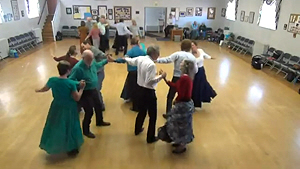
I've modified my instructions to reflect all this. But the notes that David Millstone found refer to a Playford weekend in Edinburgh in April 2010 and say that there are also differing instructions obtained from “Rocky Mountain Dancers” Salt Lake City, Utah at Billingham International Folklore Festival 1966 and from internet site of the Webster Groves English Country Dancers — so there are still more leads to be followed up!
Miss Claire Moir
Dance: Colin Hume, 2007. Music: Dave Brown, 2005. Format: 5 couples longways, 1, 3 & 5 improper
| A: | (16 bars): Ones and threes give two hands, balance forward and back; cast one place (twos and fours lead up). Ones and threes lead down one place, cast up and face up — bottom couple face up and wait for one change. |
| Grand chain for 8 hands (bottom couple only do 7 changes), one waltz step per change, finishing 4, 2 improper, 5, 1 improper, 3. | |
| B: | (16 bars): From the top, right-hand star (top two couples and next two couples right-hand star). With the next couple, left-hand star (leaving the top couple out). |
| Top couple (fours) cross and cast to the bottom; the others lead up one place. All two-hand turn partner. | |
| Progressed position is 2 improper, 5, 1 improper, 3, 4 improper. | |
I originally had a simpler first half for the B section:
| Top couple cast (you're facing out so don't spin, just go), the others lead up and follow them. Meet at the bottom and lead up to the same place. |
I tried the dance for the first time at Whitby Folk Week in August 2007 and Trevor Monson said this part was too simple, especially as the top couple then did another cast. So I changed it and tried the revised version there a couple of days later. When I asked the dancers to vote on the change no-one voted for the simple version, but I'm giving it here as an option in case you are calling for less experienced dancers but still want to dance to Dave's lovely tune. The tune is recorded on the first Skylark CD which also contains an excellent selection of American reels and jigs and a superb performance of “De'il tak the warr”.
Dave Brown explains:
Claire Moir from Scotland is a friend of ours who travelled with her fiancé Gerard (a Kiwi) and us through Africa in 2004. They were the only two left at the end of our trip — everyone else dropped out. They were married in New Zealand in March 2006 and Patience travelled to the wedding. I couldn't go so I wrote three tunes — Miss Claire Moir (Maiden name — Waltz), Mr & Mrs Eden (Married name — Strathspey) and G&C (Initials and the chords in the tune — Reel — last track on the Connections CD.) I recorded the music and made it the backing track to a DVD of pictures of mountains in New Zealand and Scotland. They loved it!
The Morland Waltz
Dance and Music: Colin Hume, 2010.Format: 5 couples longways
| A1: | (9 bars): Actives (ones and threes) star right with the couple below (3 waltz steps). Active ladies cast, followed by partner, to finish improper below that couple, who move up (or lead up left hand in left) on the second and third bars (3 waltz steps). Actives star left with the couple below (3 waltz steps). |
| A2: | Actives right-hand turn the person above (3 waltz steps). Actives left-hand turn the person below (3 waltz steps). Actives half figure eight up and finish left shoulder to left with partner facing first corner (3 waltz steps). [Order is now 2, 1, 4, 3, 5, all proper.] |
| B: | (11 bars) “Corners pass and turn”: Actives move to your own right, pass first corner right shoulder and loop right while the corners move in for a quick two-hand turn then pass right shoulder with the same active person and actives pass partner right shoulder to face second corner (4 waltz steps). Same with second corner, and actives loop round partner right shoulder to place but stay facing out (4 waltz steps). Actives cast another place, and the couple below them move up on the last two bars (3 waltz steps). |
Progressed position is 2, 4, 1, 5, 3, so the original ones have a second turn being active as the original twos start at the top. The middle couple are in both 3-couple sets, so they need to look in all directions. The dance can also be done as an ordinary 3-couple set, with the music played 3 times through. In fact I've called it with one 3-couple set and one 5-couple set, and the instructions worked for both.
The Morland Folk Dance Week started in 1986, and for the first six years Ian Jones and I shared the calling. In 1992 I was unavailable, calling on my first trip to the States, and from then on Ian has worked with a variety of callers. I wrote “A Trip to Morland” for the first week, so naturally I wanted to write something for the 25th, and this was danced there with Ian calling and Deo Volente (Dave and Victoria Yeomans) playing. A year after starting The Morland Folk Dance Week, the indefatigable Joneses started The Morland Scottish Dance Week, and one of the two leaders was John Drewry — the best-known composer of Scottish dances. John wrote “The Morland Reel” for this occasion. He has invented many new moves for Scottish dancers, including “Corners pass and turn”, and I wanted to use this in my dance. It's often used in a Strathspey, but it would appear (no doubt to the horror of the RSCDS) that any Strathspey can be turned into a waltz, so I was fairly sure the figure would work that way. (I'm referring to the figures, not to the tunes — no doubt some could and some couldn't.) I tried it out once and found that most dancers were getting there too soon in most phrases of the A-music, so I wrote a completely different tune with 3-bar phrases rather than 4-bar phrases for everything but the “Corners pass and turn”, and it works fine.
Don't believe any Scottish dancers who tell you that “Corners pass and turn” should be done with a right-hand turn. The first appearance of “Corners pass and turn” in an RSCDS publication was Moment of Truth, Book 37, in which the corners turn with both hands.
The President's Farewell
Dance: Hugh Stewart, 2001.Music: 5 x 32 bar waltzes such as “The Cambridge Waltz”.
| A1: | Ones and twos, threes and fours, two changes with hands. Ones and fours (in second and third place) the same. |
| A2: | Ends right-hand star while middles (ones) right-hand turn. Ones turn another half, then man move down the outside, lady up the outside, round one person whom they draw into a circle of five. |
| B1: | Balance in and out, circle left about half-way, ones break with left hand and lead to lines (first man at the top of the men's side, first lady at the bottom of the ladies' side). |
| B2: | First man zigzag to the bottom of the set by changing places by the right hand on the right diagonal, left on the left diagonal, right on the right, left on the left. |
The dance was written in memory of Cyril Papworth, President of the Round, and first danced at his memorial dance, February 2002.
I came across it when I was leading a Playford Weekend at Belstead House near Ipswich, Suffolk. The Saturday evening dance was usually a raffle dance: everyone has a ticket and if I draw out your ticket you choose the next dance. The second ticket of the evening was Hugh's. “The President's Farewell”, he said. “I've never heard of it”, I said. “Here it is”, he said, and handed me a sheet of instructions. After I'd called it I decided I liked the dance, and now Hugh has given me permission to put it on my website. I suggested the tune “The Cambridge Waltz” and he raised no objection.
Ten Year Tested
Dance and Music: Colin Hume, 1989. Each line of music is ten bars long. Format: 5 couples longways
| A1: | Join hands in lines, go forward and back. Cross right shoulder with partner (2 bars). End couples right-hand star, middle couple right-hand turn. |
| A2: | Lines forward and back. Cross left shoulder (2 bars). Left-hand star or left-hand turn. |
| B1: | Middle couple gallop to bottom (2 bars). gallop to top (4 bars). Cast to turn the set upside down. |
| B2: | All do-si-do partner. Clap: right hands with partner, left, cross hands on (own) chest, clap both hands with partner (2 bars). Swing partner. |
Actually I now realise I have to qualify that for non-English readers who may not know the chorus of the song “Nellie the Elephant” — The first two bars of this are quoted in the clapping sequence. Click the first button below to hear the original song (I've started it at the chorus) and the second to watch some Americans dancing and playing it — rather differently from the way we would do it in England!
Mandy Miller, 1956
Missouri, 2011